Last Visible Canary
actively parsing hurf durf
- Joined
- Nov 28, 2006
- Messages
- 4,577
first question:
I'm looking for a clear coating for wood handles that will completely seal
them and provide a wear surface that isn't wood. the only thing I've done
so far is on a Siamese rosewood handle refinish/reshaping project, where
I used what I had on hand - McCloskey marine Spar Varnish in satin finish.
I assumed that being a marine varnish it would hold up to environmental
changes and wear. but when I started thinking about it, I started to
wonder about the biocompatability of varnishes and lacquer's in general
since they are next to the hand and covered in sweat for (at times) long
periods. what is the difference between wiping, alkyd, phenolic and
polyurethane varnishes as they relate to and knife handles? are any of them
not safe for use in long term skin contact situations?
what is the most complete protection for wood handles that is
biocompatable?
(the marine varnish handle:
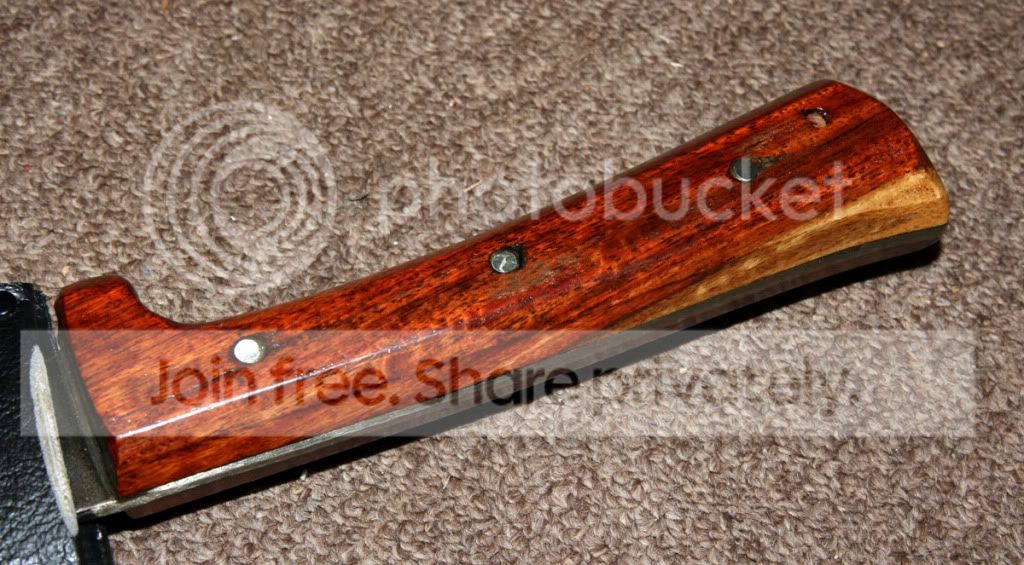 ,
,
a nice tacky finish)
second question:
do beetles eat wood or live in it? after letting some beech sit seperated and
sealed in a box away from the rest of my stock because it had worm holes in
it from the seller, I found that there was at least one beetle present (which I
squished). very small, but I was curious whether it was eating it, or
burrowing, because if the beetles are eating it it's kinda pointless just to
quarantine it, I'd rather actively seek the bugs out to stop them from living
there permanently.
third question:
how do you go about choosing a wood for use in high shock handles? specifically
in hidden tang khukuries or choppers, and in axes/hatchets/hammers.
there is a really cool website wood picking search thing that can be found here:
http://www.woodbin.com/calcs/wdpick.htm
the pertinent criteria for axe handles seeming to be:
Weight, Hardness, Stiffness, Strength, bending, Shock resistance, Decay resistance,
and Stability
but of them, I'm not sure what is critical and what isn't. it would seem that shock resistance
and strength would be the two most important, so that it won't crack on impact, and it can
bear heavy weight when being pushed back at impact. I assume that decay resistance can
be handled with heavy finishing. but does hardness, stiffness, bending, and stability come into
play in such an important way that they are necessary deciding factors?
as an example, yellow birch is high on the list when searching for shock resistance, but it's
weight and strength are stated as medium. would yellow birch be a good axe handle based
solely on the shock resistance criteria?
I'm looking for a clear coating for wood handles that will completely seal
them and provide a wear surface that isn't wood. the only thing I've done
so far is on a Siamese rosewood handle refinish/reshaping project, where
I used what I had on hand - McCloskey marine Spar Varnish in satin finish.
I assumed that being a marine varnish it would hold up to environmental
changes and wear. but when I started thinking about it, I started to
wonder about the biocompatability of varnishes and lacquer's in general
since they are next to the hand and covered in sweat for (at times) long
periods. what is the difference between wiping, alkyd, phenolic and
polyurethane varnishes as they relate to and knife handles? are any of them
not safe for use in long term skin contact situations?
what is the most complete protection for wood handles that is
biocompatable?
(the marine varnish handle:
a nice tacky finish)
second question:
do beetles eat wood or live in it? after letting some beech sit seperated and
sealed in a box away from the rest of my stock because it had worm holes in
it from the seller, I found that there was at least one beetle present (which I
squished). very small, but I was curious whether it was eating it, or
burrowing, because if the beetles are eating it it's kinda pointless just to
quarantine it, I'd rather actively seek the bugs out to stop them from living
there permanently.
third question:
how do you go about choosing a wood for use in high shock handles? specifically
in hidden tang khukuries or choppers, and in axes/hatchets/hammers.
there is a really cool website wood picking search thing that can be found here:
http://www.woodbin.com/calcs/wdpick.htm
the pertinent criteria for axe handles seeming to be:
Weight, Hardness, Stiffness, Strength, bending, Shock resistance, Decay resistance,
and Stability
but of them, I'm not sure what is critical and what isn't. it would seem that shock resistance
and strength would be the two most important, so that it won't crack on impact, and it can
bear heavy weight when being pushed back at impact. I assume that decay resistance can
be handled with heavy finishing. but does hardness, stiffness, bending, and stability come into
play in such an important way that they are necessary deciding factors?
as an example, yellow birch is high on the list when searching for shock resistance, but it's
weight and strength are stated as medium. would yellow birch be a good axe handle based
solely on the shock resistance criteria?