Quilts in the woods?

Nunatak, Mountain Laural, and Jacks R Better, and Fanatic Fringe all make Ultralight Quilts that are in the $200-$350 price range. When I open up shop, I will give the forum guys a price break!:D I have been using quilts in all types of places (except the tropics) for about 5 years. Easy in and easy out of Hammocks and Bivies.

-RB
 
I'm certainly not trying to criticize Bear's work, because I think they look excellent and super functional.

I'm just having a hard time of understanding where the distinction is drawn in this case between a quilt and a bag.

KGD, I'll dive in on this one.

As was mentioned above by SpookyPistolero, there are two ideas on the quilts:

1) when you sleep in a bag you compress the insulation beneath you so that it does you no good and whatever you're using for a pad (or ground cover) is the only real source of insulation beneath you. Therefore, the bottom insulation on a bag is worthless weight and worthless insulation -- why not just go with a top cover and sleep directly on a good pad (or equivalent). In the case of a bag and a quilt of equal weight and same fill material, the quilt will provide more insulation where it counts on the top and sides. Better performance by definition.

2) by not confining you the way a bag does, the quilt is inherently more comfortable because it allows you to shift position easily. Plus you have better heat regulation in a temperate environment because you can throw a leg outside the quilt if you like.

There are other secondary benefits -- it's easy to throw a quilt over your shoulders when walking around camp, if you go with a lover you can sleep together easily (shared body heat too). In a pinch you can belt the quilt around you and wear it as a makeshift parka, lots of things like that.

In a sense we quilt users are saying: the bag paradigm never made sense (other than a foot box) because a lot of the bag is wasted and useless to you. What does make sense is the old bedroll idea -- proven for centuries -- with new lightweight high loft materials.

Plus, they're easy to make yourself and let's face it, any gear you make yourself is more fun!
 
Speaking of making yourself- if I sucked at trying to stitch up that much stuff, and handed the materials and plans to a seamstress, how much do you think they would charge?
 
All sorts of light weight, efficient quilt designs can be made on your own humble sewing machine. My wife and I have made several quality ultra-light quilts of different weights for a variety of environments. The quilt below, has comfortably been used in temperatures well below freezing. We installed a zipper across the two-person quilt so that when we are backpacking, I carry half, she carries the other half. A significant amount of room in your pack is gained, much weight is saved over the sleeping bag while backpacking.

We do carry tapered Thermarest pads (temperatures will determine length) to place below the quilt for total comfort and insulation. Some folks will simply place jackets and clothes below the quilt to reduce weight even further.

The compressed bottom of your sleeping bag does little to insulate you. The quilt eliminates this unneeded area and can really reduce your weight on the trail...especially if you have a husband/wife backpacking partner. The shared warmth helps on the cooler nights, too.

This tapered quilt, insulated with Polarguard, has a foot pocket that keeps the quilt in one spot all night. And it has draft tubes around the sides and top to keep out the cold air. On warm nights, simply flip the quilt off part of your body, stick a leg out, whatever works. We are happy with our quilts on the backpacking trips. :)

raywaydoublequiltcd6.jpg
 
I have a Kifaru Woobie (poncho liner). They are pricey, but well made and effective. Much warmer than a standard poncho liner. I'm not sure I'd use it below 30-40 degrees though. I kinda use it as an emergency 'quilt' on longish day hikes in cooler weather.

Having said that, I'm still a sleeping bag enthusiast.
 
It is to cold for a quilt here but I usually use brush to make some insulation between me and the very cold ground anyway so the bottom part of my bag is actually useful.
I don't think that it is completely true anyway about it being not useful especially if you are using a ground sheet and foam. The best is a good down sleeping bag and a goretex bivy bag. You can wake up and have to dig yourself out of the snow but still be cozy and comfy. I have not done much winter camping recently but once you use your breath to fill your bag with warm air it is very nice.

I always feel like a bear burrito in a bag in the woods though.
 
I've never understood the whole quilt thing. For the price of a quilt I can buy a good light sleeping bag that will keep me warmer, and if it's too warm I can open the zipper and use it like a quilt. I suppose if you make your own there's some merit to it but if you buy the quilt I can't see any advantage.
 
I've never understood the whole quilt thing. For the price of a quilt I can buy a good light sleeping bag that will keep me warmer, and if it's too warm I can open the zipper and use it like a quilt. I suppose if you make your own there's some merit to it but if you buy the quilt I can't see any advantage.

The typical mummy can't be opened to use a quilt. A rectangular bag can (and the good ones will allow a foot box, which is really handy in a quilt).

Why do you think a bag will keep you warmer? Quilts are super warm. I've taken my 25 degree quilt along with a light extra poncho liner down to -8 in perfect comfort.

The warmth of a bag comes from the loft -- when you lay on top of the bottom material you crush the loft so the only insulation you really have under you is the pad you're using anyway. The bottom of a bag does nothing to insulate you.

As I mentioned in a previous post, if you take a quilt and a bag of the same material and same amount of insulation, the quilt will *always* be warmer because all of its insulation is above you, where it does some good while a significant amount of of the bags insulation is crushed under you, doing no good.

If you give a good quilt a try, I'm almost sure you'll never go back.
 
Speaking of making yourself- if I sucked at trying to stitch up that much stuff, and handed the materials and plans to a seamstress, how much do you think they would charge?

I expect the charges would vary from place to place, but my guess is you could find someone to sew it up for you for $35 or $40. It's not too complicated.

Some of the materials are a little slippery and take some getting used to so you'd have to make sure the seamstress was familiar with them or willing to be patient and careful. Since Dannyboy Leather has more experience in this, perhaps he'll weigh in on it.
 
I made mine out of Momentum and Climashield XP (2.5). I also have a nice Viking sewing machine I got just for making outdoor gear. Like anything else, it just takes time to get good at a craft.

-RB
 
I made mine out of Momentum and Climashield XP (2.5). I also have a nice Viking sewing machine I got just for making outdoor gear. Like anything else, it just takes time to get good at a craft.

-RB

Did you use the pattern from backpacking.net or did you come up with your own?
 
My own pattern making it lighter than any quilt out there. I made two that were about 9-10 ounces (40 degree) that I used for a year on and off before I started selling them. It is as simple as can be!

-RB
 
The typical mummy can't be opened to use a quilt. A rectangular bag can (and the good ones will allow a foot box, which is really handy in a quilt).

Hmmmm...I guess I don't own any 'typical mummy' bags then, since I've used mine as a quilt/blanket on more than one occasion. Even a bag with a 3/4 zipper can function as a quilt.

Why do you think a bag will keep you warmer? Quilts are super warm. I've taken my 25 degree quilt along with a light extra poncho liner down to -8 in perfect comfort.

The warmth of a bag comes from the loft -- when you lay on top of the bottom material you crush the loft so the only insulation you really have under you is the pad you're using anyway. The bottom of a bag does nothing to insulate you.

A good 3-season down bag has what are known as 'continuous baffles (no baffles on the side seam) so you can shift the down where it's needed. On my bag I could shift nearly all the down to the top if I so desired. Typically a synthetic fill bag doesn't have that option but since I only use down bags it's a moot point to me.

If it's cold it's much more efficient to zip the bag up and create an insulated tube to sleep in. The less air around you that needs to be warmed the easier it is to stay warm. If it's a mummy bag there's also a hood and likely some type of draft collar to help keep that heat inside.
 
A good 3-season down bag has what are known as 'continuous baffles (no baffles on the side seam) so you can shift the down where it's needed. On my bag I could shift nearly all the down to the top if I so desired.

(snip)

If it's cold it's much more efficient to zip the bag up and create an insulated tube to sleep in. The less air around you that needs to be warmed the easier it is to stay warm. If it's a mummy bag there's also a hood and likely some type of draft collar to help keep that heat inside.

You have a good point on the continuous baffle and manually shifting down around -- you're just the first person I've heard of who actually uses the continuous baffle to shift down around to respond to temperature changes because most people find this to be a hassle. Good for you!

On the air volume point -- you typically don't have a lot of excess air volume around you on a quilt because the quilt settles around your body (and you can tuck it around you if you like).

Also, if the air volume in a bag is really tight, by definition you're using the most confining bag that you can. Quilt lovers are lead to them partly to be less confined. You shift in the night, the quilt settles around you again, air volume issue gone, although shifting can create a little bellows effect and blow some warm air out, nothing's perfect. I've got scoliosis and so I tend to shift around a lot to deal with the back pain -- confining bags are torment to me.

On the draft tube point: what you say is certainly an issue with some quilt designs, others not so much.

Here's what I and other quilt users I know do: on a medium cold night, we tuck the quilt around our necks and it stays there, like a blanket at home. Draft tube solved. On REALLY cold nights you can duck your whole head under the quilt and just leave a little gap to breathe through. It sounds involved, but it's not -- it's natural as can be.

However, all that said, since bags work for you: that's great!

For anyone who is starting to feel a little confined or wants more flexibility with their bags, I strongly suggest giving quilts a try. I have never known anyone who tried a decent quilt who then went back to a bag.

And with that I'll stop posting on this thread because I think I've gone on too long on it. I just wanted to share the love :)
 
The kind used for this purpose aren't the huge, 10 lb ones that are quilted by old ladies. Generally these are synthetic/nylon/silnylon that are made into a more weight-effective design than a bag. I believe a main notion is that when you lay down in a bag, all the material underneath you is just getting compressed, and is therefore not insulatory, and is therefore not worth the weight. Hence cutting it out and ending up with a quilt.

Thanks for the thoughts guys! Anyone got sources for economically priced ones? May just go with the poncho liner, I suppose, if nothing is really available.

There seems to be some confusion as to what exactly a SUL sleeping quilt is, but you've got it right in the above description. A SUL (super ultra light) quilt is a sleeping bag with a foot box but no back and no hood. You should buy one at least long enough to cover your shoulders and neck. Wear a watch cap or equivalent to keep your head warm.

The best down SUL quilts that I'm aware of come from Nunatak; they use high quality 800 rated goose down and they are expensive. Here's a website:

http://nunatakusa.com/site07/main_pages/product_sleep_systems.htm

I used the 32 F rated Arc Specialist in the Grand Canyon last year and was very pleased to have a a warm, comfortable quilt that added so little to my pack weight (about a pound).

Synthetics are less expensive. Here's one offered by Backpacking Light for "summer conditions":

http://www.backpackinglight.com/cgi-bin/backpackinglight/cocoon_ul_60_quilt.html

Member sale price is currently $85.49. I use this quilt as a minimalist accommodation for sleeping. At about 11 oz. it's hard to beat for weight. Heavier bags are provided for colder conditions.

I would also check into what Bear the Dog has to offer. He is an experienced SUL backpacker with a good sense for the needs of man in the wild. At one time he was offering his quilts for sale.

Hope you find what you want Spooky. :thumbup:
 
Using ones made by my grandmother and sister, good old crochet style ;), in cold winter weather, I can say they are worth it. But, I was out on the back deck, or doing something outside, with the quilt draped around me. It was like a furnace, but heavy. I would not recommend one for camping.
 
I could jabber on and on about my love for the quilt. And, my (our) experience of many hundreds of miles on-the-trail, with the quilt, mirrors what the other quilt owners have had to say about its advantages. I just wish I would have discovered the quilt many years ago when we were thru-hiking some of the major trails in the country.

Our first quilt was made from a kit provided by Ray-Way. http://www.ray-way.com/Quilt-Kit/index.htm
With regards to a quilt being able to keep you warm in colder climates: My wife and I have only used our upgraded insulation version down into the single digits in total comfort. I'm certain we could go well below zero and still be comfortable with this quilt. I was reading on Ray Jardine's website where he and his wife used their quilt on a 57-day ski trip to the South Pole, Greenland, on Mt. Everest, etc., etc. Ray and Jenny have a well-written 23-page review of the quilt on their link above. I really can't add anything to what they have to say about the quilt on their site.

If I can make a quilt, anybody can! Though the nylon fabric covers can be slippery to sew (as Dogwood mentioned), just take your time and all will come out well in the end. If you feel you have to hurry the project, go take an ice-water bath to sober up. After making a few quilts, I wouldn't consider purchasing one at this point. It is certainly a nice reward to create your own equipment when possible. And, it is not magic, or so many people wouldn't be doing it. :)

Bearthedog, I like your quilts. Great job! :thumbup:
 
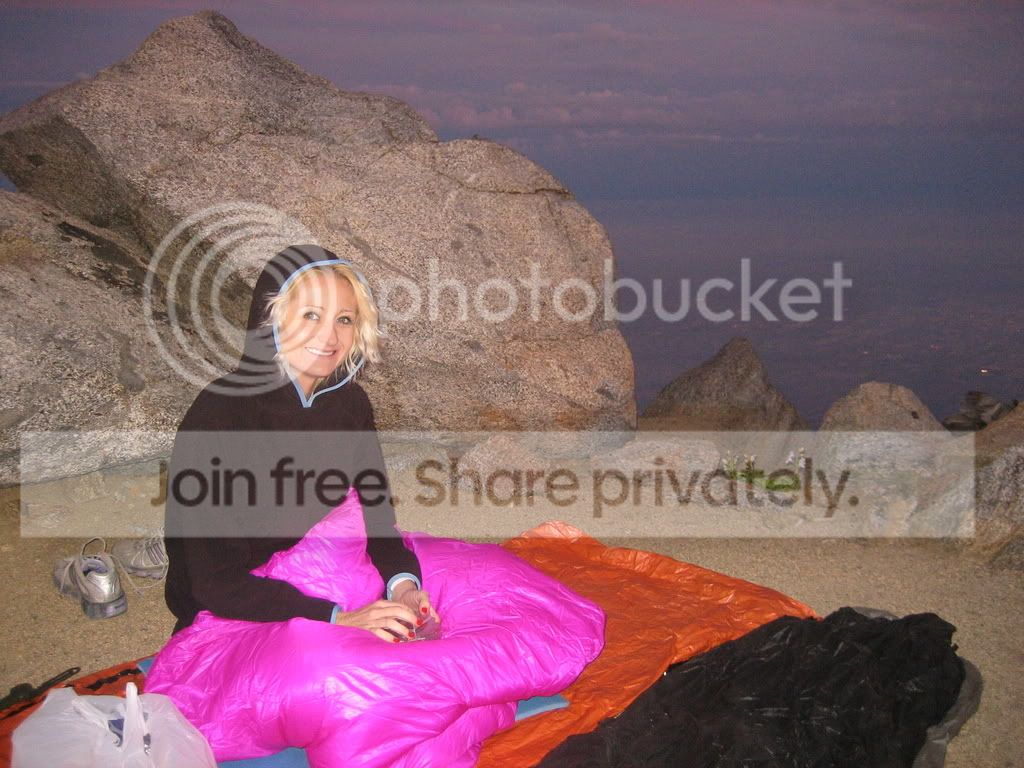
My girl made a Pink Ray Way quilt and it weighed about a pound when she was finished. When I made mine I made it as simple and light as can be. It was more like the Fanatic FRinge, but with a draw string and neck closure. I also planned on using it in a bivy, as does she. Her sleep system is an Adventure Medical Emergency Bivy and her quilt. She is always hot in it. I found through extensive research that the Ray Way quilts use too much material for SUL backpackers like me. I am very picky about my gear, I take lots but very light stuff, in a sleep system. Bivy (6 oz), quilt (10 oz.), poncho tarp (8 oz.).
IMG_2399.jpg

IMG_3602.jpg


-RB
 
Last edited:
Back
Top
