
Random puzzler: Fenching foils

Joined
Jan 17, 2008
Messages
539
Here's a fun little puzzler for your Friday viewing pleasure :)

A few weeks ago an SCA friend of mine gave me a whole bunch of old style fencing foils and asked if I could make anything with them. I took them off her hands figuring worst case scenario I could use them as blacksmith stock.

So last weekend I had a spare few minutes and thought I'd do some quick down-and-dirty testing. I cut a few of the foils off about half way down their length where the stock is about a quarter inch square (give or take) for testing. A spark test produced a pretty solid amount of sparklers so I went on to a test harden. Heated them to non magnetic in the forge, held them for a few minutes, and did a quench in peanut oil. Nothing. Nada. File bit in and I could bend them right over with a hammer.


Okay... Lets try that again. Same process, but with a water quench this time. Huh... What do you know? Hardened up just fine this time...
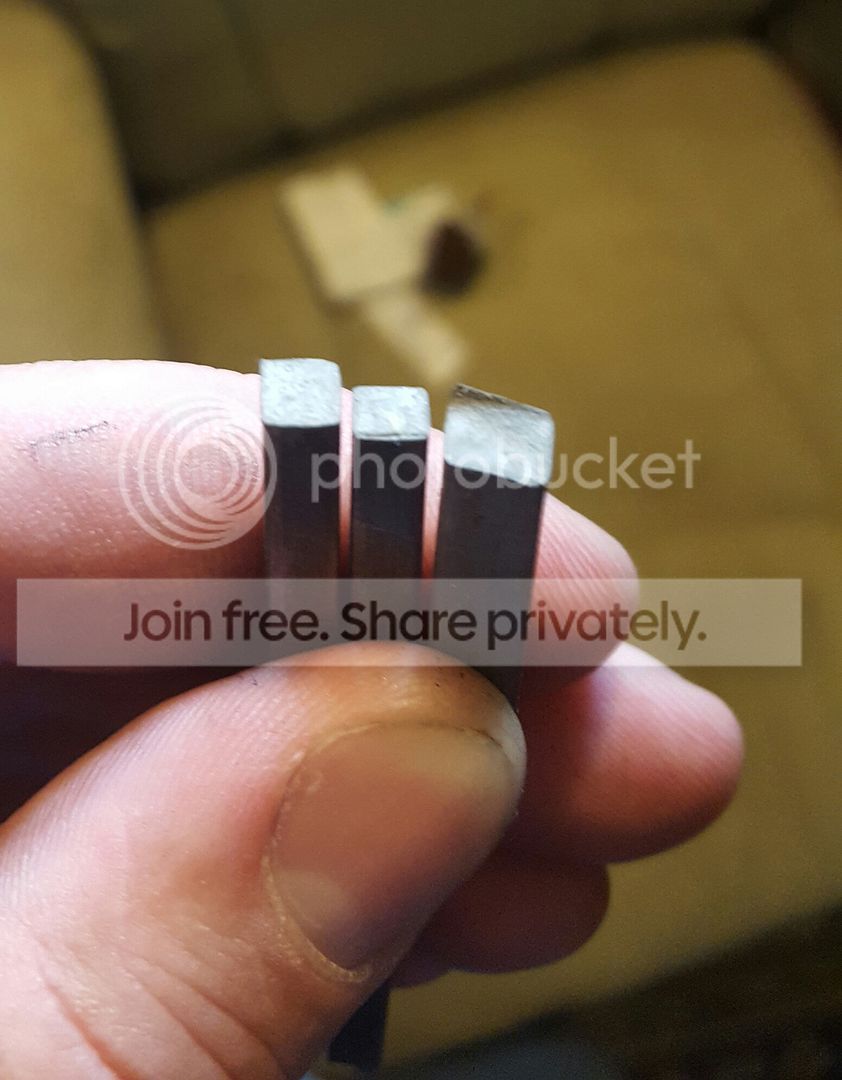
20160915_155717.jpg

Sorry for the out of focus pic. I was in a hurry and only had my cell phone.

So obviously a water hardening steel. The foils were all made in France. Anyone have any knowledge on what type of steel might have been used?
 
My guess would be low carbon steel that has a special HT, but if they are just wall hangers or for playing around, they could be any low to medium carbon steel.


Here is what I would do with them:
Clean off well and bundle the blade pieces together. Weld the ends up solid. Bring to welding heat, fluxing along the way, and twist tightly. Flux and twist tighter. Flux and hammer weld by hand. Once the billet is solid, make it square and draw out into a sword blade. You could make a new foil, an epee', a wakizashi, or a short sword.

Edited to a better answer.
 
Last edited:
You know I never thought of welding the ends and making a billet. Hmmm... Very interesting idea.

As to steel type, that's what I expected them to be, a simple medium-high carbon steel, but them not hardening in oil has me confused.
 
I missed that. I've seen a lot of wall hanger souvenir swords and foils from France and Spain that are just mild steel. In that case, put W1 square stock ( 1/4") rods in the billet with the sword pieces. THe number of squares it takes to make a billet is nine. arange them in three layers, alternating the types so no steel is touching the same type. The three layers would be A_B_A; B_A_B; A_B_A.
Fastenal has W1 round and square in most stores.

Alternatively, make the twist billet and split it for san-mai with a core of 1095 or W2.


Previous post edited to better state the steel info.
 
Last edited:
My guess would be 1070 or similar steel, but it could be any simple carbon steel up to 1095..

Here is what I would do with them:
Clean off well and bundle the blade pieces together. Weld the ends up solid. Bring to welding heat, fluxing along the way, and twist tightly. Flux and twist tighter. Flux and hammer weld by hand. Once the billet is solid, make it square and draw out into a sword blade. You could make a new foil, an epee', a wakizashi, or a short sword.

I doubt foils would be made with carbon steel, I've never seen rust on a foil blade before.


Sent from my iPhone using Tapatalk
 
IIRC, all foils are low carbon steel that has a special HT. You are not allowed to use a foil in competition that is not certified. High carbon would be too likely to break.

I haven't fenced in 40 years, but the rules were that the blade was low carbon steel with high alloy content and had to have a special HT called maraging. This made it into a tough spring that would bend and not break. As far as I know, the same rules are around today.


When I fenced we had to make contact and a judge had to see the hit. Today everything is electronic. The outfit in my old gear bag would get me laughed off of a modern piste'.
 
IIRC, all foils are low carbon steel that has a special HT. You are not allowed to use a foil in competition that is not certified. High carbon would be too likely to break.

I haven't fenced in 40 years, but the rules were that the blade was low carbon steel with high alloy content and had to have a special HT called maraging. This made it into a tough spring that would bend and not break. As far as I know, the same rules are around today.


When I fenced we had to make contact and a judge had to see the hit. Today everything is electronic. The outfit in my old gear bag would get me laughed off of a modern piste'.

I've heard about that HT when I fenced, it's tempered so when the foil breaks, it breaks clean and horizontal so that you arent left fighting with a blade with a sharp tip.


Sent from my iPhone using Tapatalk
 
IIRC, all foils are low carbon steel that has a special HT. You are not allowed to use a foil in competition that is not certified. High carbon would be too likely to break.

I haven't fenced in 40 years, but the rules were that the blade was low carbon steel with high alloy content and had to have a special HT called maraging. This made it into a tough spring that would bend and not break. As far as I know, the same rules are around today.


When I fenced we had to make contact and a judge had to see the hit. Today everything is electronic. The outfit in my old gear bag would get me laughed off of a modern piste'.

I've heard about that HT when I fenced, it's tempered so when the foil breaks, it breaks clean and horizontal so that you arent left fighting with a blade with a sharp tip.


Sent from my iPhone using Tapatalk
 
A question for me ? As a fencer/metallurgist I was interested in sword steel and how and why they broke . Back in the '60s the blades were European made ,dirty steel [lots of inclusions ] and of 9260 .That's a spring steel like 5160. The typical foil had rectangular cross section with fairly sharp corners .I don't remember the hardness. Parries would put small nothes in the blade - nice stress concentrations ! Large inclusions also made stress concentrations! Dangers ?Many fencers didn't know the safety procedures -The instant you hit , relax your arm !!! Those are the reasons for failures . Somewhere along theline they decided to make swords ofMaraging steel. At that point I was already out of the fencing game .But I knew all about Maraging as my college thesis was the making of a maraging steel !
Stacy , they may laugh at us old timers but as a fencer /coach I watch the Olympics and I'm shouting at the TV -I didn't coach that dummy !!! Much can be said for the old classical French style over the new wild , inefficient methods !
Wall hangers will be made of a cheap carbon steel , not to be used for fencing !
 
Oh these aren't wall hangers. they were used, and used heavily a couple of decades ago. I'm going to play with them a bit and see what I can come up with :)
 
Last edited:
Well, I whipped up a quick test piece yesterday. Basically I forged one piece flat and ground in into a rough chisel (about a 30 degree angle) Hardened it (again, no luck with oil, but it seem to harden fine in water) drew it back at about 450 degrees. Then sharpened it up and proceeded to beat the bejesus out of it. Chiseled quite a bit out of an old 2x4 with no perceptible dulling, then pounded it into a brass rod. No chipping, and no edge deformation that I could see with my naked eye.

I don't know what steel it is, but it sure seems to be functional in that limited application. Next project is forging out a small test blade to see how it'll do in a thinner form.

Not sure how much use I'll get out of the stuff, but damned it I'm not having fun with it so far ;)
 
Oh, and my son just reminded me he has an epee, not a foil. It is less springy than a foil, less so than a saber.
 
According to my research pretty much all modern foils are made of stuff called maraging steel, which I had to look up. It's basically a low carbon steel with lots of nickel. Not an acceptable blade steel, and not heat treatable using the methods common to bladesmithing. Wiki article on the subject https://en.wikipedia.org/wiki/Maraging_steel

These ones I'm working with appear to be old enough to still be made of more traditional carbon steel. Tough stuff, whatever it is.
 
It's NOT a carbon martensite !!! But it IS a martensite ! BTW my titanium gladius is also a martensite but not with carbon. " not an acceptable blade steel " ??? Then why are they using it ? You said that to the wrong guy !! I made my maraging steel forged it ,tested it , high strength , very tough fine for fencing !!! You need some metallurgy lessons !
 
Fencing dangers = I must add that seeing modern fencing , beyond dumb fencers are the dumb officials who permit fencers to be too close !! This is very common .The officials are supposed to stop the action when they close in as the closer they are the more likely the swords will break . I have seen a sword go under a mask but in that case no damage was done but it was caused by the fencers were too close !!
One of the changes in masks were that foils were originally light and flexible and the masks of rather thin wire. When foils went electric the blades became thicker and stiffer causing danger !! They then made the foil masks thicker like an epee mask. When you see a fencing sword bend 180 * they are too close ! They are inviting breakage ! After all I've seen two fencers bypass each other and still poke at each other .Shamefull ! Stupid !
 
They made the bibs integral to the mask as well, so the foil is less likely slip between it and the mask. My son's Uhlmann mask is constructed with noticeably heavier screen then those of 20 years ago. We are lucky that he has a coach that takes proper form and safety very seriously.
 
Back
Top