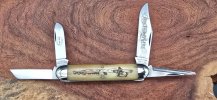
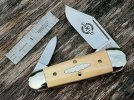
Rare knives...

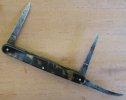
It was popular historically in England, and in France too I believe. In the days when steel was softer, and knives were used more, wear was more of a consideration. The friction between the blade and tang and spring causes wear, and the point of the knife consequently rises in the frame. With this sort of frame, more cover is given to the point of the knife.

In the case of this old Abram Brooksbank, the point of the blade isn't exposed because of wear, but because it was modded from its original form as a Lambsfoot :thumbsup:

View attachment 3128738

View attachment 3128739
Thank you for the info! Sounds like a simple and logical solution. I always thought that gunstock in its various forms is a relatively new pattern - 19th century that is - and never seen any older examples. Do you happen to have any?
 
About the Gunstock pattern and in particular, SteveC SteveC oldster from Butler. It's perhaps significant that a lot of c18th & c19th table ware knives had what was termed Pistol grip handles on them, curving downwards in the fashion of the ancient flintlock pistols. Allegedly, this was due to ergonomics in the hand but suspect aesthetics had as much to do with it, it remains a popular style in canteens of expensive cutlery.

Levine (1985) Has a section on the American Gunstock pattern p.122-3 he asserts that it is a smaller type of jack with Pen secondary and is relatively rare, popular among collectors and is a late c19th early c20th shape corresponding to a rifle. Interestingly, he says the first pocket knife shape to be called Gunstock was a French c18th version see p.272-3 under Foreign Exotic, Primitive and Historical Folding Knives. Figure 29 Couteau à la Charloise or Couteau à crosse. 'Crosse' meaning gunstock because of the roundness of the handle- in this case looking very similar to the Pistol grip knives.
 
About the Gunstock pattern and in particular, SteveC SteveC oldster from Butler. It's perhaps significant that a lot of c18th & c19th table ware knives had what was termed Pistol grip handles on them, curving downwards in the fashion of the ancient flintlock pistols. Allegedly, this was due to ergonomics in the hand but suspect aesthetics had as much to do with it, it remains a popular style in canteens of expensive cutlery.

Levine (1985) Has a section on the American Gunstock pattern p.122-3 he asserts that it is a smaller type of jack with Pen secondary and is relatively rare, popular among collectors and is a late c19th early c20th shape corresponding to a rifle. Interestingly, he says the first pocket knife shape to be called Gunstock was a French c18th version see p.272-3 under Foreign Exotic, Primitive and Historical Folding Knives. Figure 29 Couteau à la Charloise or Couteau à crosse. 'Crosse' meaning gunstock because of the roundness of the handle- in this case looking very similar to the Pistol grip knives.


Thanks for the info Will 👍
 
Thank you for the info! Sounds like a simple and logical solution. I always thought that gunstock in its various forms is a relatively new pattern - 19th century that is - and never seen any older examples. Do you happen to have any?
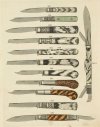
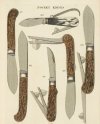
I think you're right Alex, as a pattern, but that form of pistolgrip frame goes back earlier. Here's a few examples from 'Smith's Key' from 1830. I particularly like the Barlows :) :thumbsup:

Smith's Key Barlows.JPG

Smith's Key Pocket Knives 9.JPG
 
Back
Top