Really flat

Joined
Sep 29, 2005
Messages
580
After all the responses when I first started I bought a flat granite plate and have always put sandpaper on top of it to sand blade flats flat. I always knew they weren't exactly flat around the edges, even though my sandpaper is bonded to the granite. There might be an area around the whole blade say .02 wide that will look flat when pushed around on sandpaper, but put it on a diamond lapping stone and it's a different story. It's like the sandpaper pushes or bunches up as the steel is going over it. It is very slight but enough to cause a seam where bolsters meet the blade steel. Is there anyway to correct this?

I bought some diamond lapping stones but the lowest grit I could find them in was 220. I can get true flat or at least more so on these stones than I can on sandpaper, but it takes forever at 220. I've also tried doing my blades a hair oversized for this, but it doubles work as well laying a pattern then sanding it off and trying to fit it back on once done flattening.


If this makes no sense I will try to get a picture up tomorrow. I appreciate any help.
 
sounds like the blade isn't staying flat on the stone. if your using your hand to hold the blade your going to put more preasure on one spot, pushing down on the edge or the corners making it look like it is rounded. get a magnet or some tape to hold the blade and try to keep even preasure. It also helps if you go in one direction, to keep it from rocking.
Also put a piece of regular paper down on the stone and a piece of sand paper down over half of it. Sand in one direction to the regular paper, this will keep the sandpaper from loading up so much and keeps those lil swirlie things off the blade.
 
sounds like the blade isn't staying flat on the stone. if your using your hand to hold the blade your going to put more preasure on one spot, pushing down on the edge or the corners making it look like it is rounded. get a magnet or some tape to hold the blade and try to keep even preasure. It also helps if you go in one direction, to keep it from rocking.
Also put a piece of regular paper down on the stone and a piece of sand paper down over half of it. Sand in one direction to the regular paper, this will keep the sandpaper from loading up so much and keeps those lil swirlie things off the blade.


I do use a magnet and only go one direction with each grit alternating with eachone, but I will have to try the paper trick. I appreciate the help.
 
I flatten with a 9" steel variable speed flat grinder then touch up on the surface plate with some 220, I get great results

I use tape to hold the blade I also hold the blade in the same position every time while checking with a micrometer.

Good luck
Spencer
 
Another thing to check before flattening is the straightness of the steel.I dont think I've ever recieved a piece of non precision ground steel that wasnt bowed.I use an arbor press and check it on a granite surface block to straighten the steel before making it flat
 
Hi Ryan,

I use a 12" x 12" piece of Micarta (pretty much dead flat) attached to my bench. I spray it with adheasive then lay down my sandpaper. Rather than clamping a blade then sanding it back and forth like most people do, I move the entire blade over the stationary sandpaper. I find that in my case, sanding in the traditional way results in sanding the dips as well. On the flat sanding board, go first sideways to remove dips. Then lengthwise. Back sideways, etc. Each direction uses a finer grade of paper until my last lenthwise strokes are done with 600 grit. On my final two grits I switch to a similar sized hard rubber plate. On the sideways strokes, I gently roll the blade, slightly lifting the spine to catch my convex edge. This wide, slightly giving sanding surface just shores everything up for a nice blade shape. Dont use the rubber for sanding your ricasso. Use the micarta for that.

Try coloring your blade with magic marker. This will show you your dips and irregularities.

I've tried other flat surfaces like glass and metal but if you bump your plunge-cuts into the edge it will cut into your steel. Glass chips and in a single pass a tiny fragment will gouge your blade for the entire length. Micarta has worked great.

Hope this helps.

Cheers,

Terry Vandeventer
ABS MS
 
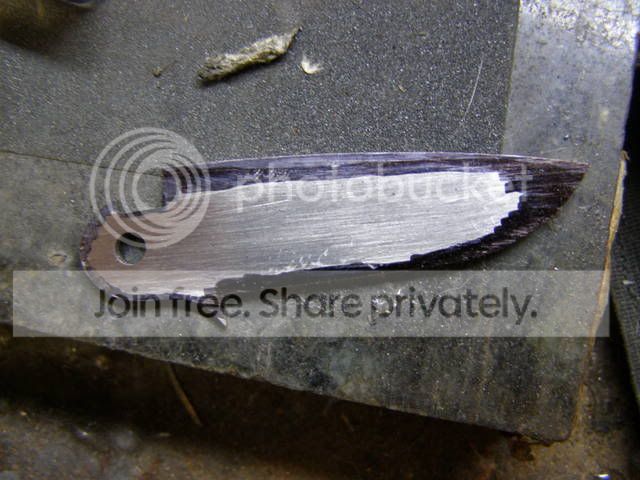
I appreciate all of the replies and help so far. My methods sound similiar to most of the ones posted, but I still don't think I'm getting dead flat. It shows when I put it on a plate that is guaranteed dead flat and to stay that way. I did take a few pictures to illustrate my problem a little better.

My method is craft bond the sandpaper to my granite plate
Use a magnet to hold the blade in the middle and sand in one direction only on the first grit of paper.
On the next grit I will sand in a different direction to make sure I get all the sanding marks out. I alternate directions with every grit change. I will do this until I have reached 600 grit sandpaper.

If I use nothing but the granite plate and sandpaper method I THINK I have it flat until I put it on the diamond plate and here is an example of what I find.
PA210706.jpg


The black area is exaggerated, but it does not sand or polish while on a diamond plate. I can take that same piece and put it on any grit 60 through 600 grit and one or two swipes will knock the marker off and polish that area leaving me to believe the piece is flat because all previous grits and scratches are removed. But I can put it back on the diamond plate and it shows the edges are not truely flat. It makes me think the sandpaper rolls or bunches up not even enough to see with the eye in front of the edge as I push the piece across even though the entire sheet is bonded to the plate.

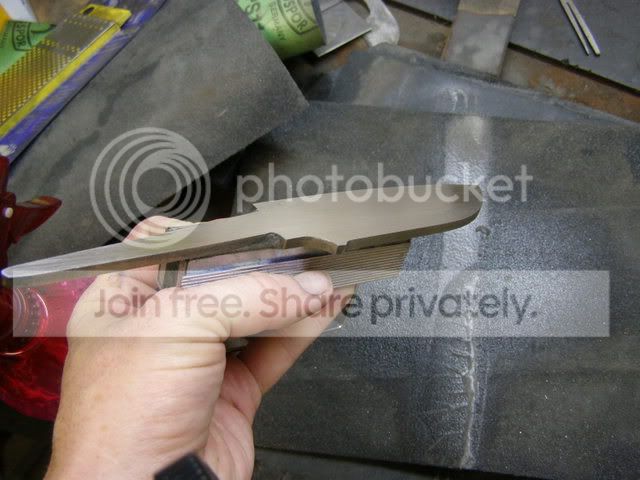
Here's a picture of my magnet
PA210705.jpg


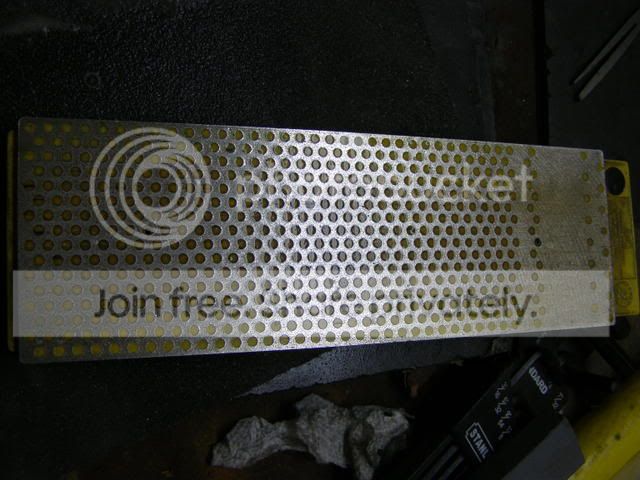
Here's the diamond plate
PA210707.jpg
 
are you going one direction only, or back and forth, I drag mine to me and pick it up and do it again, always with the point away from me. also dont try to put much presure on it, this will cause you to take off more on one edge or the other. thats why I drag it onto a piece of paper, when you pick it up its not on sand paper and the edge doesnt get sanded more.
 
are you going one direction only, or back and forth, I drag mine to me and pick it up and do it again, always with the point away from me. also dont try to put much presure on it, this will cause you to take off more on one edge or the other. thats why I drag it onto a piece of paper, when you pick it up its not on sand paper and the edge doesnt get sanded more.


I do the back and forth motion do you think that's what gets me? Do you apply any pressure to the piece or let it's own weight and the magnet do the work? Agan I appreciate ya'll taking the time to help me out.
 
back and forth always did that to me as well. I dont put much presure on it just enough for it to catch. too much and it will rock a bit. just use enough to stay in control.
 
I would assume your granite surface plate is more accurate than a diamond sharpening hone.Perhaps the uneven grinding your seeing is caused by an irregular surface from the hone wearing differently at different spots.If the diamond hone had a very slight radius(bump in the center) it would cause a wear pattern like this.
 
That's what I was beginning to think too.

I think your process, Ryan, should result in as flat a surface as a human can make... I often end up with a small rounded area along the edges of ricasso and handle - very small, on the order of a 1/132" radius or less. I just grind it away until I get to the honestly flat part. It's not enough to change the dimensions of the knife in any way that matters for my work.

I sand against paper on a piece of pool table slate. It's probably nowhere near as flat as your granite plate. I've used Micarta too, and that works very well - I just keep using it up for something else! :D
 
Thanks for the help guys. I called DMT before I ordered the stones to check on flatness. The duosharp (a new stone) I believe is what they are called are guaranteed a certain flatness I can't remember the number, but it wasn't anything more than the plate is guaranteed at. They also guaranteed it to not hollow or dip which is the whole reason I've been believing the diamond plate is the flat one and not the granite and sandpaper. It wouldn't be the first time I bought something that in no way holds true to its advertisement :o

I did try the push one direction then pick up and push again and that seems to help. I didn't get to try it much, but i'm fixing to head out there and work on that. I really appreciate everyone's advice and time.
 
Granite surface plates are not really meant for lapping. If you want very flat surfaces without a surface grinder then you need to purchase a lapping plate. This holds a lapping compound that will allow for very flat surfaces. Now parallelism will be another story. This will be dependent upon your technique. The workpiece will need to be checked frequently with a micrometer to ensure you are removing material evenly. You can usually get things close enough with a the surface plate, but then how close is close enough?? It's a personal thing. It would be interesting to see what you are reading with a good micrometer (.0001 reading) center compared to outer edge.
 
Hmm I like the idea of a lapping plate, but didn't know they existed. I understand the parrallelism though. I also like the link you posted that actually has a compound with a grit lower than 220. I do not buy precision ground steel, mainly because I can't find it in what I want. To remove mill scale I often use 60 grit I just need to figure out if the grits mean the same thing in sandpaper as compound. Thanks for the link and information.


I haven't worried about parallelism as much right now because I'm working on fixed blades. I do know it will play a part in holes being drilled if it's way off. Once I mess with the folder blades I have cut out I will concentrate on the parallel between the two sides more. My main concern is getting a seam free joint between bolster and blade. I've pulled it off twice and I can contribute that to pure luck. The seams that I do have don't catch a finger nail, but they are there. It's also a good possibility I'm being too picky on this as well.
 
Last edited:
...It's also a good possibility I'm being too picky on this as well.

I love it! :D That goes back to personal preference, and it just makes me want to see your knives! I don't think in any craft there's such a thing as "too picky." Only better and better work. For my money, you're on the right track all the way.
 
No matter what you use you will never get it completely flat by pushing or pulling in one direction. Your hand pressure will always vary slightly. You'll either put more pressure on one end or the other and even more on one side than the other.

The correct way to lap something flat is to do it in a figure eight pattern. Try it, then do your final flats grit in one direction. You won't remove enough material to get it out of square.
 
The grits are the same as sandpaper. I have seen 1000 grit lapping compound. They may even make it finer. This is what mold die makers use to lap in their work. They have to be very accurate and very flat. Good luck and keep on keepin on.

Perfection is a journey not a destination.
 
Back
Top