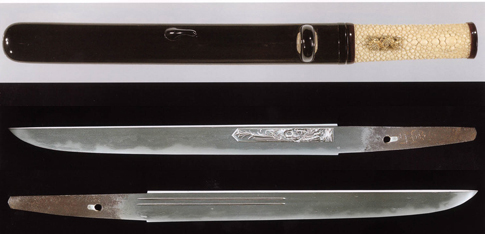
Rethinking the "Tanto."

I've never bought any "more metal" arguments. A good maker can put as much metal as you need for a given purpose, vertically or laterally, on any basic blade shape and grind as you like.

This. There is not inherently more or less metal in one type or another...it's only a matter of specific scale.
 
I've never bought any "more metal" arguments. A good maker can put as much metal as you need for a given purpose, vertically or laterally, on any basic blade shape and grind as you like.

If you flare the blade towards a very broad American Tanto point, and you use a very low sabre grind with a deep hollow grind, you will have more mass nearer the tip than with any other point design.

Furthermore, for the given amount of mass near the tip, the American Tanto can more easily retain a more aggressive initial point profile.

A flared American Tanto blade would make sense for a chopper, especially with a low sabre hollow grind, which would exploit all the mass in all the corners that other point designs would have to round off.

The TOPS Hawke Hellion had that design, but it was not hollow ground, so the cutting geometry was poor.

As for all grinds being interchangeable in mass, daggers are inherently lighter for the same stock thickness, by over 20% typically, which is why it is such a waste to see one with a full profile tang instead of a stick tang, or with heavy handle materials...

Gaston

 
Interesting.^
I do believe the yoroi toshi, armor smasher, had a thicker point, along with the contoured spine.
rolf
 
I find a tanto ok for EDC for the stuff I find myself cutting. I never use an EDC to cut food, so slicing is not an issue. The main problem I have with the American Tanto is sharpening it without rounding the point between the two edges. I do have a Japanese Tanto and find they work great.
 
Yep.^
The traditional tanto shape is like a boning knife shape. A very useful shape, indeed.
rolf
 
If you flare the blade towards a very broad American Tanto point, and you use a very low sabre grind with a deep hollow grind, you will have more mass nearer the tip than with any other point design.

Furthermore, for the given amount of mass near the tip, the American Tanto can more easily retain a more aggressive initial point profile.

A flared American Tanto blade would make sense for a chopper, especially with a low sabre hollow grind, which would exploit all the mass in all the corners that other point designs would have to round off.

The TOPS Hawke Hellion had that design, but it was not hollow ground, so the cutting geometry was poor.

As for all grinds being interchangeable in mass, daggers are inherently lighter for the same stock thickness, by over 20% typically, which is why it is such a waste to see one with a full profile tang instead of a stick tang, or with heavy handle materials...

Gaston

There's a lot wrong with many of these assertions...
 
Tanto blades FTW!

CAM06162_zpszn6y0xoo.jpg
 
I have and used an original CS Master Tanto for many years. It makes a poor utility knife as too often only a very small part of the edge gets utilised. Excellent short urban crowbar though.
Tantos: the closer the design is to a more classic utilitarian blade design the more useful they are as a knife.

For the swords and fighting knives then by combat function grinds and the like aren't so very important any more. Gets down to sword/fighting style, and all the main styles of swords do the job well enough as in truth they don't have to do much: slash stuff and punch holes in stuff. Survive one fight at a time.

With nothing better to do then fighting styles blades are tested for chopping wood or for kitchen tasks. All very wrong. Most are just rubbish. The desperation to make them more than the one job objects they are is to me silly, though many find a hobby trying to prove otherwise.
 
dwdickey- I'm not giving up on Emerson at all. I still LIKE all things-tanto.
Good post, GREENJACKET.
I think Phill Hartsfield said, To find out what tanto is, first find out what it isn't.
Thanks for the replies, gang.
rolf
 
I use mine a lot and have never had a problem cutting or slicing with it. One of my favorites in fact.

71a7cdfdebee3b60e544bfa37ea91c5e.jpg


Sent from my D6708 using Tapatalk
 
I never thought of the Wharnie for SD but I do now.
I keep learning on Bladeforums.
rolf

Michael Janich has done quite a of testing with the Wharnie this is some of what his research showed.

I became a fan of the wharncliffe pattern after lots of cutting tests on different media. In simple terms, knives cut based on a combination of pressure into the medium being cut and the drawing of the cutting edge through the material. With a natural grip and locked wrist, knives with "belly" to the edge actually lose some cutting efficiency as the cut approaches the point--where the edge curves away from the target. The straight edge on the wharncliffe cuts with full power all the way to the point.

The down side to the wharncliffe is obviously that the tip cannot be ground as thick. This gives it an exceptionally sharp point and awesome penetration in a defensive context, but does reduce its strength.

Thanks again to everyone for your support and enthusiasm.

Stay safe,

Mike


As far as Tantos go I like them. I used the American Tanto style only for the most part. It can do utilitarian tasks, but I would say it is more limited and not as all around versatile as other shapes though.
 
Last edited:
ok, but explain!^
Steel130. I'll ask Sal about a Y1 re-release. Yo do too, please.
rolf
 
I use mine a lot and have never had a problem cutting or slicing with it. One of my favorites in fact.

71a7cdfdebee3b60e544bfa37ea91c5e.jpg


Sent from my D6708 using Tapatalk

Really like the CRK tanto. Seems like it would be more user friendly.
 
Back
Top