Review my CA plan.

Joined
Jun 13, 2007
Messages
7,743
Hi guys. I'm planning on a CA finish on the knife that I'm making. The stabilized scales are on a full tang with mosaic pins and lanyard tube. They are epoxied on and I'm getting near finished with shaping.

Good news and bad.

The good news is that this is not an ultra serious knife. I'm not selling it, it'll be a user, but I do want a nice result.

The bad news, I need to use what I have on hand for the most part.

I have lots of sandpaper wood grade in 80, and 220 grit. Wet/dry from 220 to 2000 grit.

The plan is to sand the wood to (?) then apply coats of CA. I don't have debonder or fast set spray. I assume I can sand in between coats to correct runs/bubbles/flaws?

I plan on around 3 coats or whatever it takes to get a layer thick enough to finish sand without breaking through. After finish sanding I have white (plastic) buffing compound that I can use by hand.

I'd like to know how this all sounds. I also have some critical concerns.

How does the finish work on a full tang knife? Do you let the tang get covered? Mask it? Sand it after?

What about the mosaics? Can those be covered with CA, or do they need masked?

I'm a bit out of my element here. I'd love some links, but I need specifics for my particular situation. The things that I've seen all use supplies that I simply do not have access to.

A couple of supply questions.

Are there any brick and mortars that sell CA in a bottle? I'd rather not buy a bunch of tiny tubes of super glue, but will if I have to.

Also, considering the sandpaper that I have, would micro mesh be a huge benefit? Do you know if they carry the stuff at places like Hobby Lobby? I can just call on that one, but I'd like to know how badly I need it.

I may have other supplies that I'm forgetting about, or don't know that they can be used in the process. Steel wool for example. Is that useful for anything?

Thanks guys, I know I have a lot of questions in there. Any help is much appreciated.
 
Try model shops that sell lots of remote control planes... My sisters boyfriend builds them and gets his CA in big bottles from a model shop...
 
Why would you use the CA glue when the wood is already stabilized. Just sand it down size after size until you see what you like - probably about 1500. Use the wet or dry without water. Frank
 
Why would you use the CA glue when the wood is already stabilized. Just sand it down size after size until you see what you like - probably about 1500. Use the wet or dry without water. Frank

I've often read that the finish can be applied to stabilized wood. I've also read that the stabilized wood will darken and lose its figure (flames in this case) over time. That's definitely something I want to avoid.

I can always try a simple sanded surface, then if it darkens, sand it again and apply a finish.

I'd rather do it once this way though and hopefully get it right the first time. :)
 
I get my micromesh pads at Hobby Lobby for about $8. It goes from about 3200 to 12K, but not sure if that is regular grit or what. Also, they have papers up to 12K. I do agree that sand to 2000 and buff is the way to go, danish oil after to give it a bit of protection. Besides, any handling after some time will darken the wood.


-Xander
 
A real CA finish isn't over the wood, it is in the wood.

Start by sanding the wood to 400 grit or higher.
Flood the surface with thin CA and let it soak in and cure a bit. Speed cure is helpful, but not needed. Just allow it to set up most of the way.
Remove the excess from the surface with debonder, fingernail polish remover, or acetone. Take a cotton cloth dampened, but not soaked, with the solvent and start rubbing the CA. Rub it both in and off. Re-dampen the cloth as needed. Let the handle dry fully for several hours.
Sand the surface with 400 grit paper until all the CA seems removed.
Repeat many times ( up to 20 times), with the purpose of making sure the surface is fully impregnated with CA. 8-10 times is normal. After the last treatment, sand the surface up to 8000 grit, using 3M papers from green to white.

When done right, the surface is glassy smooth an shiny, but not coated with a layer of gummy CA. Any rivets or bolsters will only be metal surfaces.

What you have done is impregnate the wood surface with acrylic polymers and plasticize it, This wood will take a mush higher shine, and be completely sealed.

Touch up is easy, and usually requires no more than using the 3M papers from blue to white again.
 
Stacy has it right. I usually skip the debonder step and just rub it down aggressively with synthetic steel wool in between coats. Make sure to buy a thin CA glue for the first few coats. I usually use a slightly thicker CA for the last coat to put a smooth finish on it. Buff it - then I would finish it off with some paste wax (Renaissance Wax is my favorite).

TedP
 
The post below is from 2009:

The super glue finish process was developed by Scott Slobodian. Here is what he wrote several years ago:

"I do probably 50 coats and sand off 20. Sand to 1500 grit and rub out with a paint compound...I use "Final Cut". Do all your sanding at the end unless you get something stuck in the coats...like cotton, rubber gloves or leaves blowing through the air!

The thin glue sets fast...seconds. As it starts to slow down spritz it with accelorator and it cures immediately. It takes me about half an hour to do a handle...coating it that is."


Scott's knife handles and wood sheaths look like they were dipped in glass. The finish looks very nice.
 
I know from my model building experience that Bob Smith Industries makes a line of CA that goes by the name Insta-Cure. They make different viscosities but it sounds like you'll be wanting their Insta-Cure thin glue in the blue label. Don't get the Insta-Cure+ (purple label) or MAxi-Cure (red label); those are the medium and thick versions. There's nothing particularly special about this glue, but it comes in really handy sizes for people that use a lot of CA. I'm talking 1,2,4 and even 8 oz bottles and stores that carry this brand usually have the accelerator and de-bonder on the same shelf. I can usually find this stuff in most art or hobby stores.

http://www.bsi-inc.com/Pages/hobby/ca.html

Good luck.
 
Thanks guys! Alright so I'll plan on there being nothing on the pins/tang.

I had read about Scotts method in my research actually. His finishes are stunning. From everything I've read, and what you guys are saying, I think this is well within my abilities to do nicely. :)

I know from my model building experience that Bob Smith Industries makes a line of CA that goes by the name Insta-Cure. They make different viscosities but it sounds like you'll be wanting their Insta-Cure thin glue in the blue label. Don't get the Insta-Cure+ (purple label) or MAxi-Cure (red label); those are the medium and thick versions. There's nothing particularly special about this glue, but it comes in really handy sizes for people that use a lot of CA. I'm talking 1,2,4 and even 8 oz bottles and stores that carry this brand usually have the accelerator and de-bonder on the same shelf. I can usually find this stuff in most art or hobby stores.

http://www.bsi-inc.com/Pages/hobby/ca.html

Good luck.

I actually have some of their products that I bought years ago. I don't believe they were as CA focused back then. Fortunately the hobby shop that I purchased their epoxy from is still in business. I'll definitely stop in and see what they have. Hobby Lobby too.

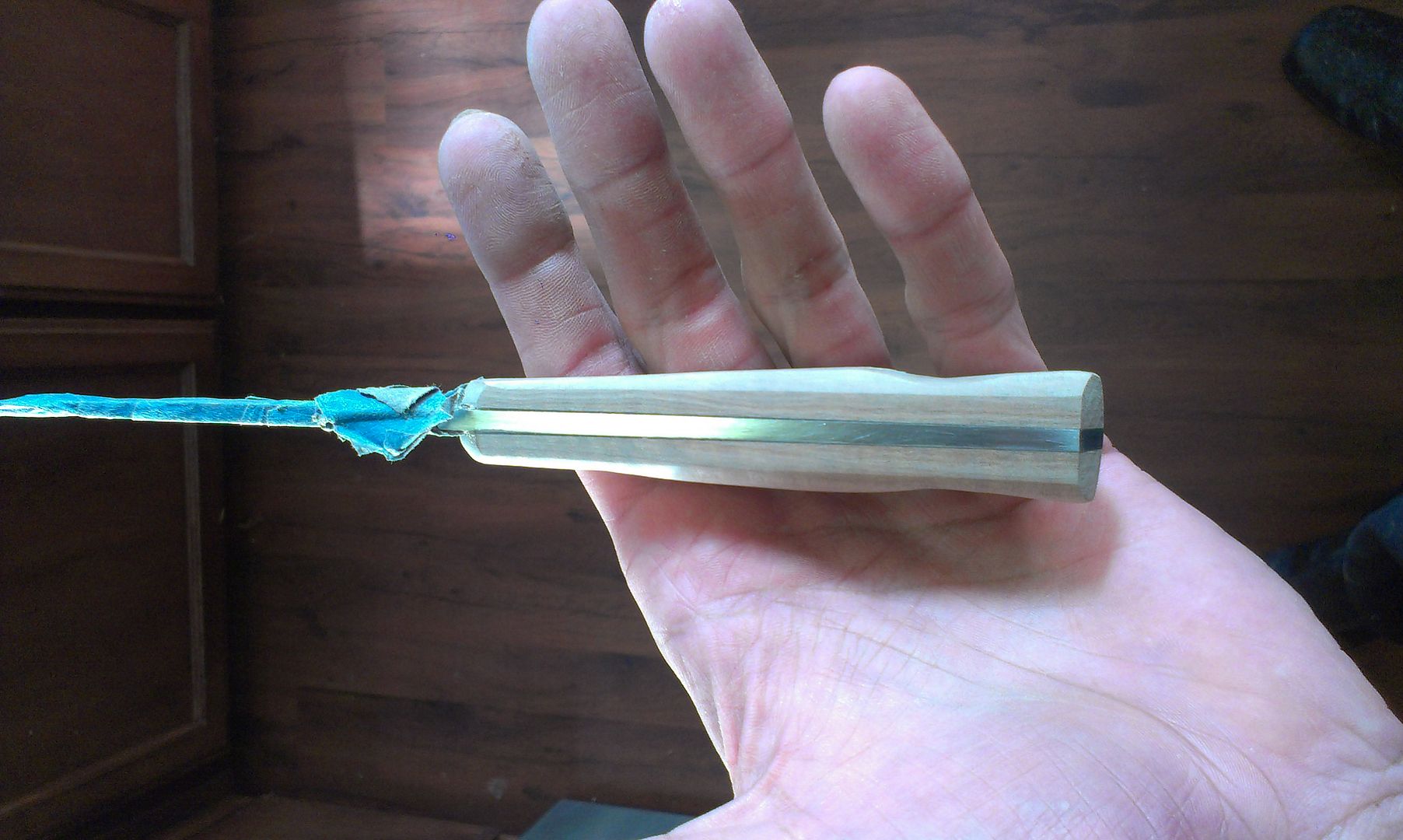
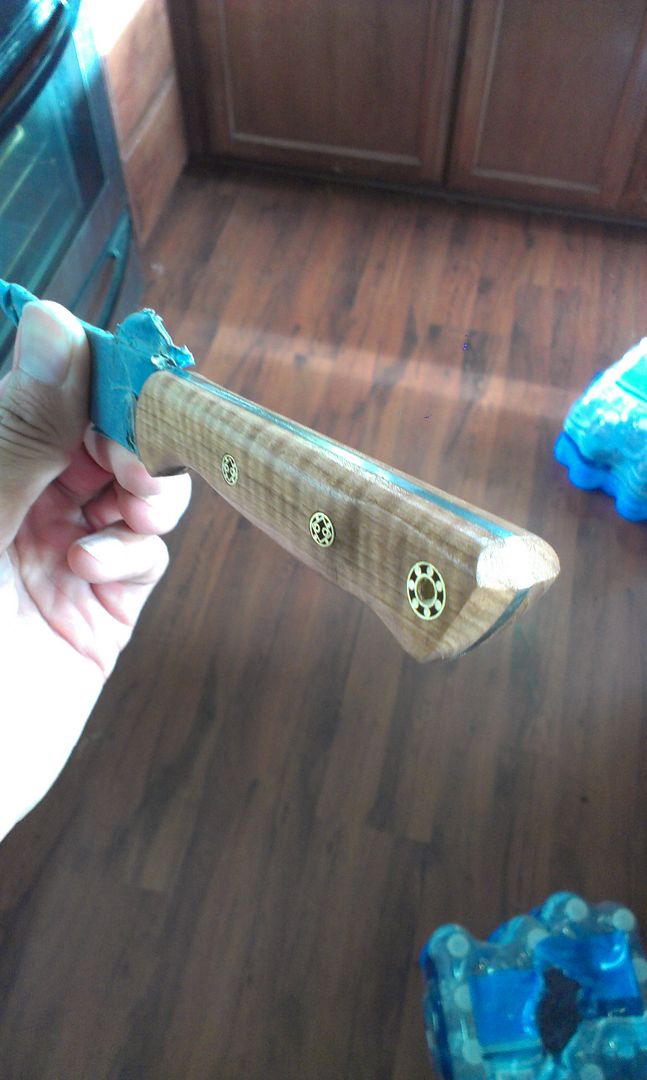
Here's a couple of pics of the scales as they sit. The second pic has a little water on the scales to show the flames. I've still got work to do, but let me know what you think.

IMAG1520_zps7a19413e.jpg


IMAG1522_zps70c53008.jpg
 
There is no need to apply CA to stabilized wood. Sand, polish, wax.
 
I've noticed some black smearing on the wood when I sand the mosaics with SiC paper. Is it the paper or the dyed epoxy (or it could be the carbon fiber rods) doing this?
220 grit is the highest in have in (synthetic) garnet paper.

Also, other than preference, is there a reason why I should NOT do the CA treatment? I'm just asking because it's been mentioned more than once that I don't need to do it.
 
Last edited:
I've noticed some black smearing on the wood when I sand the mosaics with SiC paper. Is it the paper or the dyed epoxy (or it could be the carbon fiber rods) doing this?
220 grit is the highest in have in (synthetic) garnet paper.

Also, other than preference, is there a reason why I should NOT do the CA treatment? I'm just asking because it's been mentioned more than once that I don't need to do it.

The smearing is more than likely from your paper. Try some of your paper on a piece of scrap wood and see if it leaves behind any discoloration or smearing.

A matter of preference, I think.
Stabilized wood can be brought to a nearly glass like finish without the CA.
I agree that with the CA, and done right, it looks phenomenal, but I'd go with 2000 grit and maybe a light buffing depending on how it looked.
 
Reason? You are setting yourself up for extra work, for no benefit.
Either way, you're going to need a lot finer sandpaper than 220 grit.
CA won't absorb into stabilized wood, so the finish would just be on top of the wood. Polishing the wood will have the same effect as polishing added CA.
Why bother?
 
The smearing is more than likely from your paper. Try some of your paper on a piece of scrap wood and see if it leaves behind any discoloration or smearing.

A matter of preference, I think.
Stabilized wood can be brought to a nearly glass like finish without the CA.
I agree that with the CA, and done right, it looks phenomenal, but I'd go with 2000 grit and maybe a light buffing depending on how it looked.

Yeah, I thought it was probably the paper. I tried the same 220 on scrap (and on the top of the knife, away from the pins) and there weren't any problems. My hunch is that the wood/resin is hard enough to keep loose abrasives off the wood and that it is the epoxy/cf I'm seeing.


Reason? You are setting yourself up for extra work, for no benefit.
Either way, you're going to need a lot finer sandpaper than 220 grit.
CA won't absorb into stabilized wood, so the finish would just be on top of the wood. Polishing the wood will have the same effect as polishing added CA.
Why bother?

That makes sense. I went ahead and tried the finish on a lanyard bead that I made from the same block of wood and after two coats it's just a little hazzy, but it really does look good to me.

I'm going to try the same thing on another scrap using just fine paper, buffing and polishing and see what happens.

I really appreciate your help guys.

Here's a completely separate question...

I didn't clamp the front with enough pressure while the epoxy was setting. Because of this I have a couple of voids between scale and tang. The obvious answer to me seems to be mixing and filling with a little of the same epoxy. Does that sound right?
 
You are depositing brass/metal dust into the pores of the wood. It darkens almost immediately at that fineness. Carefully filling all pores before sanding, and sanding in such a way as not to smear the dust into the surrounding wood will help. Cleaning the surface with a cleaning spray , like Windex, and then rubbing it off with a clean paper towel will usually remove any remaining smutz.
 
Yeah, I thought it was probably the paper. I tried the same 220 on scrap (and on the top of the knife, away from the pins) and there weren't any problems. My hunch is that the wood/resin is hard enough to keep loose abrasives off the wood and that it is the epoxy/cf I'm seeing.

Yup, not the paper then. I've had contamination problems with "bargain" paper before. Never making that mistake again.

It's as Stacy suggested then. Clean,clean,clean.
 
Okay, that's exactly what I'll do then. It's a little difficult because I don't have the rear pin on a flat, but I can figure it out.

Regarding the question about the gaps... The epoxy that I used is clear. It looks a little bleh... Would it be possible for me to cut a little bit of the epoxy out between the tang and scales, then fill it with dyed epoxy? What about mixing wood dust with the epoxy? I've never heard of, or tried anything like this, just trying to run it by you guys to see if it's a huge mistake to try. I'd love to make the front end look better, but I don't want to totally mess it up trying. If it's viable, what's the best course of action?
 
Back
Top