
-
The BladeForums.com 2024 Traditional Knife is available! Price is $250 ea (shipped within CONUS).
Order here: https://www.bladeforums.com/help/2024-traditional/
You are using an out of date browser. It may not display this or other websites correctly.
You should upgrade or use an alternative browser.
You should upgrade or use an alternative browser.
S125V vs. S110V vs. S90V vs. S30V
- Thread starter The_Guide
- Start date


- Joined
- Apr 21, 2006
- Messages
- 5,613
I'm pretty sure Mr. Bos isn't going to be Heat treating steels that take such a high soak. Anyway, S125 is long gone. It never was more than an experimental heat, maybe two. Not sure about how much S110V was made.

Ankerson
Knife and Computer Geek
- Joined
- Nov 2, 2002
- Messages
- 21,094
Personally I like S30V and don't find it hard to sharpen. 
With Companies like Strider, CRK and ZT using it in their hard use knives I really won't think there is much of a problem with toughness.
Strider uses it in all of their fixed blades too.
With Companies like Strider, CRK and ZT using it in their hard use knives I really won't think there is much of a problem with toughness.
Strider uses it in all of their fixed blades too.

- Joined
- Oct 2, 2006
- Messages
- 1,746
I am getting this knife as a high end EDC.
Purpose would include the usual tasks like cutting cardboard, opening packages, cutting plastic, maybe some whittling, (perhaps some shaving)
S125V is back in production! I say go for that, your listed tasks don't require much toughness. S125V does need 2150F degree hardening though, which Paul Bos won't be willing to do.
DennisStrickland
BANNED
- Joined
- Jun 24, 2009
- Messages
- 5,040
DennisStrickland
BANNED
- Joined
- Jun 24, 2009
- Messages
- 5,040
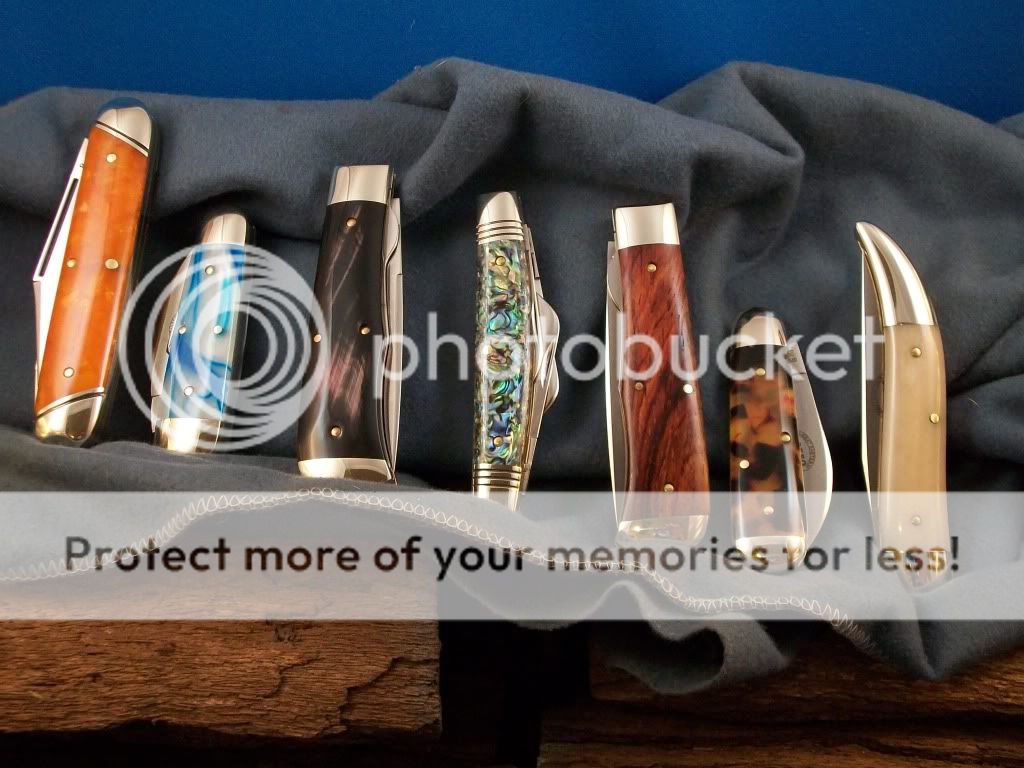
orange crush,polor ice,red buffalo,abalone,rosewood,tortoiseshell, & smooth bone . all gec personally i like a mixture of syns & naturals with a slight perferance towards bone & stag. how about you guys? do you also think some syns are great looking.?

- Joined
- Apr 10, 2000
- Messages
- 3,794
I have folders and fixed blades in all 5.
For light and even not so light use all of them will do w/i chipping and cracking.
CPM 10V, CPM 125V and CPM110V I have from Phil Wilson are all in 64-65HRC range. No cracks for years. And the edges I have on them are around 15deg per side or less.
Other than that, yeah, unless P. Boss has changed something lately, the reason my CPMS90V Lochsa is 60HRC is exactly because Mr.Boss refused to harden it to 61HRC, citing of furnace temps and related regulations. That was years ago though. Dunno what's he doing now.
Phil Wilson can do it for sure, if he is taking orders at the moment. He did reharden for me several blades.
For light and even not so light use all of them will do w/i chipping and cracking.
CPM 10V, CPM 125V and CPM110V I have from Phil Wilson are all in 64-65HRC range. No cracks for years. And the edges I have on them are around 15deg per side or less.
Other than that, yeah, unless P. Boss has changed something lately, the reason my CPMS90V Lochsa is 60HRC is exactly because Mr.Boss refused to harden it to 61HRC, citing of furnace temps and related regulations. That was years ago though. Dunno what's he doing now.
Phil Wilson can do it for sure, if he is taking orders at the moment. He did reharden for me several blades.
DennisStrickland
BANNED
- Joined
- Jun 24, 2009
- Messages
- 5,040
sorry about wrong area my comp. is screwed.
- Joined
- Jan 16, 2006
- Messages
- 386
Guide, First off if you can find a maker that will offer you the choice of those steels you have done your research. CPM S125V is available, there is some out there. I quit working with it for all the reasons stated here and also it is very hard to sharpen. It resists working to a very fine edge due to the huge carbide percentage. Try sharpening a carbide lathe cutting tool on a bench stone (even diamond) and you will see what I am talking about. Comparing the others (S90V, S110V, S30V) head to head is really not possible unless you have exact blades, heat treated to sweet spot hardness for each grade, sharpened exactly alike and used in the exact same way. If you do this you can make some general observations. For corrosion resistance all 3 are good and pretty much equal. S110V would win out but has to be heat treated for max corrosion resistance as a goal rather than hardness or wear resistance. S110V is in short supply for custom makers. Again there is some out there but until Crucible/Niagra makes more available it is not going to be in common use. It also takes the most precise heat treating of the 3 to get a high hardness reasonably tough blade. CPM S90V has been around the longest and there are several makers who will work with it but again to get a hardness over about RC58 (60-61 works best) takes a learning curve and good precise equipment. CPM S30V is much more forgiving to work with and heat treat. Also most custom makers have experience with it and Paul Bos will do the best job on the planet if the maker chooses not to do it himself. IMHO you will end up with the best general use knife with CPM S30V at about RC 60 hardness. The chipping on these steels is another concept that gets thrown around at will. Some things to understand on this. Heat treating is critical and for some of them a subzero is very necessary. Early chipping reports were from some poor heat treating on S30V. That has mostly been resolved now as experience has been gained. High alloy steels at high hardness will not have the best impact resistance. So if you are looking for something that can stand chopping you need at least a lower hardness and probably a different alloy designed for that. These high Vanadium carbide steels were developed to maximize wear resistance. The best application is for a long wearing corrosion resistant slicing type blade. The name of the game is the best steel for the application.
The other thing to keep in mind is that with a very thin blade, and thin sharp edge there is very little material to offset the high stress on the edge. On blades designed for high edge retention we want the failure mode to be fracture rather than rolling. We want the thin edge to stay there in place to allow the hard carbides to do the job to resist wear. If the edge rolls you are done. Hardness equals strength but but with very high loads and miss use you may get some chipping. This is why the production makers use the good steels but at a lower hardness and thicker edge geometry. It has to be made for a wide range of uses. The point here is that not only do you want to specify blade material, you want to tell the maker the edge geometry and hardness, maybe more important than the steel. You then have to use it in the way it is intended. Phil
The other thing to keep in mind is that with a very thin blade, and thin sharp edge there is very little material to offset the high stress on the edge. On blades designed for high edge retention we want the failure mode to be fracture rather than rolling. We want the thin edge to stay there in place to allow the hard carbides to do the job to resist wear. If the edge rolls you are done. Hardness equals strength but but with very high loads and miss use you may get some chipping. This is why the production makers use the good steels but at a lower hardness and thicker edge geometry. It has to be made for a wide range of uses. The point here is that not only do you want to specify blade material, you want to tell the maker the edge geometry and hardness, maybe more important than the steel. You then have to use it in the way it is intended. Phil
DennisStrickland
BANNED
- Joined
- Jun 24, 2009
- Messages
- 5,040
thanks phil you really summed it up. i was looking at some old blade mags or tact. knife mags from years back & saw you did quite a bit of writing for the perioidicals. from what i've seen on the forum you are the man for treats.thanks for clearing this subject up.
- Joined
- Jan 16, 2006
- Messages
- 386
Thanks Dennis, I kind of got out of the groove with the writing and maybe will get back to it one day. Sometimes I see things on the forum here that I just have to respond to. This stuff about chipping blades is one of them. These high vanadium steels we use for knife blades were really designed for the plastics industry and for high temp bearings. In this case high surface wear, corrosion resistance and higher temps are the design criteria. We have adopted them for blade steels and they work great especially for abrasion type high edge holding. The impact, dynamic (Charpy) strength is not as important for this application. CPM S30v was kind of the exception. At the time it was developed the main CPM's used for knife blades were S60V and S90V. Both needed high soak temps for HT and at higher hardness did tend to be a tad brittle. The idea was to make a steel that still had vanadium carbides for wear but more balanced for impact strength. Make it more user friendly for makers for finish and grind and heat treat. Based on the popularity today of 30V I think they pretty much hit the target. To get the full potential from it it has to be RC 58-60 and heat treat temp has to be precise to get it there. Also seems like a subzero with LN2 is necessary to maximize all the properties. I have also found that a temper cycle after all finish work is done improves the toughness. I used to make a lot of fillet knives with CPM S90V and at high hardness. RC 60/61. If pushed hard with a bending test on a flexible blade I could get them to bend (yield) take deformation before finally breaking with enough force. That is bending strength not impact strength but is a good gage of what is possible with these steels. CPM S30V is even more forgiving under bending. What toughness is required for 90V, 30V, 110V? Depends on the use but here is what I do. Push heat treat up to max hardness of 61 to 65 based on the steel grade. Grind a blade to about .008 to .010 behind the edge and sharpen with a SC bench stone at 15 degrees per side. Slice 5/8 rope against a back board until the blade tends to slide a bit. Look for chipping at the edge with the eye. Also whittle pine or redwood, cut 3/8 into the wood and twist out of the cut. If I do not get any edge chipping then it is just right. If chipping is noted then I back off a little on hardness and give it another try until the blade makes the test. This gives adequate toughness (bending strength) to work in the field for field dressing, skinning, quartering, filleting ect. Chopping or prying with this heat treat will most likely give some chipped edges. Harder use will require backing off on the hardness but at the loss of edge holding. Yes high alloy steels tend to have less ductility especially at max hardness but don't think this is limited to them. When I was 10 or so I used to make things in my Grandad's work shop. One time he gave me holy hell for banging a file on the vise to try to get the saw dust out of it. "Never do that with a tool", for sure it will break he said. I'm sure most also have had hand hacksaw blades break, mills, drills and the like. They are hard and cut good but do have limits. They are maximized for wear and reasonable toughness. Just like a special purpose knife blade made from bearing and tool steels.. Specify the use and use it as intended. If a user is concerned about fine edge chipping under every day use then all of the steels have to be 58 RC or less. If you want long edge holding , effortless cutting and scary sharp edges then the hardness has to be pushed to higher values possible with each grade. Phil
- Joined
- Jan 16, 2006
- Messages
- 386
Kaizan1, I have some blades now at 62 that are working very nice. A range of 61 to 64 works fine. I would shoot for the lower end for general use. Gives a little insurance. I used a 64 blade last October in rain, snow on an Antelope hunt. Field dress, skin and quarter 4 lopes with the same knife and still sharp. Nice thing about this steel is you can leather strop and get it back to shaving sharp with just a few strokes. Phil

Kaizen1
Gold Member
- Joined
- Jan 4, 2006
- Messages
- 6,331
Kaizan1, I have some blades now at 62 that are working very nice. A range of 61 to 64 works fine. I would shoot for the lower end for general use. Gives a little insurance. I used a 64 blade last October in rain, snow on an Antelope hunt. Field dress, skin and quarter 4 lopes with the same knife and still sharp. Nice thing about this steel is you can leather strop and get it back to shaving sharp with just a few strokes. Phil
Thanks Phil:thumbup:
- Joined
- Jan 24, 2003
- Messages
- 2,767
Well, I would take Phil at his word, knowing he is the top expert when it comes to CPM steels. I have a recent order and have on hand both S 30 and S 90. Client and I are still deciding which is best for him.Guide, First off if you can find a maker that will offer you the choice of those steels you have done your research. CPM S125V is available, there is some out there. I quit working with it for all the reasons stated here and also it is very hard to sharpen. It resists working to a very fine edge due to the huge carbide percentage. Try sharpening a carbide lathe cutting tool on a bench stone (even diamond) and you will see what I am talking about. Comparing the others (S90V, S110V, S30V) head to head is really not possible unless you have exact blades, heat treated to sweet spot hardness for each grade, sharpened exactly alike and used in the exact same way. If you do this you can make some general observations. For corrosion resistance all 3 are good and pretty much equal. S110V would win out but has to be heat treated for max corrosion resistance as a goal rather than hardness or wear resistance. S110V is in short supply for custom makers. Again there is some out there but until Crucible/Niagra makes more available it is not going to be in common use. It also takes the most precise heat treating of the 3 to get a high hardness reasonably tough blade. CPM S90V has been around the longest and there are several makers who will work with it but again to get a hardness over about RC58 (60-61 works best) takes a learning curve and good precise equipment. CPM S30V is much more forgiving to work with and heat treat. Also most custom makers have experience with it and Paul Bos will do the best job on the planet if the maker chooses not to do it himself. IMHO you will end up with the best general use knife with CPM S30V at about RC 60 hardness. The chipping on these steels is another concept that gets thrown around at will. Some things to understand on this. Heat treating is critical and for some of them a subzero is very necessary. Early chipping reports were from some poor heat treating on S30V. That has mostly been resolved now as experience has been gained. High alloy steels at high hardness will not have the best impact resistance. So if you are looking for something that can stand chopping you need at least a lower hardness and probably a different alloy designed for that. These high Vanadium carbide steels were developed to maximize wear resistance. The best application is for a long wearing corrosion resistant slicing type blade. The name of the game is the best steel for the application.
The other thing to keep in mind is that with a very thin blade, and thin sharp edge there is very little material to offset the high stress on the edge. On blades designed for high edge retention we want the failure mode to be fracture rather than rolling. We want the thin edge to stay there in place to allow the hard carbides to do the job to resist wear. If the edge rolls you are done. Hardness equals strength but but with very high loads and miss use you may get some chipping. This is why the production makers use the good steels but at a lower hardness and thicker edge geometry. It has to be made for a wide range of uses. The point here is that not only do you want to specify blade material, you want to tell the maker the edge geometry and hardness, maybe more important than the steel. You then have to use it in the way it is intended. Phil
That's funny...I showed one of my customers my emergency sharpening stone, just a standard DMT red block from Home Depot...he called to settle up a balance and thanked me for the advice, said his knife is razor sharp now! I guess I'm the "knife guy" to him now tooBeing called the " knife guy " isn't always a good thing. Sure, it'll give
ya the big head for a little while(
knives for "friends" you didn't even know you had.
PS I just realized this thread was from 2009....what the hell...I'm gonna hit reply anyway!

- Joined
- Apr 8, 2016
- Messages
- 6,630
ive only had production knives of those types of steel in folders. except for s125v. i can say they are chippy in my experience. not everyone has that issue and after sharpening you may never have the issue again, but thats debatable. if you use them to just cut and dont deflect the edge you should be fine and they will keep going and going and going and going.
EDIT: holly crap this is an old thread.
EDIT: holly crap this is an old thread.
CPM S125V is still alive and well, we have some stock at Niagara Specialty Metals, and some billet to roll. We do not like to roll this stuff, but it is not gone. CPM S110V is alive and well also.I'm pretty sure Mr. Bos isn't going to be Heat treating steels that take such a high soak. Anyway, S125 is long gone. It never was more than an experimental heat, maybe two. Not sure about how much S110V was made.

DeadboxHero
Knifemaker / Craftsman / Service Provider
- Joined
- Mar 22, 2014
- Messages
- 5,513
You guys have Rex 121 in stock too?CPM S125V is still alive and well, we have some stock at Niagara Specialty Metals, and some billet to roll. We do not like to roll this stuff, but it is not gone. CPM S110V is alive and well also.