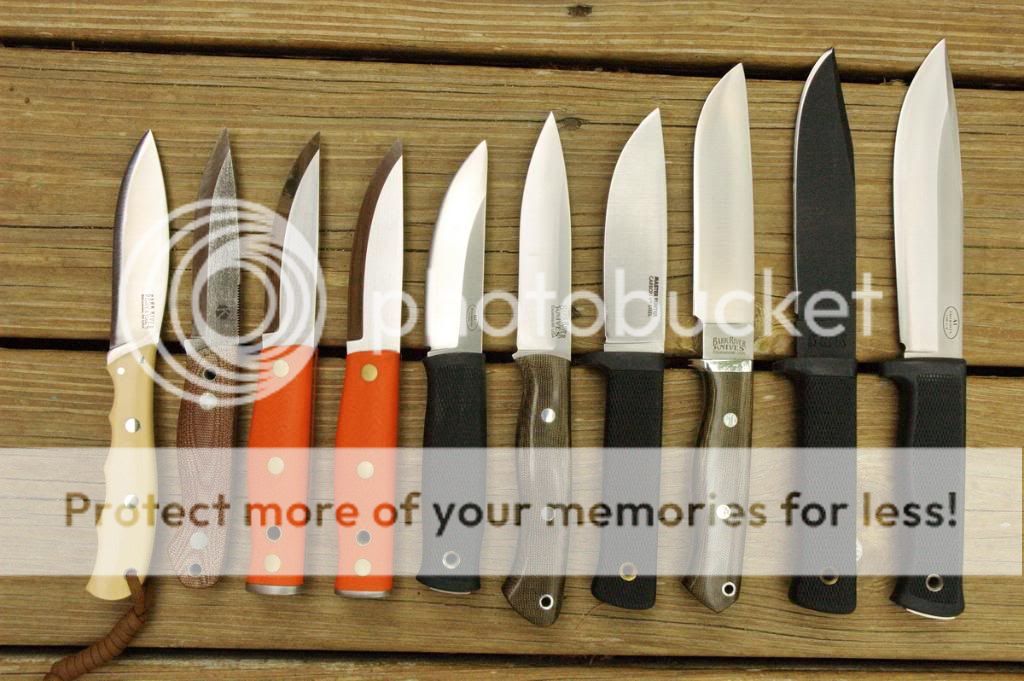
Scandi , I guess I just don't get it .

Scandi grind seems to be what knife nuts would more accurately call a Mora grind. The advantage is that they are cheap to manufacture. With the typical stock Mora knives are made from, drag isn't usually a very big deal. If the blade thickness starts at less than .125" or so, the scandi grind works fine, and as implemented on Mora knives, with a zero edge using good steel, it makes for a very good knife.

There are some advantages when using such thin blade stock. The scandi allows a high performing blade while maintaining maximum lateral stiffness, unlike a full grind would. This advantage disappears as the blade stock heads north of about 1/8" or so, when drag from plain blade thickness becomes an issue.

Sharpening can be made simpler for a lot of folks when using a flat stone. The bevel makes its own guide-just lay it flat and grind away. Paradoxically, this can also be viewed as a disadvantage, since the edge bevel, being relatively wide, requires removal of a lot more steel.

So what makes the scandi grind so nice is the same thing that makes Mora knives so nice: economical, basic, efficient use of good steel.
 
Cutting in the real world is more dynamic than I believe science can explain (without writing a text of biblical proportion).

I guess one of the primary reasons I like the grind is the control you have when shearing off large pieces of wood. Say you wanted to thin down a stick. The control the grind gives you allows you to cut the entire length of the stick while maintaining a straight unwavering cut. Other grinds with secondary bevels take more effort to keep straight all the way through the cut -because it takes more effort to keep straight, a tired hand may waver in or out of the intended cutting line you are creating -bitting deeper than you can cut, or pushing away from the cut and cutting shorter than intended.

It was also mentioned that the blades are stiff all the way to the tip, unlike blades that have an overall thinner profile which may bend/ flex in a cut. For certain applications I don't want a knife to flex a lot.
 
Ken. I see them as well and they are on usually thinner blade stock....anywhere from 1/16" to 1/8' usually. It works for that thickness. It is easy to make as well yet still have strength in the blade edge. I have made them in thicker material but also the grind is further up the blade edge and is always flat ground. Japanese kiridashi blades are made this way so that a straight edge can be used on the flat side for cutting parquet pieces. I see it as more of a preference than a necessity and I like to use the term 'Chisel Grind" as this is more accurate. You may notice that the Scandinavian blades are usually not thick as well.

You should make a blade and try one for EDC and see how you like them. I have one with a full height flat grind and it actually cuts EDC stuff quite well (0.187 thick stock with 1.250 blade height) I cannot tell the difference between it and a normal flat ground blade of similar dimensions. When it is great is when I am making sheaths from kydex. The flat side trims well and the ground side is great for the flash that occurs during drilling and such.
 
As a side note Ken, I live on Maui currently, and I find Mora knives a lot less fruitful than when I lived in Oregon.

The plants that grow here are not nearly the same, and what my Mora excelled at in Oregon is not as applicable in Hawaii.

Different regions call for different blades, and I have never found anything that works great in every environment. Hence the large variety of knife designs in the world.
 
Ken,

A scandi grind knife is a wood carving tool, nothing else.

That's basically the way I look at it. While you can use a scandi for other tasks, it really only excels when used for shaping wood. It's basically a chisel in knife form, so to speak. The lack of a secondary bevel means you can make very VERY shallow cuts.
 
dude just go buy a couple of cheap moras and use them you will figure it out. not only that but they will piss you off as well because they will outperform most of your knives you have.
 
I just picked up an Enzo Birk in D2 with a carbon fiber handle. The scandi blade seems pretty stiff for a small knife. I haven't done much with it yet, so I can't comment on cutting ease. The knife came with a microbevel, and it was easy to perfect the edge with a strop.
I can easily see a slightly large blade being useful for a walk in the woods - for fending off the stray cougar.
The Enzo folder has a 3mm thick blade that is 75mm long.
 
Principally, they are excellent for working wood. Chisels, right and very accurate for finer work. If that isn't part of your outdoor routine, its likely you won't get them I think :)

The context, or perhaps mythology, is that larger scale meat prep (reindeer) was done with a leuku - a 3mm broadbladed knife 6"- 9" long, and paired with the puukko for finer work
 
None of the three Moras I bought several years ago have a secondary microbevel.

I think they started with that on the stainless steel versions , to prevent chipping.


I did an informal "test" , one cut , at the same place on the wood, hard dry pine , light pressure , both knives hair popping sharp.

Spyderco Endura zdp-189 3mm thick, Scandi sandwiched carbon 5mm thick.

P1050513.jpg


1234,,,,:)
 
your right ken they seam like they are mostly for short cuts but they are good at them. also in my experience with batoning end grain with a scandi (helle harding for me) the wood splits and rests on the bevel not the edge which should help. bear in mind it is better on THIN BLADES!! it is a similar angle to a flat grind but a full flat grind on a thin knife would take off to much steel. plus knife doesn't drag to bad cause the steel is so thin.
 
I don't get scandi either. It never made sense to me for the same reasons cited here. I can tell you though that it works. On a recent vacation, three of us practiced some wood processing. We had a Condor Bushlore, a Fallkniven F1 and Mora Craftline. Before too long everyone was reaching for the Mora. It was just plain better. After getting a good workout on the wood, the Mora came into service again inside the cabin when none of the drawer knives would slice a hard salami stick well. Without any touching up, the same Mora sliced the salami like butter. Clean, thin slices with no tearing. I've used this knife for every form of cutting you can think of, leather, plastic, wood, frozen beef, cardboard. It cuts everything well. You can give the steel some credit, I'm sure it plays a major role. But the grind is certainly not holding it back.
 
I don't get scandi either. It never made sense to me for the same reasons cited here. I can tell you though that it works. On a recent vacation, three of us practiced some wood processing. We had a Condor Bushlore, a Fallkniven F1 and Mora Craftline. Before too long everyone was reaching for the Mora. It was just plain better. After getting a good workout on the wood, the Mora came into service again inside the cabin when none of the drawer knives would slice a hard salami stick well. Without any touching up, the same Mora sliced the salami like butter. Clean, thin slices with no tearing. I've used this knife for every form of cutting you can think of, leather, plastic, wood, frozen beef, cardboard. It cuts everything well. You can give the steel some credit, I'm sure it plays a major role. But the grind is certainly not holding it back.


I think the high performance of Moras has more to do with thin stock and narrow edge angle more so than the grind used. I'm pretty sure that if you took a full flat grind of equal profile, spine thickness, and edge angle then it would be a much better slicer. It would also be less durable, however, due to the reduced amount of supporting blade material.
 
Ken, I am certainly no expert but all I can say is that of all the knives I have tried:

http://www.bladeforums.com/forums/showthread.php/838420-Bussekin-amp-Friends-Epic-Fail

The one that cuts the best, by far, is the Skookum Bush Tool. I think the Liten Bror, a scandi-vex is probably the second best cutter that I have.

From a layman's perspective, I can understand that the edge thickness progression on a scandi will be much higher than on a ffg blade of equal thickness and height/width, plus the drag on the bevel, but on the other hand, it will have much less surface area friction than a ffg, but I don't know how much effect that really has. And of course with a ffg of equal stock thickness, the edge will be much thinner and less stable. So to offset that you could use flat grind with convex edge as was mentioned, but then the edge thickness progression is again higher than a true ffg. So I think it it is a balancing act either way and so far for me the Skookum has the best of that balancing act. I think the continuous curve on the Skookum may have something to do with it also because I find the Fallkniven H1, with a similar curve to also be a good cutter despite being fairly thick (see last pic).

But I am always hoping to find one that does it better.

DSC_2886_resize.jpg


DSC_2397_resize.jpg


DSC_8571_resize.jpg
 
Last edited:
Ken,

the only reason there is any hype at all is because of forums like this one. I'm from Scandinavia and I have lived here pretty much all of my life. During this time, I've spent a lot of time in the bush and at sea. Wherever I've been hunting, fishing, hiking, gardening or working construction, there has been a "Scandi", i.e. a Mora, Fiskars or even a custom. Nobody here "hypes" them like international knifenuts do. Who hypes a spoon or a fork?! They're just there and they work -- extremely well. These knives have been around for centuries and perhaps even longer..? Scandinavia is where the vikings came from and they discovered iron in the moss, just like the japanese discovered it in the sand.

However, I doubt that people would continue to use a flawed design through the ages of time. industrialization made the process cheap, so making a convex or scandi back in the day should have had nothing to do with how cheap or easy it is to make today. Somehow, the scandi has stayed with us.

People use them for hunting, fishing, bushcraft and in modern times, cheap plastic-handled "scandis" like Moras have become the standard equipment of any construction worker, carpenter, electrician or whatever... in Scandinavia. They don't make any fuzz about them, they just use them and throw them away.

The Sami people use their own hand-made ones when herding and butchering their reindeer and they make extremely beautiful knives and sheaths, all by hand. They use a larger chopper, axe or saw to get through the pelvis and the chopper can be used for clearing brush in the bush and so on.

5149272936d7735ef62fz.jpg


Judging by the effort put into the designs below, I doubt that the grind is there because of hype or cheapness of production.

huggaresuneenoksson1991.jpg


44210041.jpg


63afv.jpg


42an.jpg


With all due respect, I understand that you are a reputable knifemaker, but try out a cheap Mora before you judge the entire heritage of this type of knife, based on the knife that you intend to make.
 
With all due respect, I understand that you are a reputable knifemaker, but try out a cheap Mora before you judge the entire heritage of this type of knife, based on the knife that you intend to make.
Why? The only thing really being discussed is changing grind angle. Making a 12 degree grind instead of a 3 degree grind takes no appreciable change in effort and no great level of skill - at least nothing beyond even the apprentice maker, which Ken Onion certainly is not.

25161.jpg


I don't think his skill on the grinder or attention to detail are hurdles to be overcome.
 
I don't think his skill on the grinder or attention to detail are hurdles to be overcome.

My concern with reading this thread and Ken making his own is that he is already biased against the design, therefore if he tries it out without a frame of reference then his biases may be put into the blade first, without judging the design as it is commonly utilized- as he would find in a Mora.

I would suggest to Ken, utilize the Mora, find where you feel there are deficiencies, then change them to suit your tastes while keeping it a scandi. This way your admitted bias will be used constructively in order to bring out the positives in the design. As of now it seems like your testing will be searching out negatives, and that almost never leads to positive discoveries.

I am a fan of properly made knives- period. When I made a hewing axe handle out of Osage I utilized blades of many configurations. A dozier hollow, Koyote convex saber (I don't like the scandivex term- to me they are convex saber grinds), a spyderco bushcrafter and STR BUSSTR in scandi, and my own knife with a flat/saber grind. All worked because I chose them for more factors than just the edge. The BUSSTR is one of my favorite knives I own, and often perform kitchen duties with it. Trying to cut an onion with a 1/4" scandi is self defeating to me- akin to trimming loose skin on your fingers with a machete- both can be done but why?!? My 1/16" or less scandi blasts through most media extremely well, and I only needed a small secondary bevel added to prevent rolling of the edge when used as a scraper in the Osage- again slightly modifying the tool to best advantage- not picking a tool with obvious flaws for the task.

I would also suggest making the knife you choose in a range of thicknesses- 1/16", 3/32", 1/8" at least, then maybe a 1/4" to see how you can make it work/tweak the design for your uses. A single experience with a single knife will not cut it in this situation.

I have little use for knives above 1/8" (3/32" really), so for me there is nothing wrong with the scandi grind, just as there is nothing wrong with any other grind as long as done properly and applied to an applicable task. I try not to hype knives, just use them.
I'll try and add pics later.
 
You commented:
Why? The only thing really being discussed is changing grind angle. Making a 12 degree grind instead of a 3 degree grind takes no appreciable change in effort and no great level of skill - at least nothing beyond even the apprentice maker, which Ken Onion certainly is not.

I don't think his skill on the grinder or attention to detail are hurdles to be overcome.

...huh? :confused:
 
Back
Top