Scandi, just how good are they?

Joined
Oct 30, 2002
Messages
3,011
I have been umming and arrrr-ing for a while now looking for the 'one knife' (yah! Right!)

I currently use a full convex but I am very very tempted to have a custom made with a Scandi grind. My only concern is that the Fallkniven cuts so damned well I am worried that I would be dissapointed with a Scandi. Who has both and used them well and is honest enough to say which cuts better?

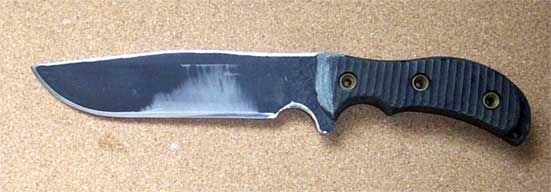
I am leaning towards a high grind, a little like mears Woodlore and starting with a 4mm 3V about 4" Blade full, tang obviously.

I am very happy with the set up I have now but I just got to know, could this be the 'one' :rolleyes:
 
"Scandi" is the term used by UK bushcrafters for a flat grind that has no secondary bevel. They like it for wood-working. Several Scandinavian custom makers have praised that grind for soft-wood carving.

Lately, UK bushcrafters prefer spear-point, full tang knives of O-1 steel and a "Scandi grind" -- plus a generous neutral handle allowing a variety of grips Call it a "Mears Style."

Such knives, as a percentage of knives made in Scandinavia, are not the norm. They are cetrtainly not a traditional Scandinavian pattern. Most such run to straight backed knives with full-length, but not "full," or blind tangs, with secondary bevels. However, I have one with a blade by Trond Petersen that fits the "Mears" style -- except for the absence of the "Scandi Grind."

No reason why the knife that you comtemplate should not work as well for most things as a typical Scandinavian knife "if the maker's hand be true." However, the edge will not stand up to what an F-1 will take.
 
Thanks TL,

I am familiar with the lay term and the real meaning, us Brits like to confuse the matter :)

I didnt think it would be as robust as a Fallkniven, but unless you are a beast with your blades, how is the cutting performance for normal bushcrafting tasks.

Is there an optimal angle per stock thickness vs grind height?
 
Temper,

I have only owned one knife with a "Scandi Grind." Lots of Scandinavian knives. One "Scandi Grind" knife. It's a MORA. Cuts like the dickens. As soon as it needs more than stropping on cardboard, it gets convexed.

Optimal edge ange depends on what you're doin' with the knife. As in shaving your face vs roughing out hardwood.

In any case, a thicker knife may go faster in some applications because you can pry more than with a thinner knife.

If you find yourself doing what the folks at BB are doing with their Mears knives, one of those should work for you.
 
Temper said:
... which cuts better?

The scandinavian single bevel has one bevel angle, typically 9-11 degrees per side for the smaller knives. While this is fairly acute for an edge bevel it is really obtuse for a primary grind. Any similar knife with a primary grind will cut better and sharpen much faster assuming the edge is adjusted to the same angle.

Imagine taking a regular scandinavian knife and applying a flat grind and reducing the edge to about 0.025" thick assuming you wanted heavy knot cutting, otherwise 0.005" just for carving. That would obviously make it cut much better and sharpen far easier than an edge which is 1/8" thick or even 3/16" thick on the heavier leukos.

Here is a shot of a Ratweiler with an edge bevel at the same angle as the typical small scandinavian blades :

ratweiler_mod.jpg


The edge isn't as wide because of the effect of the primary grind. This knife will actually outcut the Mora 2000 for general wood working, the edges are at the same angle and the Ratweiler is half as thick. The Ratweiler also isn't close to the limit of the geometry for such work because I still want to use it for chopping so I can't reduce it to pure light carving knife in edge profile.

-Cliff
 
Ack! Thanks guys, I really need to get one I suppose. Cliff, you have used 3V knives, what would you suggest for an angle for cutting mostly softwoods with the occasional splitting of hardwoods (Beech)? IIRC 3V has the best performance for a utility blade @ 59Rc, have you seen, heard or experienced anything to cast doubt on this?

TiA
 
If you are cutting then there is little minimum unless the steel grain is really coarse like D2 at which point it can break out at less than 10 degrees per side and generally benefits from a more obtuse micro-bevel to keep the carbides stable.

When splitting do you want the ability to chisel cut thick knots? This needs an edge about 0.030" at about 15 degrees per side to prevent visisble damage on a decent steel and a micro at 20 helps to prevent sub-visible edge roll.

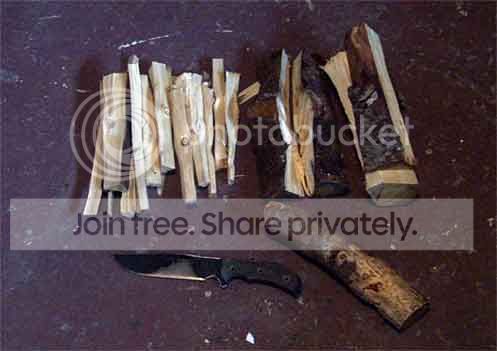
However if you elimate that rather extreme criteria you can go fairly low, the above Ratweiler did the following with no problems :

ratweiler_splitting_mod.jpg


Note the knots in the fine splits were chisel cut and the large knot in the round was split. I would not want to chisel cut the large one with the current profile but may test it out at a later date. The Extreme Judgement I had in 3V was not impressive steel wise, the edge both deformed and chipped readily. I don't think that's the true performance of the steel though and I would like to see more data on it from Crucible.

-Cliff
 
I have a Mears' Woodlore and a Falk. F1. I find the F1 is a great all-rounder and does better at slicing through thicker material and for food prep etc.
The Woodlore seems to specialize more and excels at general woodworking, particularly shaving up feather sticks. It easily out strips any other knife I've used for this function. The wide bevel seems to guide the cut and curl the shavings beautifully.
As for splitting, the Woodlore just about edges it over the F1, though there never seems much in it.
I should add that these obsevations are purely opinion based through general use rather than scientifically tested.
The Woodlore is 01 Tool Steel, 5/32 stock and the single bevel is 16 degrees per side (according to EdgePro). This is higher than a lot of 'Scandis' but it does work well and holds a very good edge.
Basically, if I'm just off to do some high level fell walking I take my F1 as it's lighter and more compact.
If I plan to go to the woods and make bow drill sets, I take the Woodlore.
Sorry if I've rambled on a bit....hope some of this helps:)
 
Thomas Linton said:
Abe,

Thanks for your observations. Few of us here have the Mear's knife.
In that case, perhaps a picture or two might be helpful:) :

Woodlore vs Falk f1GM (BB passaround)

An illustration of just how much more sculpting the Woodlore handle has. It is considerably more comfortable to use for prolonged or heavy cutting compared to the squarish slabs of the F1.
Having just watched a repeat of Ray Mears preparing an Arctic Char with his knife, I note that it is considerably more adaptable in his hands than mine:rolleyes:
 
The Extreme Judgement I had in 3V was not impressive steel wise, the edge both deformed and chipped readily. I don't think that's the true performance of the steel though and I would like to see more data on it from Crucible.

Didnt you try another in 3V (Schemp?) that was pretty tough?
 
I have one by Schott which was very tough, extremely resistant to impacts both in the spine and the edge, which had to be essentially ripped apart. The tip was weak though and bent easily for its thickness. I am looking forward to Spyderco's large 3V blade. It will be interesting to seeing how the design evolves and how it does in the competitions.

-Cliff
 
Temper said:
Thanks TL,

I am familiar with the lay term and the real meaning, us Brits like to confuse the matter :)

I didnt think it would be as robust as a Fallkniven, but unless you are a beast with your blades, how is the cutting performance for normal bushcrafting tasks.

Is there an optimal angle per stock thickness vs grind height?

The Brits are allowed to use knives now? What's the world coming to?

If I can figure out how to post a picture I'd send you one of my damascus Scandi custom. I used to be able to do this before the new computer came on line. Anyone know the secret as to how to reactivate it?
 
Spark has noted issues with attachments that are being worked on. Until then just upload them somewhere and link directly.

-Cliff
 
Digging in a piece of pine, stab and one hand push, the board was not viced so I was holding it with the other hand. It doesn't take much tip wise to chew up this wood. Darrel Ralph also report problems with 3V in regards to the edge deforming on harder work, he was talking about nails and such and comparing it to other steels. The odd thing is that Crucible promotes increased compressive strength for CPM steels. It would be easier to sort all of this out if everyone said exactly that they did and all blades were HRC tested.

-Cliff
 
Yeah I would like to see the Rc info too along with the spec and use.

In theory it sounds like the best possible steel for Bushcrafters, great edge retention and toughness. It stains easy but there always has to be give and take. I can live with having to keep it clean.

I'm still debating full convex or Scandi, my brain tells me Full Convex, my Viking heritage tells me Scandi :rolleyes:

I am looking for my ultimate Bushcraft knife, I have a bunch of stuff that performs admirably, but I want something that is a culmination of all the good points of the other knives.

I think I am leaning to FC at the moment, not by much, but considering sharpening and strength its hard to beat..
 
Temper said:
I am very happy with the set up I have now but I just got to know, could this be the 'one' :rolleyes:

I couldn't let this go. :p You already know the answer to that, don't you? :rolleyes:

:) Doc :)
 
Back
Top