School me on W's please.

Joined
Dec 1, 2008
Messages
160
Hi all,
I don't think I have asked a question in all the time I have been on here , so here we go. I have forged up a couple of billets of 15N20 and 1080, 7 pieces each, folded 3 times each. Forged corner to corner and made into a W pattern . The question is where to from here?
Option 1. keep doubling my W's to make them finer , say three or four times. Square them up, cut into tiles at 45 degrees and make the end of the bar into the face of the blade mosaic style. Or.
Option 2. double up the W's two or three times then twist, forge flat, forge blade, grind and heat treat.
I know some are forging a high stack of W's and hot cutting them into a feather type pattern but I'm doing this by hand, you know with a hand held hammer, so that isn't an option. That's why I'm asking , I have done too much hammer work so far to muck this up with experimenting.
So what do you think? What results might I get from option 1 and option 2. Are there some other pattern that can be made out of a simple W's billet that can be done by hand? Pictures ?
Cheers and thanks in advance. Adam.
 
Hi all,
I don't think I have asked a question in all the time I have been on here , so here we go. I have forged up a couple of billets of 15N20 and 1080, 7 pieces each, folded 3 times each. Forged corner to corner and made into a W pattern . The question is where to from here?
Option 1. keep doubling my W's to make them finer , say three or four times. Square them up, cut into tiles at 45 degrees and make the end of the bar into the face of the blade mosaic style. Or.
Option 2. double up the W's two or three times then twist, forge flat, forge blade, grind and heat treat.
I know some are forging a high stack of W's and hot cutting them into a feather type pattern but I'm doing this by hand, you know with a hand held hammer, so that isn't an option. That's why I'm asking , I have done too much hammer work so far to muck this up with experimenting.
So what do you think? What results might I get from option 1 and option 2. Are there some other pattern that can be made out of a simple W's billet that can be done by hand? Pictures ?
Cheers and thanks in advance. Adam.

I've only done a few Ws billets, but my experience directly addresses your question. I think you'll want more restacks than 3. 4 or 5 would be better because whether you tile and flip it or twist it, the pattern is going to stretch A LOT more than you think it will. I did both (flip and twist) with about 16 total Ws layers, and wish i had done at least one more restack. That said, if you flip it, a coarser pattern can look pretty cool. Twisting will stretch it more, and more layers would be better. Other than the fact that you're doing this by hand (your arms must either be really huge or really sore!), I can't think of any reason you'll regret going with more layers.

FWIW, twisted Ws is pretty hard to beat.
 
Well thanks for the reply Travis. I'm completely self taught ,so some would say I have an idiot as a teacher. lol ,Yes my arm was sore after the first two days but I'm not feeling any worse for wear today so I must be building up the guns. Really must build a press though, it's a stupid way to do it but I might end up with a nice little pocket knife blade at the end of it all.
Cheers Adam.
 
Well thanks for the reply Travis. I'm completely self taught ,so some would say I have an idiot as a teacher. lol ,Yes my arm was sore after the first two days but I'm not feeling any worse for wear today so I must be building up the guns. Really must build a press though, it's a stupid way to do it but I might end up with a nice little pocket knife blade at the end of it all.
Cheers Adam.
 
You don't need to forge it "corner to corner", which is what is generally referred to as the "bias". You simply draw it out once you've reached a high enough layer count, till it's about 3/4" thick, and turn it 90deg and forge it down (i.e. turn it so your layers are running vertical, and not horizontal). Once you do that, you'll want to work the "sides" as little as possible, you continue drawing, until you can restack.


The more pieces in the restack, the more activity you'll get when you draw it again, but typically, unless you're at a very high layer count, and you're incorporating other techniques to pre-distort the w's, you'll need to restack a minimum of two times. More is typically better. Each time you restack, and keep forging down the W's, you'll get more activity and sharper tips to the W's.


There are lots of little techniques you can use to control the way the W's bend, etc. etc. but the trick first is just getting a nice tight W. I recommend 50-100 layers. You can get some cool effects from lower layer counts also, but you've got to have some practice. YMMV of course.
 
I keep trying to edit my post to add that whether you're using a power hammer, press or hand hammer, the W's will move differently. A press will create a lot of activity very quickly in the center and move the W's more across the width of the bar, which can be sweeping and dramatic, (of course this varies by temp, and whether you take little bites with the press or "get after it hard") but counter productive to having defined tight small W's. A hammer will do the opposite, and create more activity where each piece of the restack lines up.
 
Unless you have a BIG rig, the majority of your steel when making these complex patterns is going to end up on the floor as scale, so prepare for that. Even with huge hammers and press, there will be some of that. The waste will be even more noticeable if you want to do the twisted patterns like firestorm and explosion, because you really have to grind deeply into the bar to get the pattern that you are looking for. One thing that some people have said is that of you are using squaring dies and you do the 45 degreebias press and then stomp that newly formed top corner at the regular 90 degree angle, you will get the patterning started more quickly. One of the more critical things that you need to do when making W pattern stuff is to use some kind of telltale so you remember which way to press.
 
When you make the first weld and then turn ninety degrees and flatten, that layer is seen as one layer. If its cut in five section and restacked and welded, thats five layers no matter how many were in the initial stack. I like ninety layers of W's to get the most activity without cluttering up the pattern.
 
That is an excellent point, Fred. When you do your first W press, you are essentially starting over on the "layer count" at one like you said. With that said, If you fold or stack once before you turn it 90 degrees, you can get a finer pattern earlier on in the "crushing" part of the process. Also, you wouldn't think that it would make much of a difference, but you can get some effect from tilting a W pattern even if you use the "end grain" pattern instead of cutting into it.
When you make the first weld and then turn ninety degrees and flatten, that layer is seen as one layer. If its cut in five section and restacked and welded, thats five layers no matter how many were in the initial stack. I like ninety layers of W's to get the most activity without cluttering up the pattern.
 
Unless you have a BIG rig, the majority of your steel when making these complex patterns is going to end up on the floor as scale, so prepare for that. Even with huge hammers and press, there will be some of that. The waste will be even more noticeable if you want to do the twisted patterns like firestorm and explosion, because you really have to grind deeply into the bar to get the pattern that you are looking for. One thing that some people have said is that of you are using squaring dies and you do the 45 degreebias press and then stomp that newly formed top corner at the regular 90 degree angle, you will get the patterning started more quickly. One of the more critical things that you need to do when making W pattern stuff is to use some kind of telltale so you remember which way to press.

I know exactly what your saying and that is why I turned it the 45 degrees to make the W's quicker , doing it by hand remember. Yes it is tricky to remember which flats your working on and you need to be careful. I have layered up these bars three times each already so the layers are pretty fine, I think I will continue to stack up the W's and use the end of the bar. Might do a twist after I make a press.
Thanks again guys. Adam.
 
Multibar explosion (twisted w's) is my favorite right now. Probably would be too wasteful in your situation though.

Laddered w's can look really cool, there were a lot of nice knives posted on the forums in 2014 featuring that pattern. One almost won the best bowie contest.
 
View attachment 525514
Salem, unfortunately this is a bad picture, but this blade was made from a fairly bold W pattern that was twisted. Instead of cutting into it for a bold firestorm look, I tiled and Ferry flipped it and what I got was what kind of looks like big waves rising up form the edge.
View attachment 525515
This one is the same bar without the twist, tiled and flipped.
W's are cool for sure. :D
 
I hadn't considered the laddering process Salem, interesting. How is that orientated? Do you stack up the W's a few times and then cut into the side of the bar and flatten, or tile the W's up thick then cut into them and flatten ? Making cuts might be wasteful but interesting and something to think about when I make a press.
Keep them coming.
 
I would most definitely recommend you do a tiled billet... huge props for doing mosaic by hand.

This is a Ws billet that I tiled.

medium800.jpg


This one was laddered Ws. It will have a lot of waste for you doing it all by hand.

medium800.jpg
 
I'm working on a laddered w's blade right now......by hand, and the pattern is quite a bit finer than I expected at only 16 layers of w's.....I grind the grooves and forge flat. I'll post pics of the pattern as soon as I can.

Here's my first try at twisted w's.

Darcy:)
 
Thanks Nick , I love the laddered W's on the second knife, and that wouldn't be the piece of Gidgee I sent over to replace the piece with the knot in it, would it?
Darcy , nice to see there is some one silly enough to have a go at this by hand too, I don't feel all alone quite as much, nice knife too.
 
Thanks Nick , I love the laddered W's on the second knife, and that wouldn't be the piece of Gidgee I sent over to replace the piece with the knot in it, would it?
Darcy , nice to see there is some one silly enough to have a go at this by hand too, I don't feel all alone quite as much, nice knife too.

That's a nice way to put it......most just call me "crazier than the @#$%house rat":D

Here's a flash etch of the laddered w's blade.....this is 16x16 w's.......initial stack was 16 layers and then turned on edge and folded 4 times....so 1layer of w's,2,4,8,16. Then forged a thickish preform, laddered by grinding grooves with an angle grinder and forged flat(at almost welding heat)
as you can see, it is a fairly fine pattern even with the low layer count.


Darcy:)
 
I try and be nice here Darcy cause every one is so helpful, face book is where I go to upset people , lol That one came up a treat , I hope mine is as successful .
Cheers Adam.
 
That is an excellent point, Fred. When you do your first W press, you are essentially starting over on the "layer count" at one like you said. With that said, If you fold or stack once before you turn it 90 degrees, you can get a finer pattern earlier on in the "crushing" part of the process. Also, you wouldn't think that it would make much of a difference, but you can get some effect from tilting a W pattern even if you use the "end grain" pattern instead of cutting into it.

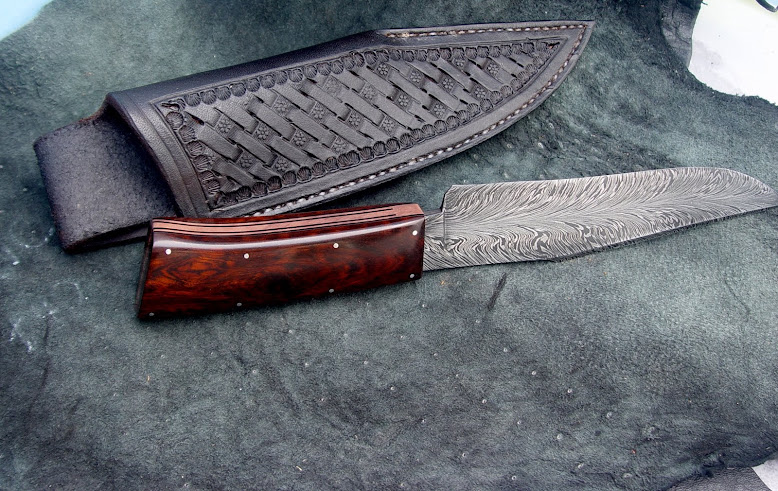
A lot of the fun from working with "W"s is their versatility. I've tried many of the different techniques including what you mention, all with good results. Most of all I like the feather pattern done with "W"s I wouldn't recommend it without a press unless you're feeling like Charles Atlas. :) I got a lot of static on this knife I built two years ago, but I must say after having it over time, it is one of my most prized possessions. We all have our little oddities.
d1eesCYxEtJ2w_SBiIywd1Lt6FRPfQbUIyvFbs2UP6E=w778-h491
 
I'm curious, what would it look like if you tiled the W's and then laddered the billet? :confused: Or rather, has anybody here done this or have a picture of this? It really does make your head boggle when trying to think in "4-D" with at these possible patterns!

~Paul

My YT Channel Lsubslimed
 
Back
Top