Mistwalker
Gold Member
- Joined
- Dec 22, 2007
- Messages
- 19,084
Saturday January 24th, 2009 was a good day for me, and by the time you finish reading this article you will know why. It was a day where I had one of those very pleasant shopping experiences that just make your week. I walked into a local sporting goods store to look at the currently available knives and there on the shelf was what I at first thought was a familiar knife that I never expected to see in a sporting goods store. At first glance I thought I was looking at a Chris Reeve knife handle which quickly caught my interest. Then I noticed how the butt cap was made and became even more intrigued. I asked to see the knife and was surprised to draw out the blade and find Schrade written on the blade in big bold letters. Feeling the heft, seeing the balance, and just how solid of the knife seemed…and for less than a hundred bucks…I was hooked. I just had to take it out and see how well it was made, and how well it would do. Could this knife, made in Taiwan, live up to the name of “Extreme Survival” or was it just a cheap knock-off that would break at the first good opportunity.
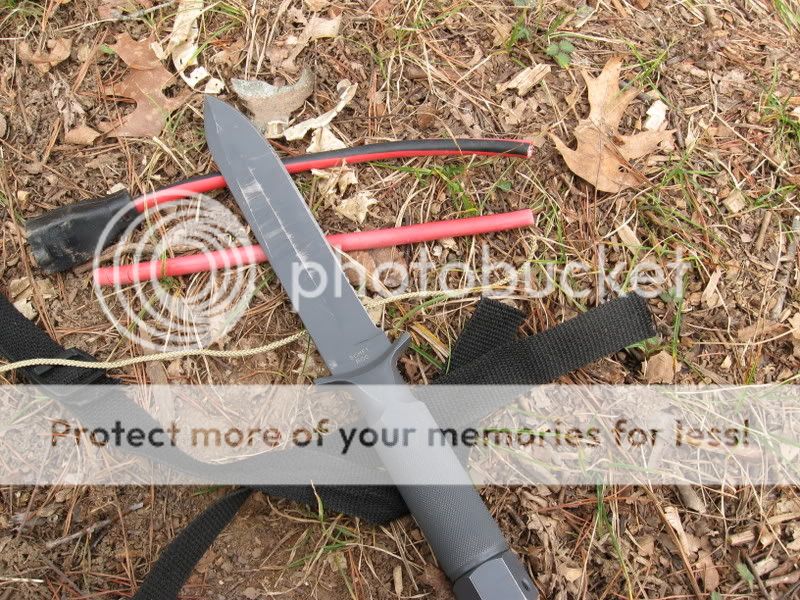
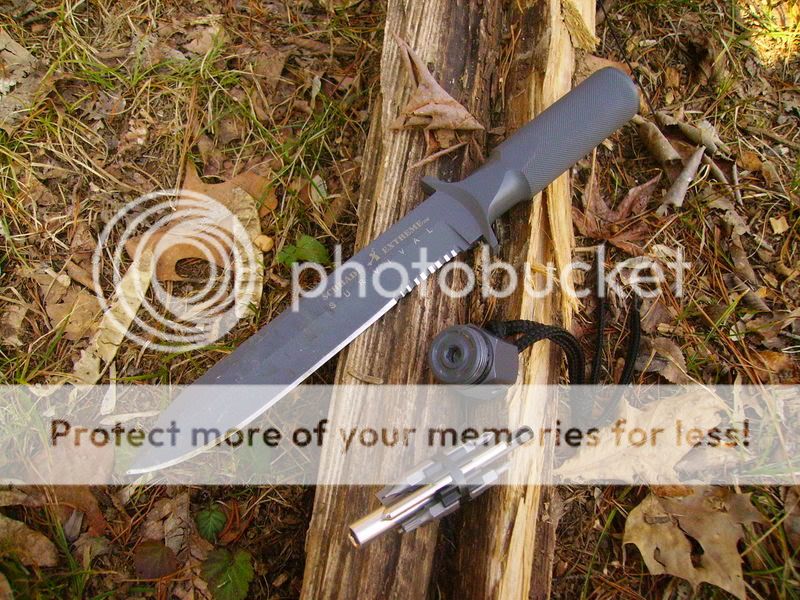
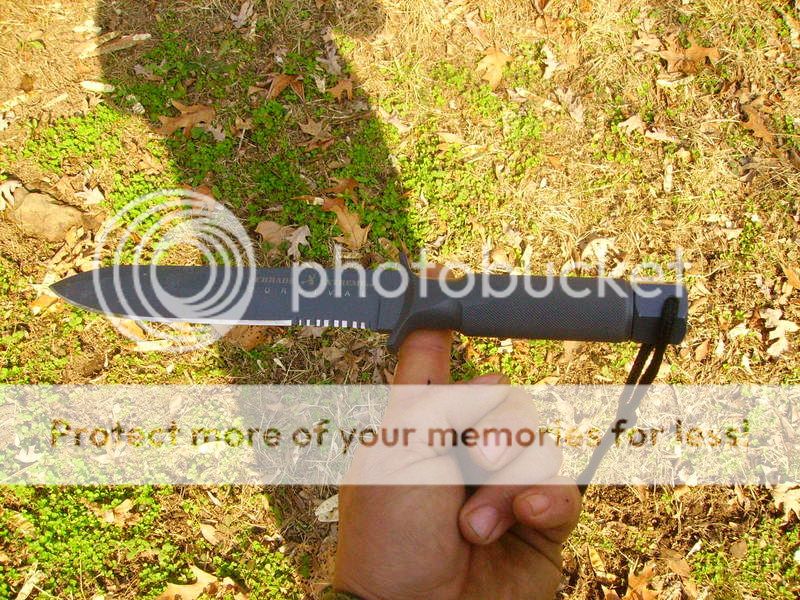
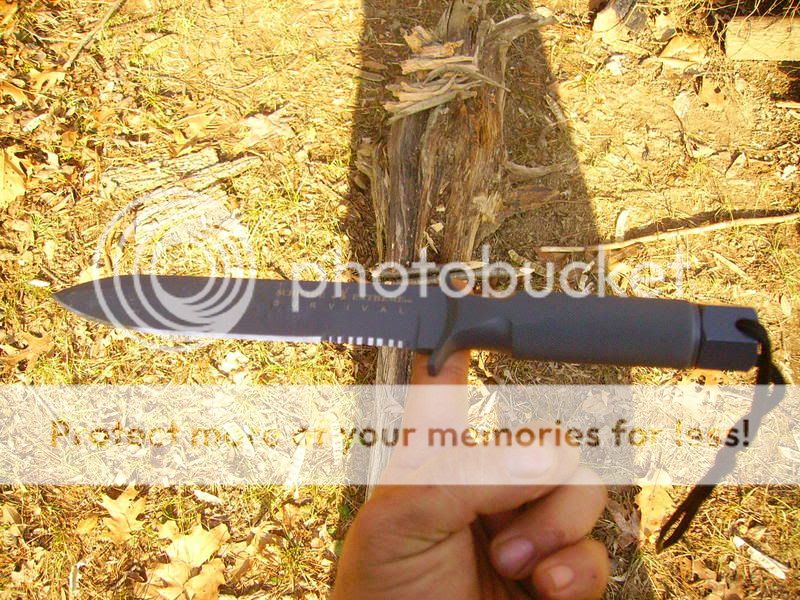
The Schrade Extreme Survival Knife model SCHF1 is a hollow handled knife machined out of one piece of 1095 high-carbon steel, and patterned similar to the Chris Reeve Project-I with some differences in the handle and the blade grind lines. Also the butt cap is made in a hexagon shape, rather than a round one, which I find much easier to grip when tightening and loosening. The knife is 12.7 inches over-all with a spear point blade that is 7.5 inches long, nearly ¼ (0.230) inch thick, 1.125 inches in width at the widest point just back from the tip, has a 1.5 inch section of serrations at the ricasso, and came out of the box shaving sharp. It comes with a tool kit in the handle which consists of a magnetic extension like those used in drills and drivers, which mated with the cap becomes a driver handle, and it has bit caddy attached. This driver and bits come in handy for a bow hunter, or working on an ATV, or the tips could be customized and replaced with the ones that are needed for a given set of circumstances. In the caddy as it comes there are 10 bits; 3 phillips bits # 0, #1, and #2, 3 slotted bits; 3/32, 3/16, and ¼, 3 Torxs bits; T-10, T-20, and T-30, and one hex bit; 5/64. The caddy also holds a small steel rod that can be placed through the thong hole in the butt cap in order to gain more leverage for tightening or loosening screws or bolts. There is a hex head set screw in the cap for securing this rod the 5/64 hex bit in the caddy is for tightening and loosening this set screw. It comes with an ABS plastic lined nylon sheath which is MOLLE compatible with several tie down points that allow for multiple carry options, has a roomy stone and accessory pouch on the front which a hook and loop closure on the cover flap, and has a hook and loop quick release for easy, but not too easy, removal from a belt. It is comfortable to wear, and has a button snap fastening retainer down by the hilt which is my preferred location, but it could stand to be a little tighter
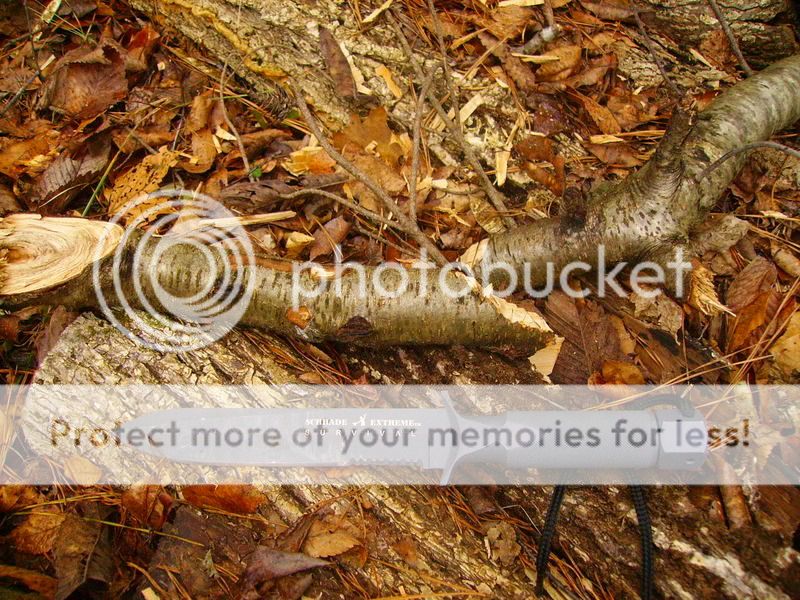
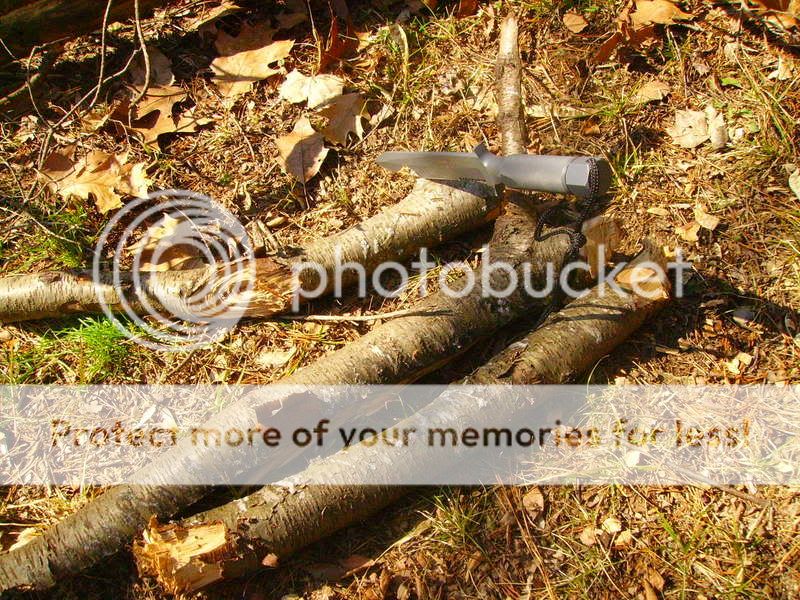
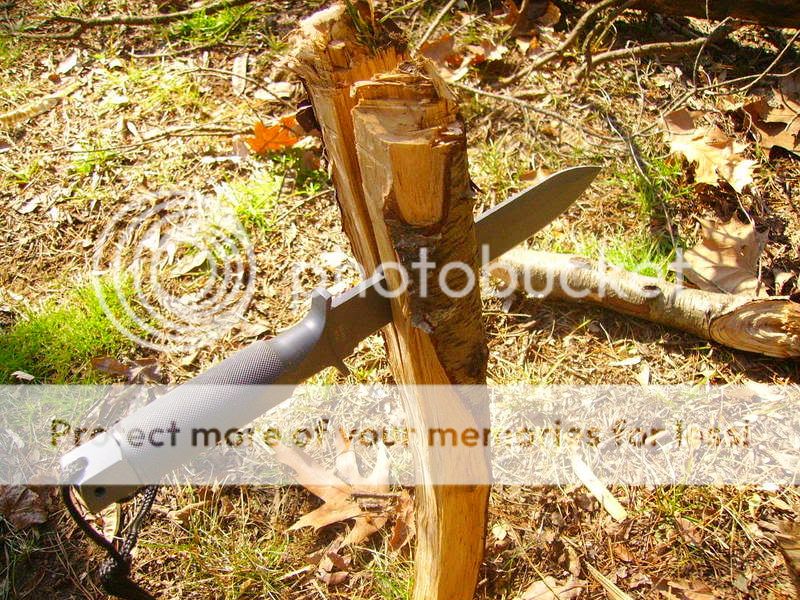
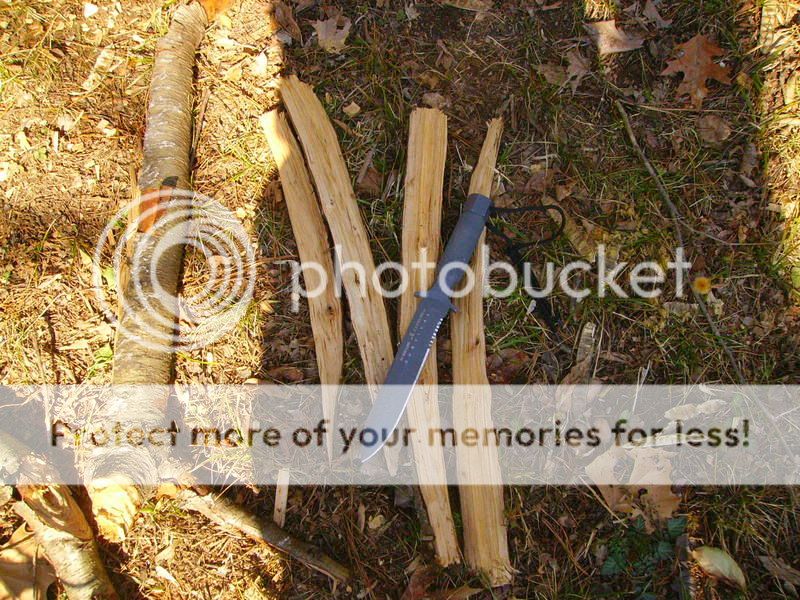
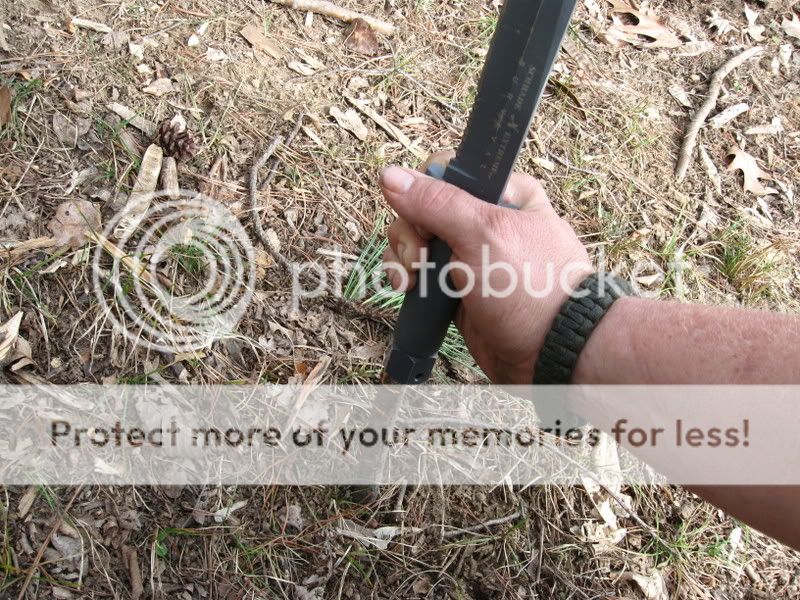
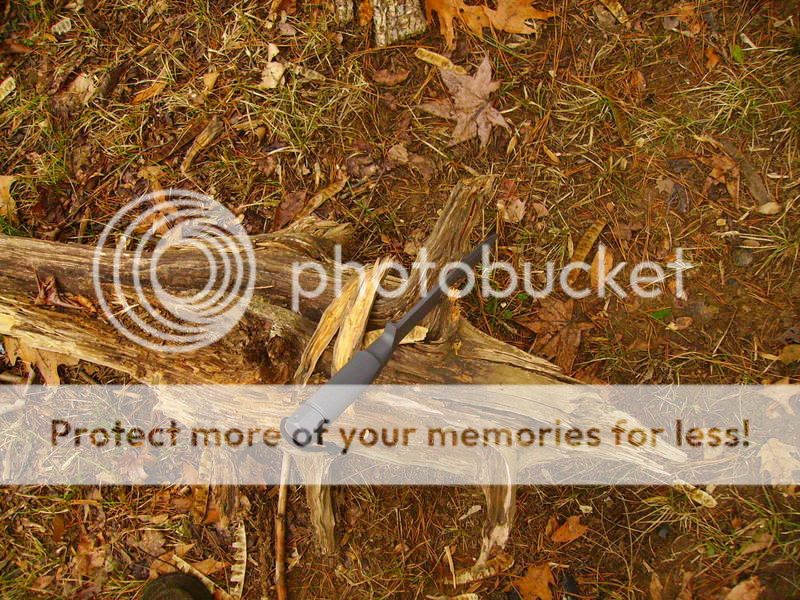
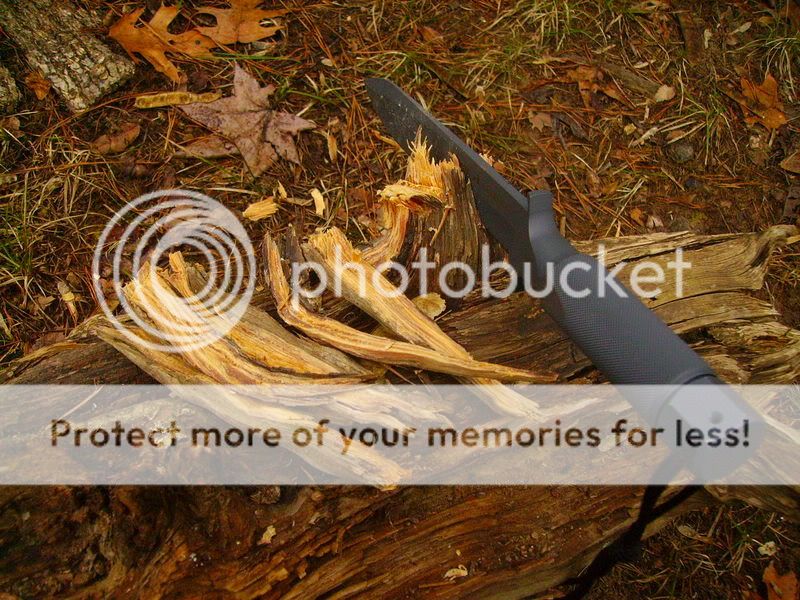
The first thing I did when I got home was walk out into the woods behind my house to an area where a storm, at the end of this past summer, had broken the tops out of some hardwood trees. Picking out a couple limbs about .75 inches in diameter I cut them and sharpened them for stakes and drove them with the butt of the knife. I really liked the way the knife handled. Next, selecting a limb of about 3 inches in diameter, I started chopping. I chopped the limb in two, then in two again, and again, and again. Then I took one of these sections and batoned the largest piece into a few sections. The wood was well seasoned and took a couple of really good licks to get the splits started well, and afterward the knife still shaved. After this, I took the knife over to the fire pit area and started busting up a root section of a good hard fatwood stump with it. Several times, I chopped the knife deep into the root (in-line with the grain) and pushed the knife sideways to pry off good sized pieces. Then I proceeded to repeatedly hack into the fatwood root from the side making some good chips for fire starting. Taking a good look at the knife, I was pleased to find that not only was it still holding it’s shape perfectly fine with little wear on the coating but it would also still shave very well.
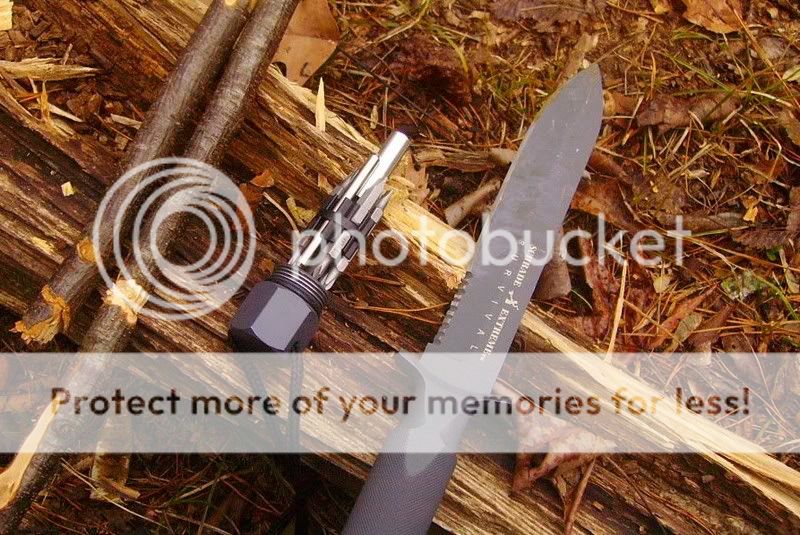

The Schrade Extreme Survival Knife model SCHF1 is a hollow handled knife machined out of one piece of 1095 high-carbon steel, and patterned similar to the Chris Reeve Project-I with some differences in the handle and the blade grind lines. Also the butt cap is made in a hexagon shape, rather than a round one, which I find much easier to grip when tightening and loosening. The knife is 12.7 inches over-all with a spear point blade that is 7.5 inches long, nearly ¼ (0.230) inch thick, 1.125 inches in width at the widest point just back from the tip, has a 1.5 inch section of serrations at the ricasso, and came out of the box shaving sharp. It comes with a tool kit in the handle which consists of a magnetic extension like those used in drills and drivers, which mated with the cap becomes a driver handle, and it has bit caddy attached. This driver and bits come in handy for a bow hunter, or working on an ATV, or the tips could be customized and replaced with the ones that are needed for a given set of circumstances. In the caddy as it comes there are 10 bits; 3 phillips bits # 0, #1, and #2, 3 slotted bits; 3/32, 3/16, and ¼, 3 Torxs bits; T-10, T-20, and T-30, and one hex bit; 5/64. The caddy also holds a small steel rod that can be placed through the thong hole in the butt cap in order to gain more leverage for tightening or loosening screws or bolts. There is a hex head set screw in the cap for securing this rod the 5/64 hex bit in the caddy is for tightening and loosening this set screw. It comes with an ABS plastic lined nylon sheath which is MOLLE compatible with several tie down points that allow for multiple carry options, has a roomy stone and accessory pouch on the front which a hook and loop closure on the cover flap, and has a hook and loop quick release for easy, but not too easy, removal from a belt. It is comfortable to wear, and has a button snap fastening retainer down by the hilt which is my preferred location, but it could stand to be a little tighter
The first thing I did when I got home was walk out into the woods behind my house to an area where a storm, at the end of this past summer, had broken the tops out of some hardwood trees. Picking out a couple limbs about .75 inches in diameter I cut them and sharpened them for stakes and drove them with the butt of the knife. I really liked the way the knife handled. Next, selecting a limb of about 3 inches in diameter, I started chopping. I chopped the limb in two, then in two again, and again, and again. Then I took one of these sections and batoned the largest piece into a few sections. The wood was well seasoned and took a couple of really good licks to get the splits started well, and afterward the knife still shaved. After this, I took the knife over to the fire pit area and started busting up a root section of a good hard fatwood stump with it. Several times, I chopped the knife deep into the root (in-line with the grain) and pushed the knife sideways to pry off good sized pieces. Then I proceeded to repeatedly hack into the fatwood root from the side making some good chips for fire starting. Taking a good look at the knife, I was pleased to find that not only was it still holding it’s shape perfectly fine with little wear on the coating but it would also still shave very well.
Last edited: