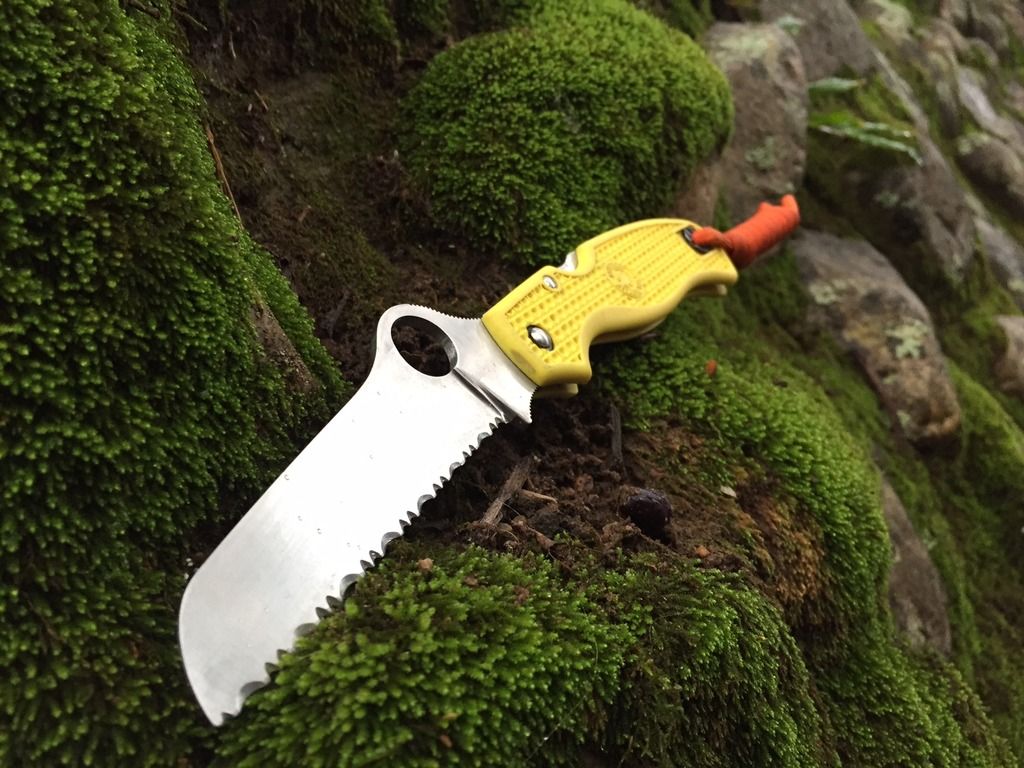
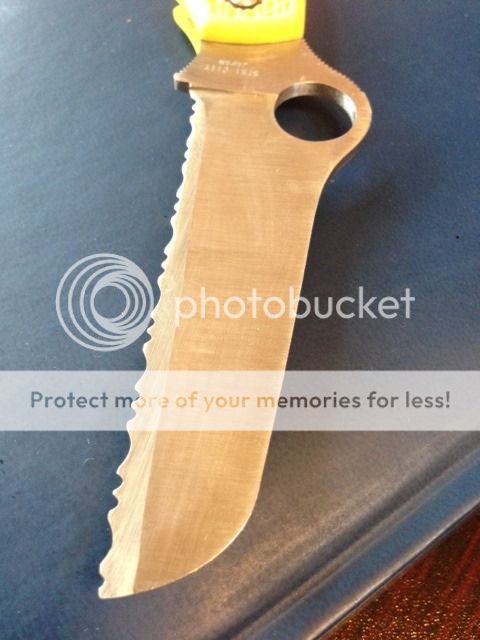
Serrated H1 Brittle?

Joined
Feb 21, 2015
Messages
23
Hey there,

After reading up on H1, I understand it can be a very tough steel. When serrated, I understand that it also becomes much harder due to the work-hardening. I've read numbers ranging from 65-68 for hardness, crazy!

Does the edge of a serrated H1 blade become brittle at such a high hardness? In comparison to say, your typical VG-10, 154CM serrated steels?

After looking into this myself, the answers I expect are that H1 is a very tough steel. If anyone has any more empirical information regarding this, I'd love to hear it or know where I can search it up. More importantly, I'd really like to hear from users of serrated H1 and if they've had any chipping or other such issues (what are you cutting? how's it holding up?).

Many thanks!

BONUS QUESTION! How is sharpening serrated H1? At such a high hardness, is it difficult to do in your experience? In comparison to what?

Shreddybear
 
No. Serrated h1 rolls. I don't really get the hype about the whole work hardened thing. Performs pretty poorly compared to other modern steels. I'd only recommend it for highly corrosive environments where edge holding takes the back seat.
 
From my research H1 has worse edge retention than 8Cr13MoV or AUS8. They only reason i would ever buy a H1 steel blade if i was living on the coast line and/or was in regular contact with the sea. Diving/surfing etc. Otherwise i dont see the point.
 
I've gone through a few different H1 Spydercos over the years. First was the original Salt (Endura sized), serrated. Edge retention was alright, even after use on cardboard. Never had issues with rolling, sharpened very easily. I think the next one was the Atlantic Salt, also serrated. Again, no issues with chipping, but the tip-most serration is fairly worn from use and sharpening. Next was a Tasman Salt, serrated. Didn't much care for it honestly. Since a hawkbill is meant for draw cuts, it made it so the serrations would bind rather than cut through materials, particularly cardboard. Now I alternate between a plain edge Tasman and my old Atlantic. I have to admit that the edge retention on the plain edge Tasman is pretty awful, and it's really hard to resharpen. However this could be because it's so worn and used that it's very visibly different than a new one (I bought a new one after I "lost" my old one, which I naturally found right after the new one arrived).

I like the Salts for a couple reasons. Main reason is my main use, which is to open bags of greasy, acidic, and otherwise gunky foods at work. Second is that I ride a bike in Tucson, AZ. Half the year it's either hot and dry and I'm sweating, or it's monsoon season and it's hot and humid and I'm sweating.
 
As an aside, if H1 doesn't offer the edge retention in an edc role that you would prefer, check out LC 200 N.
It is right along side H1 in terms of stainlessness, but higher hardness than the straight edge H1 and lower hardness than the serrated H1 with edge retention landing in between as well.
 
Does the edge of a serrated H1 blade become brittle at such a high hardness? In comparison to say, your typical VG-10, 154CM serrated steels?

In my experience, no it is not brittle. Not close to any other steel.

More importantly, I'd really like to hear from users of serrated H1 and if they've had any chipping or other such issues (what are you cutting? how's it holding up?).

I work in the mining, oil and gas industry. Cut pipe, cardboard, tape, whatever needs to be cut, even fauna and flora with not one chip on H-1.


BONUS QUESTION! How is sharpening serrated H1? At such a high hardness, is it difficult to do in your experience? In comparison to what?

Shreddybear

Sharpen mine on a flat stone and Sharpmaker to whittling hair sharpness. Not harder as any other steel. Takes an edge with minimal effort.

From my research H1 has worse edge retention than 8Cr13MoV or AUS8.

Even serrated edge?

Here is a picture of my most used H-1 Blade new vs now.

DSCN1226800x600.jpg


IMG_0805_zpst8k71rbd.jpg


Here you can see my sharpening marks on the back of the blade. I just hit the serrations afterwards with the sharpmaker corners.

IMG_8194_zpsrjp5e6ih.jpg
 
The only empirical data to be had is in the hands of Spyderco and/or the manufacturer in Seki and neither is likely to give that up. As you can see a few people have not enjoyed their experiences with SE H1 but the majority of us love our H1 SE. I use mine for EDC. Cutting mostly cardboard, plastic packaging, food, and green vegetation. As with any SE the peaks on the serrations will show wear, these are also the least work hardened. I don't let mine get very dull. I touch it up with a Ceramic Rod like I would any other knife and it stays sharp for a long time.

The Salt series fills a roll that me as a knife nut could not live without. Light weight utility that lasts for quite some time. Throw in the rust proof and you have a knife that can go anywhere. I am excited to try a knife in LC200N for a PE option.

From my research H1 has worse edge retention than 8Cr13MoV or AUS8. They only reason i would ever buy a H1 steel blade if i was living on the coast line and/or was in regular contact with the sea. Diving/surfing etc. Otherwise i dont see the point.

Sure, that might be the case for PE H1 but we are talking about SE H1. ^this isn't relevant.
 
Hi. I own a Pacific Salt PE since some years now. It’s my go-to knife for every seaside holiday :thumbup:. I’m far from being an expert and don’t own any H1 steel serrated blade but my empirical experience with H1 is that, besides being amazing in term of corrosion resistance and basically care-free, for all the other characteristics, it reminds me close of... a proper 440C steel :).

Its edge retention is fair for me, but far from remarkable :p. My PS needs to be sharpened regularly, especially after working hard in the garden with weeds, small bushes, etc., generally after any decent wood-working session. Does well on cardboards, holding its edge a bit longer than with wood. On the other hand it’s easy to sharpen and it takes a good and keen edge. I sharpen it with the Lansky system normally with little effort.

It’s a kind of “soft” steel, according to my experience and “feel” while sharpening it, specially when comparing it with today “super steels”. I think mine is not even close to 60 HRC and I am also very doubtful about the whole “work-hardening” thing when it comes to manual sharpening of knives blades. At least I have never experienced this phenomenon :). To be honest, to get an appreciable plastic deformation on industrial grade cutlery steels, it's my knowledge that the forces applied have to be significant, I don’t think it’s possible to get a work hardening with passes on a sharpening stone :). But, as said, I am not a metallurgist so can only bring in my direct experience with my Pacific Salt PE, a great knife by the way, here my long story:

http://www.bladeforums.com/forums/showthread.php/1311841-Spyderco-Pacific-Salt-PE-my-holidays-knife
 
My most used folder is a Salt 1 fully serrated. There's something unbelievably satisfying and easy about the SE H1 folders. Grab and go - lightweight, unobtrusive, and I've yet to find a (folder) task that it's not up for. Quick resharpening on a sharpmaker or a worksharp (literally, in seconds on the latter) makes it one of the most easily maintained folders I own. Did I mention the full serrated blade makes quick work of hard cutting tasks, such as thick cardboard, rubber materials, etc?

They are great knives. Personally, the Salt 1 is Delica sized and perfect for me - the Endura sized variants get a little too large for this folder IMO.
 
wow how long have you been using that knife? Thats awesome love pics of well used companions like that guy.
In my experience, no it is not brittle. Not close to any other steel.


I work in the mining, oil and gas industry. Cut pipe, cardboard, tape, whatever needs to be cut, even fauna and flora with not one chip on H-1.


Sharpen mine on a flat stone and Sharpmaker to whittling hair sharpness. Not harder as any other steel. Takes an edge with minimal effort.


Even serrated edge?

Here is a picture of my most used H-1 Blade new vs now.

DSCN1226800x600.jpg


IMG_0805_zpst8k71rbd.jpg


Here you can see my sharpening marks on the back of the blade. I just hit the serrations afterwards with the sharpmaker corners.

IMG_8194_zpsrjp5e6ih.jpg
 
My most carried work knife is an all black Pac Salt. I have beat on this knife harder than any of my others.....thick cardboard, tons of sheet rock, the edge destroying flex duct and on & on!
I find it holds its edge very well. I'll give an example......if I use my s35vn Native to make 1 cut on 6" flex duct it will no longer slice paper...at all. Same with a vg10 Endura.
The Pac Salt SE can make at least 20 of those cuts without losing its edge. I have no complaints.
Joe
 
I had an original Salt clipped to my PFD for thousands of sea miles on my sailboat. I used it exclusively for rigging emergencies or fouled props. I used it under water several different times cutting heavy fishing line off my prop, or cutting polypropylene line from crab traps in the albemarle, pamlico and Chesapeake that got sucked in from time to time. Ya hate to do it but put thousands of black floats right in the channel, and they're going to lose some traps, especially in certain light conditions.

The serrated blade is a cordage muncher and the steel did hold up very well. I could not always rinse because I was singlehanding and often would have been in 40 degree water with the stern of a 16,000 lb boat rising and falling 6-8' at times, with my tender skull underneath. Anyway, not the kind of place you can dilly-dally when you're out there by yourself, so I needed a knife that would be efficient and tie to my wrist.

My impression of the steel is it is pretty soft, and is not brittle. Only picture I have is with other knives, but you can see it got a lot of use, but doing ONLY one thing. Needs a good cleaning, has sea crud in handle. Sharpens up easily on the sharpmaker. It would have sliced a lot of cordage with the bronze prop behind it, so it was used kind of hard I guess.

Rigging emergencies can be life or limb threatening, so you gotta have something to slice lines made from spectra, Kevlar, etc. This knife is exceptional for sailing.

86cb3ebe6c4b6e2279fb77f886dbc616.jpg


Sent from my iPad using Tapatalk
 
H1 in the salt series performs very well considering its corrosive resistance and the SE model is not brittle at all. 90% of people read that its not a super steel and just decide to avoid it and spread word that its terrible, and that's just not true at all. One simply cannot make conclusions on a steel based on a silly steel chart properties sheet without having used it. It sharpens up in seconds and holds an edge decently, the SE models will out cut even some higher end steels just due to it being a bit harder at the edge and the nature and function of the serrations. Fantastic knife in my opinion and experience, really looking forward to the new spydies in LC200N.
 
wow how long have you been using that knife? Thats awesome love pics of well used companions like that guy.

It is around 5 years old, has seen a lot of work in that time as I was predominantly in the field for work :)


Sent from my iPhone using Tapatalk
 
I got the opportunity to put a Tasman on the hardness tester. So, yeah, not close to 60HRC. More like 55HRC.

It reminds me of the steel Victorinox uses. Knife snobs will avoid it, but it works for me. Easy to maintain and durable. Brittle is not a characteristic I would use to describe it. The work hardening thing I think is some lore that gained traction and stuck because it has an air of plausibility makes an interesting story. Few have an interest in refuting it, and fewer have the resources to do so.
 
I got the opportunity to put a Tasman on the hardness tester. So, yeah, not close to 60HRC. More like 55HRC.
Did you test the edge, flats, or spine area?

It reminds me of the steel Victorinox uses. Knife snobs will avoid it, but it works for me.
Victorinox has quite a following with "Knife snobs" as well as other types of users and collectors alike.

I do prefer high alloyed steels (M4, CPM Rex76, CPM Cruwear, et al), but I do own, and use, Victorinox knives regularly.

To say that Victorinox is overlooked or under-appreciated due to their choice of alloy is quite a falsehood. I would be willing to bet that most of the people who carry a Victorinox regularly to know the alloy, don't mind it one bit (and You are proof for My argument).

Edit to add: Now that I think about it, aside from 1095 (Be kers), the two victorinox knives that I own are the Only knives that aren't using a highly alloyed blade material.
 
Last edited:
Flats. Two spots. The same.

Is there any reason to think the edges would be any harder, based on any actual experiences? Like I said, the work hardening stuff sounds like some convenient lore. It's unlikely that the reports of edges rolling rather than chipping would indicate super hard steel. The whole blade gets ground, even the flats, yet somehow only the edge... of only the serrated blade... gets super hard... somehow. Makes a good story. Even moreso because it's pretty much unverifiable by just about everyone here. If you doubt it, feel free. Better yet, present some test results. If the edges of the serrated blades were forged into shape rather than ground, I think there would be a more plausible hypothesis. But that isn't the case.

Victorinox has quite a following with "Knife snobs" as well as other types of users and collectors alike.

I do prefer high alloyed steels (M4, CPM Rex76, CPM Cruwear, et al), but I do own, and use, Victorinox knives regularly.


Congratulations. That would make you not much of a knife snob by my metric.
 
Back
Top