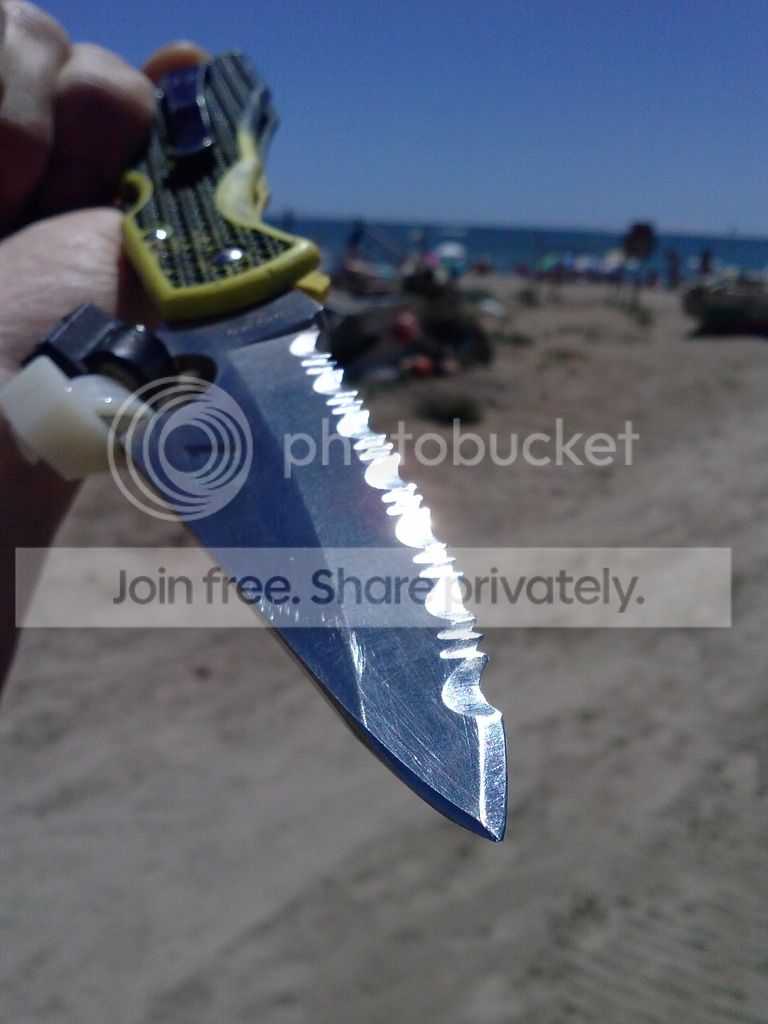
Serrated H1 Brittle?

I would actually disagree.
I Much Prefer higher alloyed knives, I just have realistic expectations when it comes to a lower end alloy.
-------
So you are stating that there is rumors, stories, or whatever you want to call it, about the edge being harder than the flats and spine.
But yet you only tested the flats and state that it is good enough and the everyone was just fed misinformation because you didn't want to test it and actually find out for sure?

Sounds like you went out of your way to Not find out, when it would have been convenient for you to do so.

Had you have done so, your (and us) would now have a measured value...
 
I have a question, how would Elmax compare to H1 in terms of stain resistance assuming you were on a ship at sea? How much of a difference will be noticed in the "real world" so to speak?
 
Whoa, thanks everyone! Didn't expect this thread to grow as much as it did. Very cool information. It's nice to hear from people who've been using this steel longer than me. Recently been using a SE Salt 1 and I'm impressed so far. I'm intrigued by steels, design choices, intended applications, I suppose everything everybody else here is interested in... Fascinating stuff to read today, thanks all!


Thanks for sharing!

As an aside, if H1 doesn't offer the edge retention in an edc role that you would prefer, check out LC 200 N.
It is right along side H1 in terms of stainlessness, but higher hardness than the straight edge H1 and lower hardness than the serrated H1 with edge retention landing in between as well.

Never heard of LC200N, very cool. I'm intrigued by this steel now as well. Thanks!

In my experience, no it is not brittle. Not close to any other steel.


I work in the mining, oil and gas industry. Cut pipe, cardboard, tape, whatever needs to be cut, even fauna and flora with not one chip on H-1.

Here is a picture of my most used H-1 Blade new vs now.

DSCN1226800x600.jpg


IMG_0805_zpst8k71rbd.jpg


Here you can see my sharpening marks on the back of the blade. I just hit the serrations afterwards with the sharpmaker corners.

IMG_8194_zpsrjp5e6ih.jpg

Very interesting, thanks for sharing all of that! Good to hear some more real world experience. I'm rather new to H1, have a small LadyBug that doesn't get used too too hard. Love it though. Also recently acquired a SE Salt 1. So far I'm very impressed with it. Love the size, weight, very comfortable to use.

Hi. I own a Pacific Salt PE since some years now. It’s my go-to knife for every seaside holiday :thumbup:. I’m far from being an expert and don’t own any H1 steel serrated blade but my empirical experience with H1 is that, besides being amazing in term of corrosion resistance and basically care-free, for all the other characteristics, it reminds me close of... a proper 440C steel :).

Its edge retention is fair for me, but far from remarkable :p. My PS needs to be sharpened regularly, especially after working hard in the garden with weeds, small bushes, etc., generally after any decent wood-working session. Does well on cardboards, holding its edge a bit longer than with wood. On the other hand it’s easy to sharpen and it takes a good and keen edge. I sharpen it with the Lansky system normally with little effort.

It’s a kind of “soft” steel, according to my experience and “feel” while sharpening it, specially when comparing it with today “super steels”. I think mine is not even close to 60 HRC and I am also very doubtful about the whole “work-hardening” thing when it comes to manual sharpening of knives blades. At least I have never experienced this phenomenon :). To be honest, to get an appreciable plastic deformation on industrial grade cutlery steels, it's my knowledge that the forces applied have to be significant, I don’t think it’s possible to get a work hardening with passes on a sharpening stone :). But, as said, I am not a metallurgist so can only bring in my direct experience with my Pacific Salt PE, a great knife by the way, here my long story:

http://www.bladeforums.com/forums/showthread.php/1311841-Spyderco-Pacific-Salt-PE-my-holidays-knife

Many thanks! Good to hear more real world experience with H1.

My most used folder is a Salt 1 fully serrated. There's something unbelievably satisfying and easy about the SE H1 folders. Grab and go - lightweight, unobtrusive, and I've yet to find a (folder) task that it's not up for. Quick resharpening on a sharpmaker or a worksharp (literally, in seconds on the latter) makes it one of the most easily maintained folders I own. Did I mention the full serrated blade makes quick work of hard cutting tasks, such as thick cardboard, rubber materials, etc?

They are great knives. Personally, the Salt 1 is Delica sized and perfect for me - the Endura sized variants get a little too large for this folder IMO.

It's funny you say that, the black SE Salt 1 is my newest try at an EDC. Super impressed so far with it's weight, size, comfort. Just real easy to carry and use. I'm thinking, like you, it might become my most used blade!

My most carried work knife is an all black Pac Salt. I have beat on this knife harder than any of my others.....thick cardboard, tons of sheet rock, the edge destroying flex duct and on & on!
I find it holds its edge very well. I'll give an example......if I use my s35vn Native to make 1 cut on 6" flex duct it will no longer slice paper...at all. Same with a vg10 Endura.
The Pac Salt SE can make at least 20 of those cuts without losing its edge. I have no complaints.
Joe

Very cool to hear. That's some rough stuff! I like the Pacific as well, but went for a Salt 1. If I needed a larger knife, it'd be worth it I'm sure. Very compact, simple knives, love that about them.

I had an original Salt clipped to my PFD for thousands of sea miles on my sailboat. I used it exclusively for rigging emergencies or fouled props. I used it under water several different times cutting heavy fishing line off my prop, or cutting polypropylene line from crab traps in the albemarle, pamlico and Chesapeake that got sucked in from time to time. Ya hate to do it but put thousands of black floats right in the channel, and they're going to lose some traps, especially in certain light conditions.

The serrated blade is a cordage muncher and the steel did hold up very well. I could not always rinse because I was singlehanding and often would have been in 40 degree water with the stern of a 16,000 lb boat rising and falling 6-8' at times, with my tender skull underneath. Anyway, not the kind of place you can dilly-dally when you're out there by yourself, so I needed a knife that would be efficient and tie to my wrist.

My impression of the steel is it is pretty soft, and is not brittle. Only picture I have is with other knives, but you can see it got a lot of use, but doing ONLY one thing. Needs a good cleaning, has sea crud in handle. Sharpens up easily on the sharpmaker. It would have sliced a lot of cordage with the bronze prop behind it, so it was used kind of hard I guess.

Rigging emergencies can be life or limb threatening, so you gotta have something to slice lines made from spectra, Kevlar, etc. This knife is exceptional for sailing.

86cb3ebe6c4b6e2279fb77f886dbc616.jpg

You'd definitely want a knife you could rely on for that type of work. Sounds like you've put it to good use. Really great to hear stories like yours. So far, I'm really impressed with fully serrated blades. I like PE too of course, but I suppose it depends on what you're working with. Thanks for sharing!

Thanks everyone!
Shreddybear
 
I have a question, how would Elmax compare to H1 in terms of stain resistance assuming you were on a ship at sea? How much of a difference will be noticed in the "real world" so to speak?

Just noticed there's a page 2! Yay!

TBH, I don't have experience with ELMAX. I have read that it's a very high performing steel with decent corrosion resistance. Lots of steels have done well throughout the years--a little rust isn't the end of the world (pitting isn't great...). Even better if you're able to rinse the blade with fresh water after exposure. Coatings can make a difference too. Many a knife steel have been used for diving and rinsed off afterwards and have done just fine.

In comparison to H1, well, H1 will not rust. It is possible to corrode however (H1 and Elmax). Perhaps someone with experience can tell you, but another steel you might be interested in for that application might be N680. Benchmade uses it on their Triage line--another nifty knife! The 916 lacks a sharp tip which can be useful in a marine situation where poking things isn't always a good thing.

Back on topic, any and all information is always appreciated. If you find this post years from now and want to share something, feel free to PM me. I look forward to getting more of my own experience with the SE variant of this steel.
 
I had an original Salt clipped to my PFD for thousands of sea miles on my sailboat. I used it exclusively for rigging emergencies or fouled props. I used it under water several different times cutting heavy fishing line off my prop, or cutting polypropylene line from crab traps in the albemarle, pamlico and Chesapeake that got sucked in from time to time. Ya hate to do it but put thousands of black floats right in the channel, and they're going to lose some traps, especially in certain light conditions.

The serrated blade is a cordage muncher and the steel did hold up very well. I could not always rinse because I was singlehanding and often would have been in 40 degree water with the stern of a 16,000 lb boat rising and falling 6-8' at times, with my tender skull underneath. Anyway, not the kind of place you can dilly-dally when you're out there by yourself, so I needed a knife that would be efficient and tie to my wrist.

My impression of the steel is it is pretty soft, and is not brittle. Only picture I have is with other knives, but you can see it got a lot of use, but doing ONLY one thing. Needs a good cleaning, has sea crud in handle. Sharpens up easily on the sharpmaker. It would have sliced a lot of cordage with the bronze prop behind it, so it was used kind of hard I guess.

Rigging emergencies can be life or limb threatening, so you gotta have something to slice lines made from spectra, Kevlar, etc. This knife is exceptional for sailing.

86cb3ebe6c4b6e2279fb77f886dbc616.jpg


Sent from my iPad using Tapatalk
what make is the bone handled knife?
 
what make is the bone handled knife?

A Morseth Hunter, and an old one at that!
Looks to be early 1990's, due to the straight guard. He started bending them back a little over the index finger a bit in his more recent knives.
 
......I have to admit that the edge retention on the plain edge Tasman is pretty awful, and it's really hard to resharpen.


.

In fact, I just called them today about this VERY issue. I just scored a clean used one, and my Sharpmaker at 30degrees was not doing the trick. She said they recommend the 40degree angle for that one. Just a thought....
 
In terms of H1's edge retention, I EDC'd a Ladybug Salt for a few years while working at a community college with a pretty crummy knife policy, and used it quite a bit. I'd say edge retention was better than something like AUS-8 but not by much. I beat on it pretty hard for such a tiny knife, lots of opening tough clamshell packs and cutting zipties in particular, and never managed to chip or damage it in any way either.
 
Some food for thought.

When Spyderco introduced the "Mariner" in 1982, with a serrated edge, (a Spyderco 1st?) we "pitched" 4 major advantages;

1. The serrated edge gives you a longer edge.

2. Often one uses the point of a knife to pierce the skin of a tomato to begin the cut. The serrated edge acts like it has points all along the edge.

3. The points of the blade protect the recessed edge which stays sharper longer, especially when cutting on something hard, like a cutting board.

4. The angle of attack of the cutting erdge to the material being cut is contantly changing as the edge passes through what is being cut.

sal

Hi HLite,

Tips are thin and will either break or bend why used for prying. Not a recommended activity for knives. For you to expect a tip to hold up to tough prying is, in my opinion unrealistic. I think if you were going to use one of our H1 knives for light prying, and you didn't want to eait for our fixed blades (still months away) I would suggest the Atlantic Salt. It is a sheepfoot which was designed to be full thickness almost to the tip and had demonstrated that it will handle light prying more effectively.

Other than the testing that we have done at Spyderco (lab testing), there are no other tests, that we know of, other than the tests Crucible did (mentioned below).

Boats,

Thanx for the kind words and support. When we did our testing, the PE model CATRA tested (edge retention) about the same as AUS8, but the serrated version's testing results were much higher. Normally, serrated edges will run about twice the plain edge of same steel and geometry, but the H1 was running about 4 times, up there with powdered metals. A puzzlement.

Hi Mete,

When the foundry rolls the H1, they roll to two different hardness, we end up with 58 for the blade material and considerably lower spec for the lock material. Not meaning to be disrespectful, but the two hardnesses are controlled by the rolling process.

Dick Barber, metallurgist for Crucible steels was curious as to why the H1 steel was testing so well and wanted to do metallurgical testing on the material. We sent them samples and they did their tests. In their micro hardness testing, they found the H1 was differentially hardening. Their explanation was as I described.

The were getting over 60 (64/65 as I remembber the report) at the edge of the blade, 58 at the spine and various hardness in between as they went from the spine to the edge.

The serrted edge version was higher (68 as I remember) which Mr. Barber attributed to the extra "work" (heat) required to serrate the edge over just sharpening as on the plain edge.

If you would like I can fax you, or mail you a copy of the report. Email me your address.

sal

Hi Me2,

Partially correct. The rolling process of binging the steel to the thicknesses that we require does in fact work harden the steel. Depending on the thickness required, it will generally be about Rc54+-. Then each grinding process adds to the work hardening process. Dick Barber at Crucible did a series of tests when we first began working with H1. As we, they too had many questions. After micro hardness testing from the edge to the spine, his conclusion was that each grinding process added to the hardness. That would be surface grinding, bevel grinding and sharpening, with the serrated edge bein harder at the edge than the plain edge by 3-5 Rc points. Hardness at the very edge was in many cases in the high 60's. We believe that accounts for the very high CATRA test results on serrated H1.

sal

So H-1 in high HRC at a low edge angle (serrated edges are lower than standard PE edge angle) performs in the same area as SE powdered metallurgical range if I am understanding this correctly.

LC200N is similar to Cronidur30. Been around for more that 30 years. A similar steel developed for the food industry and extremely stainless was Nitrobe-77. Similar to 52100 but extremely stainless. Its downfall was its extreme demand with heat treatment and could reach around 62 HRC

I have high hopes for LC200N in PE but nothing has sparked my interest model wise. If one wants a steel similar to LC200N but even higher hardness and similar stainless quality 14C28N. But I am not pleased in 14C28N in some production knives. Think the exclusion might be Southern Grind but my experience with 14C28N in a custom has been great. 500 cardboard (thick walled) cuts and push cuts newspaper with the grain still.

There are some that prefer 14C28N over S30V


Sent from my iPhone using Tapatalk
 
In terms of H1's edge retention, I EDC'd a Ladybug Salt for a few years while working at a community college with a pretty crummy knife policy, and used it quite a bit. I'd say edge retention was better than something like AUS-8 but not by much. I beat on it pretty hard for such a tiny knife, lots of opening tough clamshell packs and cutting zipties in particular, and never managed to chip or damage it in any way either.

Thanks! Ladybug is small but powerful. SAKs can get most work done in a typical day for me. Thanks for sharing!

I've always enjoyed reading posts by Surfingringo, and he has a world of experience by H1 Pacific Salt. Check him out if you would like to see his posts and pics... neat stuff...
http://www.bladeforums.com/forums/s...-things-quot-salt-quot?highlight=surfingringo

You know, I think I've probably read some of their stuff on here before. I'll give it a look, thanks!
EDIT: Just read some more from him, yup! Some good stories there indeed! Particularly that story about the fish that jumped at him. Cracked up at the part that goes: "You should always be polite to the person that is sawing on your head". Gold.

Some food for thought.

So H-1 in high HRC at a low edge angle (serrated edges are lower than standard PE edge angle) performs in the same area as SE powdered metallurgical range if I am understanding this correctly.

LC200N is similar to Cronidur30. Been around for more that 30 years. A similar steel developed for the food industry and extremely stainless was Nitrobe-77. Similar to 52100 but extremely stainless. Its downfall was its extreme demand with heat treatment and could reach around 62 HRC

I have high hopes for LC200N in PE but nothing has sparked my interest model wise. If one wants a steel similar to LC200N but even higher hardness and similar stainless quality 14C28N. But I am not pleased in 14C28N in some production knives. Think the exclusion might be Southern Grind but my experience with 14C28N in a custom has been great. 500 cardboard (thick walled) cuts and push cuts newspaper with the grain still.

There are some that prefer 14C28N over S30V

Thanks! Quite a bit of it! I've read some of these statements before I think in other posts regarding similar topics. Thanks for finding the original & fuller explanations! Very interesting indeed.

You know, I read about all of these fancy steels--and don't get me wrong--I've been impressed by many, but I'm also completely fine with Buck's 420HC or a SAK. Amazing how all of these steels if manufactured and applied properly, definitely have their place.

The best way is to put a salt in your pocket and see for yourself.

Done and done!
 
Last edited:
From my experience, H1 rolls and dulls very easily. It's a pretty soft steel and I can't imagine it chipping. My most carried knife and everyday beater for the last few years has been a Tasman Salt. I use it for everything that doesn't need a clean cut, like zip ties, packages, and even sawed into hard plastic a few times. I can hardly even call the edge sharp anymore. I've never sharpened it and don't plan to unless something terrible happens to it. There are few things that a serrated hawkbill won't take care of. I wouldn't get a plainedge blade in H1 but if it's serrated, it'll serve you well.

Like they said above, get one in hand. I'd recommend a Tasman. It's lightweight, cheap, will never rust on you, and needs practically no maintenance.
 
nothing that hasn't been said above. Just get a SE one and see for yourself.

CAM02387_zpshzvtoth3.jpg


H1 is durable, very forgiving, bendy and soft (as in not chipping or cracking) giving a very nice "hard use" edge and aggressively cutting, high sharpness blade.

CAM01622_zpskp0roaex.jpg


Perfect for abuse, and scratches very quickly. Shows off its hard work!

CAM01590_zpsevnwuqcb.jpg


And it's really easy to sharpen, entry level. Gets scary sharp too, and with little touch ups won't lose that bite even with daily use. SE and PE are really different in that steel

20170111_205331_zpsyw1q2uce.jpg


Also fairly quick to regrind, reshape and play with. :thumbup:

Pacific and Salt I are incredible users, but I'd say check the Tasman Salt too for the definitive small chainsaw, raw cutting beast in your pocket, so easy to carry and nice to use!

CAM05795_zps3gc64szo.jpg
 
Last edited:
A Morseth Hunter, and an old one at that!
Looks to be early 1990's, due to the straight guard. He started bending them back a little over the index finger a bit in his more recent knives.

You're right, 1991, got it for college graduation.


Sent from my iPad using Tapatalk
 
I use mine in the environment it was designed to be utilized in...
ldxhZH6.jpg

It is also my EDC knife and I use it a lot at work to cut back branches, etc. I work outdoors in SW FL so this knife is regularly exposed to rain, sweat, dirt, etc.
bExg7FZ.jpg

PFsF5tw.jpg

F9Pv3nO.jpg

It shows some wear but has held up well. As far as the H1 steel is concerned I noticed it dulled rather quickly the first time I used it cutting chunk bait. Hit some bone cutting up the fish and it dulled fast. It is easy to sharpen on a Spyderco Sharpmaker. It's edge holding has improved but I cannot say with any certainty that this improved edge retention is from use and repeated sharpening (the work hardening from repeated sharpening I've seen some refer to). I believe it is more likely do to getting better at sharpening this blade steel. I've paid more attention to the angle sharpening the back side and slowly sharpen the serrated side with the angled edge of the sharpmaker rods to evenly catch all areas of the serrations. Going slowly with the stones/ceramics on the serrations prevents "serration bounce" on the rods which will miss sharpening areas within the serrations and cause premature rounding of the serrations. Slow and steady wins the race here.
I have not had any issue with "brittleness" to date.
As far as LC200N goes I would love to try this steel but need it in a folding knife handle that would be usable in the above environments. Spyderco's current offering of the Spydiechef with a titanium handle just does not do it for me. Give me that blade in an FRN handle that I can get a good purchase on, is lightweight like my PAC Salt, and I can beat on with no discernible wear to the handle and I will buy it. Until then I will continue to carry the Pac Salt.
 
Many thanks for sharing everyone! So far the SE Salt 1 has been doing its job well.
 
Last edited:
Back
Top