Share your tricks for Flute Fittings

Erin Burke

KnifeMaker...ish
Joined
May 19, 2003
Messages
1,330
Good morning folks. I'm hoping to pick your collective brains on methods for fluting fittings.

Often on my projects, I like to include decorative fluting on guards, ferrules, etc.

9705287889_9b59f7b10c_n.jpg
9591002581_f836cc6328_n.jpg
21265728321_53513cd018_n.jpg
24413907973_109e8aa797_n.jpg


In the past, I have done this type of work with nothing more than a height gauge & surface plate for marking, followed by files/sandpaper/elbow grease for grooving.

9536239977_106a804035_n.jpg
9548777923_7b0e12d541_n.jpg


There are a few reasons why I'd like to explore other methods to accomplish this type result.

Firstly, I am working on a guard at present that includes some concave areas around its perimeter (see image below). It is not feasible to set the concave areas of these grooves with standard round files. I started to make an attempt at working these areas with a curved (round) riffler file, but it became obvious quickly that I would not get quality {clean} results this way.
34787602756_622e5b1b2c_z.jpg


Secondly, file work can be tedious, so I'm always interested in ways to be more efficient (faster) while still maintaining a quality result.

So my question to you folks who have done similar grooving... what are your methods? Do you have any special tools -- files, grinding discs, burrs -- to help do this?

If you have them, photos of the equipment/process/results would be helpful.

Thanks in advance.
Erin
 
I've tried to do it the way you describe and I'm either not good enough or patient enough or both.

I've seen people set up cut off wheels or discs in a mandrel on their drill press, and then use the press table like the surface plate, and I was going to give that a try. Even if it just roughed out the majority of the material with some uniformity I think it would eliminate a lot of work.
 
I've seen people set up cut off wheels or discs in a mandrel on their drill press, and then use the press table like the surface plate, and I was going to give that a try. Even if it just roughed out the majority of the material with some uniformity I think it would eliminate a lot of work.

Thanks for the input. I neglected to mention in the OP that I've done something similar with a diamond disk to create "starter grooves" for my filing. Below is photo.
If anyone knows of a carbide burr or something similar that can be "piloted" to control depth-of-cut... I'd be interested to learn of it. Maybe something like these EDGE FLUTING ROUTER BITS... just for steel.
9539057812_60ff26eb83_z.jpg


Erin
 
You can make a home brew Dremel size router table and use ball burrs. Adjust the height, set he guard/bolster on the table, and rotate it against the burr. You can start with a 90 degree knife edge burr and cut the first pass or two, then switch to the ball burr. Carbide ball burrs are far better for these tasks.

Finish up with round chainsaw type files.
 
There are even round edge "T" shaped carbide burrs available, which would probably work great in a setup like that.
 
You can make a home brew Dremel size router table and use ball burrs. Adjust the height, set he guard/bolster on the table, and rotate it against the burr. You can start with a 90 degree knife edge burr and cut the first pass or two, then switch to the ball burr. Carbide ball burrs are far better for these task.

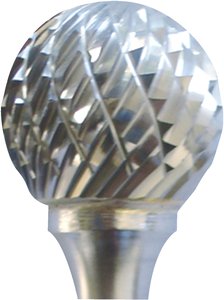
I have a few different carbide ball burrs -- with different cuts -- on {back}order from MSC to try exactly this. I'll let you know how it works out. I'm a bit concerned that a ball burr, without some sort of pilot or other mechanical stop, will be difficult to control for consistent cut depth. We'll see.


Finish up with round chainsaw type files.

I can't figure out how this would work in the concave sections of the guard.

Thanks Stacy.
 
There are even round edge "T" shaped carbide burrs available, which would probably work great in a setup like that.

I looked for something like this, but didn't find anything. Do you have a link that you could share? Thanks in advance.
Erin
 
Regarding ball burrs, isn't the shank going to essentially act as the depth stop?
 
I looked for something like this, but didn't find anything. Do you have a link that you could share? Thanks in advance.
Erin

I have to run away from my computer, McMaster has them. I'll try to find a better link when I get back.
 
Regarding ball burrs, isn't the shank going to essentially act as the depth stop?

Possibly. I ordered several 1/4" ball burrs w/ 1/8" shanks from MSC (all with different cuts, as I am unsure what will give me the best results as far as material removal rate, ease of control when holding the work piece by hand, and best surface finish). All of the burrs, however, to varying degrees appear to have some sort of transition step between the carbide and the shank. I am unsure how this will effect the cut if I take the depth all of the way to the shank. I'll experiment when they get here.

0361847_hr4c.jpg

(Pic from Fastenal)

Mostly, I'm curious if there are folks out there who have employed other methods/tools that I may not have considered.
Thanks.
 
Thanks for the input. I neglected to mention in the OP that I've done something similar with a diamond disk to create "starter grooves" for my filing. Below is photo.
If anyone knows of a carbide burr or something similar that can be "piloted" to control depth-of-cut... I'd be interested to learn of it. Maybe something like these EDGE FLUTING ROUTER BITS... just for steel.


Erin

https://c1.staticflickr.com/4/3756/9539057812_60ff26eb83_z.jpg

Like that, but a little vertical flat steel fence to keep the piece on the table and limit movement
set the depth with table travel.

Look at video and photos of what the woodchucks do with routers.

Plus tool and die folks do with tracing pantographs like a Deckel
 
in the handles and guards class I took, I learned with a dremel mounted to the Dremel router table and using a diamond wheel disk
I have one setup but have not had much practice with it quite honestly.
 
in the handles and guards class I took, I learned with a dremel mounted to the Dremel router table and using a diamond wheel disk
I have one setup but have not had much practice with it quite honestly.
I sure enjoy the super work I see of your's, Erin ! You are a "thinking" maker, but look at that burr. If you go down that deep aren't you likely to be long past a reasonable working depth? On the other hand I can understand you wanting to do the outstanding .
Frank
 
Like that, but a little vertical flat steel fence to keep the piece on the table and limit movement
set the depth with table travel.

I'm having a bit of trouble visualizing this Sam. Most any "fence" that I can think of -- and I'm picturing something similar to a router table fence -- would make it difficult, if not impossible, to get into concave corners. I'm probably missing something.
 
What if you mounted the rotary tool parallel to the surface plate, and the "fence" was just fingers like this?

99ZMA4H.jpg
 
the only thing i can come up with for a depth stop that would work for the concave areas would be like the diamond wheel in the drill press setup, but have another disc slide over the shaft so 1/32" or whatever depth you need of the diamond wheel protrudes over the edge of the additional disc. maybe thin micarta or metal would work.
 
I sure enjoy the super work I see of your's, Erin ! You are a "thinking" maker, but look at that burr. If you go down that deep aren't you likely to be long past a reasonable working depth?

Frank... for the project that I'm working on now, I'm assuming a 1/4" ball on a 1/8" shank. From the image below you can see that, given a burr of perfect dimensions, I would only get a depth of cut of 1/16" (0.0625) before the shank would stop the cut. Given that most of the burrs I've seen online have a stepped transition from shank to ball -- similar to that pictured in post 11 -- I may not even get that much depth.


What if you mounted the rotary tool parallel to the surface plate, and the "fence" was just fingers like this?

Kuraki,
I'm probably over-thinking things... I usually do... but if I were to grind inside vs. outside curves with that setup, I could see getting different cut depths. I'd mark up your diagram, but I don't have any good image editing software here, and your background gradient makes it a pain to do in MS Paint. :D
 
On your big diamond
I'm having a bit of trouble visualizing this Sam. Most any "fence" that I can think of -- and I'm picturing something similar to a router table fence -- would make it difficult, if not impossible, to get into concave corners. I'm probably missing something.

On your big diamond wheel photo, it could be a flat fence that limits travel of the workpiece towards the wheel.

You're right on concave that won't work.
I've seen woodworkers use a router with just brass pins that insert in a grid pattern.
It's easier to control depth with two or more pins, but just one pin could work.
 
the only thing i can come up with for a depth stop that would work for the concave areas would be like the diamond wheel in the drill press setup, but have another disc slide over the shaft so 1/32" or whatever depth you need of the diamond wheel protrudes over the edge of the additional disc. maybe thin micarta or metal would work.

Yep... I could see that working with a disc. It doesn't seem super workable with a ball burr though. I'm wondering if anyone makes a carbide disc burr with a rounded edge.
Thanks John.
 
Back
Top