Sheath making part 1

Joined
Feb 13, 2005
Messages
973
This is how I make the pouch type sheath for the BATAC, this one is going to be Dr. Lundes, I am sure he could have taken better pictures.:D

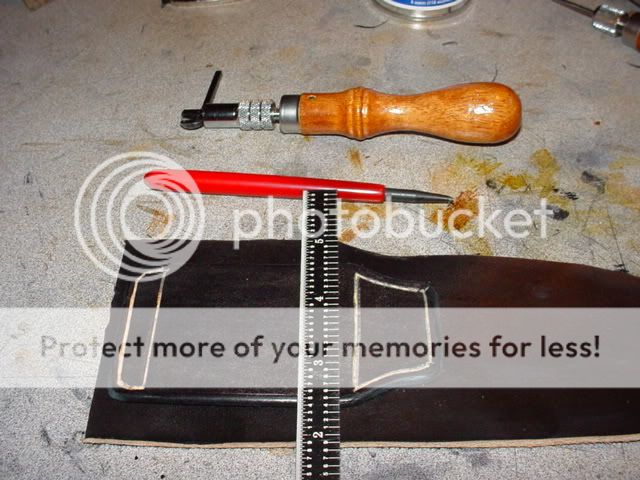
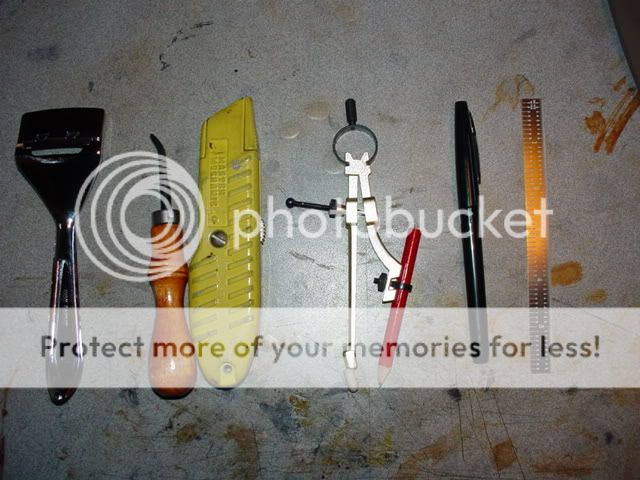
First thing is tools you will need. From left to right, a skiver, a # 2 edger, knife, compass, pen, ruler.
tutpouch021.jpg


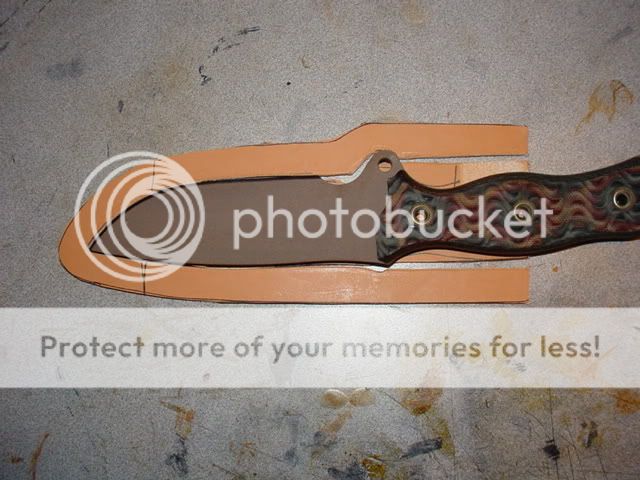
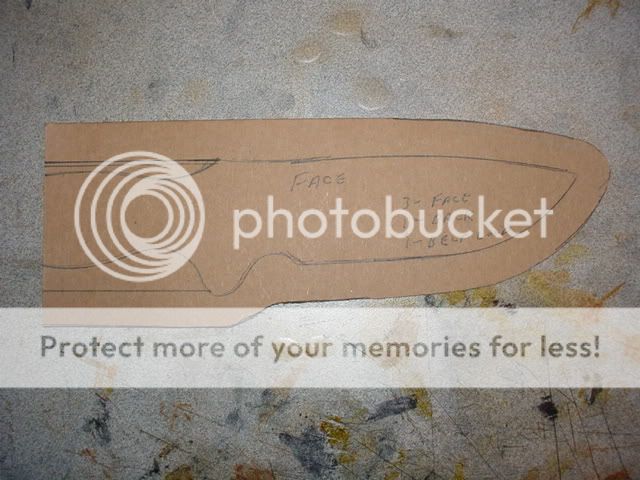
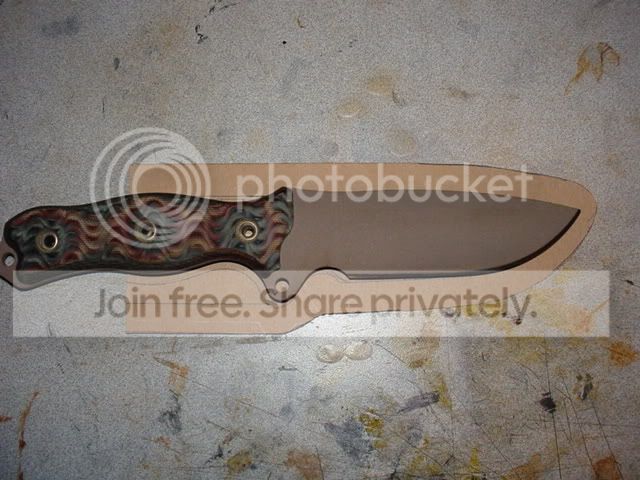
Make a template out of thin cardboard, I set the knife down and trace the outside contour with the compass making the template about 1/2 inch larger than the knife. I then tweak the template so it looks nice. Trace the knife onto the template.
tutpouch005.jpg


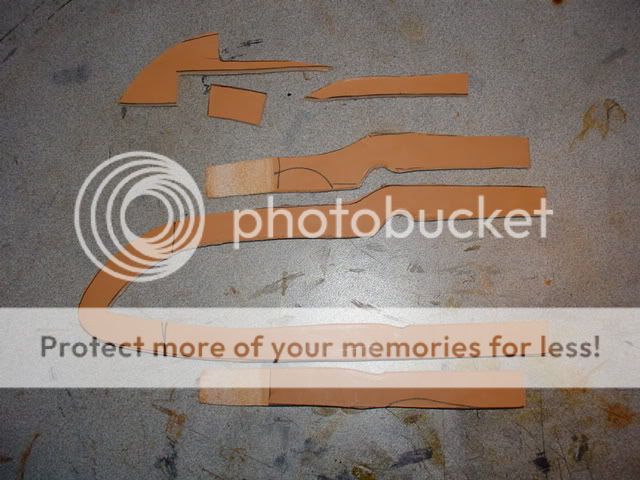
tutpouch004.jpg


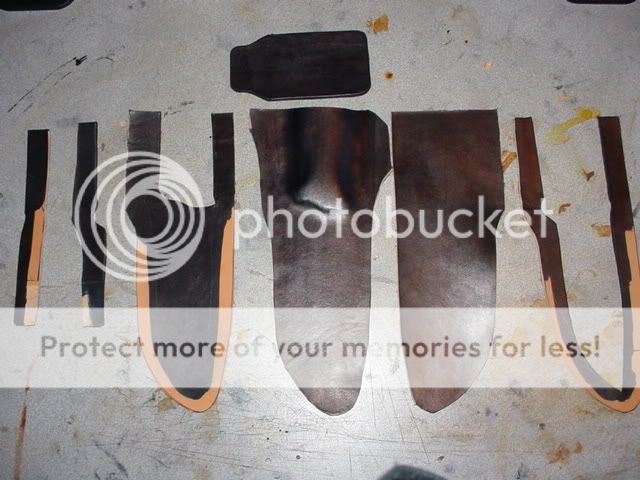
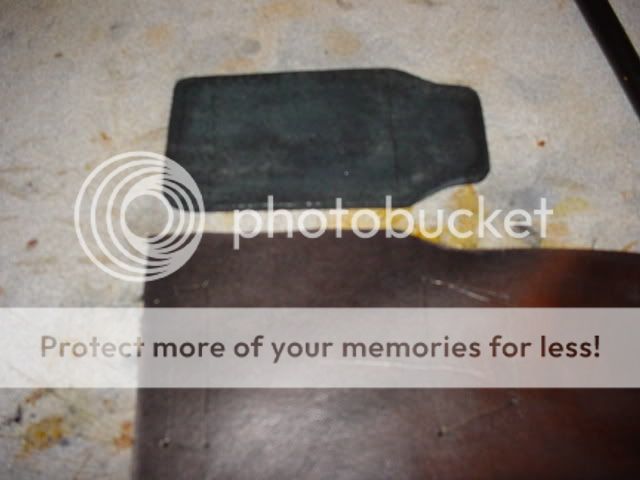
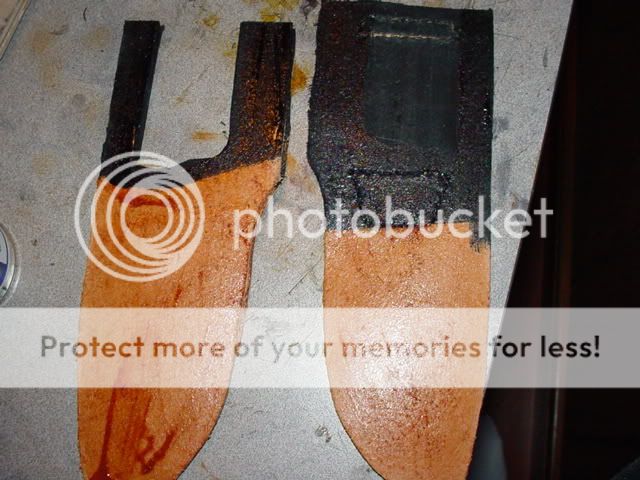
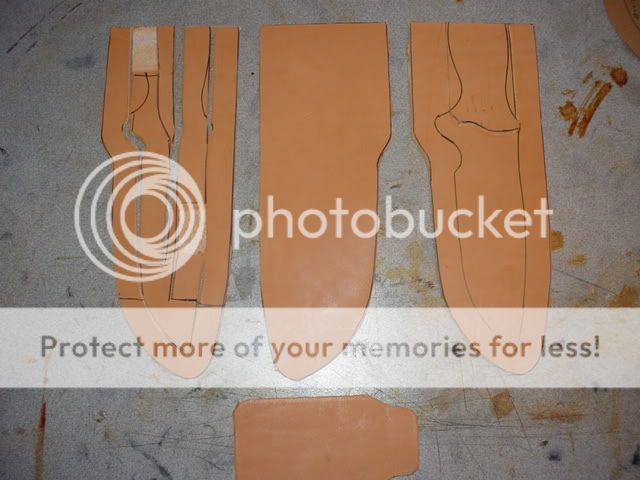
Lay the teamplate on top of your leather and cut the pieces out, one of them is reversed for the back side. The front is missing from this pic as I had already wet it at this point and I forgot about it. :D This picture also shows the belt loop which I will sew on the back later.
tutpouch007.jpg


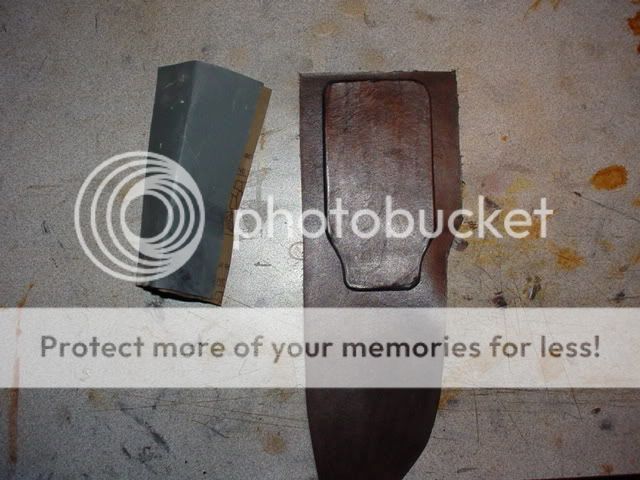
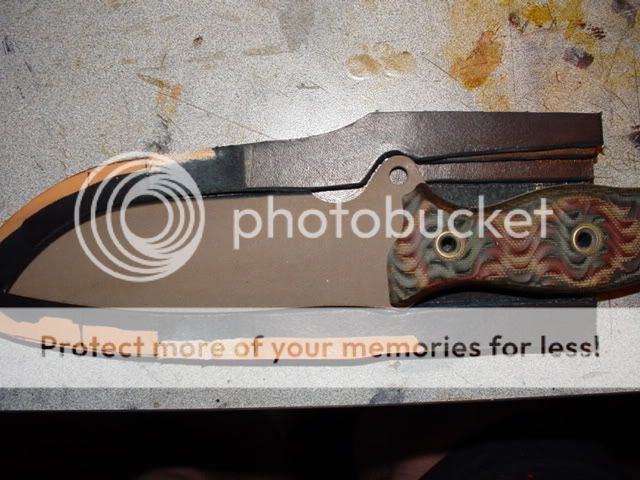
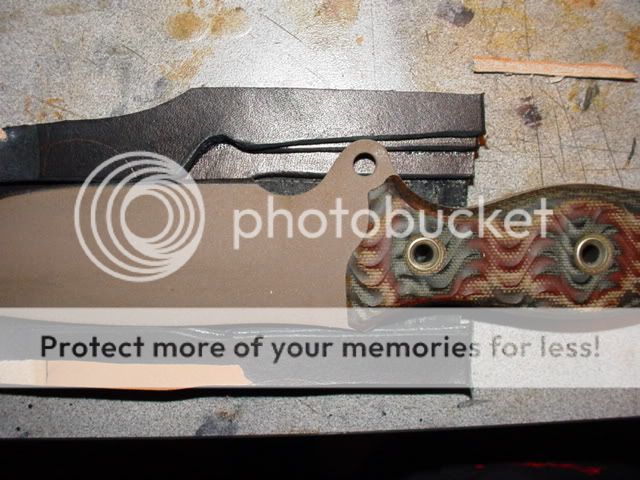
Set the knife on the backer piece (not the back piece) this will make sense as we go along. This should be skin side up.
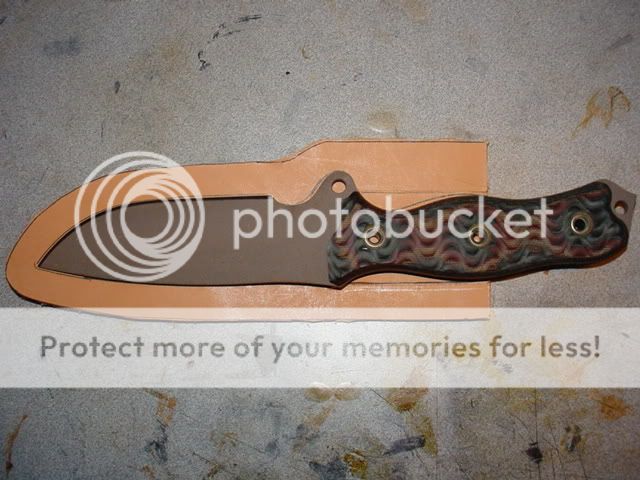
tutpouch008.jpg


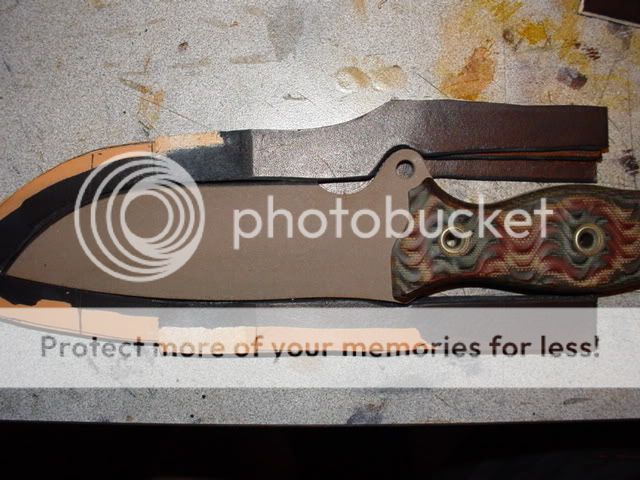
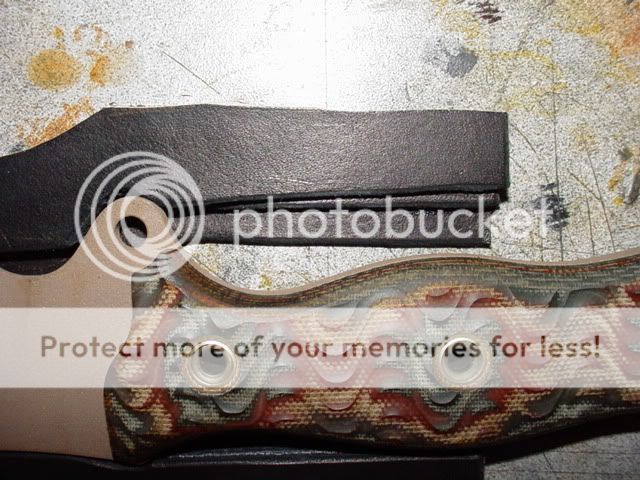
Press the handle into the leather so you can see the outline of the handle. Mark it and cut it out also leaving room for the handle to slide in and out.
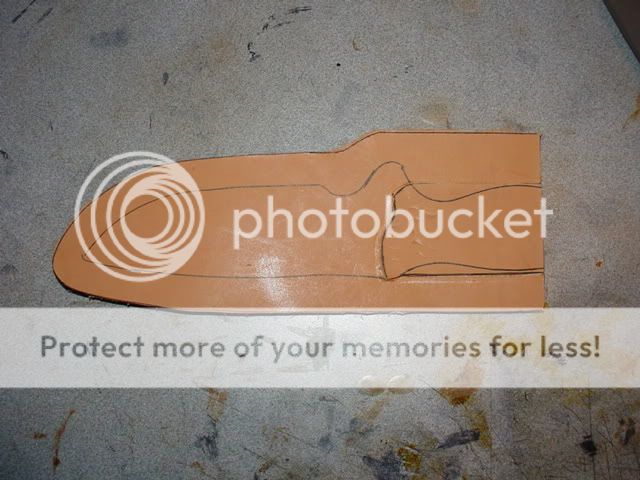
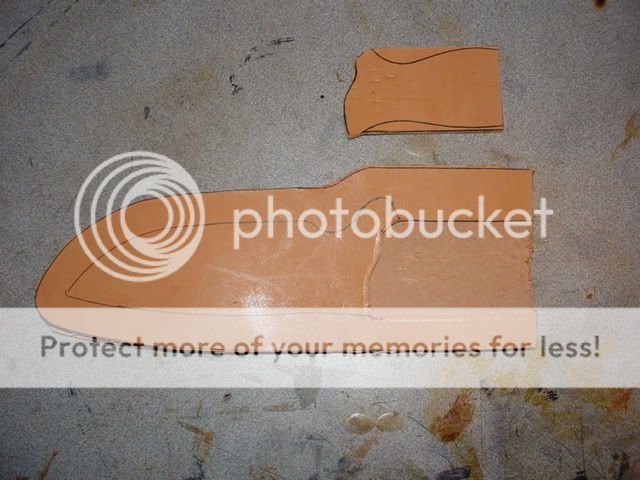
tutpouch009.jpg

tutpouch010.jpg


see part 2.
 
Very nice! And, very informative and instructive! I look forward to receiving the sheath, and will be sure to take photos of the final product, with and without a BATAC.
 
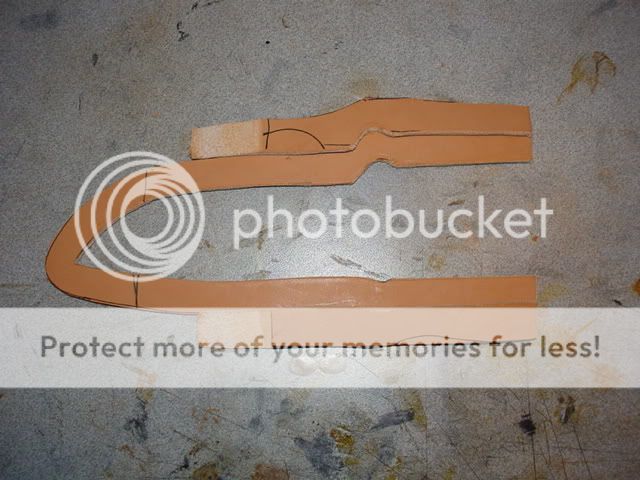
Now we will get another piece and cut the welt out. Trace the knife again making sure you line it up with your bottom and back pieces. I like the main welt piece (the one that contacts the edge) to be one solid piece of leather. There are other ways to do this and none are wrong.

tutpouch011.jpg


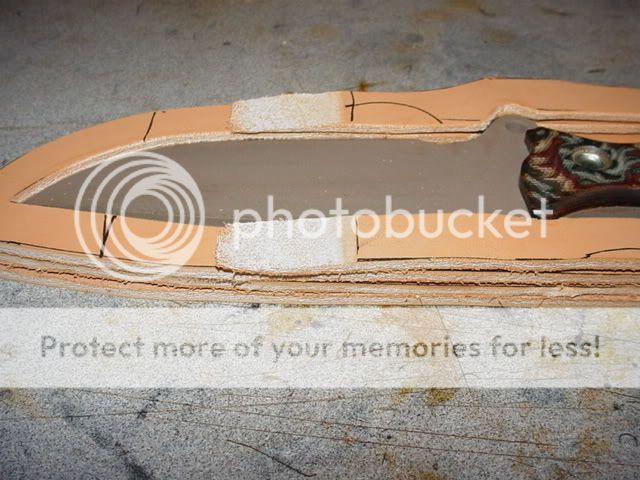
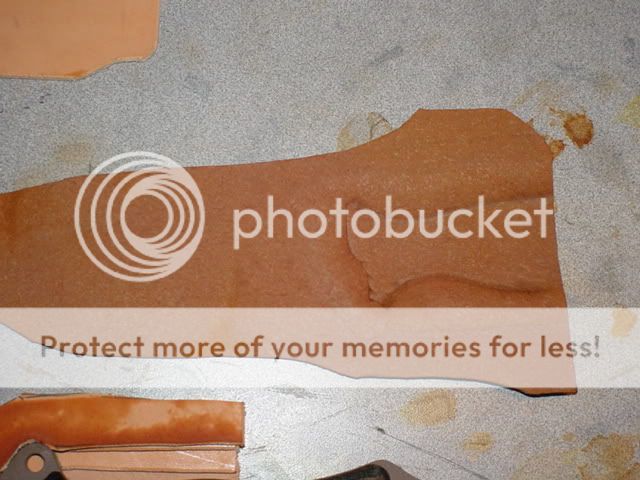
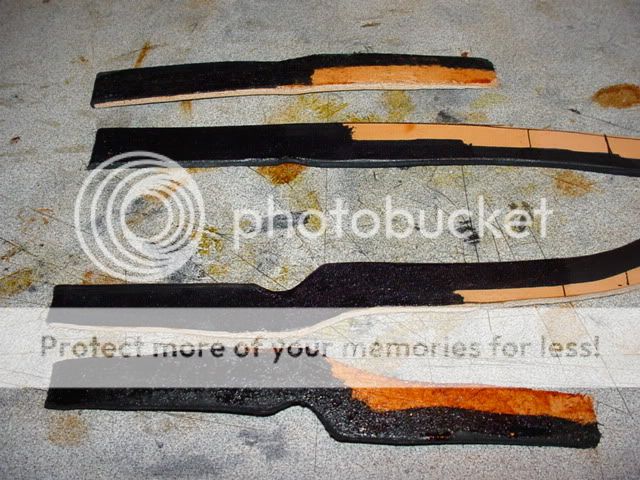
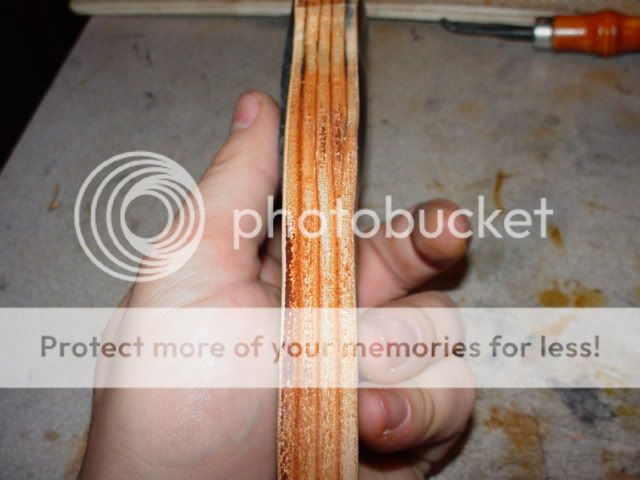
Now cut out the welt. This will leave a knife blade shaped piece of leather which I use to make two additional welt pieces to help build up the thickness of the sheath, due to the thickness of the blade. You want the welt to be the same thickness as your blade. Just lay your first welt on top of the knife shaped leather and trace and cut. Next the additional welt will need to be skived.

tutpouch013.jpg


tutpouch014.jpg


Check for fit.

tutpouch015.jpg

tutpouch016.jpg


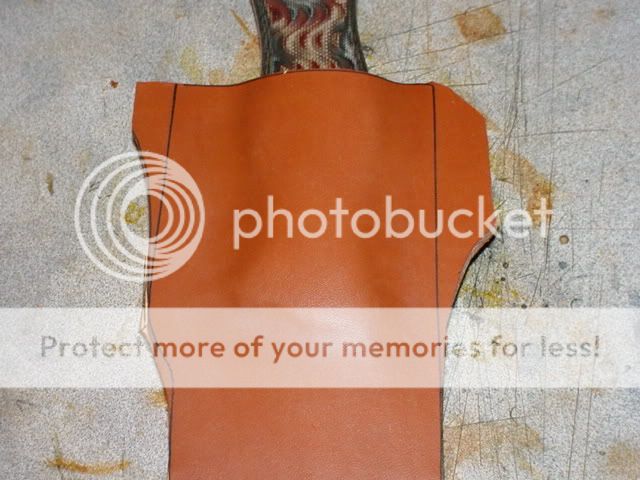
We are now onto the front piece of leather which I cut a little oversize to allow for wet forming. I put this in warm water (about 110-115%) for about 5 minutes. Take it out and pat it dry, and then let it sit for about 30-45 minutes. Then put it on top of your knife and other pieces you have stacked and wet form it using your fingers. If you have long nails cut them. Only use the pads of your fingers and push and smooth it to shape. This should take about five minutes. Take that wet piece of leather and set it somewhere to dry. I make sure it is all the way dry before I mess with it again. A dehydrator will work on low setting to dry it in a few hours also or just let it set out overnight. It is dry when the color is back to normal and it does not feel cool to the touch.
tutpouch019.jpg

tutpouch020.jpg


Now clean dry and oil your knife.
End of part two.
 
Part 3.

I am dying this one black, so I usually dye it now. For other lighter colors I dye more towards the end. Black is by far the easiest color to deal with. It is almost screw up proof.

tutpouch2001.jpg


Ok now we are going to deal with the belt loop. I use 400 grit wet/dry sandpaper. Rub the edges and get them nice and smooth. Then take the damp paper towel and slightly dampen the edges and sand the edges again with worn out 400 grit. This will shine it up nicely.

tutpouch2002.jpg


Next we are going to mark the back panel for placement of the loop. I use a scratch awl and make slight dimples inside of the outline of the loop. Then connect the dots so you know where to put the contact cement. Let them both dry for a few minutes and put them together. Contact cement is just that, once the pieces make contact you have about 2 seconds to shift them a little and then they are stuck. Be careful and dont slop it on, if it gets on leather where you dont want it, give it a minute to set a little then rub it off with your fingers.

tutpouch2003.jpg

tutpouch2005.jpg


Stick the two pieces together.

tutpouch2009.jpg


Next glue up the welts. Do a dry fit and mark the longer welt at the end of the shorter one so you know where to put the cement.

tutpouch2008.jpg


Give them a few minutes and stick them together.

tutpouch2010.jpg


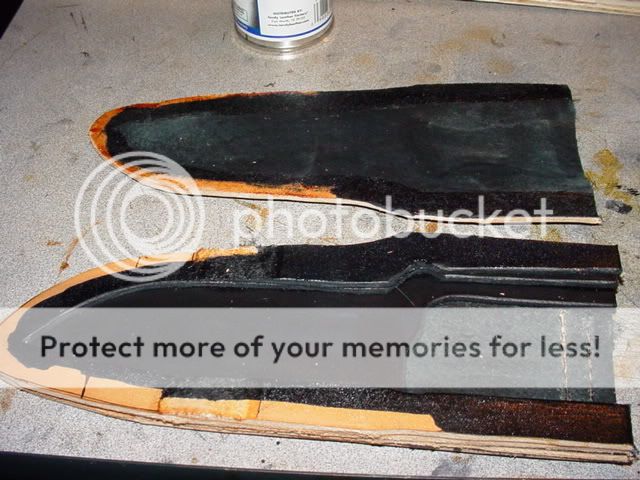
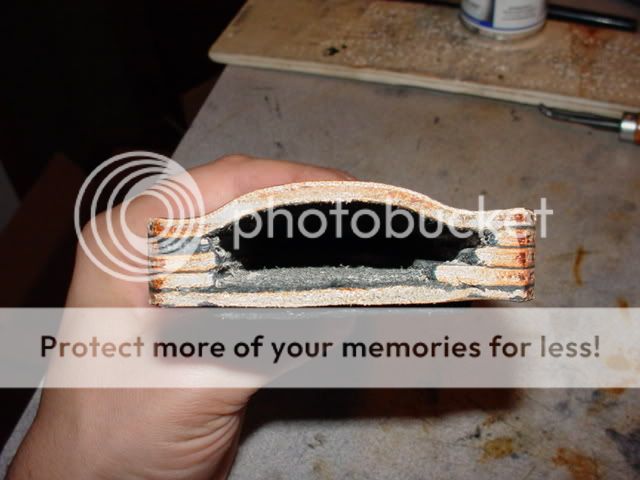
Next we are going to cement the welt to the backing piece. Do a dry fit and trace the outline of the welts onto the backing piece. Then cement. I do this with the knife inside as this sheath is very dependant on the fit. The welts at the talon hole are going to help hold this one in. In the third picture you will see that the welt is slanted, this is done for a reason, that being that it gets a little harder to slip the knife in the farther in it goes and pops into place. If you look at the third picture this should all make sense.


tutpouch2013.jpg

tutpouch2014.jpg

tutpouch2015.jpg


End part 3
 
Part 4.

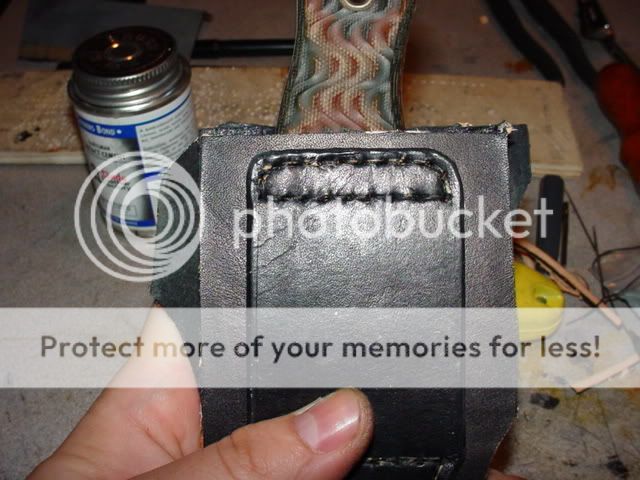
Ok, we are ready to groove the loop for stitching. Use your groover and make the groove. I use a straght edge and a free hand groover for the straight line across the back. Use a stitching wheel and mark where you want the holes for the stitches. I use an awl to make these holes, but you can drill them if you want.

tutpouch2016.jpg

tutpouch2019.jpg


Get your groover back out and groove the other side on the back piece where your holes came through for the loop.

tutpouch2021.jpg


Use a saddle stitch and stitch up the loop to the back.

We are now going to cement the backing piece to the back piece. Do a dry fit and trace the outline on the opening of the backer piece to the flesh side of the back piece. This is so you know where to put the cement. Let them dry and stick them together. I use the knife in this process also as this is your last chance to make sure they fit right. If you screw this up you did a lot of work for nothing.


tutpouch2022.jpg

tutpouch2023.jpg

tutpouch2025.jpg


We are now going to deal with the front piece. Put the knife in the sheath then cover it with the front piece and make sure it snugs up to the handle. Pick it up and mark the sides that we left oversized to be trimed. Trim the pieces from the sides.

tutpouch2026.jpg


Set the knife and sheath down and make sure again that the front piece is on correctly, pick the knife straight up holding the knife and the front piece together. Trace the outline of the blade onto the front piece. Draw lines where the welts will contact the front piece. You will need to seal the inside of the sheath before you glue them up. I used super shene. Any sealer will work though.

tutpouch2027.jpg


Ok, almost there. Cement the front piece to the rest.

tutpouch2028.jpg


end part 4.
 
part 5.

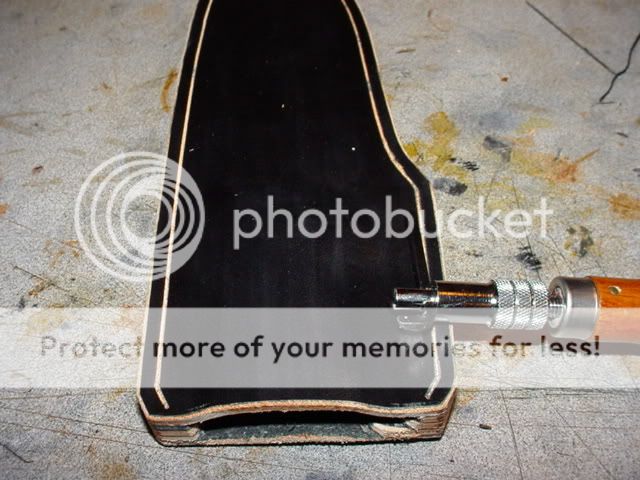
Now wait at least a couple of hours. Take the sheath and sand the sides with a belt sander, I start with 80 grit, then 120 and finish with a worn out 120. Make sure the sides stay even and perpendicular.

Once that is done, I get my number 2 edger out and do the edges. Make sure your edger is very sharp so it does not make a jagged looking edge, this will save time later.

tutpouch2029.jpg


I also trim up around the mouth of the sheath now. With a sharp blade. I use a utility knife which I sharpen on my sharpmaker. Make sure your knives stay very sharp.

tutpouch2030.jpg


Your edges and sides should look pretty decent now.

tutpouch2031.jpg


Groove the front of the sheath. Then mark the stitching holes. On dark colored sheaths I go back and touch a marker to each stitch mark to make it easier to see when drilling. On light colored sheaths I suck it up and strain my eyes.

tutpouch2032.jpg

tutpouch2034.jpg


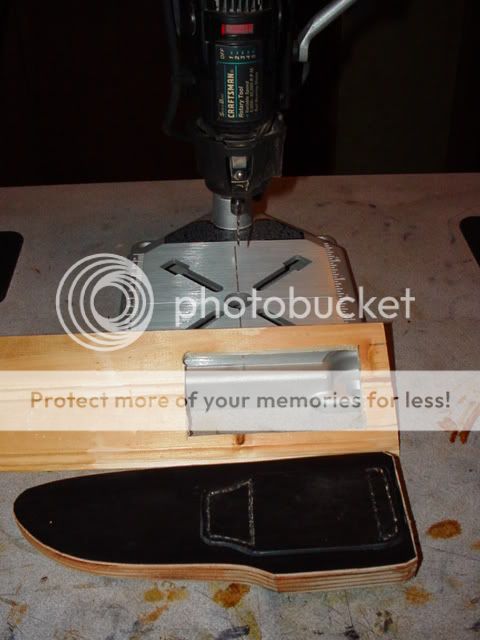
I started off only using an awl to make the holes. It works nicely but is very tough on the hands with thicker sheaths. I now use a drill press or dremmel for the main sheath holes.
I make a wooden template for every sheath I do. If there is something on the back like the loop on this sheath, I make a cut out so the sheath will stay flat end even. This is very important for the holes on the back side. I set the press so that the drill bit almost touches the wood. This will make little reverse dimples on the back side of the sheath which you will run your groover over later.

tutpouch2035.jpg

tutpouch2036.jpg


The dimples on the back side. Run your groover over the dimples and uncover the holes.

tutpouch2037.jpg


Stitch the sheath.

tutpouch2039.jpg


end part 5.
 
That's an amazing amount of work to put all this online --- thanks man!
 
part six.

whew, these things are alot of work.:D

Ok, we are almost done.:eek:

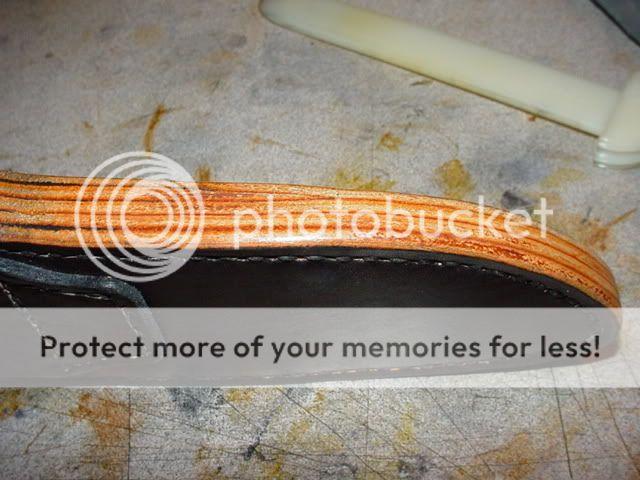
get you 400 grit paper and damp paper towel back out and do the sides and edges, they should be looking really good when you are done. I am going to put edge coat on this, but I feel better knowing the edge is nice underneath it. Your edges should look like the second picture. If you are going to leave the edges with just dye, or you are doing a natural color sheath, you will need to spend more time working your edges. I am not going to cover that now.

tutpouch2039.jpg

tutpouch2040.jpg


Next I dye the outside of the sheath again, this will cover up all of the stitch holes and bare spots. I also dye the edges.

tutpouch2042.jpg


After you dye it make sure you rub it with a soft cloth after it dries to get the powdery stuff off and make it shine a little.

I use tandy super shene to seal the leather. If you use super shene, put it on lightly as it tends to streak. After the super shene dries. I put black edge coat on the sides. Let that dry and finish it off with one coat of atom wax.

I just remembered that I forgot to mention that I sealed the inside of the sheath before I cemented the front piece on. I will go back and fix that part.

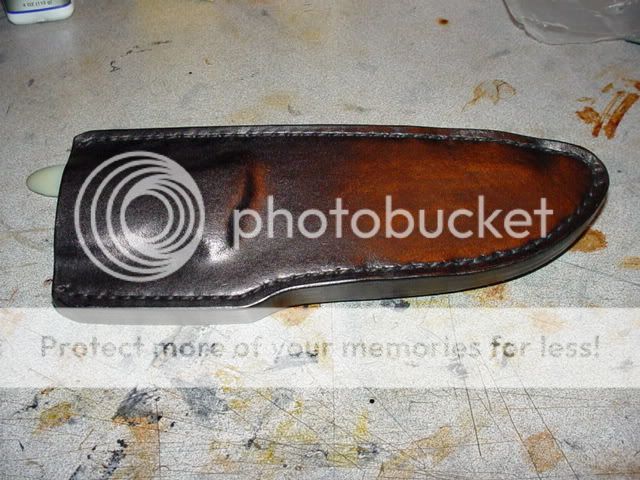
This is it finished. This was a little more work than I thought it would be. I hope it helps someone out there. :D
tutpouch2051.jpg

tutpouch2049.jpg

tutpouch2044.jpg
 
Thanks, alot of work you have put into these instructionals

Very detailed, this should help some folk:thumbup:
 
Great tutorial!!

I love the GW sheath I just got from you, and now I appreciate the work you put into it even more!!!

Thanks:thumbup:
 
Great work and pics! Thanks for the nice instructions.
 
Hey Chuddy Bear,

Do you have any tips for colors other than black? Such as, dyeing before, after, in the middle, etc? It seems like it would be tough to get even color.
 
It depends a lot on what kind of sheath I am making and what all accesories are going on it. Some of the colors are a real pain to get right. Some need to be put on while the sheath is soaking wet to get the color right, some need thinned out with rubbing alcohol (70%). Take some scrap pieces and try different things on them and see what works best. Make sure you let them dry all of the way before you decide on a method.

On the lighter colors you will get different shades if you use two different lots of leather.

I know that sounds like I am dancing around in giving you an answer, but the dyes other than black sometimes take witch craft to get to come out nice and even looking.

This is one of those things where you will get a different answer from everyone, and they will all swear their way is best.
 
chuck,

just wondering, were you a leather worker before you started making sheaths for your busses? or did you pick this up recently?

ive been interested in trying my hand at leather or kydex, but dont know where to start. i dont really have the tools, materials, or skill.

in other words, im glad you can do this, cause i sure cant! :)
 
Mark,

Prior to early March of this year I had never made anything from leather. I got interested in leatherwork due to my not wanting to wait for someone else to make it.:D

I bought a couple of books and read everything I could find on the net and then ordered the bare minimum of what tools I thought I would need and I made a few simple sheaths for myself, then badge holders, cuff cases, magazine holders, holsters etc. Guys at work started asking me for leather items and I started selling items. Then I figured I might as well sell some on that other place but their fees were killing me as I wasnt charging very much. So I figured screw them and I contacted Spark and he set me up with a Knifemakers membership and since then I have only been selling here. Now here I am working on sheaths every night after work. :D
 
Very informative and interesting reading! Pics are great! Thanks Chuddy Bear! Awesome sheath!:thumbup: :thumbup: :thumbup:
 
Back
Top