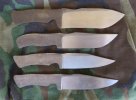
Should I make more of these? Design opinions requested

John Cahoon

JWC Custom Knives
Knifemaker / Craftsman / Service Provider
Joined
Apr 13, 2017
Messages
2,213
Greetings everyone. Thought I'd ask before forging ahead like I often do. These are pre HT so I can modify pretty easy as needed and I'd like to get some of your most valuable opinions. Longest is 10 3/4" +\- and the others around 8.5 to 9". What can I do to make these optimal?

Thanks in advance.

IMG_1254.JPG
 
I think it would be beneficial for you to spend more time looking at classic designs. Look at the work of seasoned, experienced makers and really try to understand why they shape knives the way they do. The knife has been around almost as long as man. Certain design principles and features are common because they work. Make an effort to recognize these trends and understand what works about them.

I think your knives suffer from bar-itis. You handicap yourself when you start with a bar of steel and attempt to design a knife within those boundaries. Start with a concept and drawings. You can't know how much steel you need until you know what the size and shape of the knife will be. Only after you work out the details on paper (or computer) should you go to steel.

Your handles are all pretty straight. The top sides are all roller coaster rides. You seem to have a fondness for thumb notches but they all fall in different places. The radii for the forefinger behind the heel of the blade are all different shapes and sizes. The handles could use some simplification.

I'm not trying to beat you up. Those designs just show a lack of experience. We get experience by trying and doing. You're on the right path because you are trying and doing. And it's not all bad. Your plunge lines look pretty good and I like the blade shapes of the bottom two. Your bevels also look pretty flat and well finished. I think you just have too much going on in these designs. Try to simplify shapes, make lines more flowing and continuous. Use your hand to test these shapes. Put the blade blank in your hand and mark where your thumb falls on the spine so you can put those notches in the right place. Pick a curve size and shape that feels comfortable and looks good for your forefinger, something closer to design #3. Eliminate unnecessary bumps and wiggles. Make a habit of trying to distill your designs down to their most elegant form and you'll be fine.

 
what i4marc said.

Also consider laying out all the holes in your tang before you grind the bevel. This is far safer to do then when there is a bevel to macheting its way through your flesh when least expected
 
I have a completely different take on the matter. I would suggest NOT studying "seasoned" knifemakers & smiths designs. Knives are one of the most absolutely subjective tools that exist! What I find both comfortable and eye appealing, another may feel to heavy, light or think looks butt fugly! Or, suffer from, what was it called?? Bar-Itis?? Whatever that is.

You have designed some knives that appeal to you. And that is what is important. Don't ever listen to people telling you your knife should have THIS or THAT! That is someone trying to get you to make knives according to what THEY like. It's YOUR knife, not theirs. You will gain experience and settle into your own groove over time. Just make sure they are heat treated correctly and sharp!

I remember the same type of disheartening remarks intended to be "helpful" to me years ago. But when you have person after person purchase a knife then come back for a 2nd, 3rd, 4th......! Well, you'll thank The Lord that you went with YOUR desires. Not another's.
 
I have a completely different take on the matter. I would suggest NOT studying "seasoned" knifemakers & smiths designs. Knives are one of the most absolutely subjective tools that exist! What I find both comfortable and eye appealing, another may feel to heavy, light or think looks butt fugly! Or, suffer from, what was it called?? Bar-Itis?? Whatever that is.

You have designed some knives that appeal to you. And that is what is important. Don't ever listen to people telling you your knife should have THIS or THAT! That is someone trying to get you to make knives according to what THEY like. It's YOUR knife, not theirs. You will gain experience and settle into your own groove over time. Just make sure they are heat treated correctly and sharp!

I remember the same type of disheartening remarks intended to be "helpful" to me years ago. But when you have person after person purchase a knife then come back for a 2nd, 3rd, 4th......! Well, you'll thank The Lord that you went with YOUR desires. Not another's.
I agree, looks good. Keep on keepin on.
 
When I started making knives Bob Loveless was at the height of popularity you could have and still be alive! I was fortunate to spend a little time in his shop and listen to him speak about his techniques and made two of his 3 1/2” Drop point skinner patterns . ————they sold fast and I had a bar of ATS-34 steel in my hands to make another and thought... Do I really want to make copies of someone’s else’s knives ??? ——————————————————A voice inside me said, Hell No! I want to find my own path! I’ve made what has been revealed to me! Am I as successful as Mr Loveless was? Nope, not yet and maybe not ever, but I enjoy what I do and make a living at it! So I suggest you look inside for your inspiration and feel those handles for the shape that works for you—////———Finish those knives and see what sells and have friends field test them for feedback! You are on your way! Don’t look back!:thumbsup::thumbsup::thumbsup:
 
I’m all for striking out on your own and doing your own thing. But there are certain things that work and others that don’t. Dont fall into the trap of letting your inexperience drive your uniqueness. What you think looks good might just look good becaus you don’t know any better. Plus you attached to them because you invested time. Kinda like other people’s baby’s. “Isn’t he just the cutest thing ever” no he looks like a half smashed purple alien. Peoples brains in general are the same and really good at picking out things that are off. There is a reasion the “classic” designs are classic. I say thy are a good starting point and good to practice on.
 
Greetings everyone. Thought I'd ask before forging ahead like I often do. These are pre HT so I can modify pretty easy as needed and I'd like to get some of your most valuable opinions. Longest is 10 3/4" +\- and the others around 8.5 to 9". What can I do to make these optimal?

Thanks in advance.

View attachment 905551
If they are mine ............................spine is spine .......do as you like it have no role in cutting or ergonomic :)


5Lr6ziL.jpg
 
Some of you completely missed my point. I didn't say copy other people's designs. I said look at the work of experienced knifemakers and develop an eye for what works and what doesn't. There are lots of things that work. You can be unique and break the mould while using sound design principles. Take a look at the Lockheed p38 fighter, the Tyrrell formula one race car or the Britten motorcycle. We can debate aesthetics but unlike art for art's sake, knives are tools used by people and therefore must be ergonomic.
 
I understand the thought of looking at the work of knife makers, trust me, I do it all the time and it is a tremendous help. That being said, wouldn't the expertise of a knife user actually be more valuable when in the design phase? I mean, take an outdoorsman for instance. They know what knives work best for gutting, de-boning, skinning, filleting, brush clearing, food prep and the list goes on. Call me crazy, but to look for help designing a knife I would want to speak to en expert user, for help making that knife I'd want to talk to an expert knife maker. I'm not saying there aren't tons of knife makers out there with the real world experience I'm referring to, but there are plenty who probably haven't used a knife to do half those things. I'm sorry, but if you haven't skinned 50 deer I wouldn't want you to design a skinning knife.
 
Absolutely! Get input from people with experience in what works. An outdoorsman is perfect.
 
Ok, case in point... had an origional bushcraft design. At the time, the big thing(and yo a point still is), bottle shaped handles with all sorts of fat swells sticking out. I can't stand deep swells. What many call "ergonomic", I call uncomfortable. To me it's a rediculous concept that has been copied over & over again. So to many a new knifemaker, that's just "HOW IT SHOULD BE"! I don't make knives with deep swells, yet users love how I have designed the handles.

Another...have a friend who wanted a small knife to give as a gift. Long story, but it ended up turning into a small hunting knife, which has been one of my most popular. It doesn't follow any of the "old school" thought on hunters. Yet my friend(who has hunted his entire life in Arizona, where he lives and several others states), reviewed that it is the best hunting knife he has ever used. Dressed the majority of an Elk with this little 3.6" blade.
First hunter I ever made!

As I said JWC, you will hear some good advice about your knives, and you are going to get some absolute silliness just rife with personal opinion! I guess I'll just keep "striking out" doing my thing. But I'll tell you it's very fulfilling when person after person tells you "This is the best knife I've ever used!", speaking of YOUR designed and made knife.
 
As a new knife maker myself, this had been a great discussion. Some good thoughts on designs.

I think your thumb notches on the top two need to be smoothed out a little. But looking good. The handles on the bottom two are my favorite looking.

Hope to see updates on how they progress
 
A man who does not heed history, is doomed to repeat the same mistakes over and over again. It's only human; but it's not necessary, especially in the beginning. It's not required that you rediscover the wheel in order to make your mark. Some things in tool design work, while others have been abandoned long ago. No one performs edge packing these days do they?

I'm an inventor at heart. It's how my mind works, yours does as well. We are tool makers. I am always looking for a way to improve on an existing tool. I'll take a tool in hand and ponder, "is there a way it can be designed to work better. It makes sense in making knives as well. As Lawrence stated above, not much improvement in design is needed when handling a Bob Loveless knife; but you can try.
If you take the route of shaping each knife you make using a "new" concept" you are going to be redesigning the wheel.
The slightest change in length and height, an 1/8 of an inch, makes a huge change in how the knife works. Move the tip of a Loveless blade [up] an 1/8 of an inch and it's no longer the same knife.
I am going to copy and paste an above post because I believe it is how a new knife maker should approach knife making. There is time to become another Don Hanson or Bruce Bump, but first you need to learn how and why Bob Loveless was so successful.


I think it would be beneficial for you to spend more time looking at classic designs. Look at the work of seasoned, experienced makers and really try to understand why they shape knives the way they do. The knife has been around almost as long as man. Certain design principles and features are common because they work. Make an effort to recognize these trends and understand what works about them.

I think your knives suffer from bar-itis. You handicap yourself when you start with a bar of steel and attempt to design a knife within those boundaries. Start with a concept and drawings. You can't know how much steel you need until you know what the size and shape of the knife will be. Only after you work out the details on paper (or computer) should you go to steel.

Your handles are all pretty straight. The top sides are all roller coaster rides. You seem to have a fondness for thumb notches but they all fall in different places. The radii for the forefinger behind the heel of the blade are all different shapes and sizes. The handles could use some simplification.

I'm not trying to beat you up. Those designs just show a lack of experience. We get experience by trying and doing. You're on the right path because you are trying and doing. And it's not all bad. Your plunge lines look pretty good and I like the blade shapes of the bottom two. Your bevels also look pretty flat and well finished. I think you just have too much going on in these designs. Try to simplify shapes, make lines more flowing and continuous. Use your hand to test these shapes. Put the blade blank in your hand and mark where your thumb falls on the spine so you can put those notches in the right place. Pick a curve size and shape that feels comfortable and looks good for your forefinger, something closer to design #3. Eliminate unnecessary bumps and wiggles. Make a habit of trying to distill your designs down to their most elegant form and you'll be fine.
 
A man who does not heed history, is doomed to repeat the same mistakes over and over again. It's only human; but it's not necessary, especially in the beginning. It's not required that you rediscover the wheel in order to make your mark. Some things in tool design work, while others have been abandoned long ago. No one performs edge packing these days do they?

I'm an inventor at heart. It's how my mind works, yours does as well. We are tool makers. I am always looking for a way to improve on an existing tool. I'll take a tool in hand and ponder, "is there a way it can be designed to work better. It makes sense in making knives as well. As Lawrence stated above, not much improvement in design is needed when handling a Bob Loveless knife; but you can try.
If you take the route of shaping each knife you make using a "new" concept" you are going to be redesigning the wheel.
The slightest change in length and height, an 1/8 of an inch, makes a huge change in how the knife works. Move the tip of a Loveless blade [up] an 1/8 of an inch and it's no longer the same knife.
I am going to copy and paste an above post because I believe it is how a new knife maker should approach knife making. There is time to become another Don Hanson or Bruce Bump, but first you need to learn how and why Bob Loveless was so successful.


I think it would be beneficial for you to spend more time looking at classic designs. Look at the work of seasoned, experienced makers and really try to understand why they shape knives the way they do. The knife has been around almost as long as man. Certain design principles and features are common because they work. Make an effort to recognize these trends and understand what works about them.

I think your knives suffer from bar-itis. You handicap yourself when you start with a bar of steel and attempt to design a knife within those boundaries. Start with a concept and drawings. You can't know how much steel you need until you know what the size and shape of the knife will be. Only after you work out the details on paper (or computer) should you go to steel.

Your handles are all pretty straight. The top sides are all roller coaster rides. You seem to have a fondness for thumb notches but they all fall in different places. The radii for the forefinger behind the heel of the blade are all different shapes and sizes. The handles could use some simplification.

I'm not trying to beat you up. Those designs just show a lack of experience. We get experience by trying and doing. You're on the right path because you are trying and doing. And it's not all bad. Your plunge lines look pretty good and I like the blade shapes of the bottom two. Your bevels also look pretty flat and well finished. I think you just have too much going on in these designs. Try to simplify shapes, make lines more flowing and continuous. Use your hand to test these shapes. Put the blade blank in your hand and mark where your thumb falls on the spine so you can put those notches in the right place. Pick a curve size and shape that feels comfortable and looks good for your forefinger, something closer to design #3. Eliminate unnecessary bumps and wiggles. Make a habit of trying to distill your designs down to their most elegant form and you'll be fine.

LOL!! :D I'm guessing were attempting to quote what was said. I'm reading your post and I think, "wait a minute! Isn't he repeating what was already said??!? Plagiarism much?"

Then a couple sentences in I it was obvious you just didn't quote.
Funny though.
 
Bearklr nailed it, unless the knife is a never to be used art knife. The first time you use your new knife after being dropped off by plane 150 miles from nowhere, and you get hotspots on your hand after 10 minutes of gutting, skinning, or chopping, AND you have 5 more animals to go through yet, you will curse that blade. The first time you have a quality blade that holds its edge through 5 caribou and fits the hand perfectly in slice, draw, and chop positions, you will love that knive and never get rid of it. Uniqueness is a cool factor, but should never impede on functionality and ergonomics.
That being said, an awful lot of knives, that don’t meet muster IMO are being sold nowdays. Feed your own market I guess.
 
Last edited:
We can debate what the best designs are, but to me a good question here is about execution.
Do you have patterns that you designed that look like these knives?
In other words are these the result of successful execution of a plan (or did they just come out like this somehow)?
As a beginner myself, I like to see how well I can follow my plan and then make a new better design the next time.
 
i think there is some good wisdom in almost every post. i guess it all depends on how you want to approach it. unless you are making art knives, you do have to follow some boundaries pertaining to the purpose of the knife, hunter, skinner or fighter. it seems like all the best designs for each task have already been used and spoken for and we are stuck using something that has already been invented. after all these years i can finally make a decent knife, but i cannot seem to design or draw one that is original and unique that makes tons of orders come flying in. i admire those who can !
 
Back
Top