Slip joint critique

Joined
Feb 10, 2013
Messages
1,019
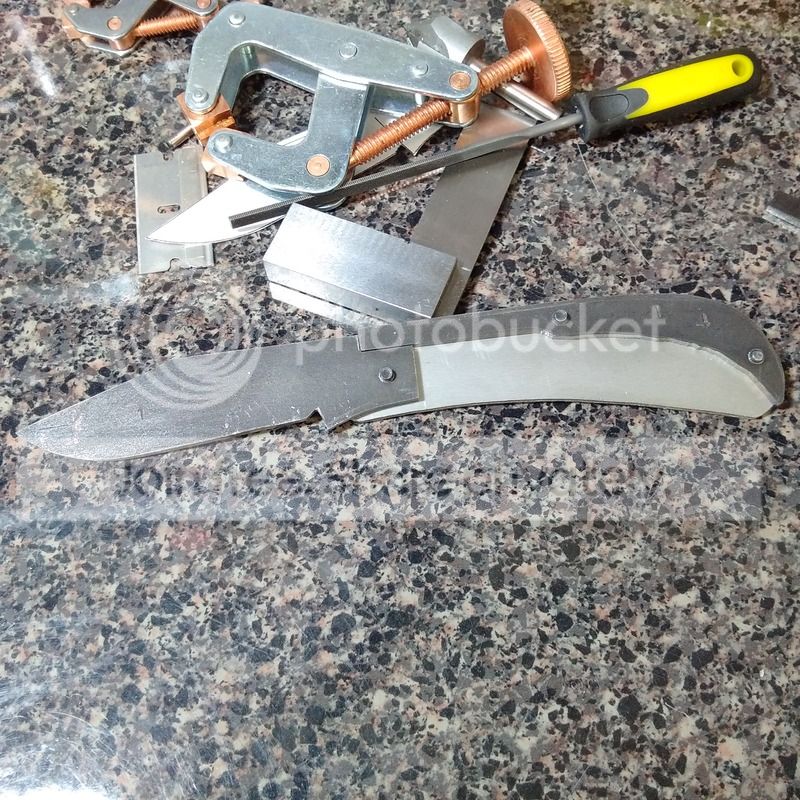
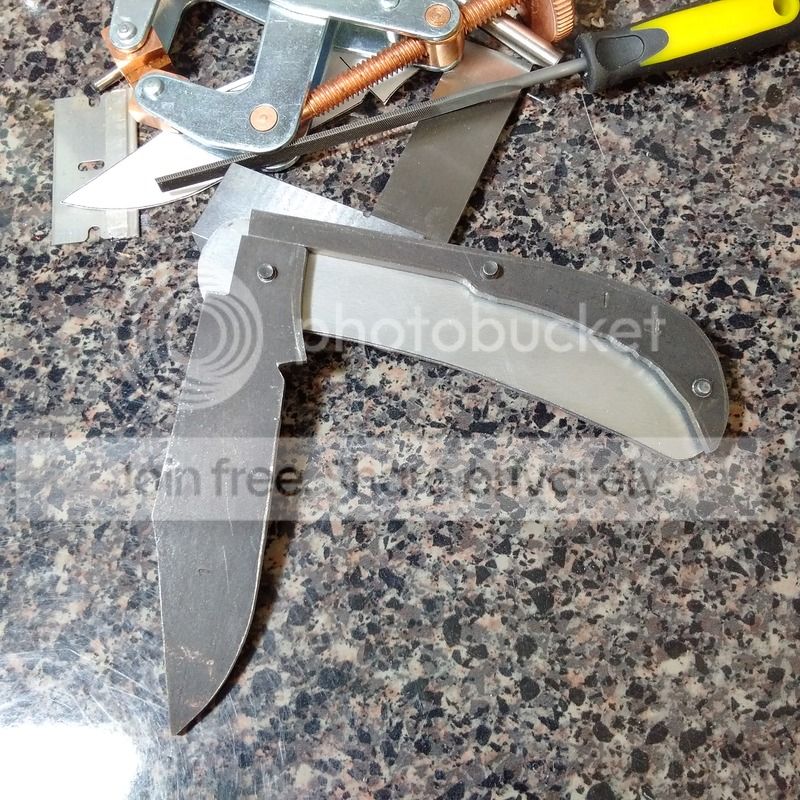
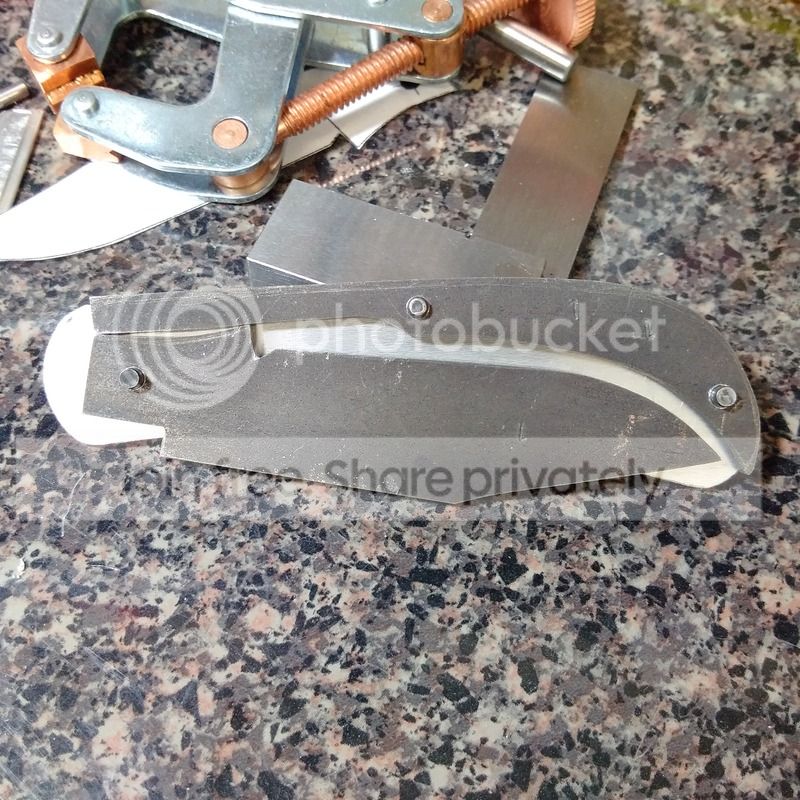
I'm working on my first slip joint and was wondering what I've done wrong or could be doing better. The spring is a little loose in the pocket right now but if I take out the middle pin and put a little pressure on the back spring it fits pretty well. I'm guessing it will be OK when there is a bend in it. The back spring is around 1/16" proud so I think there is going to be plenty of room. When does the bend get put in and what is the best way to do it? Once I round off the corners on the back of the tang the blade should sit in a little deeper. How much room in advisable between the edge and the back spring? I'm using 1/8" pivots to hold it together instead of pins.

IMG_20160227_213109_zpsoylw4xje.jpg


IMG_20160227_213834_zpshc5mrzfv.jpg


IMG_20160227_222736_zpsv4n3sxw4.jpg
 
It looks like a good start but you should pre-load your spring, not bend it. Personally I like my front spring pin to be a bit further back (about a third of the space you've got), even if I want a heavy spring, I don't want it stiff and under as much tension, although some will disagree with me.

I'm about to hit the sack, but if nobody explains how to preload your spring against the pivot, I'll explain tomorrow.
 
The spring should be pre loaded, that is the tip of the spring should be lower that the tang when the blade is opened by about 3/32 of an inch. Its easier to harden and temper the spring first so you know what the spring strength is and adjust the tang and spring to get the right opening tension. I agree the middle pin needs to be moved back to prevent excess strain on the spring.
 
Also in your second pic the spring should be sitting all the way across the tang, for a better walk and talk.
Where it's at now Will Work but will bind a bit coming from half stop to full open.
But it will work how you have it just not ideal.
The only way to correct it is to build a longer spring or rework the notch of the knife where the spring sits in the open position.

I use a light table on my paper templates checking all these variables before I start cutting steel.


Looks like it's coming along good.
Each one you will pick up a little more knowledge.
 
Thanks for the replys. Regarding the pin location, I went off an existing Lanny's Clip template so I assumed it would be good. I was just looking at the fit of the back spring and I think I will make a new one as I filed it a little too short and there will be a hairline gap where it sits in the notch and meets the spine on the blade. While I'm at it I will cut the notch further into the spine to hopefully alleviate the binding issue.
 
Last edited:
Also in your second pic the spring should be sitting all the way across the tang, for a better walk and talk.
Where it's at now Will Work but will bind a bit coming from half stop to full open.
But it will work how you have it just not ideal.
The only way to correct it is to build a longer spring or rework the notch of the knife where the spring sits in the open position.

I use a light table on my paper templates checking all these variables before I start cutting steel.


Looks like it's coming along good.
Each one you will pick up a little more knowledge.

I think once a small radius is added on each corner it will be slightly better, although the spring does seem like it may be just a hair short.

I do agree with the previous post that pre-tension should already be set by the time the holes are drilled in both the back spring and the handle. There are a couple of ways to do this, and while I have bent springs forward in the past, the best way is to drill your center hole in both the spring and handle, pin everything together, then kick your spring forward and drill your back hole. I also use a method where when scribing the back spring initially, I will scribe only the back half of the pattern, and then kick the front of the pattern forward and scribe it in a "pre-tension" position. It is then basically cut out in a pretension shape from the start.

If I'm not mistake, this is from the smaller Lanny's Clip pattern that I drew up in AutoCAD? (Based on Tony Bose's original design, of course)

I had drawn everything as it should kind of "finally" end up, though if you go strictly off of the pattern, it's not going to work exactly.

Here's a video I recently re-did showing the pre-tension method I briefly mentioned above:
[video=youtube;jefUBwGNsb8]https://www.youtube.com/watch?v=jefUBwGNsb8[/video]

Hopefully it makes things a bit more clear.

BTW, that's a different pattern in the video, but the concept is the same for just about any pattern.
 
Yes it is your pattern, thank you very much for providing it. I increased the size to 120% so the handle is over 4" long. Thanks for the video link. I will be making a new back spring so I will watch the video prior to doing it.
 
All good stuff brought out here about slipjoint assembly. A few 6-7 years ago abunch of these were floating around
BF, people were even making them and selling them. I obviously made mine but it still works fine. While this knife is
a cam-end it works the same for half stops. Allows you to clean up and polish spring and tang before assembly, you can
tell if you have roughly .040 rise. I usually leave the half stop and closed positions a bit high until closer to final. Ken.


Andrew, I watched the video and it was informative. I will be making a new back spring for this one. I'm guessing that the process is to heat treat the back spring and get the fitment right and then heat treat the blade? I was trying to get everything right prior to heat treat.
 
If I had any hair this device would help keep me from pulling more of it out. Also it can give you an idea on blade attitude
and how long the spring needs to be, pin holes, etc. Iwould now "wrap the frame" around the blade and spring by putting
pressure under the spring at the back. Then drill the back hole in the frame after you have the attitude where you want
it. You end up being a serious tool whore before its over. By the time you do the fit up the blade and spring are already
heat treated.
Ken.
 
Last edited:
Andrew, I watched the video and it was informative. I will be making a new back spring for this one. I'm guessing that the process is to heat treat the back spring and get the fitment right and then heat treat the blade? I was trying to get everything right prior to heat treat.

What I do after scribing the pattern as shown in the video, is cut the spring out, leaving a small amount of extra material on the back of the spring, as well as leaving the end that mates with the blade just a little longer than the pattern. I also drill my back pin hole in the spring as the pattern dictates.

By this point I normally also have the blade cut with a pivot hole drilled, and a nail nick cut in. The blade is cut exactly to the template EXCEPT that I leave additional material on the kick and the very bottom of the tang. The notch that the spring will fit into is cut precisely to the pattern and will serve as the "0" point for my rise and fall indicator, if that makes sense.

Once my blade and spring are "rough cut" as mentioned above, THEN I heat treat both, and go through temper cycles as normal. After the blade and spring are hardened, I will "rough assemble" them onto one side of the handle, pinning the blade, and the center of the back spring into place. I can then mate up the spring and blade and scribe the exact length I'll need for the spring. This is taken to final dimension (CAREFULLY) on my belt grinder. This video shows that process a little better, although IIRC, the ending got screwed up somehow during upload. It should still be enough to give you a good idea.
[video=youtube;FA481oy1FMs]https://www.youtube.com/watch?v=FA481oy1FMs[/video]

Once you get a good tight mate/fit, you can spring temper your spring (actually this can be done right after heat treat as well), and then start working on the rise and fall. I think I cover that some in the next video.

At some point in the hopefully not so distant future, I think I'm going to try and redo that series of videos with a little more detail and better camera angles. Hopefully these are enough to help.

 
I go about it a little different...
I do all my fit up leaving the half stop and close position a hair high.
Than I heat treat reassemble and slowly take away until flush in all the positions.
I do this because I don't have a rise and fall indicator.
I can feel better than I can see.
 
Andrew, I watched the video and it was informative. I will be making a new back spring for this one. I'm guessing that the process is to heat treat the back spring and get the fitment right and then heat treat the blade? I was trying to get everything right prior to heat treat.

Thats my way, I find it easier to shape the blade before its heat treated.
 
I do all my fit up leaving the half stop and close position a hair high.
Than I heat treat reassemble and slowly take away until flush in all the positions.

I do it pretty much exactly the same way , but with the indicator. The flush on top
is done with a fingernail and or sighting down the spine.
Ken..
 
I also do the same, high half&closed than fit flush by eye and fingernail. Fitting an opened higher position can be more tricky.

Lo/Rez, to get rid of the hairline on the spine you want a less than 90° corner on the notch, and/or a slanted front spring face....they should meet only on top, closing at the spine. Just have a look at Ken's picture to see what i mean. Also i suggest to have the spring a little longer than necessary (blade not completely opened) until the last fine tuning, to make up for the spring flex, which will have the blade open a little more and the closed position with the point a bit higher.
You could find Culver's tutorial on slipjoint design, it explains in details all this stuff...very good starting point
 
Last edited:
Another question....I was going back on another thread and was wondering why 0.040" of rise is recommended.
 
I have never read anything like that...
Not that it is not written. But I believe mine are more than that all the time.
I think it would matter where your pivot pin is on the spring.
Or how big your blade tang is.
Too much stress and you will bend rather than spring.
And to little I believe will not allow to close properly.

A quick measure of my EDC Soddy junior has a bit more than 1/16" and no issues.
Maybe there is s rule of thumb but I'm not sure of it.
 
I'm pretty sure you can make the rise whatever you want, I know my cam -tangs are more than that, but
Iv'e made stockmans that I know were'nt over .040 rise. As long as the knife operates well without too
weak of, or a broken spring you should be fine. I'm sure after working on the one in the picture its way more
than .040. I know that on half stops I round my corners pretty well- no need for bear traps as long as they
stay solid in position. As Manny said above where the spring pivot pin is.
Ken.
 
So I just shot a pic of this Grandaddy Barlow, its the one in the pic above on the rise and fall
indicator. Best I can tell its a hair over 1/16" on the rise-- so .063 plus. The action is great,
excellent W/T, with good snap.
Ken.
 
Back
Top