Slipjoint build help (DONE)

Joined
Jul 27, 2015
Messages
460
I have read so many tutorials I think I'm confusing myself a bit.
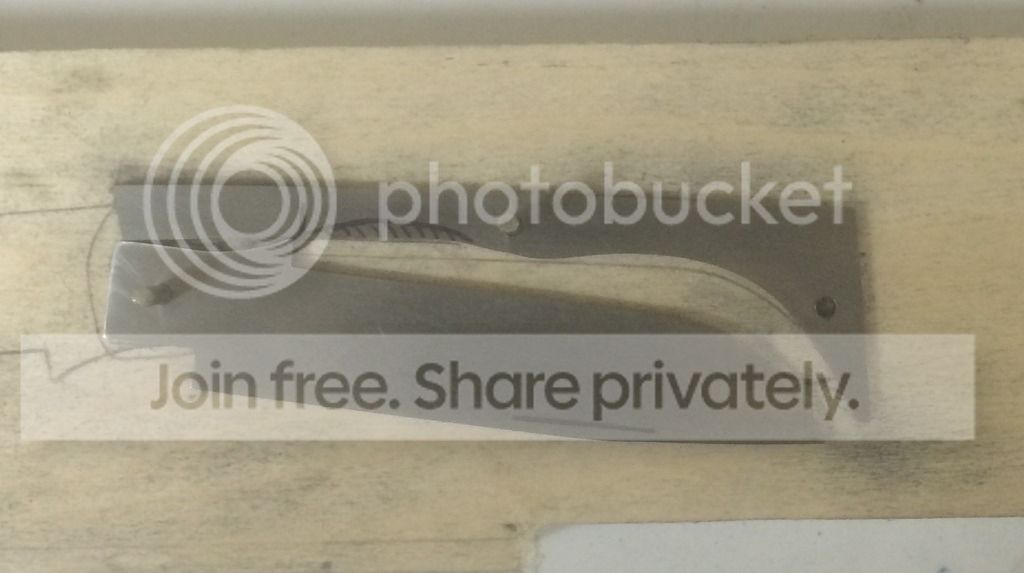
This is where I'm at, no heat treat at all.

My rise and fall of the spring bar is exactly where it should be in all three positions...( as close as I can get it with measuring anyway).

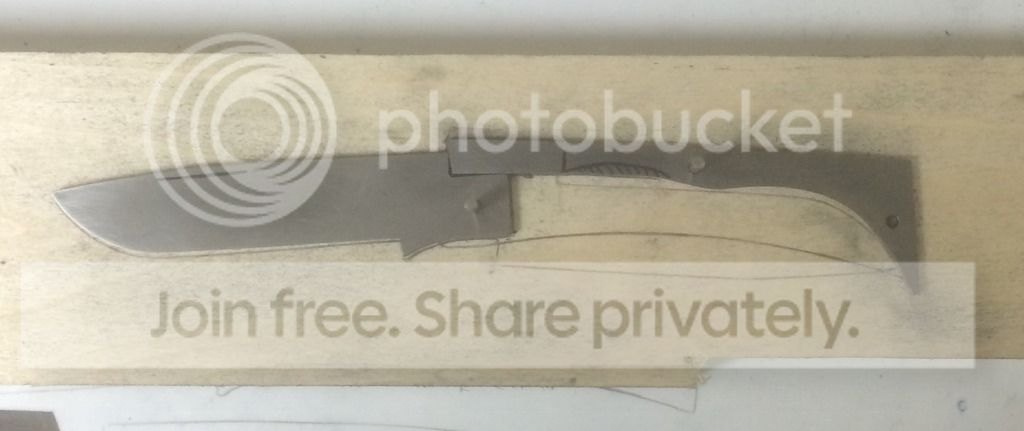
I've marked out my nail nick, blade walk, and where I would remove from spring after HT.

Although I have my rear hole drilled I have not pined it down thru this process because I need to add preload with it. I have also left plenty of top spring meat to grind away later.

Question is... Should I heat treat the spring and temper it now before going any further on adjustments?

Thanks for any help.


Last edited:
Yes. I don't bother trying to do any dial-in before HT. You need to cleanup material all around the blade and spring profile, which unless you've got some trick I'm not aware of, will likely not uniformly remove material from each component proportionately. If this isn't stainless, and you're not HTing in foil, you'll have decarb, scale, etc, to contend with.


On top of all that, if you don't get your holes drilled in your liners *exactly* where they are on this jig of yours, preload will subtly affect your mechanics.

IMHO, (and YMMV of course, I know there's a million ways to skin a cat) you're better off to ignore all this until after HT. At that point, drill your center spring hole in one "liner", setup the pivot hole (which determines engagement at the end of the spring and the run up, and thus the angle of your blade in relation to the rest of the knife), get it where you like it and drill that, then put the blade on with a pin in the pivot and the center spring hole, mark the back of your spring with a line on the liner, at full engagement, remove the blade, and use that as a guide to setup pre-load. Half of the hole diameter is a good starting point. Clamp the front of the spring, leaving the center pin in, and drill your back spring hole into the liner using the spring as a guide. All of this of course, should be done after HT, and after cleaning up the profile of the blade and spring, and you may have to re-ream your holes, if you're HTing without some atmospheric protection.

Then duplicate this liner to the second liner, and you can temp pin the whole thing together, and even without a rise/fall indicator jig, can dial in the tang geometry using feel. In fact, even using the indicator, I always make minor adjustments by feel.

You'll need a remove a bunch of the meat off the back of that spring to get it where you can open and close this with temp pins in the back spring hole, but just putting pressure on the spring by hand won't give you an accurate view of the action.


Personally, I'd thin the whole spring down, instead of leaving a huge landing on the end of it and carving out the adjustment area, but that's just the way I do it. To my way of doing things, you've got a whole lot of wasted space inside there and the end result is likely to be disproportionately wide in the handle, relative to the blade.
 
Very good suggestions! I also find almost useless the rise and fall indicator, since the adjustments i do by hand, and short of having a scribed line to refer to i prefer to go by look and feel with many trials :) The quickest tuning procedure for me is setting first the closed position, setting things up for having the spring higher in half stop and closed position...i start tuning from this situation on ht'ed components.
I believe also you may have too much lift on the spring due to the big square of your tang in relation to the lenght of the spring.
Welcome to the slippy land of insanity ;)
 
Ok worked late last night heat treated the spring and tempered in a shallow pan of oil set ablaze.
That seemed to work great minus the smoke in my garage.

Also added the nail nick and tried to flat grind the blade on the 2x42 but quickly figured out, I can't flat grind. So I finished it up on the file jig.
Polished all contact edges and temp assembled again.
The blade stance is about 1/8 to high for my liking. So going to reposition everything again.
Plus I think I need to add more preload the 1/16" I added seems to not be enough.
I'll be going liner less with g10 scales.
Any avise is welcome.
By the way this is 01 thought I would use something cheaper for my first.


If it was mine, I'd cut the spring notch a tiny bit deeper (more forward) on the blade. Also, your spring looks way thick. By cutting your spring notch so deep toward the pivot, you've got alot of material there. I suspect strongly that you'll have to remove more material (between where the kick touches and your center pin, on the bottom picture) from the spring to get the action anywhere close to right. Never heard of any knifemaking operation that involves setting oil on fire on purpose.
 
The oil trick have been done by blacksmiths back in the day.
I've read up on it in this forum thru the search.
Can't say why it works but it has worked for me and others so far.

I'm going off a pattern of a disassembled case sodbuster.
I'm sure there will be more grinding to be done here and there.

Does the spring load regulate how easy or hard it is to open?
Because it's seems easy now, but does lock up good in open and closed position.
 
Spring load will play a part in how easy/hard it is to open. Spring thickness, length, width, temper, all play a part as well as "position" or "pre-load".

Ultimately, it will play into how long the spring lasts as well...
 
Spring load will play a part in how easy/hard it is to open. Spring thickness, length, width, temper, all play a part as well as "position" or "pre-load".

Ultimately, it will play into how long the spring lasts as well...

This is correct, and under no circumstances will it be possible for any of us to explain all the caveats. Every component interacts and multiplies on the others, which is what makes slipjoints the most challenging pocket knife style to master IMO. That's also a huge part of the appeal for many of us. Everytime I think I've got all the subtleties figured out, I screw something up and realize how much more complicated it was than I thought. Especially if you're making one-offs, and not just doing runs of repeating patterns.


That's exactly why I encouraged you to heat treat everything before doing all the stuff you're doing now, and to set up your pre-load from the start. You can not approach slipjoint making as a series of independent and unrelated components. They're all highly interactive, and require high precision if you're shooting for the best possible result. 0.001 of inaccuracy at some point in the tang or spring interaction, can result in 1/16" at the tip of the blade. Take a few thou off the end of your spring where it contacts the back square/run-up and you could be making new liners, or spring.


Spring load will change the positions of your spring, blade, etc, because you're changing pressure, engagement and angle.
 
That big hump inside the backspring near the center pin needs to go. You also need to relieve the spring further to the rear. Otherwise, the first time your blade snaps shut or you squeeze the knife while closed, you'll destroy your edge.
The spring part of the backspring is still too thick, too.
Preload can be added by just bending the spring a little.
 
....Preload can be added by just bending the spring a little.

It is true, Bill is right, but i'd suggest to use as your last resort and do it very carefully and deliberatly. It is easy to slightly bend the spring sideways and will give you headaches, and you also strain the spring's steel above the yeld point :)

Another "caveat", as you are working on a wood template....you'll need to be very sure of your hole transferring on the liners, that's why i prefer to work directly from liners, when i finish i have the holes where they should be.
 
Just want to say thanks to all here.
I know it's hard to explain all the things you have been trying to get across to me.
Because there are so many variables in slipjoints.
But I am taking it in and learning with every step.
I do read and search and take everything in like a sponge.

Again Thanks to all
 
You are super welcome!
I believe this kind of knives are so fascinating, deceptively simple but actually precise clockwork everyday companions
 
I believe I'm to the point of transferring my holes to my micarta....
Where I will do final shaping of the top of the spring.
I am praying this works out ! Going to temporary glue the micarta under my oak jig and follow the holes.

I have practiced the birds eye pivot a couple times and it seems to be working out.

A question about end mill bits...
I have to relief my pivot area to avoid scratches to the tang area.
What size do you think I should pick up?
I'm thinking maybe 1/4"??
 
so do you have a mill?
I don't, so i just relieve the incriminated area with a dressed* cratex wheel by hand with a flex shaft. I do just a hair deep, blended with the surrounding relief, which is invisible, nevertheless enough to prevent any scratch on the tang. I make large use of sharpie markers and granite plate as i go, frequently checking where i am. The pattern is the same as they usually relief with the mill, but in the front i taper to zero as i go up to the spine side, since i don't like seeing gaps around the blade from spine view in open position.
At first i was sad not having the mill for this, but now i like more the way i do Vs. having a machined, deep, visible relief.

*no sharp corners, the relief is easier to be blended with the inside finish afterward.

I suggest to also center punch (the best are the hole transfer punches) your liners instead of drilling straight into the template, then using a smaller drill + final reamer will ensure exact reproduction of the holes.
 
Last edited:
Stefano, your becoming a knife maker bit by bit , very good ! You also seem to handle english better .How much do you translate now ?
 
Hi Robert,
i make progress at every knife, but i am far from being happy enough with the results yet...this keeps my enthusiasm high level :)
I don't use the translator, though i should for sure LOL ;)
 
I do not have an end mill. What I tried last night on a scrap piece of micarta, was a tungsten carbide dremel bit.
Chucked it up in the drill press and and set it to about .05 deep. I fed it by hand very slowly, while the press was set to its slowest speed.
Not the best results so I would like to try an end mill bit and see if I could get it cleaner.
 
Ok got holes transfered to the micarta, final shaped, birds eye pivot in and first assemble went great.
The spring is just a hair high at half, that can be fixed yet.
And still need to relieve the scales/ liners.

Have a few questions..
I'm guessing I need to finish the micarta on the inside smooth as glass along with the spring/ spacer?
Also should I do most of my shaping before actually peening everything?
I ask this because I think the two pins on the spring my get a slight radius while shaping...
Is it possible to peen a pin on a curved surface?

Thanks for any help or ideas.

 
Good job!
Actually i use almost always the same long 3 temporary pins, recycling for every slipjoint i make; they are aisi 303, hard as a woodpecker lips and quite unsuitable for the finished knife, but very useful for temporarily hold together the knife while finishing.
When i sand one side i slide the pins flush to the surface, just proud enough to keep the scale in the right place, then switch to the other side.
Keep the pin head in the hole if you grind/sand with a soft backup, in order not to dish the hole's rim....especially in the bolster.
When peening i find it helpful having one end of the pin already peened (on a spare drill beefy chuck or a pin vise), and if the surface is curved i dress that head accordingly. I find it easier focusing only on one head at the end.


Be very careful dressing/finishing the inside of the scale, now that you have your holes already drilled you could use a granite+sandpaper, but any machine runs the risk to change your scale plane from square to the hole.
 
Little confused...
Are you saying to go ahead and shape the knife handle contours than peen, even on a curved surface?
Meaning the top of my handle will curve down into the pinned areas of spring pivot.

I probably should of used 3/16" micarta rather than 1/4"
Than the gentle top curve of my handle would not effect the pin holes.

I believe the only way to fix this is to thin the outside of the scales 1/8" and re ream everything and probably have to redo my Birdseye washers in pivot. ( I think there only about 3/16" thick)

All my peened pins will be sanded flush.
 
Back
Top