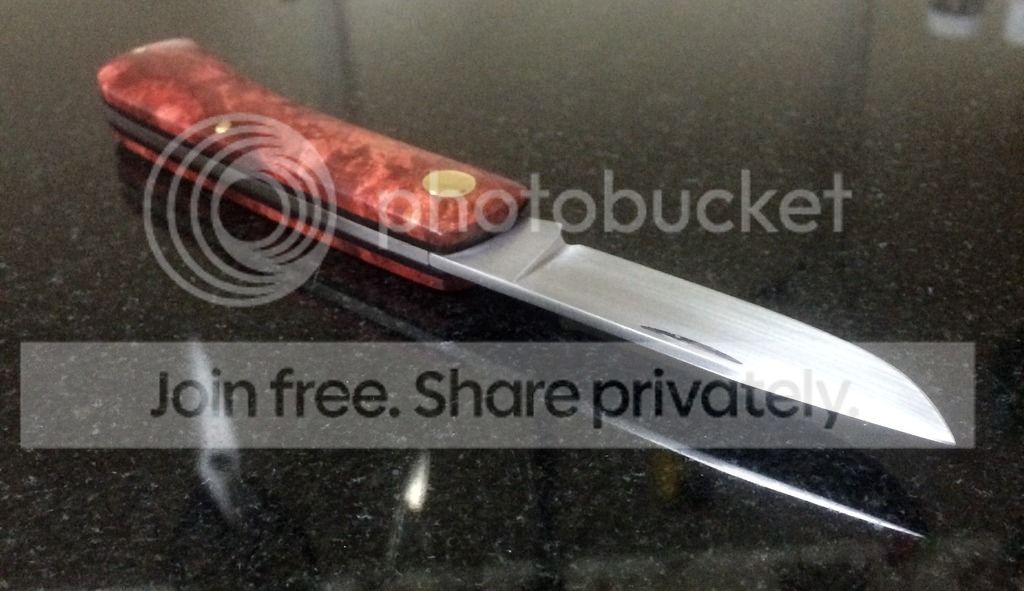
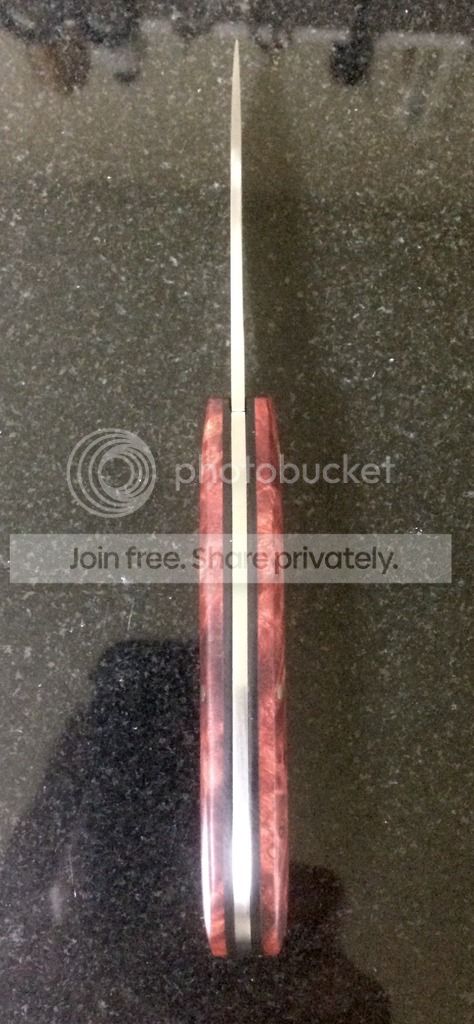
Slipjoint Critique ( New Scales Update)

Joined
Jul 27, 2015
Messages
460
I need all the help I can get, and would like to hear everything you have to say.
This is my second slipjoint and the first in wood.

I'm wanting to do better and not repeat the same mistakes over and over. Also to break any bad habits.

I can tell you this about the knife.
The Birdseye/ shadow pivot you can still see a slight circle from the main 3/32" pin. Good or bad on a knife?
It's not dead center.... And it was dead flat before filing the blade.
( I'm thinking during finishing of the blade I sanded too much on the tang???)

No half stop and it's just a hair low in the closed position.
I used a #4/0 tapered reamer on all the pins. Enough angle???

Thanks for any critiques they will be helpful in making me do better work.
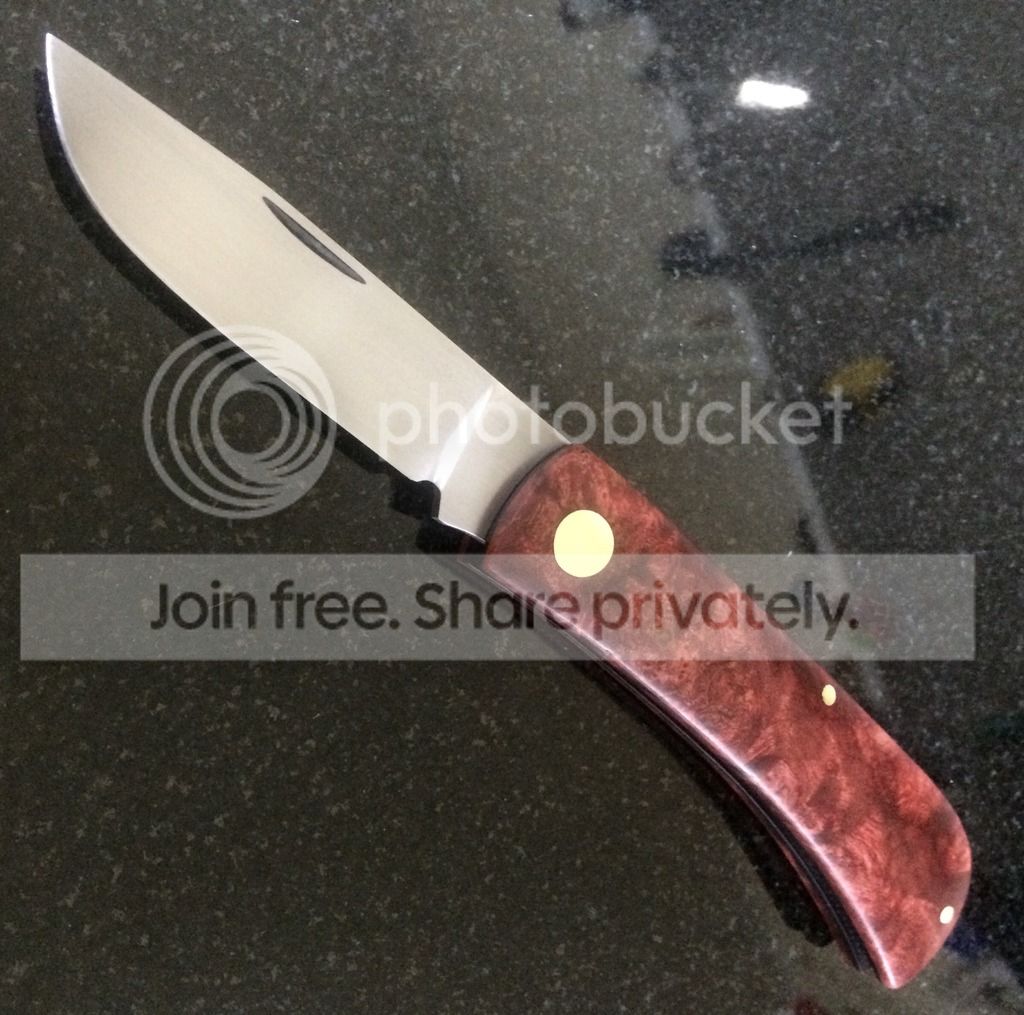


Last edited:
The liners are g10 and relieved
Dyed maple burl stabilized
Two coats tung oil
Two coats carnuba wax
 
Not bad for #2.
Did you lap the inside of the liners flat?
Did you mike the tang of the blade and also the spring to see if they were the same?If the spring is thicker than the blade will cause problems.
Both of these will make the blade wonder when peening it together.
Did it close dead center before you hammered it together?
 
To be honest I don't know what lap means...
I did run it across a granit block 400 grit until the g10 gloss finish was off.
( I figured it was dead flat already )
I didn't check if it was dead center before peening because it was dead flat before. So I didn't think about it.
And no I didn't mike the spring against the blade tang because it came from the same piece of 01. So I figured it had to be the same.
( I'm now thinking that's not going to work anymore lol)

I do know the blade was flat as flat when I got done with it on the granite.
 
If you sand on the blade and not on the spring they are no longer the same,also sanding the liners to a uniform finish is usually good enough to ensure flat.A good way to check is draw a pencil line down the length in the middle and the lightly sand and see if the whole line goes away.
If you are drilling with a drill press make sure the table is square to the quill,a hole drilled at a slight angle will also pull the blade off to one side,
 
Assuming you used a 3/32" pivot pin after you drilled the tang did you ream it with a #41 reamer to give the pin a place to swell into when peening?
Please don't take all these questions the wrong way,just trying to help figure out why the blade went off center.
Since it was O-1 did you grind before or after H/T, it could have warped slightly in H/T
 
No I did not ream the pivot it with anything.
I used a bit from Jantz supply 3/32"- .0937
A #41 is .096 It needs that much room for swell I take it.
Yep I ground the blade post HT ( possibly could of warped a bit, in really thinking now the grind could be off )
I just now put a straight edge on it and from tang to tip one side 1/16" and the other is 1/32" so that's not helping.
From now on I need to watch this while filing my bevel.
Putting all these things together on the next should center it I hope on the next.

I'm not taking any of these questions the wrong way.
This is exactly what I want to hear.
I don't want to continue making crap knives.
I have to much time in them for me not to even be able to give them away.

I guess I'm rushing it too much...
And not checking after every step.
Every little thing I don't do is compounding to a big problem at the end.

Another thing is I super glued the g10 to the maple burl after roughing both mating surface up.
Should I of used epoxy ?
I ordered the west system G/flex

I'm here to listen and take notes.
No one is going to hurt my feelings about this knife.
I need to hear all the bad I can to change things for the better.
 
The knife looks great esp. for #2. Stan's questions are all valid. Grinding post heat treat allows you to
grind the blade to center while holding tight in the frame. If its off a hair I usually put the shim in before
peening on the side its leaning toward. You can also check during peening and tap a bit more on the side
you want to draw the blade to - this can do wonders to draw the point of the blade over. Also before peening
squeeze the frame tight against the blade see where the blade sits. If its off, rotate the pivot pin 180 degrees
and check again. I use a carbide reamer in a pin vise that is shaped like a christmas tree and its been a very
long time since I've had a halo with ss to ss. Tools like these can help a lot. I've used super glue exclusivley
for about 12 or 13 years now no problems.
Ken
 
Last edited:
You mentioned every little thing you don't do is compounding to create big problems at the end.
When you add another blade or 2 it can get crazy. You're pretty much right, you have to pay attention
to every bit of a slipjoint. The holes in the vise grip jaws go right over your pivot pin. A wee bit heavy
handed on the hammer? very gently work it loose with the spreader tool from the trough side of the knife.
Ken.
 
Last edited:
KC custom that's very interesting...
So the peening of the pivot area can push a blade left or right in the closed position ?

Maybe I can get away with this to try and center it up.
It's not touching at all now but would like it better centered.
My first one did the same thing but to the opposite side.

So do I peen on the opposite side I want the tip to go to?
Or peen on the side I want it to go to?

The peening could be my major problem.
I peen the blade last when assembling.
 
Yes the blade can be drawn toward the side you're tapping on. While not the whole answer it can
move the blade . Worse case drill and drive out the pin (with a smaller bit) and try again. There's
lots of ways to move it over. Sandblasting close to the tip of the blade can also move it by setting
up a tension on the side you're blasting, this will require refinishing the blade. Early on a lot of these
things just bent my head out of shape. After all when you're done with a straight blade its finished.
Your knives look good-stick with it. You peen on the side you want it to move to.
Ken.
 
Well I was able to move it just slightly peening.
Than being aggravated I torqued the blade to the side and got the pin on one side to pop loose.
I'll have to grind down the washer on the pivot to get it the rest of the way out.

So I'll build a new washer for that side and new pin.
So I'll have a fresh start.

I'll be able to check straightness of the blade once I get it detached from the handle.
I believe my grind is off just slightly, checking it with a straight edge.
I'll post up fix if successfull.

Thanks for all the help so far I have learned a lot.
 
I guess doing it this way of taking the blade out, it's going to be very hard to get it back in under tension.
Any one do this without taking the other pins out ?
 
I guess doing it this way of taking the blade out, it's going to be very hard to get it back in under tension.
Any one do this without taking the other pins out ?
spade bit in a drill press, knife on its spine, use the bit to push the spring.
 
Well I FAILED
Decided to drill out the pins and one of the maple scales split and lost a chunk around a pin.
Ughhhhh!
I guess I'm not ready for wood yet, lesson learned.
Ill go with solid g10 or canvas micarta on the next until I get the bugs worked out.
 
Next time just drill a 1/16" hole about an 1/8" deep in one side of the pivot pin and them drive it out with a punch. Then take a 2" long piece of pivot pin material put it in your drill and turn it opposite of the way your belt runs,hold it against the belt and grind it to a point about an inch long. Then you can push it back through your pivot hole and blade and will load the spring as it goes in.. simple as dirt.
 
I like your knife, it seems you got bitten by the bug and you are on the right track.
Double check everything with the granite, always.
Be aware that lapping (sanding on the granite) when you have your holes drilled, could change your flat plane angle from square to the holes, don't understimate this happening and take your time checking often. This is true both for the scales and the tang.
Holding the blades from the tang and pointing your eyes makes easy to spot for warps, and also pressing the tang on the granite and checking the point's height, then flip and compare.
I don't use the mic, but i have it and i should :rolleyes:
 
Back
Top