Small Knives Made of 5160?

Status
Not open for further replies.
You can't beat great toughness coupled with edge retention, 5160 is probably the top steel used in the ABS performance test.

5160 is the top steel used in that test because it is the easiest steel to ht in the forge to pass that test. Not because it holds an edge that well. You have much to learn my friend, and unfortunately, you won't learn it from the typical ABS masters, unless things have greatly changed.
 
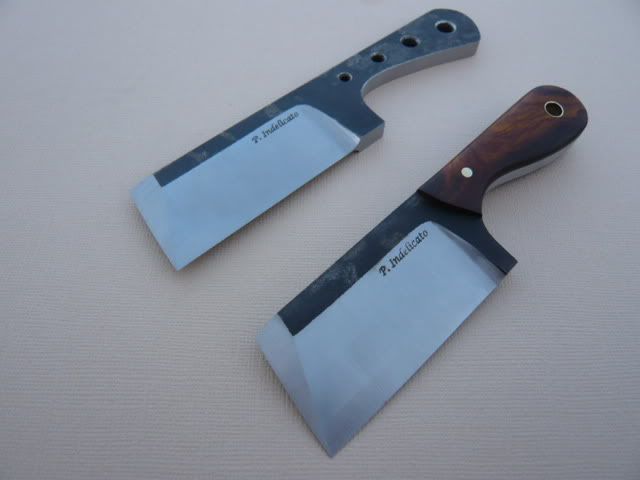
I think it depends somewhat on the intended purpose of the knife, but in general a smaller thinner knife intended for slicing and fine detail work is probably better suited to a different steel. However, I've made a few small "heavy duty" utility knives like these from 5160 with good feedback from customers.

P1030006.jpg
 
I was not going to reply to this thread, but Mr. LRB hit a sore spot.
First. Yes 5160 is a tough steel and will make a fine smaller knife, provided it is heat treated correctly. Personally I prefer a steel like 1084, 1095, W-2, but I have made smaller knives from 5160 with no issues whatsoever. They hold an edge fine. Yes this steel is used in ABS JS performance testing as it is fairly straight forward to heat treat, and done correctly will pass the test. I would say that chopping through a 2X4 twice, then slicing a 1 inch rope, then shaving hair afterwards demonstrates a pretty good edge. A number of cutting knives used in ABS demonstrations are 5160 and chop through a number of things like coke cans and hardwood dowels and a still able to slice paper. Sounds like a good edge to me. The trick is getting the edge geometry correct.

Now on to LRB's comments about learning from ABS mastersmiths. I am pretty much a "typical" ABS master and I teach at the school in Arkansas. I also demonstrate at Hammer Ins. So I guess that you are saying that a "typical " ABS master is not willing to share knowledge and that it is a closed fraternity. Totally wrong. Obviously you have not been around that many mastersmiths. In general we are pretty good people and will be more than willing to teach and educate. Perhaps you, LRB, had a bad experience, I don't know. But you might want to think before you make such broad statements.
I will get off my soapbox for now. Sorry for being long winded.
 
5160 is the top steel used in that test because it is the easiest steel to ht in the forge to pass that test. Not because it holds an edge that well. You have much to learn my friend, and unfortunately, you won't learn it from the typical ABS masters, unless things have greatly changed.

My point is that it can pass a tough test which includes edge retention and toughness.

Let's have a civil conversation, there is no need to talk down to anyone. We are all here to learn and contribute. :)

I don't think there is one ideal steel for the ideal small knife, it depends the use of the product. If you need great toughness and good edge retention in an easy to field sharpen knife 5160 is a good choice. 1084 would have even better edge retention and is plenty tough and easy to field sharpen. Maybe a stainless steel would be best for some people... you could even use S7 if toughness was a major priority or M4 for great edge retention... O1 is killer stuff too, A2 might be even better...
 
Last edited:
I imagine one reason you don't see a lot of "small" knives in 5160, is that it's generally only available in 1/4" stock.

Not a problem for the guys that forge, but it is an issue for the stock removal crowd.

I'd prefer something else for a small knife, but I'd be content with 5160 if that's all I had.

I use 5160 often for my choppers and swords; great steel.
 
Brion, I appreciate your untiring willingness to help. I get smarter when you just walk into the room.
I was once given a cool rule - "Jesus Christ, Himself, could send a bar of steel down from Heaven. It will only be as good as the heat treatment it gets."

And the way I've seen some heat treating processes used, I would prefer properly controlled 5160 to MANY of the other steels when heat treated with some of the recipes I've seen around here.

There are tons of good reasons to use decent 5160. And the reason it's used on so many Performance Tests, is because of its deep hardening aspects, and semi-successful hardening at the slow rates often found in such quenchants as french fry oil, mineral oil, old 10W30 and any number of goof-ball methods. Those reasons, and the way it responds to differential processes, make it an excellent steel for many purposes.
That said, with proper forging, post forging techniques adhered to, and proper soak times at controlled temps to deal with alloy, decent 5160 can perform exceedingly well.

A couple years ago I used 1 4 inch 5160 blade to field dress, skin and cut up for processing 8 does and 6 bucks without touching a stone.

If you want a piece of steel to perform well, simply learn the right way to heat treat it and stick to what works.

5160 will make a great small knife.

 
Last edited:
I do apologize for for my poor choice of wording, and poor manners. Yes, as to bad experiences with a few "masters", and journeymen. Not necessarily bad on a personal level, but by being subjected to their hype and misinformation regarding the superiority of forged blades, and their misguided reasons for believeing their own hype. I realize that all of them are not as I have experienced, and was wrong to paint them with a wide brush. That said, I still find 5160 a poor choice for a small knife, when so many other steels would be superior.
 
I made a really rugged small knife for a freind of mine who was going moose hunting in canada. He said that after they got a moose he used it to cut up the moose for almost all of 2 days and it only started to dull at the end of the 2nd day. it is really nice steel. i like it.
 
That said, I still find 5160 a poor choice for a small knife, when so many other steels would be superior.

guess it just boils down to what the intended use of the knife is, while 5160 may not be the best choice for many applications I think its a great steel that can go to hell and back and still keep on ticking.. some otoh may not hold up in the field and snap, varying where the steel and HT came from, I have yet to see 'horrible' 5160.. but my experience is extremely limited so take that with a grain of salt......

5160 you can pound on used as a wedge and it will come back for more..

as said already without a decent HT there are no super steels, but you know what I think 5160 comes pretty close for an all purpose field knife.. :)
 
If the question is, “Will it make a good small knife?”, the answer is yes.

If the question is, “Are there better steels?”, the answer is yes.

I’m not a big fan of 5160, but use it when toughness is the primary concern, and also have some ¾ inch round 5160 I use for blacksmith knives. It’s a little better than a R.R. spike. :)
 
Karl, thank you for the kind words, and I could not have said it better. LRB, thank you apology accepted, if you see me at a show, please say hello.
While 5160 may not be the best steel for a small knife it will be an adequate steel. Just have to heat treat it properly and know what the steels limitations are.

Brion
 
Well here's a video of the maker in question and his technique. I chug 2 beers and a pot of coffee while heating the forge and blade then pee on it when it's the right color, but just 'cause he doesn't do it like me doesn't say he's wrong.
[video=youtube_share;_Zz4o-6E8Bk]http://youtu.be/_Zz4o-6E8Bk[/video]
 
Rob,
I don't think anyone is saying that 5160 won't take a good edge. I think they are saying that it won't KEEP a good edge.

You guys can underestimate 5160 all you want. Sadly, since it's aften recommended as a beginners steel, it often gets heat treated with torches and "goop" quenching methods, with little to no grain refinement, etc.
Once properly heat treated with good temp controlled soak times following grain reduction steps, etc, 5160 can truly excel.
I have field dressed, skinned and quartered 6 bucks and 8 does on one knife prior to sharpening. And it wasn't dead dull.
Properly treated, 5160 kicks ass.
 
Far from a expert, but I have one of those layered 5160 blades of his. VERY sharp and holds a edge pretty well. My only complaint is the grind is a little bit off.

It has a look similar to the forge welded timing chain blades I have seen.
 
Last edited:
He didn't mention it, but perhaps he just had several little pieces of 5160 and welded them to make a billet large enough to make the knife with and included the line about fine grain just as a sales tactic..
 
Gentlemen. Very interesting discussion. I too have seen these blades offered for sale. I'm just starting wandering down the researching road on this pounding hot metal deal but I did wonder about the grain refinement claim. Didn't seem to sit with what I'd read here and elsewhere. So is there a cutoff coming? Mono vs forge welded 5160. I think that is the real question perhaps. Anyhoo this thread is an excellent example of why I like this outfit: offense given, counter statement, apology offered, apology accepted and invitation extended. I used the correct word at the beginning of this reply. Gentlemen.
 
I don't know how he's getting grain refinement with forge welding. I'd love to test one of his blades against a mono steel 5160 and see what performance differences there are. My experiences with forge welded blades vs. low temp forged blades the low temp does better. Depending on the steel sometimes not by much, but a noticeable difference. Not to say a forge welded blade can't make a good knife, but on endurance cutting you can see a difference, even if it's a small one.

Maybe he had some of the 5160 that had inclusions that I heard about a while back and forge welding would help get rid of it? Or maybe just the subtle pattern.
 
I watched the video and I found it odd that he would choose to use his digitally controlled heat treat oven for tempering instead of hardening.
 
From what I have experienced, the problem in the past has been getting GOOD 5160. Karl was able to find a big batch of some very high quality stuff. Likewise, a lot of Bill Moran's later knives were made from good 5160 and if you want to learn what sharp is, his knives were one way that you could find out.
 
5160 took on a whole new life for me when I set up our gas forge with a thermocouple and muffle for temperature controlled heat treating(it really does hold rock steady temps too) Anyway after what I learned from a few guys here about heat treating 5160 It just took off..I like it,.....
Now that being said I do think there are much better steels for a small knife. I personally prefer something like 1084,1095,52100,W1 and W2 for a small knife.I also like 15n20 for small knives..
 
Status
Not open for further replies.
Back
Top