So I started stripping my knife

Joined
Jul 10, 2009
Messages
3,094
My ash 1 was getting a little bit ugly in the light, so I decided to strip her. I put the stripper on, cleaned it off etc.. What's left appears to be the same color as the coating, but it's not the coating. What would be the best method to get it as close to satin as possible using just sand papers/stripper? Grits? I don't want to mirror polish it. I really don't want to take my belt sander to it.
 
I am about to strip my Ash1. The only other one I have stripped is my SS.

It was a bit dark under the coating, lightly, lightly sanded the flats just to knock the grey off. I did not finish all of it. It is still a bit gray.

post some pics of the result. Maybe this will be my "I am bored, time to strip" weekend.

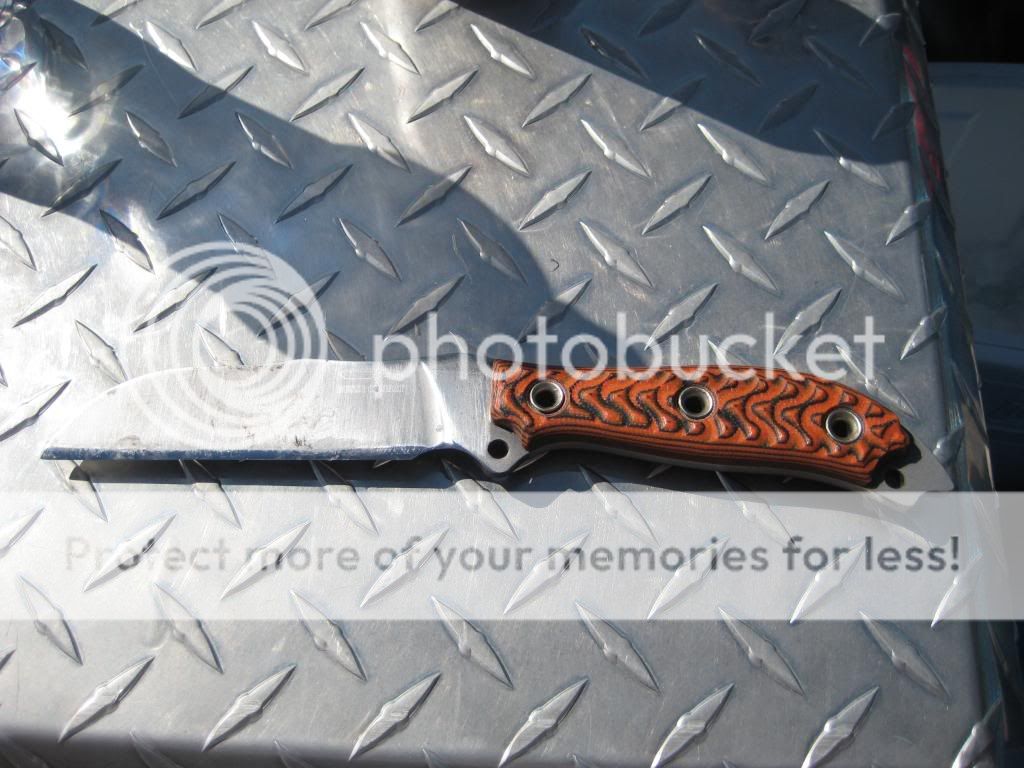
IMG_2067.jpg


It is all covered in sap from making a whole mess of marshmallo roasting sticks (that is what happens when you are the only one that brings knives camping, and there are like 30 kids running around bringing you sticks to make into roasting sticks).
 
The coating just doesn't want to come off with stripper alone, it is still actually coated a little bit. I used some 60 grit paper to explore a little bit to see if I could get down to the metal, now it's coming off with sanding. I figure the 60 grit will scratch it all to hell, but after I get all the coating off I'm going to hit it up with higher grits. How high a grit would you go to mimic a ghetto satin finish? I have to hit the store tomorrow to pick up some paper anyway.
 
I've done quite of few of these, and I can tell you from experience that using paper is a gigantic PIA; but there are some that seem to take great pride in spending hours on end and endless packs of paper doing this project by hand. I haven't found this method gives a better result than "cheating" with power tools. I figure the shop doesn't do it by hand, so why should I?

There's only two ways I will do it anymore, as I also have a life. 1) Use a belt sander which is likely how the shop applies Satin finishes and definitely achieves the best results, or 2) get a wheel that has a chuck on it for attaching it to a power drill. I got one at Walmart for $6 once that was a fibrous wheel made of some synthetic that polished an entire Crash Rat in under 5 minutes.
 
I would probably start with a higher grit than that. The finish should come off, without too deep of scratches. Unless you really are planning to run through the grits and do a lot of elbow work. I think I only hit mine for a very few passes with 220 I think. But most of the SS surface was not too bad. there is still some finish rash on one side.

It seems like some of the knives have an uber-finish under the coating from what I have seen. I don't know if it is some kind of decarb, or base coat or something. This has been discussed on here before. I am sure some others will come along to post pics.

Doing it by hand will be a PIA, but doing it with a belt sander will likely void your warranty. Not that I think any one made of human flesh and blood will be able to break a CG Ash1, but it is like a security blanket.
 
Look into what type of stripper you are using. Not all are rated for heavy duty coatings. Some are more gentle so as to not trash out delicate wood.
 
What a horrible mess this turned out to be. So my stripper was too weak, so I compensated by sanding it down with 60 grit paper.. Bad move, it scratched it up pretty bad all the way down the length of the blade. I moved up to 100 grit, going perpendicular to the original sanding, and it wouldn't take the scratches out. I went all the way up the various grits, alternating stroke direction with each grit. The finished product is so bad I don't even want to post it. Any idea how I can get it smooth and get rid of the scratches before I shoot myself in the head for trashing my knife?
 
If it was me, I would just keep sanding in the direction of the scratches: 80 grit, 100 grit, and stop there for a brushed look.
 
Looks fine to me. Knives are for beatin', not lookin' at.


Well, ok, maybe for lookin' at too. If you really want to fix it, you'll have to keep going with 80 or 100 grit until you get the 60 grit scratches out, then keep going with the next grit till you get the 100 grit scratches out, and so on. Should have probably started with something less aggressive than the 60 ;)
 
230, I think it looks fine too, just the way it is. Better looking by far than a virginous safe queen that never gets any love.

Did you apply the paint remover all the way up to the scales, and along the spine? Hard to tell.

 
230, I think it looks fine too, just the way it is. Better looking by far than a virginous safe queen that never gets any love.

Did you apply the paint remover all the way up to the scales, and along the spine? Hard to tell.


I don't care if the knife gets beat up, I use the hell out of it. I just don't like screwing something up and leaving it. I'd rather make it pretty again, then destroy it properly, not with sand paper. :eek:

It's hard to tell that I applied the paint remover all the way, because the remover didn't do it's job correctly. I wouldn't have had to sand down with 60 grit if it did. I'm getting some good stripper today anyway to finish it up, then it looks like I've got a day of sanding ahead of me.
 
Just in case you aren't aware, a lot of Busse knives have a decarb layer underneath the coating, which can, from the pictures I've seen, look a lot more like paint than bare metal, and has to be sanded off to get that bare metal look.

It's possible your stripper took off the paint but you were left with the decarb and needed to sand it off to get back to bare metal.
 
At least it's not saber ground, then you'd have a much longer day of sanding trying to get the INFI dimples off of the flat parts.
 
The shop grind the blades from the spine to the edge...IMO I would use a belt sander with a fine micro belt to remove the 60 grit scratches and give the knife a nice satin finish.

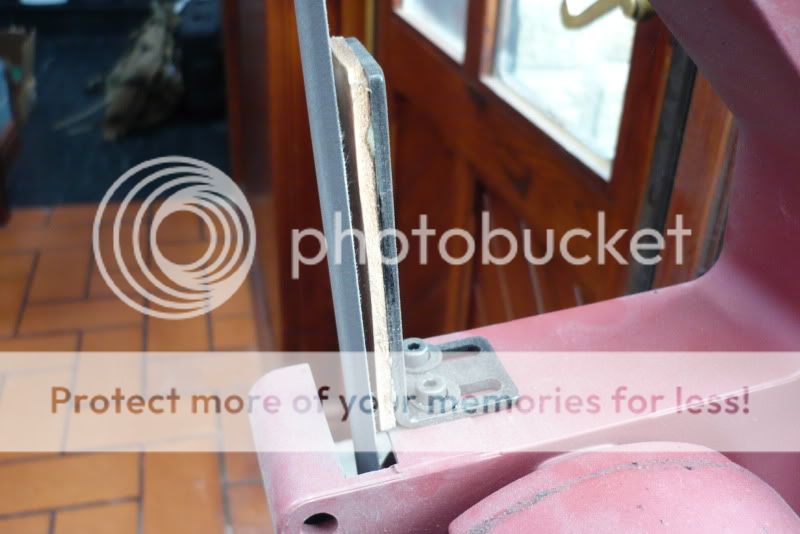
Here is my sander....

P1000837.jpg


It shows some leather glued to the platten and the belt on it is a micro polish one. Because the Ash has a flat grind you need to have the leather in place to enable the flat grind to be pressed up against it to enable a good satin finish to be given.

Do multiple light passes and use a magic marker drawing lines across the knife to show that consistant removal is being done.

Also where the edge meets the ricasso...tape this off using some flat wood on the ricasso to ensure that the grind ramp going down from the spine to the edge is not unevenly worn away with the passes needed for the sides of the knife. The ricasso needs to be done vertically and not at the angle of the grind...and should be done seperately. That way the transition from ricasso to flat grind remains as good as the shop did when they made the knife.

It sounds a lot of instruction but in reality it is a 10-15 minute job once you have the knife taped and set up.

Remember to draw the knife away from the belt once you get to the tip...otherwise this can be rounded off to a pizza knife curved effect...it is easy to pull the knife away so no problems there.

Applying a satin finish vetically down the length of the knife is not the way the knife is ground so that is why the scratches are showing up so much.

Hope this helps.:thumbup:
 
next time one of them busse knives gets a little scratch on it , just send it to me. i'll " dispose " of it.
 
When I was experimenting with the most recent machete - went through cork belts from 180-600 and then plain cork with green compound. I found about halfway through the finish resembled that of a busse satin finish.
 
Back
Top