Some insight from others. Heat Treat/IDK

Joined
Apr 30, 2015
Messages
106
Hello everyone,
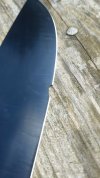
This is the second piece of mine that I've sold in my "career" that's had problems. Not nearly so bad as the first, which I probably didn't handle so well but here we are. I didn't get around to asking the opinions or insight of those wiser than myself previously so I thought I'd do it this time. I sold this knife ("Brute de Forge Chopper in 1095") to a guy in California last year, He must have re-sold it because the person contacting me about it is someone completely different from Florida (asked him if he's second owner, still waiting to hear back). Said it performed well, was mostly a wall hanger, used it recently and found after cleaning, a chip. The blade was fairly thin and tempered at two 1-2 hour cycles of 425F though my oven (yes it's a kitchen oven) goes a little hotter so probably closer to 450F. Obviously it's differential hardening. I don't have any pictures of the grain though I should get the knife back in the future to inspect. I've decided to make him another one since after my last experience that just seems like the better option but I'm just wondering what the opinions are of those outside as to the "failure". Under-temper? Large grain? Too thin of an edge? Any insight from other makers out there who know something of this craft would be appreciated

NzFVQit.jpg


C4QS0SS.jpg


sQKZnvK.jpg
 
Maybe a little over heated/grain issue. I just made a couple 1095 choppers with rather thin edges, they got thinner than I intended, but even with a 400F temper the edge wrinkled when testing, didn't chip. But these were stock removal and very fine grain.
 
Maybe a little over heated/grain issue. I just made a couple 1095 choppers with rather thin edges, they got thinner than I intended, but even with a 400F temper the edge wrinkled when testing, didn't chip. But these were stock removal and very fine grain.
Possibility I guess. My grain is usually always very fine. Thanks for sharing your thoughts. Yeah I can't quite understand why this happened.
 
Hmmm, that looks like what one of my 1095 kitchen knives tempered @ 350 would do if used as a chopper. Checking your oven with a good thermometer? Only other thing would be a grain issue to my knowledge
Hello everyone,
This is the second piece of mine that I've sold in my "career" that's had problems. Not nearly so bad as the first, which I probably didn't handle so well but here we are. I didn't get around to asking the opinions or insight of those wiser than myself previously so I thought I'd do it this time. I sold this knife ("Brute de Forge Chopper in 1095") to a guy in California last year, He must have re-sold it because the person contacting me about it is someone completely different from Florida (asked him if he's second owner, still waiting to hear back). Said it performed well, was mostly a wall hanger, used it recently and found after cleaning, a chip. The blade was fairly thin and tempered at two 1-2 hour cycles of 425F though my oven (yes it's a kitchen oven) goes a little hotter so probably closer to 450F. Obviously it's differential hardening. I don't have any pictures of the grain though I should get the knife back in the future to inspect. I've decided to make him another one since after my last experience that just seems like the better option but I'm just wondering what the opinions are of those outside as to the "failure". Under-temper? Large grain? Too thin of an edge? Any insight from other makers out there who know something of this craft would be appreciated

NzFVQit.jpg


C4QS0SS.jpg


sQKZnvK.jpg
 
Well, if it is really thin at the edge, and you hit full hardness with 1095, and your oven really was only at 400, that's potentially ~63 RC. 425 is still potentially 62. 1095 in a knife this size, with an actually thin edge (most people's opinion of thin aren't the same as mine though), seeing edge chipping wouldn't be remotely unexpected. Now, on the other hand, that chip, looks like either a) a grain, inclusion, or fracture issue, or b) someone hit a rock or something really hard chopping something.

Kuraki, personally, I wouldn't expect to see 1095 edge rolling at that hardness with thin edge geometry, did you test yours for hardness? I run a lot of W2 at 62-63 RC, that's where it shines IMO, but if the edge geometry gets thin enough, it will chip, although not typically like the above photo, however, it's expected behavior.


One thing that sometimes happens (fairly often I think); if you do heavy pre-HT grinding, you may have a lot of decarb at the edge. Remember, decarb doesn't just happen on the flats of the bar, it happens at every exposed surface. I often see makers not remove any material at actual apex of the cutting edge, after thermal cycling and hardening. The more time in the furnace or forge you spend, the more this can be an issue. This can leave you with a fairly soft edge apex, until you sharpen past that. At an edge, decarb is penetrating from both sides, and the edge apex into the steel, consider that, and it'll give you some perspective how much potential decarb you could have, if you pre-grind too thin.


I would definitely recommend minimum 2 hour tempers each time, and if you do heavy finish grinding, do your second temper after you go introducing tons of stress from working on the knife.


Regardless, if you're not able to utilize specialized HT equipment, and unable to test your hardness. I think you'd be better off tempering long thin choppers from 1095 at 500 degrees F. Assuming everything else is correct, that should put you at a much more comfortable 59-60 RC, which will perform well in that role. Running steels that aren't extreme toughness alloys, above 60, really sort of mandate having everything dialed in, precise control over the forging, thermal cycling, stress relieving, hardening, and tempering, in conjunction with precise (in the sense that you've tested the results of those variables and can repeat them) edge geometry, and even still, your customers should be educated as to what the knives can and can't handle, as frankly, it's a specialized configuration, not a "jack of all trades" one.


To be honest, I'm surprised you haven't seen this before, if you regularly make knives like this. If you're going to run 1095 or W2, or White steel at 62+ RC for a long thin chopper, you've got to compensate somewhere, typically in the apex edge geometry.

Although it still looks like they chopped a rock or something else very hard. I have seen hardwood knots take chunks of steel out that shape, especially if they wedged the knife if it's thin, and put lateral stress on it trying to get it out.
 
Another thing worth mentioning, a lot of kitchen ovens, not only are grossly inaccurate on temp, but swing a LOT. Don't assume because you checked it once at a certain temp, that it's holding that temp consistently. You really need to use a thermocouple with a digital meter, and watch it, duplicating your process. i.e. bring the oven up to temp, let it stabilize how ever long you normally let it, open it, put some steel in there, then watch what it does. It'll probably overshoot, and rebound, but sometimes the cheap internal probes overheat during that and take a long time to cool, leaving the oven significantly colder than it's reading, even though it shot up to a high temp for a bit.
 
I would expect that it was too thin an edge, and perhaps a bit too hard for a chopper. Edge damage on a chopper is something to be expected. That is why I recommend a convexed final edge.

I agree with javand that most folks temper way to low. I would do all 1095 choppers at 450-500F.
I think the reason many makers get Rc 59-60 blades with a 400F temper is they never fully hardened the blade in the quench. Wrong oil, wrong oil temperature, not soaked long enough to get fully austenitized, wrong austenitization temperature, etc.
 
I did not check. It's completely possible they were a little underhard from the quench.
 
Thanks for the feedback javand and Stacey. Very informative. I'll probably take you up on your suggestion checking the oven. I've checked it with an oven thermometer (I usually just leave it in there every time and check it every so often) (and just observing the temper colors) before and it seems pretty stable (though that may be a relatively novice tool and inaccurate, I don't really know) your suggestion seems wise though. Perhaps I'll build a tempering oven too if this turns out to be a real issue. I think excess hardness and lack of time was an issue on the one other piece I had issue with.
I think I'll definitely take the suggestion of 450-500F as a Standard. Most of what I've read before was people saying "375F and 400F" maybe even "425F" which seemed a little crazy to me for a chopper and was difficult for me to understand since (I'd use 400-425 on a kitchen knife) problems like this happen and then I feel like a crummy maker or that somethings wrong with my grain. On all the pieces that I break though or even on pieces that chip the grain always appears to be small/well refined. Maybe I'm just blind or don't know what truly small grain is. (though through observing sheared pieces of manufactured steel I feel like it's relatively easy to get a good idea of fine grain) Most of what I know on that just comes from doing the file test quench refining process (and really any simple steel) (by that I mean heat the file or simple -I've done it with both- steel up to the upper forging range, quench, break, observe the large grain, do a standard normalize cycle temp, quench, break, observe refined grain, do it again, and observe finer grain). I do at least 5 minute hold cycles on all my simple steel blades (for refinement and quench) (I really don't heat treat anything other than simple steels since I'm not set up to) so I've never fully been able to convince myself in these cases that I'm screwing up the grain, especially since others seem to do the same things I do (even with simple tools) and come out with grain that performs beautifully. Another thing is I've never actually experienced failures like this myself (even when I got back a damaged piece and tested it chopping through some wood and deer antler) but then again I'm probably "too gentle" with my work.
With this piece I was aiming for something "Japanese like" with a very hard edge and exceptionally durable spine yet I may have made it too hard and too thin (probably one of the thinnest I've made, really only took 4 passes to set an edge, I can't remember the exact edge thickness but it was probably .02"-.025"). It was a complete flat grind. 0 convex even at the edge. "Sigh" and then something like this happens and I realize that I was probably asking a little much especially since I work with "primitive tools" e.g. my eyes, magnet, 2 burner forge, and a regular oven. Yet at the same time I've seen incredible heat treat done with just the eyes and I've had fair results myself so idk. In the future I definitely want to build a temperature controlled forge and possible a nice tempering setup (definitely check the one I already have), convex the edges on choppers and make em a bit thicker.
Anyway, got a little wordy there. Thanks again for all the insight so far!
 
I don't think you're grinding "too thin" Matt, at all. Honestly, if there's anything to *not* change, it's that. Many (most?) makers chicken out long before "too thin".

The only real problem, are the variables; the unknown factors.

You can rock a 62+ RC 1095/W2/White, super thin, long chopper. You simply need to know exactly where you're at, have your process nailed, and know your results are repeatable. The chips in your photo are too large probably, but if they were a quarter that size under abuse, with that steel at high RC, you'd need only minor adjustments to edge geometry to be nearing the top potential performance envelope of those steel in that format and application. However, regardless of your setup, when pushing that envelope, I'd recommend testing each to it's limit, and adjusting back from there (either tempering slightly higher in a final temper (which is always good after any machining), or adjusting back your apex edge geometry (i.e. sharpen back past the point it's chipping)).


Lastly; unfortunately, you can't expect a standalone "oven thermometer" to be any more accurate than the oven itself. You can however, buy inexpensive thermocouples and pyrometer/digital thermometers for *VERY* cheap on ebay now. Or, buy an electronic Multi-Meter from any big hardware store, that comes with a temp probe/tc (most of them will read certain types of TC/probe inputs, but many come with them), which isn't enough for forge temps, but is more than enough for ovens. However, you can get a digital thermometer with a k-type TC on ebay, for roughly $30 shipped, which will cover all your needs, and accept a myriad of other probe types in the future, should you need it.
 
I'm looking at buying a pyrometer with k type thermocouple to install in my forge and another lower temp k type to use in my oven. That should really help I think. Any recommendations on a pyrometer? each one whether it's $24 or $80+ seems to have bad reviews of not being accurate.

Thanks for the info about thinness too. I've seen some makers go mega thin and others quite thick. Perhaps if I can dial in my process I'll really be able to tell how thin I can go! :D

If only it was John hehe. Doubt the person would honestly tell me now. Not sure if the response should be less harsh to a nail, though I've never really had good experiences with chopping/cutting through them myself. Yet I have seen knives survive them much better than what ever caused this one to chip.
 
I'm looking at buying a pyrometer with k type thermocouple to install in my forge and another lower temp k type to use in my oven. That should really help I think. Any recommendations on a pyrometer? each one whether it's $24 or $80+ seems to have bad reviews of not being accurate.

Thanks for the info about thinness too. I've seen some makers go mega thin and others quite thick. Perhaps if I can dial in my process I'll really be able to tell how thin I can go! :D

If only it was John hehe. Doubt the person would honestly tell me now. Not sure if the response should be less harsh to a nail, though I've never really had good experiences with chopping/cutting through them myself. Yet I have seen knives survive them much better than what ever caused this one to chip.
I have this one and it has done well for me. I replaced the thermocouple with a K type probe thermocouple from Auberns. It also works great for doing turkeys on the grill! http://a.co/5jYGQl4
 
I was going to say the same thing. I was abusing a test blade I did in S30V and chopped a nail with it. Had a chip very similar to that. That blade is 62rc if i recall correctly.

View attachment 948785
For how thin the blade was it wouldn't surprise me that a nail could cause that damage. At the same time I'm no master. And thanks for the suggestion man! Time I upgraded and refined my process, especially since a few more "guarantees" don't cost much. My main problem is I respond to problems with customers (though I never actually sold to this guy heh) too quick without first thinking and getting info before I say "yeah I'll cover that" sigh....
 
Yup I'd say too thin an edge and abuse of blade. I went through the same thing a couple of months ago. Knives, regardless of their size are not made to chop through nails, or rocks.

Edit to add: get the omega probe part number KTXL-14U-12 seems to be the one most reccomend. Its type k with 36in leads and a xl ceramic sheath.
 
Thanks for the feedback valknut! and the recommendation
Yup I'd say too thin an edge and abuse of blade. I went through the same thing a couple of months ago. Knives, regardless of their size are not made to chop through nails, or rocks.

Edit to add: get the omega probe part number KTXL-14U-12 seems to be the one most reccomend. Its type k with 36in leads and a xl ceramic sheath.
 
we bought a new kitchen oven recently, then the renter who is a chef told us it's off more than 25 degrees....who knew?
I'd say it's a thin edge geometry, too hard for chopper use and chopped a nail or something like that, but I see that's all been covered already :D

I regularly chop nails with a kitchen knife to check the hardness of the san mai core I'm working with, but I do it when the edge is still .03 or so thick.

My main problem is I respond to problems with customers (though I never actually sold to this guy heh) too quick without first thinking and getting info before I say "yeah I'll cover that" sigh....
. I've done this, when I first started. A repeat customer bought a knife and when he rec'd it he said there was some problem, I was so embarrassed I overreacted and immediately refunded his money and told him he could keep the knife. I wish I had not done that.
 
Last edited:
Strange , rest of the edge is like new ? I can t see even smallest chip , like blade was never used if I can say that ? Anyway , looks like it is are very , very thin behind edge ............
 
Back
Top