some work with a Battle Mistress

Cliff Stamp

BANNED
Joined
Oct 5, 1998
Messages
17,562
I have a lot of wood working to do, clear a few lots, cut wood for the winter etc., and generally it isn't overly exciting so I usually take some knives and break up the tedium by doing other things. I was mainly interested if the edge on the knife could take harder limbing as I had adjusted it to a fairly thin 8/12 profile :

shbm_limbs.jpg


I did a lot of sloppy work like that and did finally manage to turn the edge just to the point where I was almost positive it was bent. I later confirmed it when I sharpened it as you can see where it is abraded, but it took an extended sesstion of sloppy limbing on really hard work to turn the edge and even then it was very slight. That is the best performance I have seen to date, and this is a large blade and it hits really hard.

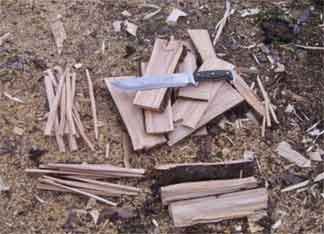
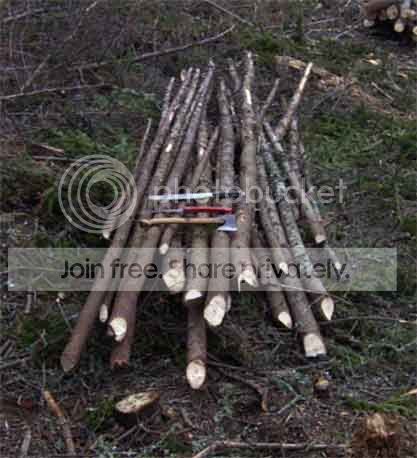
I also did a bunch of finer work, including some really thin splitting :

shbm_splits.jpg


Some of these spints are actually as thin as the individual rings of the wood. I was reminded then of the weak points of the grip as the choil could really benefit from extensive rounding. That is just green guard tape on the handle, I was experimenting with really thick grips when I put it on and I put rubber tape under the green tape as an underlay to absorb shock, it works well and the grip feels much like the rubber Swamp Rat grips.

With the splits and all those limbs and boughs it was no trouble getting a fire going, I started it on a pit used last years to burn some boughs :

shbm_fire.jpg


I also did some digging to check the water levels as the ground here is fairly peaty :
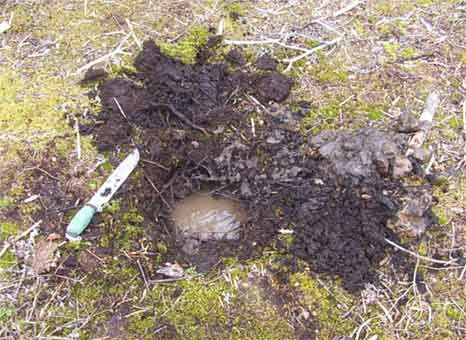
shbm_water.jpg


You can't dig it very easily with a stick, there are way too many roots. It is much easier to use a knife to cut all the roots out of the way and pry up the rocks. Nothing serious to the knife, the edge was a little impacted in the tip from working it under the rocks. The water came in very rapid. I took out a gallon and just minutes later it was that level again.

For those not familiar with the design, that is an older straight handled Battle Mistress, the current evolution of the design is the Fusion model which has a similar blade but radically different grip.

-Cliff
 
If I read you right you put on as thin an edge as you could and went to work ?
It must be good metal to put up with what you put it through .

That is some boggy ground . It must be hard to walk on . It looks like it would give a less than positive feeling unless you have size rwelve EEE feet like me .
Are you clearing lots to sell ?
 
The edge bevels are really dramatic, the edge is 0.070" thick and 0.25" wide, yeah that isn't a typo, it is eight degrees per side. It was actually this angle origionally for the entire bevel but I found the edge would turn on harder knots in the winter when I was cutting frozen wood and thus the edge retention was low so I increased it to 12 by adding a secondary bevel which sets in at about 0.040" or so. You can't see a distinction in the bevels by eye, I just freehand sharpen it on flat stones and it all blends together.

The origional profile was about 35 degrees included and I kept grinding it down trying to see when it would start to get damaged. It was very difficult to reduce it to eight per side, I was working in the slack above the platen on a belt sander and this angle is so low that you end up grinding the spine as well so there is a big strip of metal removed from the knife there as well. It is much easier to grind on the platen, but back when I modifed it I found it easier to work on the slack section of the belt.

The ground isn't soft to walk on, you won't sink in it for example, however most of it is moss covered which means hauling the wood out can be problematic because there is little traction. You also have to be fairly careful when carrying wood due to the footing, I broke one of the bones in my feet awhile back when I stepped on a sharp rock which shifted which I didn't see as it was covered in that thick moss. The biggest problem for cutting wood is that if the roots run through that ground the tree is loosely held in place thus it will move with the axe which not only severely limits penetration it makes it fairly dangerous, especially if the wood is hard.

I am helping a friend clear a lot to build and also clearing family owned land for wood to burn which will eventually be developed for building lots. However it will likely be grown back in by the time that happens as there is a lot of wood owned by our familiy locally and there are lots that were cleared a long time ago which are now heavily grown back in again.

-Cliff
 
I keep my knives at 15 degrees per side so that is half of mine . I even have a thin bladed jackknife and I don,t find a need to have it thinner than that . It wouldn,t stay sharp for long thinner than that anyway . I am just learning the basics and secondary bevels as well as most of what you said concerning sharpening flies by . I do enjoy it and am learning slowly .
It does not seem like a natural condition for those trees to live in especially if they are not secure in the ground . Has the land been damaged by clear cutting ?
 
Kevin the grey said:
It does not seem like a natural condition for those trees to live in especially if they are not secure in the ground . Has the land been damaged by clear cutting ?

Welcome to the Canadian North! It's just natural! And it (or similar conditions) exist in a wide area across the top of the continent.
 
Kevin the grey said:
I keep my knives at 15 degrees per side so that is half of mine . I even have a thin bladed jackknife and I don,t find a need to have it thinner than that .

As Joe noted years back there is a pretty large cutting difference between 20 and 15, there is even a larger difference between 15 and 10, consider that 15 is actually 50% heavier than 10, the knives really won't feel similar at those angles. One of the most obvious differences after adjusting the bevel to that level of a relef grind is that for brush work the limbs will start to be cut off rather than chopped off because the level of push cutting ability is so high it doesn't require a lot of force to cut through the wood. There will also be a big difference in feedback because the cuts are so smooth.

It does not seem like a natural condition for those trees to live in especially if they are not secure in the ground . Has the land been damaged by clear cutting ?

There is a lot of farm land which has been grown over, so only has 30-50 years of new growth but that is pretty easy to spot and isn't the case here. There is a marsh fairly close to this spot in particular, but as noted it isn't an uncommon type of ground in general. Some more splitting :

shbm_batoning.jpg


The Battle Mistress does this very well, the first few splits need a baton but after this the shingles and wedges can be chop split and there are no problem making shingles less than 1/4" thick and pencil sized sticks. On longer woods the shingles make great construction material and one piece of wood can cover a lot of surface area. They can be further split for various uses as well. An upside down figure four :

shbm_figure_four.jpg


which can be used for a mangle trap, easily filled out with stakes from all the small splits. A one pin toggle trigger :

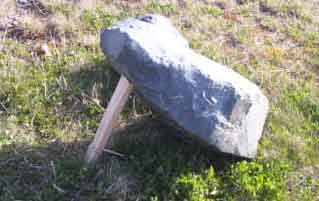
shbm_toggle.jpg


This is one of the most annoying things I have done wood working wise. That was the best rock I could find and it was horrible as the surface was very uneven and the rock oddly shaped so it was difficult to balance and a one pin toggle is trivial to set up compared to a figure four. This is where a saw is really nice as it is easy to make even surfaces, batoning a knife through works as well, but a saw can be much cleaner and more even.

-Cliff
 
Dang son you are so ahead of the game . Its fun trying to catch up though .
I guess the shingle splitting takes pretty straight grained knot free wood ?
Thats an interesting observation concerning a thinner blade and its ability to cut instead of chop limbs . I am theorizing that the secondary bevels support helps to maintain the thinner edge without it folding over ? (I hope I am using enough of the right terminology to get my point across ?) How would I learn more about secondary bevels and other good sharpening techniques ? The only larger knife I have is a B:A:S: !5 inch 17 ounce Kukuuri . Due to its convex blade and complex blade shape I am staying away from sharpening it until I learn more . I am using a drawknife which has a convex blade . I have used a piece of wet dry sandpaper on a moused pad to sharpen it with poor results . How could I learn to sharpen that ? When I learn to sharpen that I will move on to the Kukuuri . It is ane awesome chopper and doesn,t seem to dull at all . It is the first blade I have owned that seems to have abilities which are beyond my own .
 
Kevin the grey said:
I guess the shingle splitting takes pretty straight grained knot free wood ?

You can work around knots. If the blade is robust enough you just cut right through them, if not then split up to the knot and then wedge around it and pop the wood off of the knot. If the grain is all twisted then it is difficult as it won't split and you have to basically cut off a shingle which takes a lot more batoning.

I am theorizing that the secondary bevels support helps to maintain the thinner edge without it folding over ?

Yes, one rather interesting thing you will note when you start adjusting them is that as you add a relief grind the secondary bevel can also be reduced as well which at first seems counterintuitive but the increase in cutting ability tends to lower strain on the very edge so it gets more durable for chopping and cutting. Of course on accidental impacts or cuts which don't go through the media this doesn't hold and you have just made the edge less durable directly.

How would I learn more about secondary bevels and other good sharpening techniques ?

Reading what others have done takes out a lot of work, as you have to just adapt it to your skill levels and specific tasks. You can learn a lot from simple blades, modifing a $5 machete goes a long way. Stronger and harder steels will allow thinner geometries but the same basic principles apply.The great thing above machetes is that they are so soft you can just file them which means you can rapidly reshape them without power tools.

The only larger knife I have is a B:A:S: !5 inch 17 ounce Kukuuri . Due to its convex blade and complex blade shape I am staying away from sharpening it until I learn more .

Khukuris are pretty easy to sharpen because the bevel is so wide you can actually see the curvature and thus there is no difficulty with angle matching which is the biggest problem for most. They are also simple steels and thus easy to grind so. I would suggest starting with small stones, holding the blade fixed and moving the stone over the curvature. Once the edge is set, meaning you have honed the bevels so they meet, make a couple of light passes at an elevated angle to micro-bevel the edge to remove the burr. Start off with a stone which is coarse enough to allow efficient honing and then progress to finer abrasives and each stage should have high sharpness.

I am using a drawknife which has a convex blade . I have used a piece of wet dry sandpaper on a moused pad to sharpen it with poor results.

There are many possible reasons for that, how sharp is the drawknife right now?

-Cliff
 
There-in lies the question . It is not sharp at all . While the edge has not been abused much it has been used to scrape hides . It is an excellent tool for thicker tougher hides . As you can imagine a super sharp blade would just cut in too much . The blade is in good shape as far as rust is concerned . It is either blackened with age and use or shiny near the convexed edge . It may be that the edge needs to be reshaped as the convex is almost eliptical (sp) in shape . Of course this is a bit of an exageration . It is as close as I can come to describing it . I am also using a finer grit which is somewhere around 200 , I used a finer grit due to the fact that I thought it only needed a touch up . Until I get an answer I will switch to a much coarser grit and see how that works . As it is now It does not shave it only produces coarse sawdust on a hard wood .
 
Many drawknives are really thick, they often come with bevels as high as 25 degrees which for wood working means it is suitable for clearing knots and little else. The problem you noted with convex bevels thickening is a common one for freehand sharpening as there is a tendancy to increase the curvature to sharpen faster which radically thickens the edge. On such tools the best solution is often to take a file and just plane them off almost right to flat. Drawknives are either hone on one side like chisels, or given a light bevel on the opposite side just a few degrees to enable the knife to turn in the wood and thus cut curves. Wood working angles are generally low as in 15-20 degrees included.

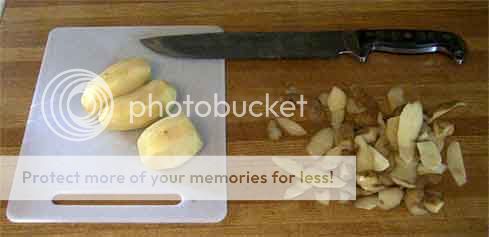
Just to note the knife isn't just a heavy chopper :

shbm_potato_peeled.jpg


No issues with cutting ability, but this is way too much knife in hand to do this for an extended period of time. Nothing that preparing a meal for yourself while camping would be a problem, just a few minutes work of course.

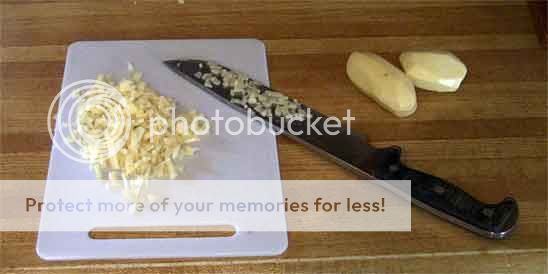
shbm_potato_diced.jpg


No problems with dices either cutting wise. The guard gets in the way though so you have to either put the cutting board on the edge of the counter or cut on an angle and draw the blade to make the cuts through the bottom.

shbm_apple.jpg


Slices fine, cuts out the core. No real issues with corrosion either for such work. I would not want to leave it overnight sitting in the juices, but no need to keep cleaning it during the cutting aside from taste issues of mixing food juices anyway.

-Cliff
 
That knife definitely looks more like a machete than a chefs knife .

As far as the draw knife is concerned ? I will look at the radius of the convex and begin to adjust it accordingly . I may just flatten out the radius and change the angle on the edge a bit . I suspect To do one is to do the other at this point . Once I get closer to where I want to be I,ll try a finer touch .
 
I,m a little closer to getting to the point where you can,t get there from here . At least I think so . L:O:L

I buy lotsa flea market tools and either I came up with a dud file or its a hard drawknife . The file did do a job . It more realigned the edge than took much off at all . That having been said it did raise a slight burr so it musta done something . At the end of 15 minutes work it would take off small shavings instead of dust . I was putting somewhere between a 15 and 20 degree edge on it . I put the file on a raised 4x4 and drew the knife along it just like I was cutting into it . I was almost getting that abrasive feel you get when you are close to the angle on the blade originally . I then flat stone honed the back edge . Guess I gotta scare up a better file . Worse part is there is a super sharpening place close to my usual haunts who could put on a super edge for next to nothing . But what fun would that be ?
 
Kevin the grey said:
That knife definitely looks more like a machete than a chefs knife .

It is essentially a short heavy machete, I will post some shots of it in its native enviroment this weekend hopefully. I have been waiting for some heavy rain as there is way too much scrub built up on the current lot being cleared to continue cutting and setting fire to it when it is dry is kind of dangerous.

I put the file on a raised 4x4 and drew the knife along it just like I was cutting into it

Generally you need to lean into files to have them cut, lock the blade in position. A decent vice is a really valuable tool if you do any serious filing.

Worse part is there is a super sharpening place close to my usual haunts who could put on a super edge for next to nothing . But what fun would that be ?

These are getting rare now especially for the guys that shapen a wide range of tools. I asked a guy awhile back about sharpening spokeshave blades and he replied that he only did wood working tools.

-Cliff
 
Mr. Stamp,

What do you carry for field/emergency sharpening. You have listed strops and stones to reprofile, but do you carry something to re-sharpen your blades? I assume that a day of work like that would require re-sharpening at some point.
 
For softer blades, machetes and axes, I carry a file to restore the edge from accidental contacts, mainly into rocks. A small DMT 600/1200 diafold will quickly micro-bevel the edge even on larger blades. No matter where I am I always have a small ceramic sharpener hanging around my neck which is plated steel and very durable. It was introduced on the Busse Combat forum a few years back. If you are confined in regards to weight space you can go with sandpaper in a few grits. Just Cliff is fine by the way.

-Cliff
 
Cliff,
Thanks for the response, I do not want to deviate the thread but the ceramic sharpener has me curious now. Is it available for sale?
 
I don't think it was ever put into production, a bunch were sent out for evaluation and the responce was very positive, they are near invunerable and ideal for pouch type sharpeners. It also has a groove for a fish hook / point sharpener. Plus the sides are also coated and can be used to sharpen fine serrations like the corners of the Spyderco rods.

-Cliff
 
Generally you need to lean into files to have them cut, lock the blade in position. A decent vice is a really valuable tool if you do any serious filing.

The file actually was butted up against an upright so I could have applied more pressure than I did . I still trewated it like a stone . I will apply a little more pressure until I see a better result . Thanks

These are getting rare now especially for the guys that shapen a wide range of tools. I asked a guy awhile back about sharpening spokeshave blades and he replied that he only did wood working tools.

-Cliff[/QUOTE]

Cliff I have to admit you got me laughing with that one .
First good laugh of the day . This sharpening place seems a little tech oriented so I question as to whether they would handle convex edges .
On a separate note . I used a coarse grit of wet dry paper today with slightly better results . The blade is sharp enough to partially cut a piece of paper .
I suspect that it binds on the too abrupt radius as you suggested . I worked just the convex and left the very edge alone and got again a slightly better result . I suspect a good working over with the file reworkuing the convex to a gentler curve will have things shaving sharp in no time . I,ll let you know .
 
Convex profiles tend to be rare now, but slack belt sanders are pretty common in most sharpening setups and the sander plus a buffer is ideal for convex edges assuming they have experience. Tuning an old piece of equipment is fairly rewarding, watching it come back to life instead of seeing the dump.

shbm_felling.jpg


Ok that is what the Battle Mistress is supposed to be used for. I only got an hour of recreational cutting before I lost the light. I was working with the Iltis in the morning. The knife, hatchet and saw were just used on the small wood, nothing significantly larger than the bit of the axe. The wood was felled with all and limbed with the knife and the axe, way to slow to try limbing with the saw.

I want to do at least that much more a few more times again before I am willing to talk specific numbers, but there are a few things which are obvious pretty much as soon as the first few sticks are cut. The first is that on really small wood the knife is much better, the power of the axe tends to just knock the wood around. As the wood gets larger and more securely rooted the power of the axe can be brought into the wood and since it is more fluid in the wood it will pull ahead of the knife in regards to time. The saw is generally behind, but close, as the wood gets really large, the saw falls behind, trying to cut 6" wood (done on other days), it has twice the time of the hatchet and is way more fatiguing, the blade is just too short.

On limbing I expected it to be a blowout, but it was actually closer than I thought. I origionally figured it would be similar to the blade width ratios (so about 3 to 1), but the advantage of the blade, while significant is much smaller time wise. This puzzeled me until I looked closely what I was doing which was pretty much reflex. The knife doesn't cut along the entire blade length, it doesn't through the tip and you have to go a bit ahead of the choil to avoid snags. It is also difficult to make cuts all along the working length because each cut slows down the blade. I am going to work on technique a bit more with this in mind and see if I can't get it closer to 3:1.

-Cliff
 
Are you talking blade width ratio as in between axe and knife or a ratio pertaining to two features of one blade ? Such as length to width ?

Do you happen to have a pic of a semi permanent camp of a lean-to , latrine and other camp niceties made principally from roughly 1 1/2 inch trees
 
Back
Top