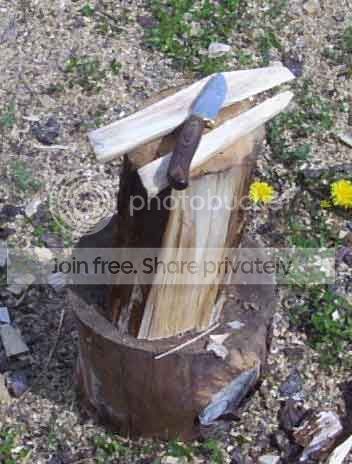
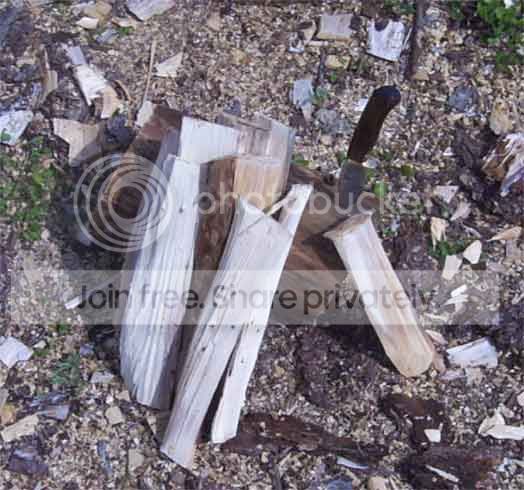
some work with a Battle Mistress

Length of the blade vs width of the bit, so 10" vs 3". The best way I have found is to just do just straight push cuts with the axe because you can't sweep much through a few inches. In terms of time it is still well behind the blade and even more in regards to the fatigue rate. They are not in the same class, it is a many to one difference in terms of overall functinality.

Doing some more work with the Battle Mistress, I had intended to spend some time burning debris but it stopped raining so I spent some time clean up instead, just getting rid of brush, small wood and debris to make axe work easier. A before shot :

shbm_before.jpg


A long blade is much more efficient here than a axe, saw or small blade, and even than all of them combined. It easily cuts away the brush deftly, chops through the larger sticks as necessary in a few seconds and prys up the roots when necessary or hacks through them. Some of this is old fencing as well so it readily works as a prybar popping the sections off of the nails. It only takes about 15 minutes to turn the above into :

shbm_after.jpg


I spent about an hour doing that on one side of the lot before doing some more chopping and limbing comparisons. The knife made it ease to haul out massive amounts of material with the combined ability to cut small brush, chop heavy wood and hammer/pry as necessary :

shbm_debris.jpg


I have made a bunch of lean-tos and debris shelters as well as other things like elevated platform beds, there are pictures of them in the reviews. In general there is no reason to work with larger wood and it is far less efficient both in cutting it down, moving it plus preparing it. A regular debris shelter is actually fairly robust, I have seen them several years later being still perfectly fine. The only general concern is the vegetation tends to dry and rot so it needs to be replaced. But even without cordage to keep the frame together, it has no problem handing the elements.

-Cliff
 
oh, the torture. Pretty soon she's gonna be as thin as a razor, like the basic 7 before her. Just kill her and get it over with.:eek:
 
I am actually fairly curious as to the lifetime of that knife as a general working blade. Daren Cutsforth noted that a working Martindale Golok has a short lifetime so you go through dozens of them in a lifetime. This is easy to understand as they to be filed sharp, and when used seriously are ground thin enough so that they tend to take damage in use occasionally, as otherwise the productivity is too low. Since they are being filed and do take visible damage on a regular basis, each sharpening takes off a significant fraction of a mm of edge and it doesn't take long before a user one looks visible different from a new one.

In contrast though the high end blades not only wear much slower, they take damage much less as they are so much stronger and so sharpenings remove a trivial amount of metal. I damaged the edge on my Ratweiler cutting up some metal awhile back, just light damage, nothing serious. I have sharpened it about a half a dozen times since then after wearing the edge down on wood work like the above and the damage is still visible because sharpening is usually just fine waterstones. INFI actually wears even slower still. As far as I know, Pat is the only one to wear out a blade of that class and the only reason he did it was that he sharpened it on a belt sander which usually had 80/100 grit belts.

I am going to start using my SHBM as my primary work blade and see just how long it takes to wear it to the point the performance degrades significantly from loss of metal. It would be interesting to use it side by side with a standard working blade like a decent machete and see how much wear is on the SHBM before the machete needs to be replaced.

-Cliff
 
You must have blades break on you occasionally ? Seeing the amount of work you do and the tests you make it must be pretty hard to avoid ? I picked up that fiskars 14 inch for 22 canadian . Do you think I should reprofile the edge as you have done or use it as is for a while ? Is The more obtuse edge to make up for metal quality or is due to a cheap way to grind on an edge ? Your idea of a small survival kit in the handle has given me ideas . With the lanyard hole there is a perfect sysyem to lock the plug in place .

I have made one wedge using my becker necker . Its none too pretty but its only my first . Do you have a thread with tips on making wedges through batonning ? I am trying to simulate walking into the woods with just the knife and basics and setting up camp from there . I am sure I will cheat a little bit . I will try and keep it to a minimum .
 
Cliff Stamp said:
I am actually fairly curious as to the lifetime of that knife as a general working blade. Daren Cutsforth noted that a working Martindale Golok has a short lifetime so you go through dozens of them in a lifetime. This is easy to understand as they to be filed sharp, and when used seriously are ground thin enough so that they tend to take damage in use occasionally, as otherwise the productivity is too low. Since they are being filed and do take visible damage on a regular basis, each sharpening takes off a significant fraction of a mm of edge and it doesn't take long before a user one looks visible different from a new one.

In contrast though the high end blades not only wear much slower, they take damage much less as they are so much stronger and so sharpenings remove a trivial amount of metal. I damaged the edge on my Ratweiler cutting up some metal awhile back, just light damage, nothing serious. I have sharpened it about a half a dozen times since then after wearing the edge down on wood work like the above and the damage is still visible because sharpening is usually just fine waterstones. INFI actually wears even slower still. As far as I know, Pat is the only one to wear out a blade of that class and the only reason he did it was that he sharpened it on a belt sander which usually had 80/100 grit belts.

I am going to start using my SHBM as my primary work blade and see just how long it takes to wear it to the point the performance degrades significantly from loss of metal. It would be interesting to use it side by side with a standard working blade like a decent machete and see how much wear is on the SHBM before the machete needs to be replaced.

-Cliff

I have gone through countless machetes, albeit, the total for all the machetes I have gone through is still less than my SHBM was new. However, the damaged those machetes received was far beynd what a good working blade would have taken. Most of the damage was edge damage that indented up to a 1/4 inch deep. I was able to grind it down and still use it, but the metal is even flimsier after that and seems to take on damage even quicker. I have also had them take a set while working them out of wood they had stuck in. Mostly Ontario and tramontina machetes, plus a few other brands I have picked up along the way. Believe it or now the best ones so far have been the cold steel machetes. They seem to hold an edge longer, but damage just as badly. In the time you have had your SHBM I have probably gone through 20 machetes. I ground one to the point it looked more like a narrow sword. But hey what do you expect for less than 40 bucks for even the best machetes I bought. I'd say that bang for the buck they are hard to beat.

Pretty soon your SHBM will be as thin as a machete:eek:
 
Kevin the grey said:
You must have blades break on you occasionally ?

Yes, especially the longer ones, wood working can be fairly demanding. In the above I was speaking of blades which can handle the loads without significant gross damage and thus you are just dealing with mainly blunting to the extent damage would be difficult to see by eye at arms length.

Do you think I should reprofile the edge as you have done or use it as is for a while ? Is The more obtuse edge to make up for metal quality or is due to a cheap way to grind on an edge ?

Most axes now tend to have really obtuse edges similar to most knives. There is really no need to have the edge as obtuse as they come unless the axe is intended for really rough work, cutting sods and similar. For wood work the performance increases in all respects once it is reprofiled to optomize to wood type. As to why they come that way, common perspective on most edges is really obtuse for some reason. Read Lee's book on sharpening and note the angles he recommends in general are extremely acute, often in the single digits.

Do you have a thread with tips on making wedges through batonning ?

I have done a bunch of it here with smaller blades on wood of various types :

http://www.bladeforums.com/forums/showthread.php?t=402509

The general idea is that the first splits you made are tools to make further splits, eventually leading to decent hardwood wedges which can be semi-permanent These will improve with time as they season. You need to keep the points sharp and strong, initially this can mean recutting them after ever couple of splits. The initial wedges can be very crude and often don't last beyond the first use.

If you are just walking into the woods there will be no precut rounds and cutting thick wood isn't going to be practical with a small knife so most splitting you do is going to be on dead fall so it is more prying based than batoning. With nice local hardwood you can cut sticks for digging/prying. This saves you sharpening time on the knife at times, though in most cases the thin and sharp edge of the knife is usually many times more efficient.

In most case when the chopping ability of the knife is really limited you are not going to look to actually cut a lot of felled wood because it just takes too much time. You are instead going to look to make a debris shelter and similar from deadfall and work more with natural existing conditions like a tree pit rather than just go into a site and carve out a home which is pretty easy with something with a high chopping ability.

Cobalt said:
However, the damaged those machetes received was far beynd what a good working blade would have taken. Most of the damage was edge damage that indented up to a 1/4 inch deep.

I have seen a lot of that, on many long blades not just machetes, the Ontario RTAK for example I used rippled immediately in use. Given the amount of metal which was highly distorted it would have been worn out within a week. I have seen some though with have been solid enough so that regular sharpening is generally limited to a small fraction of a mm.

In the time you have had your SHBM I have probably gone through 20 machetes. I ground one to the point it looked more like a narrow sword. But hey what do you expect for less than 40 bucks for even the best machetes I bought. I'd say that bang for the buck they are hard to beat.

20*$40 = $800, it would not be hard to get a custom large brush blade for that price, even half assuming an average price of $20 and my SHBM is still working. In many cases this is the drawback of inexpensive equipment when used seriously. It is okay for recreational use on occasion, but when you start to put them to serious use they can wear out rapidly and thus when looked at from a lifetime cost perspective then the better blades are actually cheaper.

-Cliff
 
It is good that I keep things in perspective . While it is my goal to be able to walk into the woods with a knife and minimum equipment I realise at my age and skill level I must content myself with just being more self sufficient . The more self sufficient I can become the more content I will be .

I appreciate your acute observation on modern mass produced blade sharpening .
Quote:As to why they come that way, common perspective on most edges is really obtuse for some reason .

While I do think they get it, the it they get is an economic one . I think they realise the average client almost treats kitchen knives and blades in general as darn near disposable . When you pay 2 bucks for 6 steak knives you don,t pay 6 bucks to have them sharpened . Even if you could . Could the obtuse angle be a compromise between job type , durability and knowing their client needs a long lasting edge that might not get resharpened ?

How often do we see sharpened or even reasonably well maintained axes at garage sales ? What I see most often would serve better use as bludgeons than cutters . Use em and lose em seems to be the motto .

Wow I seem to losing it myself a little bit . No bitterness over abused blades .What they throw away I can bring back . Sometimes anyway . I am going to get out and practice what I preach . Wedge number two and finish roughing out the hawk handle .
 
Cliff Stamp said:
I have seen a lot of that, on many long blades not just machetes, the Ontario RTAK for example I used rippled immediately in use. Given the amount of metal which was highly distorted it would have been worn out within a week. I have seen some though with have been solid enough so that regular sharpening is generally limited to a small fraction of a mm.-Cliff

I think I have had better luck than you with Ontario knives. They HT is a hit or miss event and mine have been hits so far. The machetes n the other hand are quite soft IMO, maybe even a little to soft.


Cliff Stamp said:
20*$40 = $800, it would not be hard to get a custom large brush blade for that price, even half assuming an average price of $20 and my SHBM is still working. In many cases this is the drawback of inexpensive equipment when used seriously. It is okay for recreational use on occasion, but when you start to put them to serious use they can wear out rapidly and thus when looked at from a lifetime cost perspective then the better blades are actually cheaper.
-Cliff

Well, not all were $40, but even if you cut that number in half, the point you make is the same, the better piece of equipment isn't going to fail you like those many machetes eventually did to me and the cost is the same or better. Although I have to say that when dealing with thorny brush, there is nothing better than a machete's reach.
 
Kevin the grey said:
Could the obtuse angle be a compromise between job type , durability and knowing their client needs a long lasting edge that might not get resharpened ?

Damage vs cutting ability is a big concern, especially now where knives and axes are being used for other things. Axes in particular are now rarely used for felling so the edges have thickened dramatically to cut sods and similar. Knife profiles have changed in a similar manner if you compare the edges on tactical blades to a Swiss Army knife for example. A lot of it is also based on misconceptions. For example John Juranitch of Razor Edge notes a typical sharpening angle of 20 degrees per side. However this is a microbevel applied after a heavy relief grind. It doesn't work the same if you ignore the relief grind and sharpen the entire edge at 20 degrees.

Cobalt said:
I think I have had better luck than you with Ontario knives. They HT is a hit or miss event and mine have been hits so far. The machetes n the other hand are quite soft IMO, maybe even a little to soft.

That is kind of funny, the two Ontario machetes I used were quite hard and fractured readily on hardwoods. I have also seen too soft and too hard in the fixed blades including one which even bent through the tang. I have also seen them ground the wrong way so the edge was thicker than the spine. Nothing else I have seen comes close in regards to the horrible inconsistency.

Although I have to say that when dealing with thorny brush, there is nothing better than a machete's reach.

You can get longer blades for customs, typically thought 10" is pretty much standard for some reason, personally I prefer at least 12-14". Longer is better on dedicated light brush but most of what I do is thicker wood work and about a foot or so it what I like for saplings and such. I do like the 18" Barteaux though for heavy limbing on felled woods and such, longer than that though and they start to get floppy, especially the thinner and more traditional machete patterns.

-Cliff
 
Thanks for the link to battoning wedges .I think I am trying for too pretty a wedge . Your initial wedges are just meant to get you a better wedge . I,ve got this and now will no longer try for a perfectly planed door stop wedge . When you get to the better wedges how do you split it at an angle ? Sooner or later you are going to be going through growth rings at an angle instead of down through them edgewise . How do you angle your split.cut ? Up till now I have been batton/chiseling/sculpting them which is time consuming and led me to a scalloped uneven angle . While my original wedges will be kindling soon enough I would want a smoother longer lasting wedge eventually ?
 
Wood will readily split to the side if the knife is presented in such a manner. The shingles will naturally tend to slab off an an angle unless you work to keep them even. When I first take apart a small piece of wood, say 3-5", more than half of the slabs will require little work to make them into wedges. On the ones which don't tend to form nice tapers then just hack the end quickly into a v-notch and use them to open wood forcefully once the tapered wedges get stuck. With even a small chopping blade you can cut a wedge to shape from a solid piece of wood with no taper in less than a minute. Evening out the grind into a smooth profile helps of course but you don't need to do that right away. With small knives like the Becker Necker which are not optomized for wood cutting then carving can seem a lot harder than necessary. With an optomized wood cutting profile you will rapidly rip off stock woods even with such a small knife.


-Cliff
 
How can I optimise the necker blade/edge as a general purpose knife ? would a simple convex blade/edge be a good choice over the flat grind and obtuse secondary bevel ? I do like its chunky blade for the durability it seems to offer me .At this point I want it for a last ditch all purpose camp tool . I battoned a wedge point on a long piece of 2 inch poplar . I then battoned off a 5 inch long section simply by cutting straight across as deep as it would go and then rotating again and again . I was surprised at how even it came out . just the very middle where it popped off instead of cutting was a little raised . I do understand it won,r ever be a whittler . I would like some cutting ability at acute angles to the wood .
 
I'm from the tropic, basically machete territory. It never passed my mind that the moisture/water in the wood could be frozen in extremely cold weather, that changes my perspective on some of the comments on wood splitting I've read. have you ever had a brand name (quality) fixed blade knife break in half by batoning it with another piece of wood (both frozen)? Do the edge rolls easily during batoning?
 
dante said:
... have you ever had a brand name (quality) fixed blade knife break in half by batoning it with another piece of wood (both frozen)?

No, but it has happened to others. There were several reports of problems with Cold Steel in this regard for example and the wood wasn't frozen.

Do the edge rolls easily during batoning?

You can ripple the edge body if the edge isn't think enough, once you dip under 0.030" it is a concern chisel cutting hard knots. The extreme of the edge can roll depending on the angle, but generally few knives are acute enough for this to happen. I grind mine to about 12/14 per side at the edge and this is enough for the fine grained tools steels which are decently hard. You do see some slight edge roll on the softer and more coarse steels, it is similar to just chopping really knotty woods. Chopping on that type of wood is also problematic as they can shatter on impacts and the shards can hit you in the face/eyes.

Kevin the grey said:
How can I optimise the necker blade/edge as a general purpose knife ?

For wood working, grind a relief to the blade at about ten degrees or so per side. If you want to cut metals and bone you will want to micro-bevel this at 15 or so but for just wood carving and cutting then you can leave it at ten. If you are freehanding then just gradually bleed this bevel back into the primary grind and sweep the last hint of the edge (less than 0.010" or so) to about 12 degrees.

I do like its chunky blade for the durability it seems to offer me .

The Blackjack Small I have is similar, a short blade, very thick for its length, but it tapers to a very acute edge so it cuts wood exceptionally well. The thick choil (0.215") also gives it lots of prying ability so you can for example drive the knife into woods and then pry off a slab :

blackjack_round.jpg


Then with that wedge you are set :

blackjack_split.jpg


Fire away :

blackjack_smudge_reborn.jpg


I was showing my nephew some basics of fire building, how to use leafy vegatation to make a smude / shelter from mist and how to rebuild the fire once fuel was gathered. I was burning mainly thick bark as I was cleaning up some wood which had been cut but not seasoned properly (it had been abandoned) and thus it had rot and I had to debark it to get it to dry out efficiently.

I would like some cutting ability at acute angles to the wood .

That is more a matter of edge profile than stock thickness as the wood doesn't actually much of the blade when carving so all that matters is how the knife is shaped near the edge.

-Cliff
 
Cliff that fire reminds me of the little bomb shaped pots they used to light road hazards with . Do you happen to remember them ? Smudgy flames sooting out of the round cannisters . I would like to do some smudge work myself . The skeeters are the worse I have ever seen them . My back is alive with their poison and I didn,t go out in the woods today .
 
We are getting some around here now but they never get very bad, however in Labrador the black flies are much more intensive. It is very nice to have a small fire going in the woods however in the summer you have to be exceptionally careful in dry weather and it is insanely dangerous in any wind.

-Cliff
 
here is some interesting info to read. Cliffs comments on machetes.
 
Back
Top