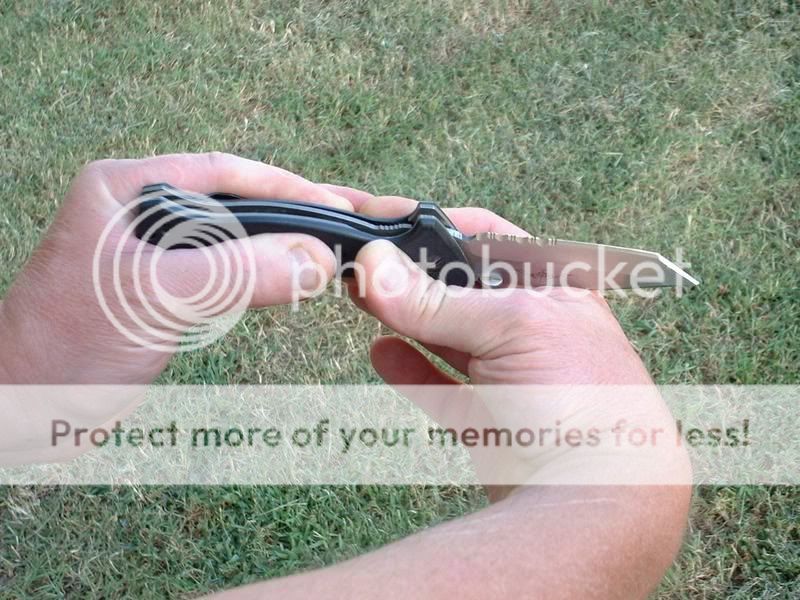
Spine Whack Test

Thanks to all those who replied sensibly. It's a shame I had to wade thru all the gibberish to get a few coherent responses. I think there is some merit to spine whacking as long as it isn't done excessively. Hand pressure on the back of the blade is all I have done in the past. Obviously everyone has their own opinion on the matter. Have a nice day.:)
 
Last edited:
It's your knife, do what you want. However, don't expect the manufacturer to fix the knife when you mess it up.
 
Enough.

Answer the question or best to say nothing.

Fair warning has just been posted. If you do not have the patience to post accordingly and with respect here, do not post. The childish antics are going to stop one way or another.
 
Spine Tapping is very useful to make sure the lock is working properly and within specs.
 
You flamers need to go elsewhere so I can get some legitimate input here. I will ask again: How about periodic testing of the lock with a LIGHT spine tap?

I didn't read the entire thread, so this may have already been mentioned, but... if you'll do a search on user STR, you'll find a very comprehensive explanation of what he thinks (and many of us agree with Steve) about testing a knife lock by putting steady pressure on the spine of a blade instead of "whacking" the blade on something.

Personally, I test every new lock I get by using the method that Steve is talking about, but not by whacking the blade on anything. In 55+ years of using folders, I've never run into a situation that is duplicated by whacking a blade spine, so for me, it's not a valid "real world" test of what my knives will go through.
 
I didn't read the entire thread, so this may have already been mentioned, but... if you'll do a search on user STR, you'll find a very comprehensive explanation of what he thinks (and many of us agree with Steve) about testing a knife lock by putting steady pressure on the spine of a blade instead of "whacking" the blade on something.

Personally, I test every new lock I get by using the method that Steve is talking about, but not by whacking the blade on anything. In 55+ years of using folders, I've never run into a situation that is duplicated by whacking a blade spine, so for me, it's not a valid "real world" test of what my knives will go through.

Well said, Dale. I too test my locks with a steady dynamic load on the blade. That said, spine 'taps' are also useful to discover a borderline lockup, IMO. Spine 'whacks' on the other-hand, become a self fulfilling prophesy as they apply an unrealistic load on the lock that can damage same and increase the risk of future failure.
 
Thanks to all those who replied sensibly. It's a shame I had to wade thru all the gibberish to get a few coherent responses. I think there is some merit to spine whacking as long as it isn't done excessively. Hand pressure on the back of the blade is all I have done in the past. Obviously everyone has their own opinion on the matter. Have a nice day.:)
+1 , I agree with what you have to say..... all of it. ;)

I rarely do a "spine whack test" myself, for reasons that I stated in an earlier post.

However on occasion, I will do it with a knife to see the results. It is usually done with a like knife that someone else has posted on here that they had fail. To date I have never had one come even close to failing.

I don't do it with a great amount of extreme force, cause I think that is dumb... but I will "test" one on occasion.

I appreciate your thread. Sorry you had to wade through all the "crapola" of a few to find the serious answers & opinions. ;)
 
Thanks to all those who replied sensibly. It's a shame I had to wade thru all the gibberish to get a few coherent responses. I think there is some merit to spine whacking as long as it isn't done excessively. Hand pressure on the back of the blade is all I have done in the past. Obviously everyone has their own opinion on the matter. Have a nice day.:)

I think you are severely mistaken and only deluding yourself.

You chose to ignore my posting of how unscientific "spine whacking" is without multiples (36) of samples to perform the test with, and how the weight and force must be carefully controlled in order to generate any useful data.

If you choose not to believe or follow the basics of science or statistical analysis, you are just left to beating on the back of a knife for no useful purpose.
 
Another safe method to test (not sure how scientific it is) is that I grab the tip of the blade safely and try to rock it up and down while watching the lock bar contact on the tang. If you see the lock bar wiggle that "could" be something you might want to investigate further.

Vertical play is the biggest concern to me with folder lock up. I just feel that if that lock bar can rock a little or wiggle with up and down force on the blade, that can't be all that good.

Again, this is not scientific or proven. It's just something I do rather than a spine tap. I have never once spine whacked or tapped any knife I have ever owned and don't plan to.

I should note that I have had a few knives over the years demonstrate a wiggling lockbar on the tang when I exerted up and down pressure on the blade. I sent them back for repair and they came back seated perfectly without wiggle.
 
Last edited:
Whacking the spine is a perfectly good way to test a knife lock. The problem with it is that it's difficult for the typical end user to effectively and consistently gauge how much force one uses on a test. As a result, quantifiable and repeatable results can be difficult or impossible to obtain. This creates a situation which doesn't lend much credibility to any particular result, either failure or success.

That being said, the average knife user probably doesn't really need such specific information to find the test useful. I've always got the feeling that some of the most vociferous opposition of the spine whack test more a result of the possible revelation that one's pet brand might turn up less than stellar, rather than objecting to the test itself.
 
someone once posted that they test a knife by tapping the back of the blade on the back of their hand. i do this now too, since it limits the amount of force you can really exert
 
On the rare occasions I do that "test".. I use the spine area of a thick phone book. I figure that won't mar the knife in any way.

I have never had one do anything but stay locked up tight. I know it is not "scientific" and I mainly do it out of curiosity after reading here about a particular model failing. I don't but much stock in it at all.

If I ever did have one fail.... I would be totally shocked. ;)
 
I didn't read the entire thread, so this may have already been mentioned, but... if you'll do a search on user STR, you'll find a very comprehensive explanation of what he thinks (and many of us agree with Steve) about testing a knife lock by putting steady pressure on the spine of a blade instead of "whacking" the blade on something.

Personally, I test every new lock I get by using the method that Steve is talking about, but not by whacking the blade on anything. In 55+ years of using folders, I've never run into a situation that is duplicated by whacking a blade spine, so for me, it's not a valid "real world" test of what my knives will go through.

Well said, Dale. I too test my locks with a steady dynamic load on the blade. That said, spine 'taps' are also useful to discover a borderline lockup, IMO. Spine 'whacks' on the other-hand, become a self fulfilling prophesy as they apply an unrealistic load on the lock that can damage same and increase the risk of future failure.
+1 Steady pressure on the spine of the blade is exactly how I test all of my locks as well.
 
A good way to test a knife is by applying force to the spine as demonstrated here by STR

test-1.jpg


If a liner lock or framelock jumps, or slides to the unlocking position it is not a good sight. Now testing any lock like this keeping your fingers clear you can see if a lock is moving, jumping or how it is behaving. You cant see this with a spine wack. A spine tap Sal Glesser has used to see if the knife's lock is nested correctly, in other words, behaving like the lock was designed to.

Now the reason for many of the posts is you see people stating the lock failed a spine wack....later on the discussion it becomes apparent that the said person has been WACKING the crap out of a knife. case and point, there was a video on a Benchmande 710 shown....then in the video you can see the pieces of wood that has been wacked out of the desk! Now there lies the problem. People taking the WACK way to seriously and think they can wale on a knife's spine.
 
There is nothing wrong with a small tap on the back of the blade. Does it really prove anything? Not sure, but it does make me feel a bit more confident about the knife lock. OTOH, spine whacking is stupid and actually can damage the knife so that it does fail. In other words, a self-fulfilling event.

BTW, I seem to recall a previous thread about this subject? :rolleyes:

- Mark
 
problem is its so abusive that if it doesn't fail the first time, you may have damaged it so that it will fail the next time in use
 
To the OP - as you can see this issue has been - well lets say - "vigorously debated".

My opinion - I treat any knife that "folds" like a slipjoint - whether it has a lock or not. Therefore - I think the spine whack test reveals nothing for me.

If I need to go "grape ape" with a knife I defer to my fixed blades.

A folding knife is a mechanical device that can fail, period. Some are stronger than others - but at the end of the day they can all fail.

A knife can be replaced - the full use of my hand or fingers after they are severely cut cannot.

Well said Toyz This about sums it up:)
 
I inadvertently discovered that my kershaw skyline fails the spine wack test. I was watching tv and tapping the spine on my thigh. Eventually I tapped slightly harder and the lock failed. I tried it a few more times and the same thing happened. I have to hit it on my thigh hard enough that if it was any harder, it would hurt.

I also tried applying pressure on the back of the blade. The lock did not fail during this test.

Overall, I don't really care that I was able to fail the lock by hitting my leg because I don't forsee myself "wacking" the spine during use. Also, it did not fail under heavy pressure. This is more important to me than "wacking" the spine.
 
I inadvertently discovered that my kershaw skyline fails the spine wack test. I was watching tv and tapping the spine on my thigh. Eventually I tapped slightly harder and the lock failed. I tried it a few more times and the same thing happened. I have to hit it on my thigh hard enough that if it was any harder, it would hurt.

I also tried applying pressure on the back of the blade. The lock did not fail during this test.

Overall, I don't really care that I was able to fail the lock by hitting my leg because I don't forsee myself "wacking" the spine during use. Also, it did not fail under heavy pressure. This is more important to me than "wacking" the spine.
True enough. My ZT 0301 also folds with a small tap on a semi-hard surface, but won't budge an inch if a try to muscle it closed.

Looking back on my stabbing comment, I realize that I misconstrued that somewhat. The only time I functionally needed to "stab" something was to open a hole in some thick cardboard. But when I did that, I didn't really "jam" the knife in there. More like put the tip against the cardboard and pushed on the back of the knife.

In real-world use, there isn't much that calls for a sudden impact on the blade like that. The exception probably being self-defense in which you jam the tip into the baddies' skull. Though I suppose it's a point in the users' and the knife designer's favor if the knife folds on your hand in such a scenario, because you can legitimately say that the knife is not a purpose designed weapon due to the fact that it was never designed to handle a sudden impact that would occur from stabbing another person:thumbup::thumbup::thumbup:.
 
I don't think it's a good idea for the end user to do spine whack tests, maybe a few light taps. The spine whack will take years away from your locks life, in fact maybe kill it alltogether. There is a certain amount of "room" for say a liner lock to move after wear or excess pressure to the lock faces, and you will likely use it up in impact tests. Even excess flipping open can wear out your locks like. (however, I like to build them to so you can flip till you get tired of it). In short, I say leave the testing to the guys how review knives and the makers.
 
Back
Top