splitting wood with a small blade

billy_cee said:
How odd. I was just think the other day, what the best way to make a wedge would be, using a small blade, to then be able to split logs.

I'm in Australia, where a lot of the wood 'outback' is a member of the Gum family, so it carries a load of sap. The smaller sticks tend too burn off fast and bright (light no heat) but, you tend to keep warm by collecting too much wood, I would rather have a small pile of split logs, that take longer to burn off, so I can enjoy a cold beer for longer and tell lies about the snakes, crocs, dingos I've had to fight off with my bare hands :-)

Hahahahaha! I want to see the pictures.

Don't let the Dingo eat your baby! Or tipover your Fosters.
 
Okay. Here is a challenge to all you knife wood splitters. You find the site and I'll bet that with my portable bow saw (not my Husqvarna because that would be way to easy) I can clean the site and build a wood pile for the fire faster than you can with your Bowie. And my bow saw probably weights less and is easier to carry. The downside is I can't fight off the grizzlies and other demented creatures that live in the forest with my bow saw. But my buddies Remington, Browning, and Winchester help me with those types of problems.

http://www.landbigfish.com/tacklestore/showcase.cfm?PID=1851

Here is the Alaska Steet Gang.
 
I was just joking about the chainsaw, well I do love it, but I rarely have it with me in the brush. I do however often have by Becker and have downed small trees with it on occassion, mostly for "fun".

I think its a good idea to train on doing as many tasks with the fewest and simplist tools possible.

As for saws, I like them well enough but thats just one more peice of equipment to lug around. I have one in the pop-up camper but it never rides with me when backpacking or hiking but the Becker always does.
 
You can get really packable swede saws, the trailblazer fits into a hollow tube, very lightweight, I rarely carry it though as it takes a really large piece of wood to make it more efficient than a small folding saw, and in general I rarely want those if I have a decent chopping tool.

Kevin the grey said:
I am not saying that I will never rip open a beautiful calm morning in the woods with the sound of a chainsaw.

I love the sound of chainsaws in the morning, it shuts up the roosters.

DGG said:
You find the site and I'll bet that with my portable bow saw (not my Husqvarna because that would be way to easy) I can clean the site and build a wood pile for the fire faster than you can with your Bowie.

Low light conditions, all well seasoned wood, 1-2" thick, very dense and ingrown, no room to move. The saw will be very slow clearing the scrub to even enable it to cut the sticks, the tooth pattern is too open to work well on that size of wood and it will be extremely slow removing the limbs. In comparison a large blade will easily cut back the scrub, take down the sticks in a few cuts, sweep the limbs off in full passes and buck it to length in just a few chops per section.

There is a pretty big variety of wood types and growing conditions, tools can work exceptionally well on one type and be near useless on another, hence why there are so many saw tooth patterns and so many types of profiles of chopping tools. I have a really nice timber saw which works very well on hardwoods, will readily cut small limbs fast, goes through man made laminates readily, but bogs down rapidly on really sappy soft wood which sticks to the teeth and doesn't clear.

Kevin the grey said:

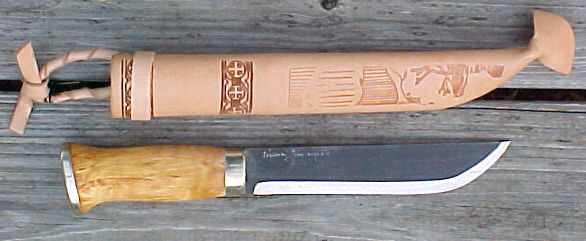
Yes, really thin, the standard scandinavian large blades, leuko's are more commonly 1/8" or even 3/16" thick, but this one is really thin. I would prefer something a bit more substantial, I just picked this one up to check out how a really thin blade works for those kinds of tasks. You can see it and many more at Ragweed Forge :

http://www.ragweedforge.com/SwedishKnifeCatalog.html

This is the more common profile of a large scandinavian style blade :

5229.jpg


This is 0.137" thick for the carbon steel version, the stainless version is thinner, I am not sure that type of stainless comes in really thick stock.

-Cliff

 
My Dad got me a Mora when I was 6 or 7 . He only paid 2 or 3 dollars for it and a good thing as I didn,t treat it that well . Now that I have more sense I appreciate what great knives they are . There are just some knives that seem to cut easier . Its proabably a combination of metal and grind . I am going to get off my butt this morning and do some chopping instead of texting . Thanks for the links .
 
Reading helps, talking to people with experience helps, there is no substitute for doing the work though. A lot of the method you need to learn will depend on you and only you can figure that out anyway, plus it is generally more fun doing it than reading about it.

-Cliff
 
A bit of a tangent from this thread, but has anyone here ever tried splitting would with a UDigIt folding trowel? I put a bevel on the digging edge with a file. I leave the handle at 90 degrees and beat on the end with a piece of wood. Once in the wood, I can extend the handle and pry on the wood. This only works near the edge of a round, because of the curve of the UDigIt. The UDigIt is a multi purpose tool. A Stanley 6 inch PryBar II also works well for light splitting when sharpened.
 
I have done it with the Cold Steel Shovel which has enough chopping power and is rigid enough to just chop and pry apart a lot of woods. A large claw hammer works fairly well used aggressively which carpenters do on a regular basis demo'ing lumber.

-Cliff
 
Cliff, thank you for your response to my first post! I should have added that I pair my Mora with either the UDigIt or the small Stanley pry bar. One makes up for possible limitations with the other. Teamwork is always important.
 
I can,t agree more that experience tells a great deal . I used the becker on 2x6 lumber and it worked like a charm . As soon as I attempted half rounds of wet seasoned firewood it was another story . It could handle splitting down edges as long as there was no knots . If the wood offered a little resistance the becker would bind . Also the short length of the blade meant I was soon wacking on the back of the point . It is time to make some wedges .I think I will take down a small poplar using your technique and make some wedges from that .
 
Spuddate said:
...the small Stanley pry bar.

The wonder bar? I don't know a local carpenter without one, very solid and very versatile. It would be kind of interesting to explore rural "survival" with more urban tools in more detail. Does that shovel have the open frame round bar stock handle? Do you find it comfortable/secure to work with? Nice to see a new voice by the way.

Kevin the grey said:
I used the becker on 2x6 lumber and it worked like a charm . As soon as I attempted half rounds of wet seasoned firewood it was another story .

Lumber is usually pretty easy, you can chop split it readily with a knife generally, locally it is mainly spruce, there is some clear pine but you don't see that as scrap very often, cedar some times but even more rare than pine. Seasoned wood which is wet is the worst combination of properties. It is a nice way to get rid of frustration if you have a large maul otherwise can just be a source of them.

Also the short length of the blade meant I was soon wacking on the back of the point.

Short blades tend to be problematic like that, even when there is enough blade to stick out the very point just tears up the wedges and little force is transmitted to the blade to drive it into the wood. If you have to use the knife it is usually better to cut the wood off in sections. On standing logs, not precut rounds, you can often just pry them apart if the knife is rigid enough.

It is time to make some wedges .I think I will take down a small poplar using your technique and make some wedges from that .

Wedges are nice in that they are relatively safe. If you think of "emergency" situations where you are prepared and experienced with a sharp knife they allow you to make the unexperienced useful without giving them your hand tuned custom knife and have them come back to you in ten minutes with either themselves or the knife mauled. With a wedge the most they can do is break a piece of wood which you can cut a replacement for in a few minutes at most.

-Cliff
 
Cliff Stamp said:
Wedges are nice in that they are relatively safe. If you think of "emergency" situations where you are prepared and experienced with a sharp knife they allow you to make the unexperienced useful without giving them your hand tuned custom knife and have them come back to you in ten minutes with either themselves or the knife mauled. With a wedge the most they can do is break a piece of wood which you can cut a replacement for in a few minutes at most.

-Cliff
That is a situation that comes up with me . No-one touches my folders except for trusted friends . It is rare I find your average man mature enough to handle a knife let alone one of my knives . Handing over a tool that is proabably sharper than what they are used to dealing with and the question of whether a casual aquaintance will abuse my knife leaves me hesitant to hand it over . Making wedges for them to use is a good idea . Doesn,t the original cut/split still have to be made with a knife ?
It also seems to me that the person who objects the most when I don,t want to hand over my knife is the type I least want to hand it over to . I always ask what an aquaintance wants it for . Very often they want to use the knife as a pry . It is not that I don,t think you should pry with a knife . It is usually the goal of the person to complete the task . The condition of the knife when finished is secondary .
 
Kevin the grey said:
Doesn,t the original cut/split still have to be made with a knife ?

Depends, some wood cracks readily when seasoned, and the wedges can be started in these cracks. If this isn't the case you can still start the cuts way faster than the guys running the wedges, you could easily keep several people busy wedging wood apart. When considering "survival" knives you might have to hand over your knife for lots of reasons so this might be something to consider when selecting it.

-Cliff
 
Cliff,
Sorry to be so late replying, but I have had trouble connecting and busy working. The small Stanley wonder bar is what I have used. They are inexpensive, and they can take a beating. A little sharpening really helps with performance. The UDigIt is the small folding trowel you described. The handle is not bad if wearing gloves, but it is slippery and cold in wet weather without gloves. The UDigIt is expensive than the small wonder bar, but very useful and better for moving hot coals and rocks.

Spud
 
The are great wood working tools in general, the Wonder Bar is also very unlikely to get you any concerns about carrying a weapon as opposed to a large blade or small axe. They are also really cheap, <$10.

-Cliff
 
I took down a 4 inch poplar batonning the Becker Necker . Its sharp enough and sturdy enough . I found I still had to work around the tree a bit instead of just chiseling into one side . I would not like to have to do this at ground level in a hurry . I,m going to use the poplar for a camp hawk handle and for wedges to split some firewood .The becker is no whittler so I am going to cheat a bit and use a drawknife for the handle . The wedges will be battonned out . .
 
Small blades tend to require multiple notches, it can be done safely and requires side notches, sometimes people will just work around the tree and this is a bad idea unless the tree is so small that it can be man handled and you don't need to be concerned about kickbacks. Nice progression on wood -> tools for more wood work. That is the general idea for small tools.

-Cliff
 
I guess by kick back you mean the cut end kicking back at you ? When I have to take down another teree I,ll stay closer to the example you showed us . I did find it a little awkward . I felt I was a little choked in my movements . Kinda like I was trying to chisel with the sharpened side of a chisel . It felt funny in my blade hand and the baton felt funny as well . Kinda like a hammer with no head .
Practice I guess . I hope to get out tomorrow and do some wedges . If I don,t I,ll shave myself a hawk handle .
 
Yes, unless the hingle is set right the tree can kick back and violently on larger wood. It is really bad if the tree is leaning because it can split up and crack before it is cut through. Always check overhead before felling and stay away from trees off straight of any size unless you know what you are going.

-Cliff
 
Back
Top