Stabilizing wood with polystirene ???

What is B72???

I am sorry if my grammar is bad, people. I am trying. :)

Acryloid B-72, also called paraloid B-72 at times, is a soluble methacrylate copolymer used in the art restoration business. Some knifemakers have used it as a stabilizer for wood, bone, etc.

I don't think you need to apologize for your English grammar. You do well. It is almost certainly far better than anyone's Bulgarian here. :)
 
Sorry - must have said that badly. I wasn't suggesting you weren't talented. No idea. I was suggesting that many have tried stabilizing - using the same materials and processes - and it still still seems to make a big difference who is doing it. That's the craftmanship I was referring to.

MMA is Methylmethacrylate - a water thin acrylic monomer. VASO is a polymerization catalyst that is added to the MMA to help the heat kicked polymerization (hardening) of the acrylic.

Thanks for the explaination of the polystirene. Makes more sense than the image of styrofoam. Still have to wonder though because plastic forks have a tendency to give up the ghost in a hot bown of Chili - even without IG's heat treat Salsa. :)

I'm all for experimenting, and I've had all kinds of things in my vacuum chamber (Ewwww.... NO!!!!) I just twitch a bit when people use the word 'stabilized' a bit loosely. No offence intended. Let us know how it works out.

Rob!
 
I use stirofoam, because it is easier to make solution in the aceton than forks and plates. I am learning chemistry in motion. :)
I am about to make myself a workshop for knifemaking soon. Repair walls, HT oven project in progress, benches, tools. I am steping on your path, guys. :D
 
Ok, Guys, bubbles stoped coming out yesterday. I split the wood pieces, and stirofoam compound was inside all the lenght. Small pieces... They are more heavy, little bit more harder, and water takes in very difficult. Still stink of aceton. I will leave them on my balcony if the smell will go away. It is somehow stabilized or atleast surface impregnated. I will check it on grinder in the weekend.
 
Last edited:
Lookin forward to your update.Dont let the nay sayers get you down.Many things done in the knife and art world now were considered silly ideas at first.Do people think the first time a Japanese smith said "hey lets coat the back of the blade with mud" didnt get a lot of strange looks from his peers!?
 
Hey i know , one of you knife makers that have the resources have a piece of wood from wssi analysed and tell us what they use for there's.
( or send it to abby on nsic) <grin>
vern
 
Interesting thread, when the word chemical is involved people run and hide,its just a different facet. The guy with a dragons breath will stand there all day with 2300+ borax ready to run out on his shoe. When I try to explain bone dye process to others they're in the next county before I'm done. Being knifemakers (from Ed Fowlers book) is what allows us that precious time for experimentation. Really a cool thread and pursue it like theres no tommorow.

Ken.
 
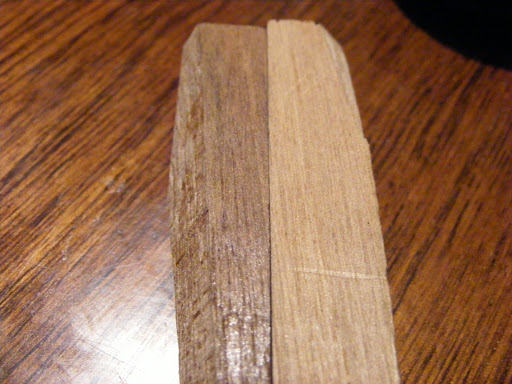
DSCF3449.jpg


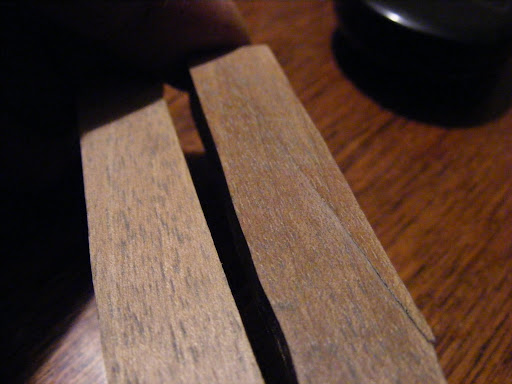
DSCF3451.jpg


So this are the two parts of one wooden piece. The darker is treated with Polystirene solution, other isn't. Treated piece is little bit harder, and wood is not takin in water as fast as untreated one. I will put both in water to see how it will do.
 
Last edited:
Wood is doing good in water, but I have to make a knife with scales handle to see if it moves on the edges.
Hey, people. Someone tryed that allready?
 
How much Styrofoam did you add to how much acetone? The pics look good.:thumbup: Did the "resin" penetrate all the way through/into the wood?
Thanks,
Mitch
 
Tt penetrates all the way, Mitch. As you see on the photos i crack the piece and inside there is darker colour, uniform all the lenght.
Well, I fill half of the bottle with aceton and start to stuff stirofoam pieces unthil it became like liquid soap consistence. I dont have precise dozage. :)

Good thing of all stuff is that aceton keeps the polysirene in liquid state all the time, and it penetrates as long as there is dissolvent in the liquid. I will make more solution and I will place inside a big piece of wallnut wood - enough for handle slabs.
 
Tt penetrates all the way, Mitch. As you see on the photos i crack the piece and inside there is darker colour, uniform all the lenght.
Well, I fill half of the bottle with aceton and start to stuff stirofoam pieces unthil it became like liquid soap consistence. I dont have precise dozage. :)

Good thing of all stuff is that aceton keeps the polysirene in liquid state all the time, and it penetrates as long as there is dissolvent in the liquid. I will make more solution and I will place inside a big piece of wallnut wood - enough for handle slabs.
Wow! It looks like it actually worked! Another way to save a couple of bucks.:thumbup:
Thanks again,
Mitch
 
Nop, Mitch, I seem to forgot to check the wooden block. It is still in the solution. :o I will check it this weekend. I had a lot of work on my HT oven lately and only weekends are for my hobby......
 
Ok, people. I made some experiments with a wooden block, impregnated with polystirene solution. It is 32.2mm thick. I split it in two pieces in lengt to keep two pieces with the 32.2mm thickness, and I throw one piece in a bucket of water for 6 hours. After I take it out it was 32.8mm thick. It is 0,6mm movement in water.
Than I split the soaked half in two and I got surprized. Water reached only on 1mm from the surface of the wood. It is deep impregnated.:thumbup:

I grind off a little bit of dry piece. It is harder than regular material and it polish very good, on 400 grit belt it is like glass, and there are no hollow fibers and chips.

Wood has been in the solution for 2 weeks(I forgot it :o) and dryed out in open air for one week.
People, try this solution and tell me what you think. I have no expirience with profesionaly stabilized woods. I need other opinions. It's for the science.:)
 
I wanted to see how the polystyrene compares to the Acryloid B-72 that I've been using.
I used two identical pieces of Padauk for the test. For the PS, I placed 0.6 oz. (dry measure) of styrofoam into a 2 liter mason jar, and filled it to the 2 liter mark with acetone.
The entire 0.6 oz. of PS did not go into solution entirely, so after sitting in the acetone for a couple of days, I removed the PS that was sitting on the bottom of the jar; the stuff that wouldn't go into solution.
The pieces of the Padauk were 7" x 1 7/8" x 1/2" thick. One went into the solution of Acryloid B-72 (approx. 20% weight to volume mixture with the acetone), and the other went into the solution of PS.
After the padauk both sunk to the bottom of the jars, then waiting a few more days, I pulled both pieces from their jars and let them dry for a week. (The PS piece sunk to the bottom of the jar faster than the B-72 piece.)
I then weighed both pieces of treated padauk.
PS piece weighed 2.7 oz.
B-72 piece weighed 2.8 oz.
The results don't mean a whole lot so far; but I guess you can say that the B-72 piece is "denser" than the PS piece. At any rate, it seems like the padauk held more of the B-72 than the PS.
- Mitch
 
I wanted to see how the polystyrene compares to the Acryloid B-72 that I've been using.
I used two identical pieces of Padauk for the test. For the PS, I placed 0.6 oz. (dry measure) of styrofoam into a 2 liter mason jar, and filled it to the 2 liter mark with acetone.
The entire 0.6 oz. of PS did not go into solution entirely, so after sitting in the acetone for a couple of days, I removed the PS that was sitting on the bottom of the jar; the stuff that wouldn't go into solution.
The pieces of the Padauk were 7" x 1 7/8" x 1/2" thick. One went into the solution of Acryloid B-72 (approx. 20% weight to volume mixture with the acetone), and the other went into the solution of PS.
After the padauk both sunk to the bottom of the jars, then waiting a few more days, I pulled both pieces from their jars and let them dry for a week. (The PS piece sunk to the bottom of the jar faster than the B-72 piece.)
I then weighed both pieces of treated padauk.
PS piece weighed 2.7 oz.
B-72 piece weighed 2.8 oz.
The results don't mean a whole lot so far; but I guess you can say that the B-72 piece is "denser" than the PS piece. At any rate, it seems like the padauk held more of the B-72 than the PS.
- Mitch

Mitch, I am a big fan of B72. But, I mix it with Mini-Wax Woodhardener and acetone. 1/3 part each.;)
 
I had also heard that a cheap way to stabilize wood is to soak the wood in cyanoacrylate. I have a bunch of maple burl and I plan on soaking a couple of pieces in this stuff for about a week. If it soaks all of the way through, I'm gonna use it.
 
Back
Top