
-
The BladeForums.com 2024 Traditional Knife is available! Price is $250 ea (shipped within CONUS).
Order here: https://www.bladeforums.com/help/2024-traditional/
You are using an out of date browser. It may not display this or other websites correctly.
You should upgrade or use an alternative browser.
You should upgrade or use an alternative browser.
steel vs steel
- Thread starter samuraistuart
- Start date

james terrio
Sharpest Knife in the Light Socket
- Joined
- Apr 15, 2010
- Messages
- 22,618
Industry uses cryo to deal with the retained austentite.
Yup. It's not "magic", it's about completing the quench cycle in high-alloy steels and developing a good base structure for further tempering.
RA can actually be a good thing in many industrial applications, like blanking dies and slitters. I have never seen any evidence that RA is good thing in fine-edged knife blades.
I invite you all to look up posts/testing by Kevin Cashen and Nathan the Machinist (among others) for more in-depth discussions on that topic.

Last edited:

Willie71
Warren J. Krywko
- Joined
- Feb 23, 2013
- Messages
- 12,214
The 1550 F austenizing temperature is used for bearings because it leaves a higher amount of retained austenite, which is advantageous for some reason. The higher heat will certainly result in smaller carbides. Even higher, and they will be completely dissolved.
You would have to go to 1800f to fully dissolve them quickly, or 100 minutes at 1500f or so. This only accounts for them in the austentite phase. Once quenched, the alloys have to go somewhere.

Willie71
Warren J. Krywko
- Joined
- Feb 23, 2013
- Messages
- 12,214
Do you have an approximate hardness just after quenching but before tempering? Are any of your grain refinement steps ended by quenching or are they all air cooled from high temperature?
I get Rc66 out of quench. I air cool, not furnace cool to magnetic between each cycle.
With those procedures and hardnesses, the carbides in your final quenched blades are probably as small as they'll get. Rest assured you did dissolve all but 5% or less of the carbides. It seems backwards, but annealed/spheroidized steel has considerably more carbide than hardened steel. With hardness that high, you had to dissolve enough to get sufficient carbon into the austenite. Starting structure has a large role in how fast carbides dissolve, and with your procedure, you likely had some fine pearlite and maybe bainite to start from before hardening. 1800 F would surely dissolve them all, which we don't want to do. My percentage estimate is just that. You might have 4-7%, depending on your temperatures, speed of heating, etc.

- Joined
- Oct 18, 2011
- Messages
- 870
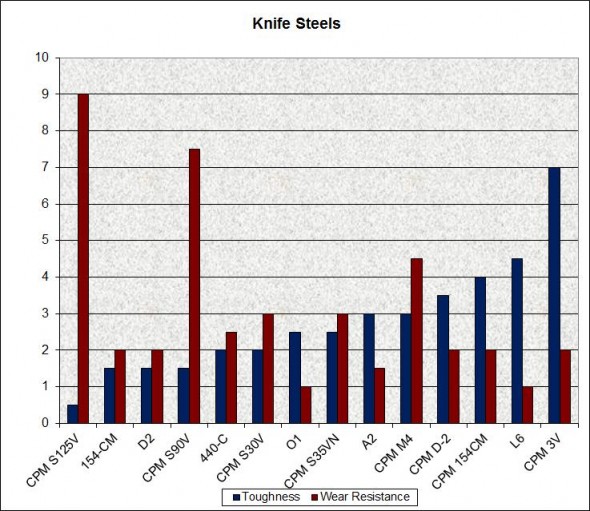
Actually I think u wrong there. According to the chart I have cpm D2 has 40% better toughnessOr Elmax. CPM-D2 is pretty good stuff but it never really turned out to be all it was cracked up to be IMO. It's basically just clean D2 (takes a much better finish and finer edge) without much if any other useful improvements.
Willie71
Warren J. Krywko
- Joined
- Feb 23, 2013
- Messages
- 12,214
With those procedures and hardnesses, the carbides in your final quenched blades are probably as small as they'll get. Rest assured you did dissolve all but 5% or less of the carbides. It seems backwards, but annealed/spheroidized steel has considerably more carbide than hardened steel. With hardness that high, you had to dissolve enough to get sufficient carbon into the austenite. Starting structure has a large role in how fast carbides dissolve, and with your procedure, you likely had some fine pearlite and maybe bainite to start from before hardening. 1800 F would surely dissolve them all, which we don't want to do. My percentage estimate is just that. You might have 4-7%, depending on your temperatures, speed of heating, etc.
I'm pretty happy with my results with 52100. :thumbup: its a good balance between fine grain, wear resistance, and toughness. Now if it would only cooperate and get a good hamon, it would be my only high carbon steel. :grumpy:

- Joined
- Dec 21, 2006
- Messages
- 3,158
Do you guys suggest going into hardening with a spherodized structure with steels such as 52100? Also, what are your thoughts on treating other tool steels, that have similar carbon content range of 1.0 to 1.2, and tungsten and vanadium for carbide formation, the EXACT same way Warren and myself are heat treating 52100? As in, the carbide dissolving/normalizing heat of 1650F for 10 minutes, step down heats to help reduce the grain structure, (what if we went straight to hardening right now....what if we spheroidize anneal it right now), harden at 1475F-1490F for a 10 minute soak, quench/temper.
The answer to the second question is probably "NO", I think. The more I tumble this around in my head.....the 52100 sequence we use was developed to handle Cr carbides....as there is no W or V in 52100. But I may be wrong there as well. The choosing of your highest normalizing temperature I would assume is based on the carbide forming alloys and their percentages. As in O-7 for example. Plenty of carbon, tungsten, and vanadium. I thought I would heat treat it the same as 52100, but that may be wrong. One of the reasons I have heat treated O-7 as 52100 is so I know how the steel is set up. I don't know how this steel is set up internally as it arrives from Germany. Roman Landes, who I have mucho respect for, suggest to do the normalizing/thermal cycling only if I am forging it, which I am not. He suggests if doing stock removal only....just go right to 1475F for 10 minutes. I am NOT questioning Roman....but I guess he knows that steel, and how it is supplied, and knows WAY more about all of it than I can think of.
Seems like it is that Chromium in 52100 that we are trying to deal with. Not sure how that translates directly or indirectly to tungsten and vanadium and how to deal with those.
The answer to the second question is probably "NO", I think. The more I tumble this around in my head.....the 52100 sequence we use was developed to handle Cr carbides....as there is no W or V in 52100. But I may be wrong there as well. The choosing of your highest normalizing temperature I would assume is based on the carbide forming alloys and their percentages. As in O-7 for example. Plenty of carbon, tungsten, and vanadium. I thought I would heat treat it the same as 52100, but that may be wrong. One of the reasons I have heat treated O-7 as 52100 is so I know how the steel is set up. I don't know how this steel is set up internally as it arrives from Germany. Roman Landes, who I have mucho respect for, suggest to do the normalizing/thermal cycling only if I am forging it, which I am not. He suggests if doing stock removal only....just go right to 1475F for 10 minutes. I am NOT questioning Roman....but I guess he knows that steel, and how it is supplied, and knows WAY more about all of it than I can think of.
Seems like it is that Chromium in 52100 that we are trying to deal with. Not sure how that translates directly or indirectly to tungsten and vanadium and how to deal with those.
Willie71
Warren J. Krywko
- Joined
- Feb 23, 2013
- Messages
- 12,214
There are two types of spheroidized structures, one with course carbides, as Aldo's 52100 is supplied, and fine carbides which is more time consuming to produce, so industry uses the coarse condition most. Look on Kevin Cashen's site, and he explains the processes well. From a fine spheroidal structure, you can harden directly, but its the coarse condition that forces us to normalize Aldo's steel first. Regarding the carbides, I am just learning the relationships between time, temp, and different carbides, so I can't help you there.
james terrio
Sharpest Knife in the Light Socket
- Joined
- Apr 15, 2010
- Messages
- 22,618
Actually I think u wrong there. According to the chart I have cpm D2 has 40% better toughness
Yeah... all the charts say that but that just hasn't been my experience... although it's difficult to even estimate closely without fairly sophisticated equipment. Regardless, for the same price, machineability, wear-resistance and corrosion-resistance as well as being able to get a nice finish on it, CPM-3V is much tougher than either form of D2. It's also more readily available. So when I want tool steel I just use 3V.
- Joined
- Dec 21, 2006
- Messages
- 3,158
But you DID totally answer the question I had of the two different sphero structures! Thanks Warren...that cleared it up....as far as that goes!
- Joined
- Dec 21, 2006
- Messages
- 3,158
I'm shaping the bevels right now on the first knife out of this CPM M4. I thought it was going to be difficult to file. It sure does seem VERY easy to file. Like I have to be careful with a chipbreaker!!! I guess the PM helps in machinability?