
-
The BladeForums.com 2024 Traditional Knife is available! Price is $250 ea (shipped within CONUS).
Order here: https://www.bladeforums.com/help/2024-traditional/
You are using an out of date browser. It may not display this or other websites correctly.
You should upgrade or use an alternative browser.
You should upgrade or use an alternative browser.
Sticky lock = Good
- Thread starter vwb563
- Start date


- Joined
- Dec 7, 2016
- Messages
- 11,261
Lock stick is literally caused by the metals galling together. Unsticking is the titanium face losing a layer of metal. Lockstick tends to increase the wear ln a lockface because of this. So it can wear the lock into not working.
Lockstick isn’t a bad thing in my eyes. But I prefer for a sticking lock to wear into a sweet spot where lockwear slows down exponentially. To me this is better than a lock sticking and wearing all the way to the other side.
Also if the lockstick is weak enough that it is easily overcome by one hand then it’s not providing anything but superficial security anyway. If it is a lock that would fail otherwise but only stick is preventing it; then it will only take a little bit of force to the spine to cause it to unstick just like it takes only a little force to unlock by hand.
I’m saying that the extra margin of security lockstick will give you to a lock that would fail without that lockstick is not what a well built lock is all about. Light lockstick is totally secondary to good geometry.
Lockstick isn’t a bad thing in my eyes. But I prefer for a sticking lock to wear into a sweet spot where lockwear slows down exponentially. To me this is better than a lock sticking and wearing all the way to the other side.
Also if the lockstick is weak enough that it is easily overcome by one hand then it’s not providing anything but superficial security anyway. If it is a lock that would fail otherwise but only stick is preventing it; then it will only take a little bit of force to the spine to cause it to unstick just like it takes only a little force to unlock by hand.
I’m saying that the extra margin of security lockstick will give you to a lock that would fail without that lockstick is not what a well built lock is all about. Light lockstick is totally secondary to good geometry.

- Joined
- Oct 28, 2017
- Messages
- 4,464
I think perhaps there needs to be some clarification on what you mean by ‘lock-stick’. I have two Fällkniven liner lock knives that are solid as the proverbial rock. Absolutely solid and reliable. The lock release is easily actuated and there is no ‘stick’. I fail to understand how this lock could in any way be inferior to a lock that ‘sticks’. The only sticky lock I have is on an ESEE framelock Avispa - I regard it as yet one more failure on an already flawed design.Lock stick is literally caused by the metals galling together. Unsticking is the titanium face losing a layer of metal. Lockstick tends to increase the wear ln a lockface because of this. So it can wear the lock into not working.
Lockstick isn’t a bad thing in my eyes. But I prefer for a sticking lock to wear into a sweet spot where lockwear slows down exponentially. To me this is better than a lock sticking and wearing all the way to the other side.
Also if the lockstick is weak enough that it is easily overcome by one hand then it’s not providing anything but superficial security anyway. If it is a lock that would fail otherwise but only stick is preventing it; then it will only take a little bit of force to the spine to cause it to unstick just like it takes only a little force to unlock by hand.
I’m saying that the extra margin of security lockstick will give you to a lock that would fail without that lockstick is not what a well built lock is all about. Light lockstick is totally secondary to good geometry.
I think perhaps there needs to be some clarification on what you mean by ‘lock-stick’. I have two Fällkniven liner lock knives that are solid as the proverbial rock. Absolutely solid and reliable. The lock release is easily actuated and there is no ‘stick’. I fail to understand how this lock could in any way be inferior to a lock that ‘sticks’. The only sticky lock I have is on an ESEE framelock Avispa - I regard it as yet one more failure on an already flawed design.
The Avispa specifically or frame locks in general?
- Joined
- Dec 7, 2016
- Messages
- 11,261
I think perhaps there needs to be some clarification on what you mean by ‘lock-stick’. I have two Fällkniven liner lock knives that are solid as the proverbial rock. Absolutely solid and reliable. The lock release is easily actuated and there is no ‘stick’. I fail to understand how this lock could in any way be inferior to a lock that ‘sticks’. The only sticky lock I have is on an ESEE framelock Avispa - I regard it as yet one more failure on an already flawed design.
There must be some misunderstanding. I’m saying lockstick tends to be a bad to neutral thing, not a neutral to good thing. I would rather a lock with no lockstick that is solid due to good geometry rather than a lock where I am counting on stick as a safety feature.
I typically find lockstick to be a bad thing for a number of reasons including tending to wear faster.
- Joined
- Oct 28, 2017
- Messages
- 4,464
The Avispa most specifically. Some appalling ‘design decisions’. The sort of thing that causes red faces in board rooms, and in many organisations would result in immediate redundancies. It is pretty, that’s about it.The Avispa specifically or frame locks in general?
I don’t buy into frame locks full stop, so I would not feel confident to pronounce either way on them.
- Joined
- Oct 28, 2017
- Messages
- 4,464
Ah! Yes, I do regard you as somebody who speaks good sense. My misunderstanding.There must be some misunderstanding. I’m saying lockstick tends to be a bad to neutral thing, not a neutral to good thing. I would rather a lock with no lockstick that is solid due to good geometry rather than a lock where I am counting on stick as a safety feature.
I typically find lockstick to be a bad thing for a number of reasons including tending to wear faster.

- Joined
- Dec 7, 2016
- Messages
- 11,261
The Avispa most specifically. Some appalling ‘design decisions’. The sort of thing that causes red faces in board rooms, and in many organisations would result in immediate redundancies. It is pretty, that’s about it.
I don’t buy into frame locks full stop, so I would not feel confident to pronounce either way on them.
You don’t like framelocks at all? I obviously respect your opinion but can I ask why?
Especially why you exclude framelocks but apparently not linerlocks?
- Joined
- Oct 28, 2017
- Messages
- 4,464
Don’t like the feel of ‘em! Simple as that. I have all sorts of foibles, and my wallet is healthier in girth due to some of them.You don’t like framelocks at all? I obviously respect your opinion but can I ask why?
Especially why you exclude framelocks but apparently not linerlocks?
I snigger at all these arguments over framelocks and their viability. I will at some point inevitably buy a CRK, just because, and that would be an exception for me. But I don’t doubt that a well executed framelock is every bit as decent as any other well executed lock, within what I would call reasonable use.
I am often bemused by certain attitudes among knife enthusiasts, and it is fairly easy to spot those who use knives outdoors in a sensible way. Sensible being with a view to preserving the usefulness of that tool by thinking, rather than merrily hacking away with what was once called, ‘gay abandon’.
- Joined
- Dec 7, 2016
- Messages
- 11,261
Don’t like the feel of ‘em! Simple as that. I have all sorts of foibles, and my wallet is healthier in girth due to some of them.
I snigger at all these arguments over framelocks and their viability. I will at some point inevitably buy a CRK, just because, and that would be an exception for me. But I don’t doubt that a well executed framelock is every bit as decent as any other well executed lock, within what I would call reasonable use.
I am often bemused by certain attitudes among knife enthusiasts, and it is fairly easy to spot those who use knives outdoors in a sensible way. Sensible being with a view to preserving the usefulness of that tool by thinking, rather than merrily hacking away with what was once called, ‘gay abandon’.
I actually used to prefer linerlocks, often they have a fuller more comfortable handle.
I have grown to like framelocks because they are often thinner. I figure that my pocket knife spends 99% of the day I’m carrying it in my pocket so I usually don’t need the fuller handle. For a real working knife I do.

91bravo
Gold Member
- Joined
- Jun 29, 2008
- Messages
- 30,171
The Spyderco Military is one of my favorite folders and it's a liner lock. Funny that some feel that the liner lock is inferior to others, but I honestly feel that my Militaries are superior compared to some of my knives costing much more. Especially in the performance department. There's not much out there that can match the cutting prowess of a Military, no matter what kind of lock it has. Never experienced any lockstick in any of my liner or frame locks either. I must be a lucky SOB!
I've had a few US-made Kershaw Speedsafe frame locks that were the opposite of sticky; they were 'mushy'. They would barely engage and felt weak/loose. I guess that could be considered a 'lazy' lockup.
I had/have some Emersons whose liner locks would 'pop' out of the locked position slightly when pressing the blade spine in the open position. They never fully unlocked and closed, but those liner locks also felt 'mushy'. I haven't bought an Emerson in maybe 15 or 16 years, so things might have changed with Emersons. A big issue with the ones I had that 'popped' out of position was the blade tang locking surfaces were ground way too steeply, which would create premature wear and make it easier to develop sloppy locks in a relatively short time.
My all-time favorite liner lock design is the Spyderco Military. I have 3 of them, and have never had any lock stick, lock rock, nor any over-travel to the opposite side. Great materials, and excellent gradual concave angling (not too steep, not too flat) on the blade tang mating surfaces.
In frame locks, I've never had a problem with any of my 5 CRKs. I know people are probably tired of hearing about CRKs, but since 2002, I've never experienced lock stick nor any weakening of a CRK frame lock. They seem to wear very minimally over time, then just stop dead in one spot. Or so it seems to me.
Jim
I had/have some Emersons whose liner locks would 'pop' out of the locked position slightly when pressing the blade spine in the open position. They never fully unlocked and closed, but those liner locks also felt 'mushy'. I haven't bought an Emerson in maybe 15 or 16 years, so things might have changed with Emersons. A big issue with the ones I had that 'popped' out of position was the blade tang locking surfaces were ground way too steeply, which would create premature wear and make it easier to develop sloppy locks in a relatively short time.
My all-time favorite liner lock design is the Spyderco Military. I have 3 of them, and have never had any lock stick, lock rock, nor any over-travel to the opposite side. Great materials, and excellent gradual concave angling (not too steep, not too flat) on the blade tang mating surfaces.
In frame locks, I've never had a problem with any of my 5 CRKs. I know people are probably tired of hearing about CRKs, but since 2002, I've never experienced lock stick nor any weakening of a CRK frame lock. They seem to wear very minimally over time, then just stop dead in one spot. Or so it seems to me.
Jim
Last edited:


- Joined
- Jul 25, 2014
- Messages
- 6,390
I’m sorry, but your comments don’t make any sense.Locks, be it frame, liner, or sub-frame, are supposed to mildy gall. That's if someone wants a tool. If someone wants a stick free lock then they are concerned with the knife's fidgetability. That's fine, but just know whether you want a fidget toy or a tool. If a company is more worried about ease of disengagement of the lock than of the lock operating as it should, then simply realize you're buying a toy, not a tool.
And I seriously doubt anyone has, through real world use, ever encountered a lock face from a good company that genuinely wears out from anything but purposeful and unnecessary abuse or a manufacturing defect.
In reality, most people here want high end toys rather than tools and companies know that so they produce toys.
Locks that operate on different principles than frame, sub-frame, or liners are exactly that, different. You won't see these arguments about the triad or compression or axis type locks because they can be smooth and perform as tools. Different strokes for different folks. But ask yourself if you want a tool or a toy and if you want a tool with a lock that performs smoothly and yet still functions as a tool, don't buy a knife with frame, sub-frame, or liner lock.
It'd be like asking for a backlock knife that has no tension to keep the blade in the handle just because you want to fidget with it. It defeats a major intended purpose of the feature.
Do you even knife, bro?
- Joined
- Dec 7, 2016
- Messages
- 11,261
I've had a few US-made Kershaw Speedsafe frame locks that were the opposite of sticky; they were 'mushy'. They would barely engage and felt weak/loose. I guess that could be considered a 'lazy' lockup.
I had/have some Emersons whose liner locks would 'pop' out of the locked position slightly when pressing the blade spine in the open position. They never fully unlocked and closed, but those liner locks also felt 'mushy'. I haven't bought an Emerson in maybe 15 or 16 years, so things might have changed with Emersons. A big issue with the ones I had that 'popped' out of position was the blade tang locking surfaces were ground way too steeply, which would create premature wear and make it easier to develop sloppy locks in a relatively short time.
My all-time favorite liner lock design is the Spyderco Military. I have 3 of them, and have never had any lock stick, lock rock, nor any over-travel to the opposite side. Great materials, and excellent gradual concave angling (not too steep, not too flat) on the blade tang mating surfaces.
In frame locks, I've never had a problem with any of my 5 CRKs. I know people are probably tired of hearing about CRKs, but since 2002, I've never experienced lock stick nor any weakening of a CRK frame lock. They seem to wear very minimally over time, then just stop dead in one spot. Or so it seems to me.
Jim
Cause CRK carburizes their lockfaces on the lockbar. Next time you have your Sebenza apart look at the bottom leading corner of the lockbar lockface and you’ll see a change in colouration there which is the hallmark of carburization.

vanadium
Basic Member
- Joined
- Apr 5, 2003
- Messages
- 816
what's the problem with having a mildly sticky lock?
The problem is called galling.
https://en.wikipedia.org/wiki/Galling
EDIT: Sorry to repeat what some others already said.

- Joined
- Dec 10, 2006
- Messages
- 5,983
I have not posted the below in a long, long while and some links might be broken, but here goes for those interested in learning more on this lock.
My framelock post
This is a compilation of resources and discussion on angles, lock interface, steel vs. ti etc. that I have compiled over the years.
Here are some comments from a very well and respected maker on the forums that has tested numerous locks. I will not post his name as this was a private conversation and let’s keep it that way.
"I've done some steel inserts in mine. The wear rates are not far off from titanium to steel. Both wear very well. Heat anodizing helps to form a deeper near ceramic hardness on the titanium since heating it by a torch anodizes the ti from the inside out as opposed to using a DC current which is from the outside in or the outside layer only. That ceramic hard oxide layer wears pretty well against even the hardest blades. If it didn't people would have stopped using ti a long time ago.
The real factors as I see it is impact strength not wear resistance. In my own testing for Kershaw and other companies that sent me product to beat the snot out of on their behalf I found that the steel frame knives held up better to sudden shock impacts like spine and overstrike whacking as opposed to the softer ti which could indent easier and deeper scarring the surfaces more. So to me this is the key factor behind it but there is a draw back since steel is less forgiving than titanium. Ti tends to gall or stick to itself and dissimilar metals and this sticking effect has been seen forever by makers as a real benefit.
Not to sound bad but you can be off some on contact angle and get by with it by using ti since it can make up for your short fallings here whereas steel would just slide right off the contact. Steel will demand the contacts be spot on and if they are not well, you'll see locks sliding off the contact toward release easier than ti when the contact angle is not right.
I've used inserts of steel in a couple folders I did a while back. To me having to do them the way I did they were more trouble than they were worth. Most of my folders give me very little trouble as it is. However, I am low key and not selling what is being marketed as a 'hard use' knife either. We'll see how long this lasts but it could be the beginnings of a trend in the hard use category if people start testing them and find they hold up better. It will depend on the steel used. I really fail to see much benefit if the steel they are using is just 410 stainless at 45 Rockwell. Ti is 39 Rockwell or so and although softer by quite a bit technically it wears at such a slow rate that in normal use most folks are not going to notice any diff or benefit to this insert at all. It’s just the guys beating on them that will pick up on it probably.
My framelock post
This is a compilation of resources and discussion on angles, lock interface, steel vs. ti etc. that I have compiled over the years.
Here are some comments from a very well and respected maker on the forums that has tested numerous locks. I will not post his name as this was a private conversation and let’s keep it that way.
"I've done some steel inserts in mine. The wear rates are not far off from titanium to steel. Both wear very well. Heat anodizing helps to form a deeper near ceramic hardness on the titanium since heating it by a torch anodizes the ti from the inside out as opposed to using a DC current which is from the outside in or the outside layer only. That ceramic hard oxide layer wears pretty well against even the hardest blades. If it didn't people would have stopped using ti a long time ago.
The real factors as I see it is impact strength not wear resistance. In my own testing for Kershaw and other companies that sent me product to beat the snot out of on their behalf I found that the steel frame knives held up better to sudden shock impacts like spine and overstrike whacking as opposed to the softer ti which could indent easier and deeper scarring the surfaces more. So to me this is the key factor behind it but there is a draw back since steel is less forgiving than titanium. Ti tends to gall or stick to itself and dissimilar metals and this sticking effect has been seen forever by makers as a real benefit.
Not to sound bad but you can be off some on contact angle and get by with it by using ti since it can make up for your short fallings here whereas steel would just slide right off the contact. Steel will demand the contacts be spot on and if they are not well, you'll see locks sliding off the contact toward release easier than ti when the contact angle is not right.
I've used inserts of steel in a couple folders I did a while back. To me having to do them the way I did they were more trouble than they were worth. Most of my folders give me very little trouble as it is. However, I am low key and not selling what is being marketed as a 'hard use' knife either. We'll see how long this lasts but it could be the beginnings of a trend in the hard use category if people start testing them and find they hold up better. It will depend on the steel used. I really fail to see much benefit if the steel they are using is just 410 stainless at 45 Rockwell. Ti is 39 Rockwell or so and although softer by quite a bit technically it wears at such a slow rate that in normal use most folks are not going to notice any diff or benefit to this insert at all. It’s just the guys beating on them that will pick up on it probably.
- Joined
- Dec 10, 2006
- Messages
- 5,983
Now that goes to another issue. What happens when the insert dislodges or falls out? The screws will have to be very secure for some of these guys beating on them and if they think the knife is supposed to take it they will do that. Again time will tell. My thoughts are that overall there are some benefits from the stand point of repairs.
It’s much easier to replace an insert to refresh a lock that has worked its way all the way across the contact. This beats the hell out of making a whole new lock or peening the contact like Emerson, Kershaw and many other companies do to repair theirs. Don't get me wrong that’s an old cutler trick as old as the liner lock itself and it works. Heck many makers do it as a part of the process along with heat treating because they believe peening compresses the molecules making it denser so it wears better.
The point is that is not as precise as people like to be whereas a new insert would be, well, new and just like it was before theoretically. It may even be something the user can do themselves in the field or at home. We'll just have to see how this develops. "
 eening the contact is a technique used by cutlers to 'refresh' the actual physical contact area on the lock where it connects to and wears against the blade in use. Since the lock is technically supposed to connect and support the blade at the bottom of the lock at the point far enough away from the mid line of the pivot barrel or pin to prevent 'blade roll', (bottom being the area many refer to as the top since its up by the thumb grooves where one depresses the lock to release and free up the blade to close it. Think bottom of the blade when opened and that is technically the bottom of the knife and the where the edge runs with the spine of the blade when opened being at the bottom running along the full length of the folder)
So again since the lock connects at the bottom you have a triad or three points to support the blade when opened. The stop, the pivot in the middle and the lock. If the blade connected to the lock more in the middle or at the top of the lock down where the detent is on most then you would experience blade roll. This is when you have vertical type play but what happens is the blade actually rolls on the lock because the lock connects in the wrong place.
The lock should also be flat not angled at a pitch like the contact is on the blade. Some makers make them and the blade is not quite right so they adjust the lock to fit the blade instead of the blade to fit the lock. This is incorrect and it can cause a 'stepped' or angled pitch to be formed on the lock and that in conjunction with a pitch on the blade is a sure fire way to lead to lock defeats.
When a lock wears and works its way across the tang to the opposite side liner or when it develops blade play many times the maker or the manufacturer will correct this not by bumping up the size of the stop pin but by peening the contact area. This again if you picture it is the area showing signs of wear marks on the lock itself and it should be somewhere on the bottom third of the lock far enough from the mid line of the pivot to make a rock solid contact for no play in the blade. Peening means a ball peen hammer and a 3/32 flat end punch placed precisely at a the area just to the left of the contact on a right handed knife. You swing the hammer hitting the punch so it physically 'squishes' out the contact more toward the blade. When done this creates a little 'bubble' sticking out just a few thousandths of an inch and it refreshes the contact as well as compresses the material. This can be done on steel, ti or brass locks and requires different touches or pressures to do it right. It’s been done on compression locks and lock backs also to peen the usually softer area of the rocker arm just a micron or two to adjust the lock for fit before they ship it out the door.
Anodized ti is usually surface only. Heating with a torch usually brings the ti lock contact up to a straw colour or at the least a cherry red orange colour. Letting it cool on its own and repeating this three times builds up quite a bit of anodizing that at times can be resistant to even bead blasting it off and it can harden the metal to the point that it is much more wear resistant in that spot that was heated. Most are done and then blasted afterwards cleaning off the surface that is seen. Others simply don't treat it knowing that titanium is technically a 'self healing' metal that creates an oxide layer on its own as soon as fresh ti is exposed to oxygen. This is true by the way and why ti is resistant to all kinds of corrosion. It’s that oxide layer that forms a barrier between the ti and the atmosphere sealing it off that makes it so resistant to it. Heat and electric current simply stack on layers of this seal and the light refracting off those multi layers is why we see colours. You actually would have to read some of the tech manuals on that to get the full jist. I'll stick with a nut shell description.
Correction. Steel would probably have been dinged also just not as bad and this depends as you said earlier on type of steel, how hard it was set at and so on. Steel as I said requires that things be just so. I repair a lot of knives and most are liner type locks of the thinner type. These wear and indent and even in steel. They also of steel tend to be easier to find fault in contact angles. For example you see a few knives with steep pitch angle contacts 12 degrees or more and to try this with steel will surely cause the locks to defeat with a sharp tap to the spine. Most steel locks need a pitch of 7 to 8 degrees max to work. 10 or above is really pushing it and even Spyderco walks that fine line at times as I see plenty of Military folders with locks that slide toward release back to the flatter area on the blade contact. This with simple spine pressure from my hands so there is no telling how that would go for the user if it was a sharp blow to the spine. "
It’s much easier to replace an insert to refresh a lock that has worked its way all the way across the contact. This beats the hell out of making a whole new lock or peening the contact like Emerson, Kershaw and many other companies do to repair theirs. Don't get me wrong that’s an old cutler trick as old as the liner lock itself and it works. Heck many makers do it as a part of the process along with heat treating because they believe peening compresses the molecules making it denser so it wears better.
The point is that is not as precise as people like to be whereas a new insert would be, well, new and just like it was before theoretically. It may even be something the user can do themselves in the field or at home. We'll just have to see how this develops. "
eening the contact is a technique used by cutlers to 'refresh' the actual physical contact area on the lock where it connects to and wears against the blade in use. Since the lock is technically supposed to connect and support the blade at the bottom of the lock at the point far enough away from the mid line of the pivot barrel or pin to prevent 'blade roll', (bottom being the area many refer to as the top since its up by the thumb grooves where one depresses the lock to release and free up the blade to close it. Think bottom of the blade when opened and that is technically the bottom of the knife and the where the edge runs with the spine of the blade when opened being at the bottom running along the full length of the folder)So again since the lock connects at the bottom you have a triad or three points to support the blade when opened. The stop, the pivot in the middle and the lock. If the blade connected to the lock more in the middle or at the top of the lock down where the detent is on most then you would experience blade roll. This is when you have vertical type play but what happens is the blade actually rolls on the lock because the lock connects in the wrong place.
The lock should also be flat not angled at a pitch like the contact is on the blade. Some makers make them and the blade is not quite right so they adjust the lock to fit the blade instead of the blade to fit the lock. This is incorrect and it can cause a 'stepped' or angled pitch to be formed on the lock and that in conjunction with a pitch on the blade is a sure fire way to lead to lock defeats.
When a lock wears and works its way across the tang to the opposite side liner or when it develops blade play many times the maker or the manufacturer will correct this not by bumping up the size of the stop pin but by peening the contact area. This again if you picture it is the area showing signs of wear marks on the lock itself and it should be somewhere on the bottom third of the lock far enough from the mid line of the pivot to make a rock solid contact for no play in the blade. Peening means a ball peen hammer and a 3/32 flat end punch placed precisely at a the area just to the left of the contact on a right handed knife. You swing the hammer hitting the punch so it physically 'squishes' out the contact more toward the blade. When done this creates a little 'bubble' sticking out just a few thousandths of an inch and it refreshes the contact as well as compresses the material. This can be done on steel, ti or brass locks and requires different touches or pressures to do it right. It’s been done on compression locks and lock backs also to peen the usually softer area of the rocker arm just a micron or two to adjust the lock for fit before they ship it out the door.
Anodized ti is usually surface only. Heating with a torch usually brings the ti lock contact up to a straw colour or at the least a cherry red orange colour. Letting it cool on its own and repeating this three times builds up quite a bit of anodizing that at times can be resistant to even bead blasting it off and it can harden the metal to the point that it is much more wear resistant in that spot that was heated. Most are done and then blasted afterwards cleaning off the surface that is seen. Others simply don't treat it knowing that titanium is technically a 'self healing' metal that creates an oxide layer on its own as soon as fresh ti is exposed to oxygen. This is true by the way and why ti is resistant to all kinds of corrosion. It’s that oxide layer that forms a barrier between the ti and the atmosphere sealing it off that makes it so resistant to it. Heat and electric current simply stack on layers of this seal and the light refracting off those multi layers is why we see colours. You actually would have to read some of the tech manuals on that to get the full jist. I'll stick with a nut shell description.
Correction. Steel would probably have been dinged also just not as bad and this depends as you said earlier on type of steel, how hard it was set at and so on. Steel as I said requires that things be just so. I repair a lot of knives and most are liner type locks of the thinner type. These wear and indent and even in steel. They also of steel tend to be easier to find fault in contact angles. For example you see a few knives with steep pitch angle contacts 12 degrees or more and to try this with steel will surely cause the locks to defeat with a sharp tap to the spine. Most steel locks need a pitch of 7 to 8 degrees max to work. 10 or above is really pushing it and even Spyderco walks that fine line at times as I see plenty of Military folders with locks that slide toward release back to the flatter area on the blade contact. This with simple spine pressure from my hands so there is no telling how that would go for the user if it was a sharp blow to the spine. "
- Joined
- Dec 10, 2006
- Messages
- 5,983
"Correction:
Peening the contact is a technique used by cutlers to 'refresh' the actual physical contact area on the lock where it connects to and wears against the blade in use. Since the lock is technically supposed to connect and support the blade at the bottom of the lock at the point far enough away from the mid line of the pivot barrel or pin to prevent 'blade roll', (bottom being the area many refer to as the top since its up by the thumb grooves where one depresses the lock to release and free up the blade to close it. Think bottom of the blade when opened and that is technically the bottom of the knife and the where the edge runs with the spine of the blade when opened being at the (insert TOP not bottom as I said) running along the full length of the folder) Even I get confused. Lay people often mean top when they mean bottom and bottom when they mean top because these two points are confused.
The point is the lock should connect at the bottom third of the lock and nowhere near the pivot mid line or top. "
And here are some other comments from me and my opinion.
For those like me that like the theory
A recent few posts I did regarding frame locks, but many of the same principles apply to liner locks geometry.
"There are a few things I want to cover, based on my talking with custom makers and reading Bob Terzuola's book: The Tactical Folding Knife (hereafter BT), where he explains in detail the aspects of a good liner lock and the same principles are applied to framelocks.
Three points of contact:
1. Stop pin
2. Pivot pin
3. Interface between blade and spring (ie, lockface/lock engagement area hereafter referred to LF) Spring is also the liner lock, framelock.
This forms a triangle.
Now, the LF is the area let’s focus on first.
BT. refers to the angle of the lock face to be between 7.5 and 8.5 degrees. Les then 5 degrees and the spring will jam. More than 10 degrees and the spring will start slipping off the LF.
Now the start of a radius lock face, the maximum therefore cannot exceed 10 degrees or else the lock will start slipping when the lock wears to that point. As mentioned as lock rock in the video when referring to the Strider (
)
Now.
Do not thing the angle plays the only role in the lock slipping. The finished LF can have a rough spot, not be polished enough, the spring's interface between the LF can also play a role.
Let us examine this from the Emerson website.
http://emersonknives.com/blog/emerson-knife-anatomy/
If the LF connected to the spring more in the middle or at the top of the spring where the detent is on most (point nr 3 closer to the pivot pin nr 2) then you would experience blade roll. This is when you have vertical type play but what happens is the blade actually rolls on the spring because the spring connects in the wrong place with the LF.
The picture shows the extremes of the different designs; you can have a lock that engages more than the bottom 0.90-.125" of the spring. Chris Reeve has proven this, but, you can also have a knife that engages only on that bottom 0.90" (point of contact in the picture)
Not every lock is the same. The basic ingredients are the same, but the final application is what the maker chooses. This can be seen even with Spyderco difference between the Military and the Gayle Bradly.
Now that is just the geometry of the lock.
The spring itself if it is Titanium can be heat treated or carbonized. Strider and Hinderer do the latter. This helps tremendously with wear on titanium and if done right will last you a life time. CRK and a few custom makers that I have do Heat Treating of the lock. Wear is about nun and equal to (if) steel was used.
HOWEVER. Titanium is NOT PERFECT and it can have flaws in it when received from the supplier. EVEN aerospace titanium (grade 5 titanium). These flaws only become apparent when it is used and is sometimes not even noticeable until it begins to form a problem. This is where a good warranty comes into play.
Steel used as a liner is not always the answer as well. Different steel interfaces can result in slipping. Steel on steel requires a lot of research to find what can be used and heat treated as a spring and still provide excellent wear resistance and safety.
Finally, lockup percentage is a strange thing and depends on the final user. I prefer later lockup as it usually means less chance of slipping off the LF.
I hope this helped you in some way."
At the end, if you either use Ti or Steel, the LF geometry is key.
I have Ti lock custom that I have flicked vigorously, the maker asked me to test the lock face.
BT also writes in his book there is no significance between steel and Ti if done right. A Sebenza will wear for a while and then stop. Most quality locks do this. Chris Reeve also wants a later lockup as
Peening the contact is a technique used by cutlers to 'refresh' the actual physical contact area on the lock where it connects to and wears against the blade in use. Since the lock is technically supposed to connect and support the blade at the bottom of the lock at the point far enough away from the mid line of the pivot barrel or pin to prevent 'blade roll', (bottom being the area many refer to as the top since its up by the thumb grooves where one depresses the lock to release and free up the blade to close it. Think bottom of the blade when opened and that is technically the bottom of the knife and the where the edge runs with the spine of the blade when opened being at the (insert TOP not bottom as I said) running along the full length of the folder) Even I get confused. Lay people often mean top when they mean bottom and bottom when they mean top because these two points are confused.
The point is the lock should connect at the bottom third of the lock and nowhere near the pivot mid line or top. "
And here are some other comments from me and my opinion.
For those like me that like the theory
A recent few posts I did regarding frame locks, but many of the same principles apply to liner locks geometry.
"There are a few things I want to cover, based on my talking with custom makers and reading Bob Terzuola's book: The Tactical Folding Knife (hereafter BT), where he explains in detail the aspects of a good liner lock and the same principles are applied to framelocks.
Three points of contact:
1. Stop pin
2. Pivot pin
3. Interface between blade and spring (ie, lockface/lock engagement area hereafter referred to LF) Spring is also the liner lock, framelock.
This forms a triangle.
Now, the LF is the area let’s focus on first.
BT. refers to the angle of the lock face to be between 7.5 and 8.5 degrees. Les then 5 degrees and the spring will jam. More than 10 degrees and the spring will start slipping off the LF.
Now the start of a radius lock face, the maximum therefore cannot exceed 10 degrees or else the lock will start slipping when the lock wears to that point. As mentioned as lock rock in the video when referring to the Strider (
Now.
Do not thing the angle plays the only role in the lock slipping. The finished LF can have a rough spot, not be polished enough, the spring's interface between the LF can also play a role.
Let us examine this from the Emerson website.
http://emersonknives.com/blog/emerson-knife-anatomy/
If the LF connected to the spring more in the middle or at the top of the spring where the detent is on most (point nr 3 closer to the pivot pin nr 2) then you would experience blade roll. This is when you have vertical type play but what happens is the blade actually rolls on the spring because the spring connects in the wrong place with the LF.
The picture shows the extremes of the different designs; you can have a lock that engages more than the bottom 0.90-.125" of the spring. Chris Reeve has proven this, but, you can also have a knife that engages only on that bottom 0.90" (point of contact in the picture)
Not every lock is the same. The basic ingredients are the same, but the final application is what the maker chooses. This can be seen even with Spyderco difference between the Military and the Gayle Bradly.
Now that is just the geometry of the lock.
The spring itself if it is Titanium can be heat treated or carbonized. Strider and Hinderer do the latter. This helps tremendously with wear on titanium and if done right will last you a life time. CRK and a few custom makers that I have do Heat Treating of the lock. Wear is about nun and equal to (if) steel was used.
HOWEVER. Titanium is NOT PERFECT and it can have flaws in it when received from the supplier. EVEN aerospace titanium (grade 5 titanium). These flaws only become apparent when it is used and is sometimes not even noticeable until it begins to form a problem. This is where a good warranty comes into play.
Steel used as a liner is not always the answer as well. Different steel interfaces can result in slipping. Steel on steel requires a lot of research to find what can be used and heat treated as a spring and still provide excellent wear resistance and safety.
Finally, lockup percentage is a strange thing and depends on the final user. I prefer later lockup as it usually means less chance of slipping off the LF.
I hope this helped you in some way."
At the end, if you either use Ti or Steel, the LF geometry is key.
I have Ti lock custom that I have flicked vigorously, the maker asked me to test the lock face.
BT also writes in his book there is no significance between steel and Ti if done right. A Sebenza will wear for a while and then stop. Most quality locks do this. Chris Reeve also wants a later lockup as
- Joined
- Dec 10, 2006
- Messages
- 5,983
he feels it provides a safer lock and less chance of slipping. I tend to agree. Besides. If any quality product wears out so fast, they should cover it under warranty.
I have seen a 18 year old Sebenza. No issues. I have a Military with the steel insert. No issues. Both locks apply different end results, but the basics are the same resulting in great locks that can last you a live time.
BT also feels that the strength to weight ratio of Titanium is excellent compared to steel.
Some imagery
Comments from well-known custom maker Des Horn
Now, there is also been some good testing and evaluation done by Kyle Harris (cKc Knives) from new Zealand discussing blade play vs lock security. In short, though we think blade play is bad, making a truly dependable lock in the framelock/linerlock conversion requires some blade play.
Have a look at these videos:
www.youtube.com/watch?v=M2cZQv5cIqQ
Chris Reeve Knives;7284330 said:This thread was brought to my notice so I thought I would make a couple of comments. We do not recommend that anyone adjusts the tension on the lock bar - i.e. pushes it one way or the other. The result of doing this will probably be blade play. When Clay told Rickster "...To repair the condition all they due is disassemble the knife & bend (Tweek) the lock-bar a little at a time..." you have to bear in mind that Clay and Thomas, who are our two assembly guys, do this all the time and they are trained to recognize a variety of other factors that go in to perfecting the lockup. The tolerances around the lock/pivot area are sufficiently close that if you move one thing, another is going go out of whack!
No doubt some of you have "tweeked" your Sebenza locks with no resulting blade play - that's been fortunate! We still would prefer you send the knife back to us if you are not happy with the lock. Our recommended tolerance is 50-75% - if it goes over further, and there is no galling or blade play, that is even better!
BTW - a technicality: as much as we enjoy having Clay on our staff and how great a worker he is, he is not the Shop Foreman!
Anne
I have seen a 18 year old Sebenza. No issues. I have a Military with the steel insert. No issues. Both locks apply different end results, but the basics are the same resulting in great locks that can last you a live time.
BT also feels that the strength to weight ratio of Titanium is excellent compared to steel.
Zenith;749285 said:Not really. The routing that is done is to make the disengagement for the user more comfortable. STR has made Ti framelocks without any cut-outs (routing) because the user wanted it only to have it returned later on because the user complained it was too difficult to disengage.
The cut-outs (routing) also provide a "safe burn" for those "accidental moments" when the lock does fail due to excessive force on the blade.
An Emerson HD-7 showed this perfectly.
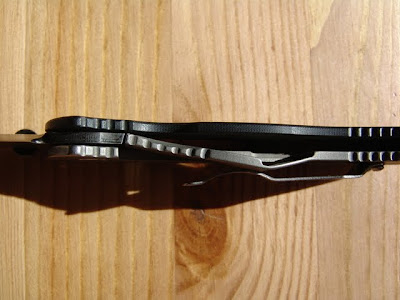
http://strsbackyardknifeworks.blogspot.com/2009/07/bins-horseman-hd-and-jryan-edc-folder.html
In short
"Contrary to how many readers may feel about that picture above. That my friend is a design that deserves praise for defeating the way it was engineered to go. That HD7 above did its job and so did the designer/maker of the knife. I doubt any sutures or ER trips costing great amounts of money were needed with that defeat. We should all pray to be so lucky should we be the on the unfortunate end of a defeat ourselves one day."
The cut-outs are the weakest link in a Framelock IMO.
I have been surprised by some framelocks. A Kershaw vapour that I had would disengage with some force on the spine when not held in hand. When I gripped it the lock did not move as ones fingers actually force the lock in.
Zenith;749294 said:Titanium that is used in framelocks has to be at least grade 5 quality. It has natural spring tension if I can remember correctly.
Zenith;749554 said:Dwayne
Emerson knives start live out so early because it is the Mr. Emersons personal choice for his locks. I know of custom makers that also do this.
However, in my experience it is Ti liner locks such as Emerson knives (and there are many others that also do this) that are not heat treated or carbodized lock faces of the springs that tend to wear much faster. In these locks the geometry of the lock has to be as close to perfect as one can get.
Chris Reeve.....well this is interesting because he is credited as the father of the "framelock" or R.I.L.
The reason why his knives do not really have a break in period, or if it has it is very little is one thing: Tolerance.
CRK also does what I feel is good practice in that they adopt the blade to the spring, not the spring to the blade. In other words, when they fit a blade to a lock, they have multiple handles that are pre-assembled, checking in which handle the blade fits best and then if required they grind the blade LF area to mach the spring. They never fiddle with the spring or springs LF area after it has been heat treated and bead blasted to match the blade. This is good practice IMO and great makers do this.
The only real advantage steel has over Ti is not in its wear resistance, but IMO in its impact resistance if one wants to beat the :spyder: out of the spyderco or other knife.
(I wanted to ad that my knowledge is not perfect and if any maker wants to correct me I am willing to learn, I am just sharing what I have learned from makers and books)
Zenith;749571 said:It does not really matter if the company is Emerson or not, the quality control needs to be good and with whatever company there have been a few melons going through. This is wear warranty comes into play.
The thing why Emerson knives wear so fast is due to the wave feature. If you wave that knife 20 times a day at full speed then the lock will wear faster.
The second question I don’t fully understand, could you elaborate on it a bit before I attempt to answer it in full?
If you are referring to why CRK knives start locking up at 50%, that is his preference (mine to) and the LF is designed and executed that way.
The initial wear on a CRK is minimal due to the close tolerances on the LF and the entire knife. However, sometimes there is a rough spot on the LF that just wears smooth and the lockup will increase from 50%-60% within a few days, or weeks, but after that it would wear very slowly. CRK wants the lockup to be between 50%-75%, but this is different on the Umnumzaan. On the Um it looks closer to 90% but it is actually 75% and I have yet to hear a complaint about the Umnumzaans LF or geometry.
Some imagery
GarethBull;11923 said:^ Nice post bud
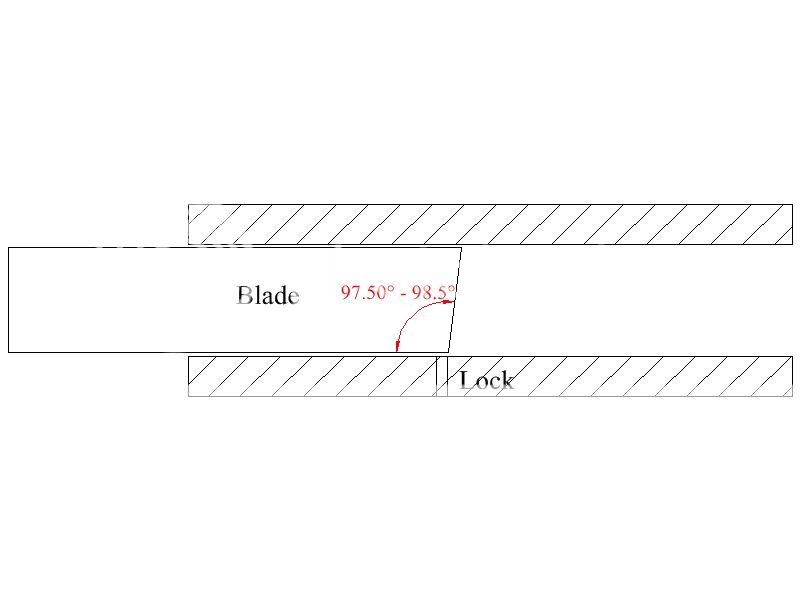
Comments from well-known custom maker Des Horn
Des Horn;11955 said:I do not believe this is wear.
In my view this is "setting" of the face to a perfect fit against the blade, and once there it does not move.
This is a really great thread giving lots of advice to the novice makers.
Now, there is also been some good testing and evaluation done by Kyle Harris (cKc Knives) from new Zealand discussing blade play vs lock security. In short, though we think blade play is bad, making a truly dependable lock in the framelock/linerlock conversion requires some blade play.
Have a look at these videos:
www.youtube.com/watch?v=M2cZQv5cIqQ