Straightening thin kitchen knives after HT and final grinding

Nick , thanks for starting this thread! I will have to try that peening method, it sounds too good to be true.

That is essentially what the bead blasting does. It stretches the surface metal to straighten the blade. I have used it on .100" blades that have only been profiled and up to .125" with bevels roughed out. I have done it on roughly 10 blades but mostly on kitchen knives. Mine seem to warp during the sub zero quench.
 
The bead blasting then might be even more effective. I have a 10" W2 blade .125" thick. The blank was unground, just profiled. I had it deferentially heat treated by a friend but It came out to only 54 RC. I sent it too Peters to see if they could get it the proper 63 RC, which they did. But man, this blade is hooking to one side as I grind it. It sounds like this could be my ticket to straightening, otherwise I was thinking I would have to go back to square one.
 
The bead blasting then might be even more effective. I have a 10" W2 blade .125" thick. The blank was unground, just profiled. I had it deferentially heat treated by a friend but It came out to only 54 RC. I sent it too Peters to see if they could get it the proper 63 RC, which they did. But man, this blade is hooking to one side as I grind it. It sounds like this could be my ticket to straightening, otherwise I was thinking I would have to go back to square one.

Give it a shot and let me know how it works. I've recommended it to others but haven't heard of anyone trying it. I mark the section of the bow on the concave side and then blast it vertically (if the spine is horizontal) and then check it. Do a spot about 1-2" wide and then check. It doesn't take a lot and I have over corrected before and had to go back the other way.
 
Especially on thin blades are sand/bead blasting effective.

MattR: I see You love this straightening method... ;)
 
I'll always admit when I've put my foot in my mouth, but this is a doozy.. and I had to chuckle. This morning I started grinding on a Nakiri, 3/32 O1 that I heat treated before doing any grinding to try prevent warpage. I had to do a minor tweek during the temper cycles and got it straight, BUT, when I was grinding the bevel today guess what started happening?! The damn thing started taking off on me. I've never had that happen before, and so odd that it happened the next day after I pretended to know what the hell I was talking about haha . So I was thankful for this thread because otherwise I would have assumed I was loosing my mind yet again.

I have a few more grits to go but I did get it straightened out so far, but I had to counter it a lot as you mentioned in the original post. We'll see how it goes. Lesson learned
 
Hey Mark funny how that turned out, sounds like we jinxed you [emoji23]

Timos yea I also want to try the preening method since it doesn't require a whole new machine on top of everything I've already amassed haha. The bead blasting does sound like the best method by far however if one is readily available.

I'm going to temper and quench while shimmed and see how that goes. Will post updates after :)
 
Why would an additional tempering cycle overheat your edge? What does it matter how thin the edge is if you control the temperature of your oven?

The usual process when trying to straighten in a tempering oven is to clamp and shim, and go up 25 degrees f. Hardness will be decreased.
 
Hey everyone just wanted to come back and say I tried a combination of methods, essentially just tempering the spine of the blade while it was the clamped and shimmed, followed by immediately dunking in water.

Happy to say it worked perfectly!!!

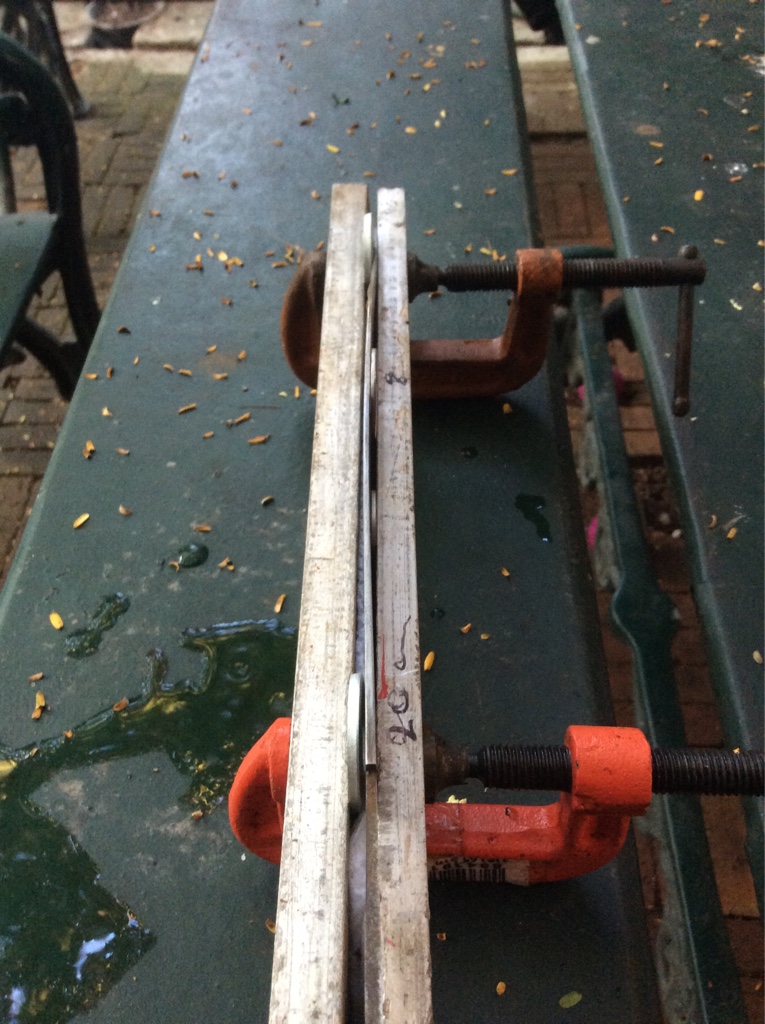
Here are some pics showing the process with a short description.

The key is to protect the cutting edge with some wet paper towel, so that the heat doesn't travel too far down.

Take two pieces of straight aluminum or steel, then place a folded piece of wet paper towel for the cutting edge to lie on.

Similar to straightening using oven tempering, it worked best by clamping the blade so that after shimming it is now curving in the opposite direction with the same amount of counter-curve.

Using washers or anything thin and flat to shim the blade, place the shims in the proper area to get the right counter-curve when sandwiched/pressed between the two outer pieces of metal.

Clamp so that it holds together but make sure to not clamp down too much at risk of cracking your blade.

Using a gas torch, pass the flame back and forth along the spine of the knife until it takes on a deeper yellow-brown color. I believe it just needs to be higher than original temper, for mine the initial temper was a light straw color so I took mine to dark yellow-brown along the spine (mine was less even than I would have liked it to be but still worked).

Once you've tempered the spine to the right color, and while still hot, dunk in water.

Take it apart and check, all the while keeping those fingers crossed!

Last pic is the knife on top of my new anvil which is perfectly flat.

e7b8971aaa4849627ce0aa9fe11eb9b6.jpg
292ea24fd70d4192a76721e757879558.jpg
6994eff1f43704111cbb6608bf9003b4.jpg
f0c22539abeb2fafd08163262930d050.jpg
09e76ae61c8e3e6af97a099ca928a09f.jpg

(I didn't want to also hold my iPad and photograph while actually heating with the torch so in this photo it's just staged ;))

3cf3698311db1dabf668685346847277.jpg
 
Excellent! Thank you for sharing too, Im gonna give this method a try with a Mapgas torch this weekend
 
Here is another thought...perhaps instead of using a peening hammer or a sandblaster, maybe one of those 20$ dremel steel engravers could work? Im'a try it :)
 
Ooh that's a great idea too...maybe just round off the engraver tip a touch and then give it a go? I can't believe I didn't even think of this as I have an electric graver setup with a whole bunch of tips! It can give super fast and short/light strokes which could be perfect. Will definitely try next time around!
 
Back
Top