Stuff moves

Thanks for sharing your knowledge/experiences with us Mark.

The shifting of handle materials is kind of a "fact of life" in the custom knife world.

Not if you focus on synthetics, mother-of-pearls or stabilized woods, generally, it isn't.;)

I don't feel ivory is an ideal material for knife handles.

Best Regards,

STeven Garsson
 
Great thread, Mark. This is the main reason that I don't use horn of any type anymore (that and the smell when grinding it). I do however use a good bit of ivory as well as wood which is just as effected. Here in the Ozarks the humidity is very high and air dried wood is usually 14% or higher in moisture. You can see where I'm going. This is why I use a lot of the oily exotics and stabilized blocks or woods that are more naturally stable..

Gary

Yep, and then some of the woods present problems too, snakewood and ebony are probably the most notable.
 
Not if you focus on synthetics, mother-of-pearls or stabilized woods, generally, it isn't.;)

I don't feel ivory is an ideal material for knife handles.

Best Regards,

STeven Garsson

Lots of people are with you on that STeven, but ivory has been one of the most sought after materials of kings and noblemen alike for centuries. I personally find it hard to sell a wooden handled knife in my store, by any maker. People don't come to Alaska to see wooden handles, they want Alaskan materials, fortunately and unfortunately that means ivory, horn or teeth.
 
Lots of people are with you on that STeven, but ivory has been one of the most sought after materials of kings and noblemen alike for centuries. I personally find it hard to sell a wooden handled knife in my store, by any maker. People don't come to Alaska to see wooden handles, they want Alaskan materials, fortunately and unfortunately that means ivory, horn or teeth.

Mark,

Don't get me wrong, for certain applications, IMO, ivory rules....maybe sealed inlays or something like that.

Tourists who come to Alaska are looking for the "romance" of the bush, and nothing says that like a knife using ivory....I'm opposed to the material for no other reason than it's lack of cracking resistance and some other qualities that don't meet MY standards. I wouldn't say people shouldn't use it but I go for stag over ivory any day of the week....just like some people PREFER ivory or sheephorn.

Best Regards,

STeven Garsson
 
Not if you focus on synthetics, mother-of-pearls or stabilized woods, generally, it isn't.;)

I don't feel ivory is an ideal material for knife handles.

Best Regards,

STeven Garsson

A custom knife collection without Ivory? Stag?
Would take a lot of the interest out of it for me.

Perhaps like collecting only black and white landscape photographs, you would be missing out on a lot of beauty in my opinion.

I have owned many ivory and stag handle knives. Pretty much all I collect except the occasional wood handle piece.
I Don't know if it's because of the climate here in Virginia, my taking very good care of my handle material, my being careful of what I buy or just being lucky but I have only had movement problems with two knives. One ivory and one stag and both occurred while the knives were being shipped.

Now, I only ship knives when I absolutely have to and only ship overnight when I do. I also wrap the knives in the "big bubble" bubble wrap as it serves as an excellent insulator against temperature change.
I will say that in both cases the makers were glad to fix the problems for me and didn't want anything for doing such. One was an extremely complex and laborious fix.
 
Last edited:
Mark,

Don't get me wrong, for certain applications, IMO, ivory rules....maybe sealed inlays or something like that.

Tourists who come to Alaska are looking for the "romance" of the bush, and nothing says that like a knife using ivory....I'm opposed to the material for no other reason than it's lack of cracking resistance and some other qualities that don't meet MY standards. I wouldn't say people shouldn't use it but I go for stag over ivory any day of the week....just like some people PREFER ivory or sheephorn.

Best Regards,

STeven Garsson

I'm with you brother
 
Very informative thread - and interesting comments on the ivories most and least likely to move.

Roger
 
A custom knife collection without Ivory? Stag?
Would take a lot of the interest out of it for me.

Perhaps like collecting only black and white landscape photographs, you would be missing out on a lot of beauty in my opinion.

I have owned many ivory and stag handle knives. Pretty much all I collect except the occasional wood handle piece.

Kevin,

Ivory is like a tooth or tusk, stag antler is more like bone.

While proper aging and upkeep is necessary in both cases, stag is MUCH less likely to crack, and moves at a much slower rate than ivory.

I like stag too, and have not had a stag handled knife crack on me.

You ever hear the story of the Randall collector at the East Coast Custom Knife show? I think it was last year....snap, crackle, pop....Florida to NYC, knives got to the hotel and BAM!

Mark, would like to thank you for starting this thread, it was extremely informative.

Best Regards,

STeven Garsson
 
Kevin,

Ivory is like a tooth or tusk, stag antler is more like bone.

While proper aging and upkeep is necessary in both cases, stag is MUCH less likely to crack, and moves at a much slower rate than ivory.

I like stag too, and have not had a stag handled knife crack on me.

You ever hear the story of the Randall collector at the East Coast Custom Knife show? I think it was last year....snap, crackle, pop....Florida to NYC, knives got to the hotel and BAM!

Mark, would like to thank you for starting this thread, it was extremely informative.

Best Regards,

STeven Garsson

Not if you focus on synthetics, mother-of-pearls or stabilized woods, generally, it isn't.;)
Best Regards,

STeven Garsson
Steven, though I don't know much, I do know the difference between ivory and stag. ;) :)

My point was that if one focuses only on synthetics, MOP and stabilized woods, they are seriously limited their collection and will no doubt take themselves out of consideration for many or even most outstanding knives. You can even strike MOP off your list as it's very limited in large enough scales to make a decent size bowie.

Yes, I did hear that story. Wasn't it multiple and different ivory handle knives all cracked?
I expect we didn't hear the whole story though, as it's extremely odd for multiple knives of different ivories to ALL crack in that short a time period unless there were other factors in play.
 
Last edited:
You can even strike MOP off your list as it's very limited in large enough scales to make a decent size bowie.

Yes, I did hear that story. Wasn't it multiple and different ivory handle knives all cracked?
I expect we didn't hear the whole story though, as it's extremely odd for multiple knives of different ivories to ALL crack in that short a time period unless there were other factors in play.

1. I collect a lot more folders than you do, so no reason to strike MOP. Easily available for a 4"+ handle and the thickness should not be an issue if backed with suitably attractive substrate.

2. Ivory+cold winter temps+well heated hotel room=disaster.;)

Best Regards,

STeven Garsson
 
Steven, though I don't know much, I do know the difference between ivory and stag. ;) :)

My point was that if one focuses only on synthetics, MOP and stabilized woods, they are seriously limited their collection and will no doubt take themselves out of consideration for many or even most outstanding knives. You can even strike MOP off your list as it's very limited in large enough scales to make a decent size bowie.

Yes, I did hear that story. Wasn't it multiple and different ivory handle knives all cracked?
I expect we didn't hear the whole story though, as it's extremely odd for multiple knives of different ivories to ALL crack in that short a time period unless there were other factors in play.

Do you want to hear an even worse (for me) story, I once sent seven knives to a climate with indoor humidity in excess of 50% indoor humidity. I thought it would be a good idea to put them each in a zip lock bag, I had not done it before and will not do it again. NOT A GOOD IDEA Within a half hour of opening they started to pop. One was in my friends hand and popped.
Out of the seven, I had problems with four of them by the time I got them back. These knives had been built properly (to the best of my ability) they had been cured properly over the course of a year, stabilized, everything. I have since come to realize that if a knife gets a chance to acclimate gradually as it travels to a new climate it has little or no trouble, but if it is put in a bag and expected to adjust from 8% to 50% humidity all at once it can't handle it. All of the knives were horn except one, I wonder if it wasn't a similar situation with the ivory handled knives you speak about.

Don't ship knives in zip lock bags. (at least not exotics)

I was able to fix all the knives with little trouble and ship them where they needed to go and have not had any more trouble with any of them. One of them is in London, have you heard of the "London Fog"? That's humid.

As mentioned, many makers and owners do well with exotics with a small persentage of failure.
 
^who'd a thunk? That is golden advice right there. Gradual acclimatization FTW:thumbup::thumbup::thumbup:
 
Kevin,

Mark, would like to thank you for starting this thread, it was extremely informative.

Best Regards,

STeven Garsson
You bet, This is fascinating, I would like to hear more about the Randall knives, if anyone knows more.
 
Do you want to hear an even worse (for me) story, I once sent seven knives to a climate with indoor humidity in excess of 50% indoor humidity. I thought it would be a good idea to put them each in a zip lock bag, I had not done it before and will not do it again. NOT A GOOD IDEA Within a half hour of opening they started to pop. One was in my friends hand and popped.
Out of the seven, I had problems with four of them by the time I got them back. These knives had been built properly (to the best of my ability) they had been cured properly over the course of a year, stabilized, everything. I have since come to realize that if a knife gets a chance to acclimate gradually as it travels to a new climate it has little or no trouble, but if it is put in a bag and expected to adjust from 8% to 50% humidity all at once it can't handle it. All of the knives were horn except one, I wonder if it wasn't a similar situation with the ivory handled knives you speak about.

Don't ship knives in zip lock bags. (at least not exotics)

I was able to fix all the knives with little trouble and ship them where they needed to go and have not had any more trouble with any of them. One of them is in London, have you heard of the "London Fog"? That's humid.

As mentioned, many makers and owners do well with exotics with a small persentage of failure.

Air flow or ventilation is probably a good course of action regarding the storage of handle material or metals. In addition to the above, condensation can build up in an air tight environment causing rust/corrosion in metals or initiate rot in wood.
 
Last edited:
You bet, This is fascinating, I would like to hear more about the Randall knives, if anyone knows more.
It's a sore spot to the owner, for sure. Lawsuits were even posed.

Still, you asked: http://www.deadsexycustomknives.com/ Contact the owner. He's a good guy. Guess what: came from CT to the NYC show when the damage happened. :(

Coop
 
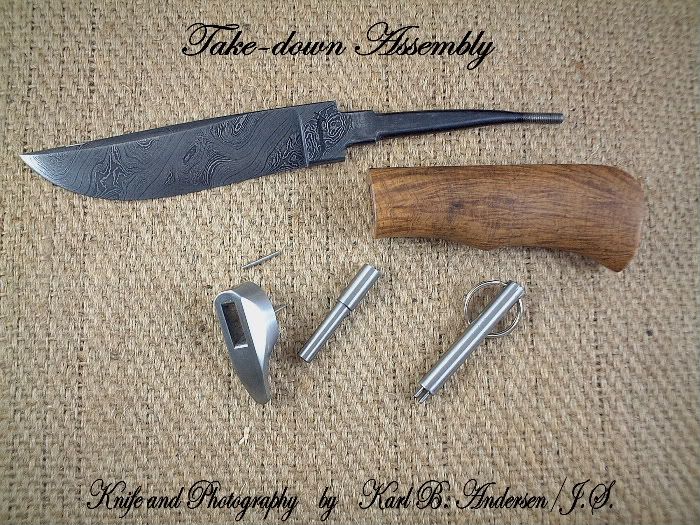
There ARE other solutions:

Since 2003, when I began perfecting my take-down assembly methods, I've had one knife come back, and it was checking/cracking of a piece of stabilized Bubinga that went to Arizona.
Out side of the full tang knife - which isn't fool proof either - this is the strongest handle assembly I've discovered to date, yet allows for free full movement of any materials used.
Loosen it up - let it move.
Tighten it up - go to work.
What ever handle materials are used, are NEVER under any stress.
Why fight it?
Go WITH it!

TMa-1.jpg


TP8-1.jpg
 
There ARE other solutions:

Since 2003, when I began perfecting my take-down assembly methods, I've had one knife come back, and it was checking/cracking of a piece of stabilized Bubinga that went to Arizona.
Out side of the full tang knife - which isn't fool proof either - this is the strongest handle assembly I've discovered to date, yet allows for free full movement of any materials used.
Loosen it up - let it move.
Tighten it up - go to work.
What ever handle materials are used, are NEVER under any stress.
Why fight it?
Go WITH it!

TMa-1.jpg


TP8-1.jpg

probably the best way to "handle" it
 
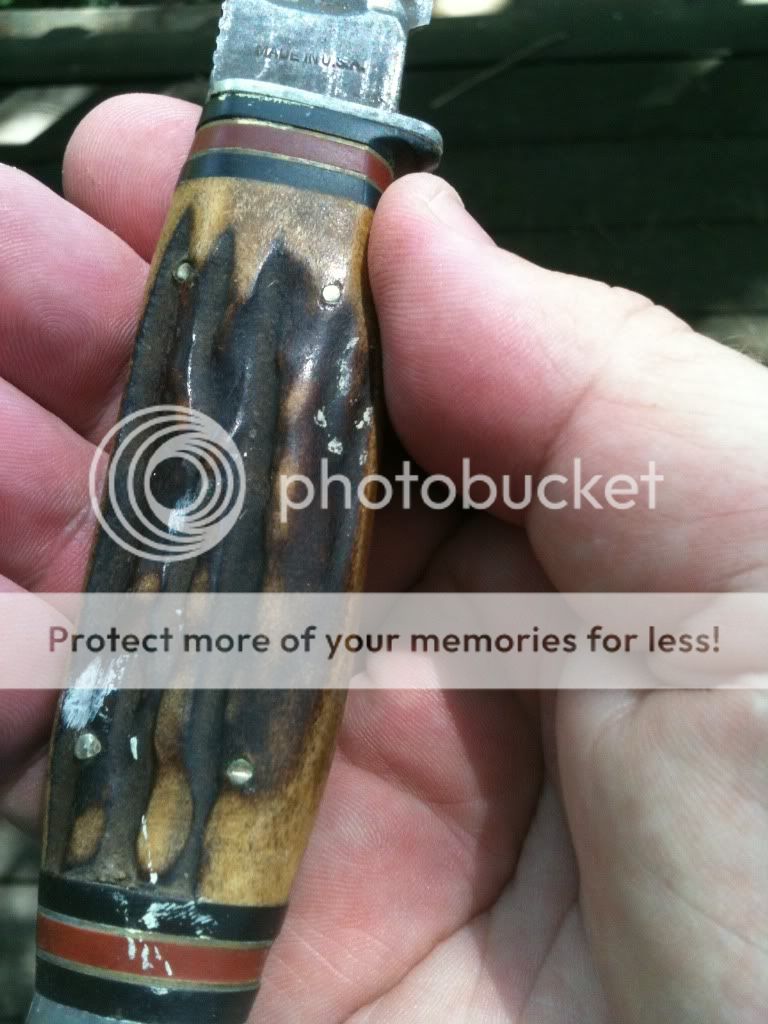
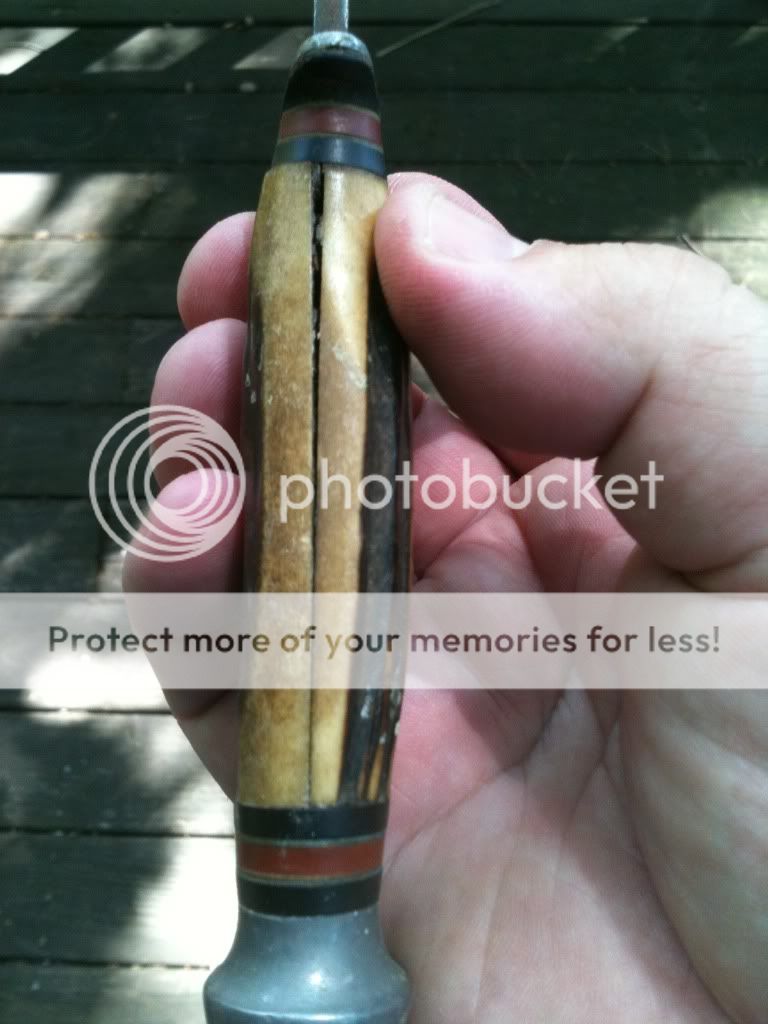
Here's an old Cattaraugus stag handled knife that hasnt received any care, more than a shed tool. And as one can see, it is fine.. and likely will be 50 years from now. Why some handles have tendencies to shrink and others dont is a good question.
Thanks for the great thread Mark.

5343c5c6.jpg


550b9410.jpg


a0d25bdf.jpg


There is a separation going on, but I think not due to moving, but result from a lot of hard use.
af9c0877.jpg
 
Here's an old Cattaraugus stag handled knife that hasnt received any care, more than a shed tool. And as one can see, it is fine.. and likely will be 50 years from now. Why some handles have tendencies to shrink and others dont is a good question.
Thanks for the great thread Mark.

5343c5c6.jpg


550b9410.jpg


a0d25bdf.jpg


There is a separation going on, but I think not due to moving, but result from a lot of hard use.
af9c0877.jpg

Hi David, There is movement in the knife you posted without a doubt, to you and many it may be acceptable movement, to others, any movement is inacceptable, period. Stag antler as you show is not one of the noteable trouble materials. If left in the sink to soak or put in a dishwasher it will absorb water like a sponge and pop off the tang, but if treated like it should be treated most stag handle don't move a lot, you can count on all to move at least a little. Thanks for posting, talk to you later
 
Back
Top