Super Quenchant Speed?

BluntCut MetalWorks

Knifemaker / Craftsman / Service Provider
Joined
Apr 28, 2012
Messages
3,475
First of, I aware of *ping & explode* possibilities when using SQ to quench steel with more than 0.4% of Carbon.

Normally Park50 considers as 7 seconds oil (for certain mass & cross section). Brine 4-5 seconds quenchant. How fast is the cooling rate of super quenchant (SQ)?

So for an instance. If a 0.187 x 1 x 2" test piece at 1500F took 7 seconds to cool to 150F when quench in Park50. How long will it takes to cool to 150F in SQ?

Insights (and humors) are appreciated.
 
How big is a knife?


No answer? The same applies here. SQ isn't a specific product with testing and standards. It could be anything. Any answer given would be no more than a SWAG.
 
Thanks Stacy.

My test knife is 0.1 x 1 x 7.5" - 3.5" edge length. I plan to quench it in cold SQ (brine+dawn detergent+surfactant), target for a 2 seconds SHOCKING quench speed. If SQ is successful, I will try 1475F quench in LN2 (maybe it won't work at all due to air jacket).

How big is a knife?

No answer? The same applies here. SQ isn't a specific product with testing and standards. It could be anything. Any answer given would be no more than a SWAG.
 
I have been told that the Red Devil lye based "super quench" can get 1018 hard enough to pass the ABS JS performance test.
 
Thanks Joe,

It might works as SQ however sodium hydroxide vapor probably unhealthy, so this will be low on my list to try.

My knife steel has plenty of carbon (above 0.35% of C) so I've option of up the hardening aust temperature to obtain higher hardness.

I have been told that the Red Devil lye based "super quench" can get 1018 hard enough to pass the ABS JS performance test.
 
Thanks Stacy.

My test knife is 0.1 x 1 x 7.5" - 3.5" edge length. I plan to quench it in cold SQ (brine+dawn detergent+surfactant), target for a 2 seconds SHOCKING quench speed. If SQ is successful, I will try 1475F quench in LN2 (maybe it won't work at all due to air jacket).

Liquid nitrogen won't work for exactly the reason you said. I have poured LN down my bare arm with no ill effects (don't try this). A slight sting from the expanding gas and a very slight cooling of the arm was all that happened. You could very well blow a lot of LN out if you try this with your hot knife. If you get the LN on your clothing it can get the skin underneath the clothing cold enough to freeze.
 
Why do you want to cool your blade to room temperature so rapidly???
 
What steel are you using to try this? I doubt you'll find numbers from standardized cooling tests even from the guy that came up with Superquench. It will supposedly get 1018/1020 as hard as can be expected. If you haven't already bought the steel, or if what you try doesn't work, get some low alloy, low carbon steel to try. Nickel-Chrome-Moly and Chrome-Moly alloys will oil harden. 41xx, 43xx, 86xx, etc.
 
Thanks Bo - for your reply above & asking why. I want hyper energy loss (collapse), mostly to induce lattice shock to see if possible to generate a different micro structure. As a non-metallurgist, I theorize (ignorant so be it) that a most compact structure will be stronger & tougher, especially when electrons are free to exchange along the lattice plane.

Why do you want to cool your blade to room temperature so rapidly???

I omitted steel type info on purposed, hopefully/appreciative to get some answers independent of steel carbon mass % and avoid early laughs. I am using steel with excess of 0.45% C (hahaha going up since my prev post). Plan to aust temp around 1500F 5-10 minutes soak.

Thanks me2, what's my chance of a perfect quench result - 1%?

What steel are you using to try this? I doubt you'll find numbers from standardized cooling tests even from the guy that came up with Superquench. It will supposedly get 1018/1020 as hard as can be expected. If you haven't already bought the steel, or if what you try doesn't work, get some low alloy, low carbon steel to try. Nickel-Chrome-Moly and Chrome-Moly alloys will oil harden. 41xx, 43xx, 86xx, etc.
 
An experimentalist. It will be interesting to see your result. Austenite is more compact crystalline structure than martensite. If you can get an ultra-fine grain structure you will increase the toughness of the steel at a given hardness. If your blade does not break, you will probably get a good conversion to martensite, so your blade will be strong but brittle before tempering. I have not heard that lattice shock from quenching will cause the ultra-fine grain structure you might be seeking. I seem to remember reading something about the possibility of a high pressure shock wave creating an amourphous steel that would have enhanced characteristics, but I might be confusing papers.
 
I agree that shock/collapse alone is not a good candidate to induce end-all-be-all super fine grain. Fine grain need to be preset and elements (exclude FE & C) are properly pinned at grain boundary ready for this shock, which hopefully put structure at lowest potential energy. Then into LN2 to catch tiny % of dangling RA and hopefully down to yet another lower potential energy level. If this process as planned (yeah my hand-waving approach), tempering won't precipitate carbides nor put back potential energy into the structure. Ideally tempering should only re-orientate/align unstable lattices.

Thus far, my brine quenched test knives perform extremely well (eheheh but of course according to my subjective self). Once, I accomplish this shock step, I'll do a performance show down (video?) against [k390, s90v, 20cv, zdp-189, cpm154] use compounding test material, e.g. [tomato, newsprint, dry pine, sisal rope, dry hardwood, zip tie, paracord, cardboard, ...].
 
It's difficult to predict your chance of success as I don't really understand what your specific goals are. Are you hoping to quench fast enough to get something besides martensite? If you quench, then go to LN2, then temper, you will get carbide precipitation. Epsilon and Haag carbides or some others, depending on carbon %. These are extremely small, nanometer or even angstrom scale. They are also unstable and will convert to cementite if given enough time or temperature (a lot of the former, just a little more of the latter). The electrons are already pretty free to move, since we're dealing with a metal. Also, assuming you want martensite, remember that it is metastable, so the lowest energy arrangement is already not what you have. I think it's some fairly recent stuff, but RA is possible even in low carbon steels, so the LN2 is a good idea, maybe, depending on what you're actually trying to do.

This is a general statement, not just for the OP. Maximum hardness does not increase with quenching speed beyond a certain point. Infinitely quenched 1018 will not reach 60 HRc. The upper limits are pretty well established and documented as a function of carbon content.
 
Sorry, I spelled it wrong. It's Hagg. These are metastable tempering cabides formed in high carbon steels at low tempering temperatures. They are replaced by cementite as tempering temperature is increased, though for knives and cutting tools they may still be around. They are extremely small, 100 angstroms/10 nanometers or so. Epsilon and eta carbides are also precipitated carbides that form during tempering. Which one you get depends on temperature and carbon content and alloying.
 
Thanks me2!

You're right, steel consists of transitional elements and in lattice/crystalize form (non-convalent) therefore electrons are free to tranverse. However martensite & grain & micro structure interfere with the electron flow, indicate the lowering of toughness, which also can indirectly deduce from increase in resistivity. There are many form & state of metastable lattice. To me, amount of carbide precipitation during tempering reflects martensite instability. Could mean when this matrix encounter impact exceed (tempered energy), that matrix may fracture along the lattice since there is no time to diffuse by precipitation.
 
Yes, the fact that carbides precipitate during tempering indicates it is not the stable phase. Yes all those things change the resistivity and can therefore be estimated using that correlation. I'm not sure what you mean by that indicating a loss of toughness. I am following this with the flash processing of automotive sheet steel in mind, ie it was found to do beneficial things w/r to properties, but the people who noted that couldn't explain why. Are you trying to go from austenite to an amorphous phase by cooling extremely rapidly? Also, I can't help feeling there is a language barrier here. Is English a second or 3rd language? It's my only one, so that's kinda what I have to deal in on the internet. I also get the feeling you may be giggling quietly to yourself at odd times while working on this, ie a classic mad scientist. If so, have fun.
 
English is my 2nd but my 1st is also pathetic. Mad scientist would giggle in a dungeon/lab *it's alive!*, sorry such status is too high for me to attain :cool:

Flash processing on top of random structure could gain w/r because of high stressed/sheared resultant structure but I suspect it will suffer high friability. otoh, flash processing on top of a coherent structure, could mean a different high strength micro structure + low stress metastable lattice. All wouldn't mean much for a blade if we have large and or weak grain boundaries. So maybe flash/shock will break up (flatten/distribute) unwanted other elements aggregation along the boundary.

Am I chasing my mis-guided/delusional/hyperbole/ignorant/baseless metallurgical goals? I will take good result even for the wrong scientific reasons or sheer lucks:thumbup:
 
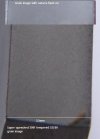
15x mag grain image of 52100 after super-quenched & 300F tempered. Quenching experience: 0.5 second of silent (I can see the vapor jacket), then implosion felt cascade from blade -> tong -> gloved-hand. 3 seconds to cool-to-touch 1/8" x 1.6 x 10" blade. Large grain section(tang) suffered many cracks, fine grain section(blade) - successful.

IMG_1075 small.jpg
 
How much larger is the grain in the tang? I am assuming you normalized the blade but not the tang?
 
Back
Top