
-
The BladeForums.com 2024 Traditional Knife is available! Price is $250 ea (shipped within CONUS).
Order here: https://www.bladeforums.com/help/2024-traditional/
You are using an out of date browser. It may not display this or other websites correctly.
You should upgrade or use an alternative browser.
You should upgrade or use an alternative browser.
Super Quenchant Speed?
- Thread starter BluntCut MetalWorks
- Start date

BluntCut MetalWorks
Knifemaker / Craftsman / Service Provider
- Joined
- Apr 28, 2012
- Messages
- 3,475
Bo T - I just grinded the tang, all cracks were restricted to 0.01 surface. Grain looks about 25% larger, probably because the knife was a tad too long to stick in my 1 gal voodoo oil during one of the refinement thermal step.
Me2 - I want to induce stronger bond and possibly greater martensite lattice sheer.
I super-quenched 4 52100 blades with aust temp 1485F. two 4" blades came out perfect, a 0.09 thick 8" gyuto came out bacon edge, the bushcrafter slightly warp - so I put my weight on it, after multiple pumps, it broke into 2 pieces. Not all loss, I got grain pic
I also super quenched a D2 coupon - it just cracked apart (pings sound probably masked by the implosion noise).
Me2 - I want to induce stronger bond and possibly greater martensite lattice sheer.
I super-quenched 4 52100 blades with aust temp 1485F. two 4" blades came out perfect, a 0.09 thick 8" gyuto came out bacon edge, the bushcrafter slightly warp - so I put my weight on it, after multiple pumps, it broke into 2 pieces. Not all loss, I got grain pic
I also super quenched a D2 coupon - it just cracked apart (pings sound probably masked by the implosion noise).

Stacy E. Apelt - Bladesmith
ilmarinen - MODERATOR
Moderator
Knifemaker / Craftsman / Service Provider
- Joined
- Aug 20, 2004
- Messages
- 38,467
I removed this earlier, but decided to say it. It is not an attack on you or your knives, just a comment on your current "research":
Bluntcut....let me be blunt.
I can see no reason to deliberately damage the steel in an attempt to create something that
1) probably won't happen;
2) isn't needed;
3) the existing science says is a foolish thing to do.
If you think you will create a super hard or super strong steel, take a good look at your results to date.....you won't. As for cracks only being .01" deep....I tend to think that is just where you stop seeing them...but they don't quit there.
I don't claim to be a university trained metallurgist, but most of what you are saying and doing seems pseudo-metallurgy at best.....and just plain silly at worst.
I would love you to put the info you have posted so far on a metallurgical forum like hypefreeblades.com
Bluntcut....let me be blunt.
I can see no reason to deliberately damage the steel in an attempt to create something that
1) probably won't happen;
2) isn't needed;
3) the existing science says is a foolish thing to do.
If you think you will create a super hard or super strong steel, take a good look at your results to date.....you won't. As for cracks only being .01" deep....I tend to think that is just where you stop seeing them...but they don't quit there.
I don't claim to be a university trained metallurgist, but most of what you are saying and doing seems pseudo-metallurgy at best.....and just plain silly at worst.
I would love you to put the info you have posted so far on a metallurgical forum like hypefreeblades.com
While I don't think any new information will come of it, I don't see any harm in trying what you're trying, as long as you understand there has been literally a room full of research on martensite, quenching speed, lattice shear, bond strength, etc. I feel pretty certain what you are trying has been researched extensively already, with no benefit found. If you have some information that shows promise for this line of testing, could we see it? Again, I don't want to rule out something just because I've never heard of it, and it's your time an money after all. However, I think this path has been cut before.
With that in mind, I would like to pose a few more questions.
What specific bonds are you hoping to strengthen?
What benefit would be gained from greater shear in the martensite lattice?
Why do you think extremely high quenching speeds from austenizing temperature are the way to achieve your goals?
Why choose 52100 over something else?
Have you hardness tested the blades to see if there is a difference between them and the oil quenched blades in 52100 that are typically done?
Why do you make blades for this testing rather than use simple coupons?
Do you plan on having micrographs done, assuming you see some differences?
With that in mind, I would like to pose a few more questions.
What specific bonds are you hoping to strengthen?
What benefit would be gained from greater shear in the martensite lattice?
Why do you think extremely high quenching speeds from austenizing temperature are the way to achieve your goals?
Why choose 52100 over something else?
Have you hardness tested the blades to see if there is a difference between them and the oil quenched blades in 52100 that are typically done?
Why do you make blades for this testing rather than use simple coupons?
Do you plan on having micrographs done, assuming you see some differences?

- Joined
- Jan 27, 2013
- Messages
- 19,120
I removed this earlier, but decided to say it. It is not an attack on you or your knives, just a comment on your current "research":
Bluntcut....let me be blunt.
I can see no reason to deliberately damage the steel in an attempt to create something that
1) probably won't happen;
2) isn't needed;
3) the existing science says is a foolish thing to do.
If you think you will create a super hard or super strong steel, take a good look at your results to date.....you won't. As for cracks only being .01" deep....I tend to think that is just where you stop seeing them...but they don't quit there.
I don't claim to be a university trained metallurgist, but most of what you are saying and doing seems pseudo-metallurgy at best.....and just plain silly at worst.
I would love you to put the info you have posted so far on a metallurgical forum like hypefreeblades.com
Metallurgy speak gives me headaches, but I am enjoying Kevin's insight and teachings.Thanks for the read.
BluntCut MetalWorks
Knifemaker / Craftsman / Service Provider
- Joined
- Apr 28, 2012
- Messages
- 3,475
Stacy - Thanks for your valuable blunt insightful and sounded guidance:thumbup: You + Robert/Mete + KevinCashen + Lande + few others are those I look up to and had learned (and yet more) a lot from.
When I 'research/hack', I do try to stay within the realm of metallurgical science. I've basic science background(comp sci & math) but surface-scratching knowledge & skills on metallurgy. I try to keep a reasonable discipline in follow positive feedback loop on metallurgy/knife progression. I stride to learn what & why & how. super quench is my 'how' to get 'what' I seek, and 'why' mentioned earlier. Here is my progress in experimental knives performance testing (non-52100 knives listed & a handful of production folder & kitchen serve as baseline).
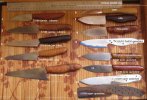
Knife#13 (surface cracks) - I grinded it from a 6" bushcrafter into a bone chopping 4" cleaver. Surface cracks (in tang butt) restricted to decarb layer depth.
Stacy, maybe I am delusional/mis-guided/hard-headed but for certain, I am not dismissive of your and other's advices.
Very appreciated,
Blunt.
When I 'research/hack', I do try to stay within the realm of metallurgical science. I've basic science background(comp sci & math) but surface-scratching knowledge & skills on metallurgy. I try to keep a reasonable discipline in follow positive feedback loop on metallurgy/knife progression. I stride to learn what & why & how. super quench is my 'how' to get 'what' I seek, and 'why' mentioned earlier. Here is my progress in experimental knives performance testing (non-52100 knives listed & a handful of production folder & kitchen serve as baseline).
Knife#13 (surface cracks) - I grinded it from a 6" bushcrafter into a bone chopping 4" cleaver. Surface cracks (in tang butt) restricted to decarb layer depth.
Stacy, maybe I am delusional/mis-guided/hard-headed but for certain, I am not dismissive of your and other's advices.
Very appreciated,
Blunt.
I removed this earlier, but decided to say it. It is not an attack on you or your knives, just a comment on your current "research":
Bluntcut....let me be blunt.
I can see no reason to deliberately damage the steel in an attempt to create something that
1) probably won't happen;
2) isn't needed;
3) the existing science says is a foolish thing to do.
If you think you will create a super hard or super strong steel, take a good look at your results to date.....you won't. As for cracks only being .01" deep....I tend to think that is just where you stop seeing them...but they don't quit there.
I don't claim to be a university trained metallurgist, but most of what you are saying and doing seems pseudo-metallurgy at best.....and just plain silly at worst.
I would love you to put the info you have posted so far on a metallurgical forum like hypefreeblades.com
BluntCut MetalWorks
Knifemaker / Craftsman / Service Provider
- Joined
- Apr 28, 2012
- Messages
- 3,475
While I don't think any new information will come of it, I don't see any harm in trying what you're trying, as long as you understand there has been literally a room full of research on martensite, quenching speed, lattice shear, bond strength, etc. I feel pretty certain what you are trying has been researched extensively already, with no benefit found. If you have some information that shows promise for this line of testing, could we see it? Again, I don't want to rule out something just because I've never heard of it, and it's your time an money after all. However, I think this path has been cut before.
With that in mind, I would like to pose a few more questions.
Inter plates microstructureWhat specific bonds are you hoping to strengthen?
Locked carbon, prevent carbide precipitation.What benefit would be gained from greater shear in the martensite lattice?
Implosion. too bad, not enough psi to make diamond.Why do you think extremely high quenching speeds from austenizing temperature are the way to achieve your goals?
huge amount of search data available and cheapWhy choose 52100 over something else?
Only tested 2 batch (6 Rockwell readings) via Trugrit (Jeff Lutz). High RC# is not as important nor valuable to me now as once did.Have you hardness tested the blades to see if there is a difference between them and the oil quenched blades in 52100 that are typically done?
I made & broke quite a few knives and coupons too. There is a pic in prev post of my partial listed knives in my experimental performance testing.Why do you make blades for this testing rather than use simple coupons?
Yes SEM & maybe TEM as well... IFF my knives performance validated by 3rd party.Do you plan on having micrographs done, assuming you see some differences?
Stacy E. Apelt - Bladesmith
ilmarinen - MODERATOR
Moderator
Knifemaker / Craftsman / Service Provider
- Joined
- Aug 20, 2004
- Messages
- 38,467
Glad you understood my point. It was meant as a friendly comment. However, I consider your chances of getting the desired results the same as the chances of edge packing making a denser blade.
Have fun and research away....just don't expect any results beyond what you have discovered. The very best result you are likely to get will be to get the results of a normal quench using proper HT parameters.
Just to be fair and take my lumps, too:
When I was about 4, my dad went goose hunting and gave me the wings to play with. I was holding them in my hands trying to fly. He said a person was too heavy to fly. I figured if I got up some velocity and flapped faster to create lift, I could overcome that annoying property of physics dealing with gravity ( yes, even at age 4 I knew some physics). I ran fast and flapped like a madman....to no avail. Seems the physicists were right after all. Don't you just hate it when that happens
Before someone says "A Bumble bee can't fly according to physics"...that is just an urban myth. Bumblebees can and do fly just fine as long as they keep their weight down. When they get loaded with pollen on their legs and body, they sometimes can barely stay aloft. They have to land and clean off the extra weight before they can fly home.
Have fun and research away....just don't expect any results beyond what you have discovered. The very best result you are likely to get will be to get the results of a normal quench using proper HT parameters.
Just to be fair and take my lumps, too:
When I was about 4, my dad went goose hunting and gave me the wings to play with. I was holding them in my hands trying to fly. He said a person was too heavy to fly. I figured if I got up some velocity and flapped faster to create lift, I could overcome that annoying property of physics dealing with gravity ( yes, even at age 4 I knew some physics). I ran fast and flapped like a madman....to no avail. Seems the physicists were right after all. Don't you just hate it when that happens
Before someone says "A Bumble bee can't fly according to physics"...that is just an urban myth. Bumblebees can and do fly just fine as long as they keep their weight down. When they get loaded with pollen on their legs and body, they sometimes can barely stay aloft. They have to land and clean off the extra weight before they can fly home.
BluntCut MetalWorks
Knifemaker / Craftsman / Service Provider
- Joined
- Apr 28, 2012
- Messages
- 3,475
As promised, here is my video-thread shows my super-quenched 52100 knife in action.
http://www.bladeforums.com/forums/s...-quenched-52100-knife?p=13488637#post13488637
http://www.bladeforums.com/forums/s...-quenched-52100-knife?p=13488637#post13488637
BluntCut MetalWorks
Knifemaker / Craftsman / Service Provider
- Joined
- Apr 28, 2012
- Messages
- 3,475
FWIW - I am almost able to super quench D2 with austenite temp 1815F. Hahaha ran out of D2 to mangle... waiting for a bar of D2 from Aldo.
So far, I got usable D2 knives but edge is not as stable as 52100, i.e. micro chips on hard impact, however much less chippy than standard 1 thermal ht. Cryo-ed blades tempered 400F (avoid secondary temper hardness hump). I expect these blades plenty hard from super quench, therefore no need for CrC precip extra hardness.
So far, I got usable D2 knives but edge is not as stable as 52100, i.e. micro chips on hard impact, however much less chippy than standard 1 thermal ht. Cryo-ed blades tempered 400F (avoid secondary temper hardness hump). I expect these blades plenty hard from super quench, therefore no need for CrC precip extra hardness.