Surface grinder attachment issue

Ltortorich

Formerly known as Rocketmann
Platinum Member
Joined
Jul 12, 2022
Messages
50
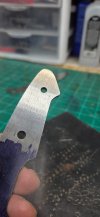
Guy's I'm having an issue with the surface grinder attachment that I built.
It makes things flat but i can see RIPPLES in the steel after using it.
I thought it might be an out of balance wheel but it does it no matter how fast or slow I move the steel.
Is this typical?
It is very hard to photograph.
Thanks for any help.
 

Attachments

  • 20260413_173255.jpg
    20260413_173255.jpg
    69.1 KB · Views: 5
What's the duro number on your wheel? Most of the commercial offerings for rubber are around 90. (vs 70 for contact wheels)
 
pretty typical especially for a home built sga, caused by a few things but main contributor will be contact wheel rubber runout and too soft of rubber or a combination of both. If it bothers you you’d have to either rig a way to true up the rubber on your wheel or buy a precision ground wheel
 
Thanks for the replies.
Im glad to k ow I'm not the only one with this issue.
 
I have a cheap Harbor Freight surface grinder. It leaves ripples like that. I know another knifemaker with one that came from Enco. His does not leave ripples. I think The difference is, his surface grinder rides on ball bearings and mine does not.
 
Belt splice bump. Norax ceramic or Trizact ceramics work pretty well, as do the felt backed finishing belts from Pops.

What wheel did you end up using for a contact wheel?
 
Any surface grinding done on a home built unit will show some degree of chatter. Even a big heavy floor unit will have it if the ways are worn, wheels are not true, or belts have a "bump" at the splice.

The ripples are often more optical than physical. Even a ripple that is only .0001" deep will show as a distortion pattern and look much more severe than it is. Some folks like the machined look.

Ways to reduce rippling:
True all wheels as round as possible on a good lathe.
Use hardest wheels available.
Make sure the ways are gibbed snug, properly lubricated, and all bearings are in good shape. (one reason used SGs are sold for a low price is worn bearings and guides).
Use a "spliceless" belt, like a Trizac or some of the fully coated ceramic belts.. They still have a splice, but it has been reduced.
Use a fresh belt. The more the grit gets worn, the more it bounces at the splice.
 
As others have said, it’s normal with an SGA and I also agree that it’s mainly due to the joint on the belt. You can adjust belt speed or feed the table back and forth at different rates to minimize the effect. Also, lighter passes can minimize it but it’s really only a visual problem when light hits it just right. Unless something is way off you won’t notice anything between the tang and the handle scales when you finish it. Any place visible on the flats will come out quickly during hand sanding. Using an old sharpening stone to prep the belt joints helps too.

Now that I have a good carbide flat platen I’ll generally just do a low speed 400-600 grit pass on the flats with the blade parallel/lengthwise to the belt to get the ripples out of any place that’s visible. If I can’t use the belt I use sandpaper on my surface plate. Either way it’s only a few passes to remove them.
 
Thanks for the replies, i thought something was wrong.
No one ever mentions this in the YouTube videos..
 
An SGA is never going to give as good of a finish as a real surface grinder. They’re just not as solid to start with and once you add a spliced belt and rubber wheels something has to give. Fortunately they do a good enough job for most knife making tasks. I have a KMG SGA and when I first got I went through the process of trueing up the table and prepping the belt splices and got pieces within less than 0.001” of parallel. You could still see that wavy pattern in them but the difference in mic readings was negligible.
 
another person who had good surface results by truing up a wheel

I just built a surface grinding attachment and noticed some slight waviness in the surface finish of the test pieces I ground. The amplitude of the waves is very small and barely makes the needle on my test indicator move, but it is pretty visible by eye, even though it is very difficult to capture in a photo. I remember reading some posts about this issue being caused by the contact wheel being slightly out of round. There is a video by Reeder showing how they true up their contact wheels to overcome this issue, but it is a pretty elaborate rig. I thought about trying to true up the wheel on the lathe, but it seems like you have to have a tool post grinder to machine the rubber. So, before doing something complicated I thought I'd try something really simple. I took a piece of precision ground 3/8" thick by 2" wide A2 tool steel and glued on a piece of 220 grit sandpaper using 3M 45 spray adhesive. I then put the A2 on the magnetic chuck and spun the wheel by hand as I very slowly moved the sandpaper covered A2 towards the wheel using the feed mechanism on the SGA. I could tell that the wheel was slightly out of round when it started to make contact in one spot during its rotation. I kept spinning the wheel and could actually get it up to a pretty good speed by advancing the chuck very slowly. The total feed on the SGA's dial indicator from first intermittent contact to where the wheel made contact throughout the entire rotation was 1.5 thou, and I went a bit past that for a total of just over 2 thou. I locked the translation stage at the end and kept spinning it for maybe half a minute or so. There was a small amount of rubber grinding dust just below the contact point. I did move the chuck laterally throughout this procedure to expose fresh grit on the sandpaper.

After doing this, I ground in the chuck again, which hardly took off any material. Then, I ground another test piece using the same 120 grit ceramic belt as before and the difference in surface finish was just amazing. There was almost no waviness left. In the picture below, the top piece is the one I ground before truing up the chuck and the bottom is the one after. Unfortunately, the picture does not really show the difference very well, but the vertical bands in the top piece on the left are caused by the surface undulations.

Thought this might be useful to somebody. If you try it, please post your results.

kn3Mrbu.jpg


An SGA is never going to give as good of a finish as a real surface grinder. They’re just not as solid to start with and once you add a spliced belt and rubber wheels something has to give. Fortunately they do a good enough job for most knife making tasks. I have a KMG SGA and when I first got I went through the process of trueing up the table and prepping the belt splices and got pieces within less than 0.001” of parallel. You could still see that wavy pattern in them but the difference in mic readings was negligible.
Don reeder thought the same thing and was pleasantly surprised on how good of a finish you can get on one of these things just by truing up a wheel, it’s not true surface grinder level of finish but it’s much better than a lot of people thought possible. A lot of the wheels on the market are pretty rough on runout even if the balance is good.

I think it was REK Knives REK Knives who found out about it and how it’s primarily not the splice by having a shop turn him a solid aluminum wheel to very tight runout tolerances and he suggested it to reeder.
 
I’m not saying you can’t get a “good” finish. I’m just saying there’s a reason machine shop grade “small” 18” surface grinders literally weigh around a ton and wheels for them start around $100 each for cheap ones. They still leave an optical pattern too.

Runout is certainly a factor but rigidity is where the money is at when it comes to precision. One of the reasons you dress wheels is to keep them from breaking. Something has to give when an unbalanced/uneven wheel comes in contact with a rigid surface.

I’m perfectly happy with the results I get from my SGA. To be honest it does a lot better than I expected it to.
 
I’m not saying you can’t get a “good” finish. I’m just saying there’s a reason machine shop grade “small” 18” surface grinders literally weigh around a ton and wheels for them start around $100 each for cheap ones. They still leave an optical pattern too.

Runout is certainly a factor but rigidity is where the money is at when it comes to precision. One of the reasons you dress wheels is to keep them from breaking. Something has to give when an unbalanced/uneven wheel comes in contact with a rigid surface.

I’m perfectly happy with the results I get from my SGA. To be honest it does a lot better than I expected it to.
that’s fair, also not sure of many people who aren’t doing final finishing steps after surface grinding anyway so it’s kinda a moot point regardless tbh. As long as the thing is flat is all most care about which is the important part
 
that’s fair, also not sure of many people who aren’t doing final finishing steps after surface grinding anyway so it’s kinda a moot point regardless tbh. As long as the thing is flat is all most care about which is the important part
Exactly I’m trying to get flat/parallel off of the SGA. I always finish the flats after on a surface plate or something. As long as you get a decent finish surface grinding it generally only takes a few passes to clean everything up. Plus you can change the direction of the scratch pattern and make grind lines look extra crispy that way.
 
Tightening up the bearings in the linear rail and tightening the actuator table will help a bit, too. I am actually using the 6" 90 duro wheel on my combo platen and it seems to be fairly true, but I never lathe trued it. The smaller wheel from AmeriBrade is the one on my SGA currently.

I clean up the finish on my carbide platen.
 
I am actually using the 6" 90 duro wheel on my combo platen and it seems to be fairly true, but I never lathe trued it. The smaller wheel from AmeriBrade is the one on my SGA currently.
Ameribrade is pretty good about truing their wheels

The only companies I know of personally who true their wheels either themselves or have whoever’s making it true them are

ameribrade
wuertz
reeder
northridge when they still existed (do they still exist?)

With the ali wheels it’s usually a dice roll some get incredibly good luck some don’t…I unfortunately rolled 0/4 on my 4 aliexpress wheels, even the 2 and 4in wheel had enough runout to make my reeders tension arm spaz tf out when i still had it
 
Back
Top