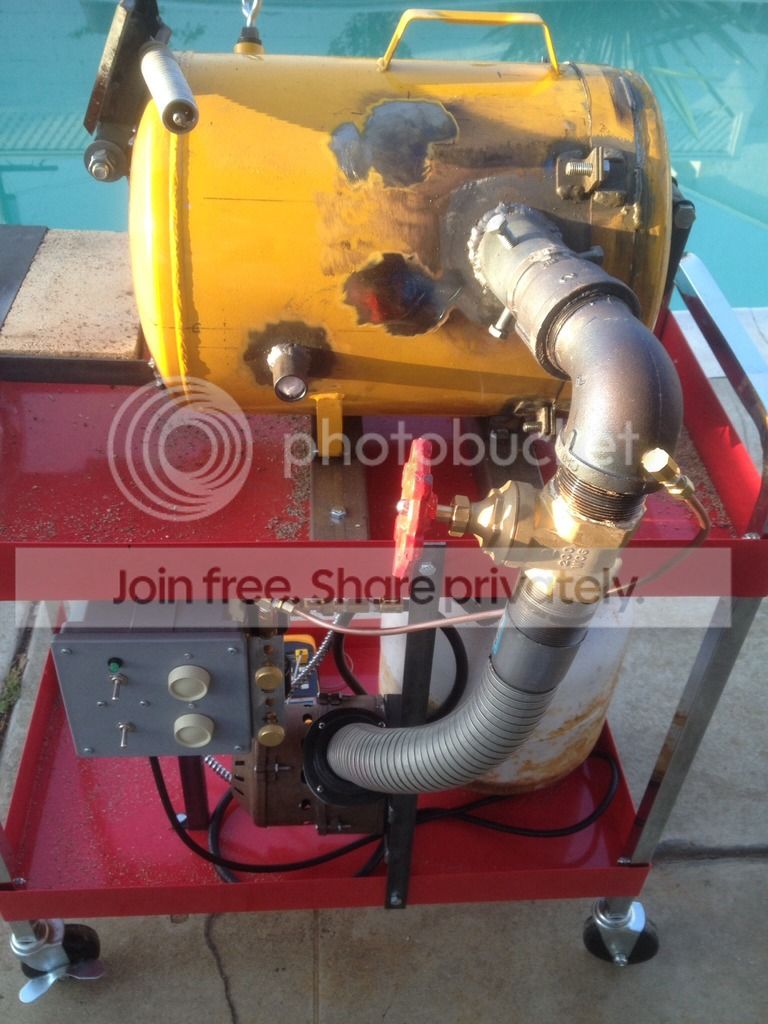
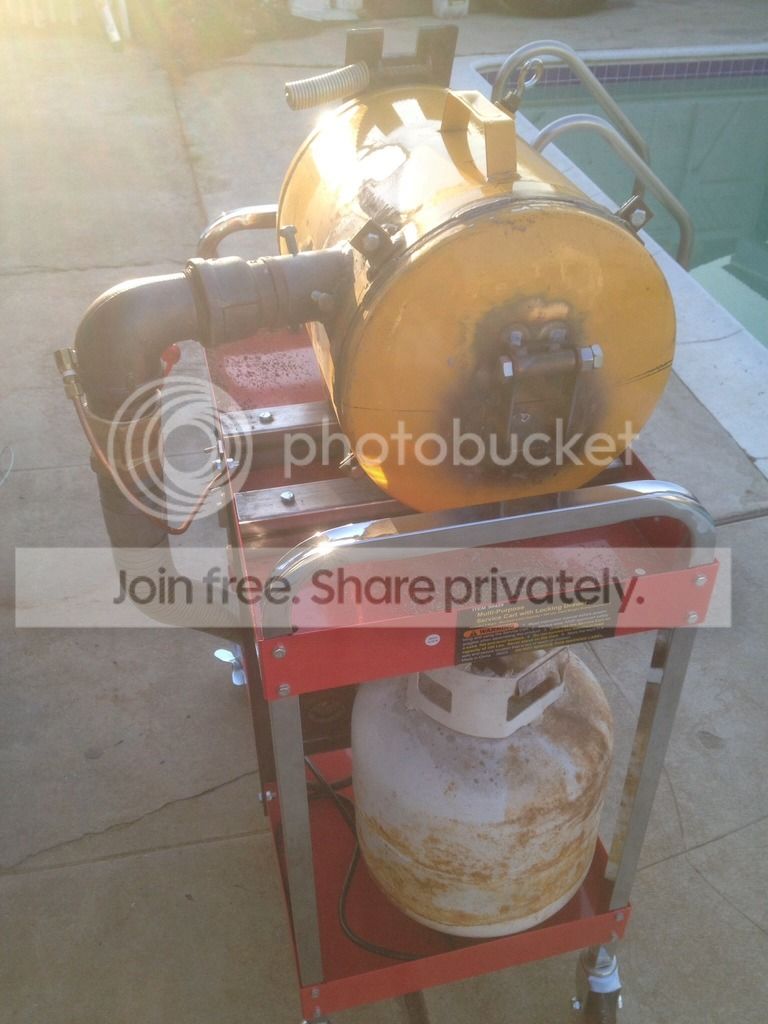
Tank forge.

Thanks.

Yeah John, I figured it would work much better once it's in the forge. Then I can fine tune it.

I plan to replace the two longer nipples with close nipples to make it more compact. I actually plan to make an angle frame and mount the blower on the other side of the tank, and control box on the other, so it's self contained and semi portable.
 
I use flex exhaust pipe. It is "Da Bomb! and looks so cool. I also use a twist baffle in some burners to create a full mix and swirl as the gas/air enters the chamber.

It don't know how big the issue would be, but I would remove the tee with the waste gate. Having it right at the gas injection point has some safety issues as well as possibly creating turbulence in the air flow where you don't want it. I don't really see a need for it at all, since the gate valve can shut the air flow to zero if needed.
 
Thanks Stacy,

You're probably right, since I added it before I added the gate vave, it's probably redundant now anyhow, plus it reduces a bit of bulk.

Got it lined today, welded in the burner tube holder and temp probe tube, and first coat of satanite is done. Happy with how it's coming along... almost there!
 
Another step closer... tidied up the plumbing and mounted the blower last night.
I will mount the control panel today.

 
I just want to add that posting my progress at each step and getting so much extremely knowledgeable and helpful feedback from those with more experience has been the most valuable experience.

A huge thanks to everyone for all you past, and hopefully, future contribution to my learning.
 
You might want to consider a heat shield between the blower and the forge made from 18gauge steel, after running for a while the outside will get hot, possibly hot enough to burn the yellow paint off the tank, I would be a little concerned that after shutting the forge down it will get the blower hot enough to melt the wires
 
Thanks John, yes, I plan to move the wires on the blower around 60 degrees to the left so they come out the side opposite the forge, and then run them through 1/2" flexible metal conduit. I have room and a mounting point to mount a heat shield between the forge body and the blower itself, which is probably worth doing.

Appreciate the feedback.
 
I'm with John. The first thing I saw in that photo was the blower. You should raise it away from the tank at least 3-4". Perhaps make a bracket, or just stick a soft firebrick between them.

For a future build ( or this one), it is simplest to place the blower under the forge and mount it on the cart that you mount the forge body on. The cheap HF welding carts work perfect for mounting a forge.
You can mount the controller, the blower, and any other components on the shelves underneath where they are both safely out of the way as well as shielded away from the heat.
As I said earlier, I like the flex exhaust pipe for the air manifold. I also like using metal clad flex gas lines for the gas feed. A 36" or 48" flex metal clad line in 1/4" or 3/8" fittings is fairly cheap. That allows the rubber gas line to be attached to the forge gas line at a place away from the forge body and also away from hot metal that could burn through the rubber in a second. I also highly encourage using the quick connect gas fittings sold by High Temp Tools and other places for connecting and disconnecting the rubber gas line from your propane tank.
 
It's finished!!! (A huge thanks to my friend Mike (an engineer) who added a lot of help and advice on this project. We had a lot of fun on this one, and I learned a lot from him along the way!)

Below are some photos, but I now have some questions on tuning it.

John and Stacy, I took your advice on moving the blower... I didn't like the HF welding cart or service cart because that folder 18g angle they use is so flimsy, but they had a coupon this week for the heavy duty service cart with drawer for $55, so I grabbed one of those... much better with tube steel legs. (I didn't fit the drawer... that will go nicely under my welding table!)

Mounted the blower and controller under the table and made a work platform and insert for a fire brick on the front of the forge, and fitted doors front and back. The wire wound handle on the door stayed cool enough to operate with a gloved hand even after the forge had been running at 1,900 degrees for an hour. (I though it was going to be a fail since it was so close to the opening, and I thought I should have made it longer.)

Four coats of Satanite and a final coat of ITC-100. Sat the fire brick floor on a bed of Vermiculite, though as soon as I fired it up, it blew all the Vermiculite from around the side of the brick straight out the door! Hopefully the stuff under the brick will stay in place with the weight of the bricks on it.

Now for my questions... it got up to around 1,700 on high, and when I switched it back to idle, it actually got hotter, and went up to 1,950. Obviously, I tried slowing the blower and winding back the fuel, but still seems to burn hot on idle. Next, I will try setting both fuel valves fully closed and the blower and gate valve as low as possible, then try adjusting it up from there on idle, then do the same on high. I am using a mig tip drilled out to a 1/16 orifice...is it worth playing with a different orifice size?

Any advice or comments would be welcome.


Drop your pressure back. I start at 4-5 pounds until I get the forge to heat and then drop it back to 1-2 or even less to maintain temp.
 
If your setup is PID controlled, use the instructions in the PID sticky to set the controls. If it isn't ( I don't see a PID in the photos) read on.

As near as I can see from the photos, your setup is a manually controlled two-stage burner, not PID controlled. No problem, it runs pretty much the same as a PID control, with no automation or learning program. I assume you have some sort of TC readout to tell the temps. It will drift a bit as it runs a while, but you can make adjustments as needed.

It sounds like you are confusing the HIGH and LOW solenoids and fan controls. The following should help.

The basic first run tuning for your setup is:

Set the pressure from the tank regulator at what seems to be a moderate setting. For a blown burner about 2-3 pounds is fine to start with.

On your control box:
Turn off both gas needle valves and close the air gate until it is open only about 25%. Turn off both the LOW and HIGH switches. Set the fan controls to 50%.
Turn on the power to the MAIN SHUTTOFF solenoid only ( the one in the gas line to the burner is the MAIN SHUTTOFF and the one on the end of your copper tubing loop is the HIGH). The MIAN SHUTOFF switch and fan control are the LOW set of controls.
The LOW fan control should be set to about 50%. Open the LOW gas needle valve just a bit (the one that is first as the gas enters your setup from the tank) a bit ( leave the HIGH valve closed). Light forge and adjust the LOW flame with gas and the gate valve for a neutral flame. Open the gas valve a few turns. Opening/closing the gate valve as needed as you adjust the flame. Just keep the fan control knob at 50% for now.
Continue to adjust the LOW gas valve and the gate valve until it gets to the desired LOW temp and holds around there for five to ten minutes ( this will "soak" the refractory). 1400F is good for this setup. The temperature will climb a bit as it soaks the refractory fully. Once fully soaked, back down the gas/air as needed to lower the chamber slowly to the LOW range. You can use the fan control knob now. Again, you want the flame to be neutral.

NOTE - If the needle valve only works when it is nearly closed, turn down the pressure from the regulator at the tank. If it is wide open, raise the pressure a pound or two. When the LOW settings are done, the gas valve and air control should be about at 50% open.

Lets say it is now running around 1400F in this example.

Once the LOW is good, turn on the HIGH solenoid and slowly open the HIGH needle valve.
Adjust the HIGH gas and air knob to increase the temp slowly until it hits around 1800F ( or whatever HIGH you want) and holds a few minutes without climbing much. This is the HIGH setting. Maintain a neutral flame with the air adjustment. As before, raise the regulator pressure a little if you can't hit the HIGH setting with the valve wide open ( you may have to go back and adjust the LOW setting a tad if you raise the pressure when setting the high).

The forge should be set now. With the HIGH switch off, it will run at no less than 1400F. With the HIGH on, it will run at no more then 1800F.....more or less. Any adjustment from here is just a matter of adjusting the high and low controls. Turning off the LOW/MAIN SHUTOFF switch will immediately shut down the forge.


Adding a PID controller will allow your setup to run the forge at an exact preset temp and it will maintain it for you. The PID "learns" as it goes through heat up and cool down cycles until it knows exactly how long to keep the flame on HIGH to maintain the temp within a few degrees.
The PID connects to the HIGH solenoid via an SSR in the power line to the solenoid. If the voltage of the fan and solenoid are the same, the same solenoid can control both lines of the HIGH side.
A TC also connects to the PID.


I think I got all that right.
 
Thanks John, it was running at around 2 1/2 psi so I think I have that pretty right.

Stacy, thanks for the detailed instructions. I have the hi and low the right way round, I think it's just the tuning. I'll follow your instruction, they all make perfect sense.

I don't have the PID yet, I wanted to get it set up and working manually first before I complicate it more. I wired it so i could easily add the PID later with minimal rework.

Thanks again for the info.
 
Hey, LeaderofthePack... how's your forge planning going?

I know I kinda hijacked your original thread, but we seemed to be at about the same point, so I hope the discussion on my build helps yours!

I'm keen to follow your progress.

Cheers.
 
Back
Top