I carried a tanto folder in the form of a large CRKT M-16Z for a few days after sharpening it for a friend. I loved it, and have wanted one ever since. No problems doing things I normally do with a knife. I also carried a CRKT KISS folder for a while and the chisel ground tanto gave me no trouble. I had issues with the handle though. I am in the unfortunate position of having to get my Griptillians blade replaced. It might be time to try a new tanto folder, though I prefer thumb holes to studs. We'll see what happens when I call Benchmade tomorrow.

-
The BladeForums.com 2024 Traditional Knife is available! Price is $250 ea (shipped within CONUS).
Order here: https://www.bladeforums.com/help/2024-traditional/
You are using an out of date browser. It may not display this or other websites correctly.
You should upgrade or use an alternative browser.
You should upgrade or use an alternative browser.
Tanto blades seem so impractical
- Thread starter B Hess
- Start date
I guess I should weigh in on this one. Years of Iiado practice and several years in Japan I feel that there are some good advantages to a traditional tanto as opposed to an Americanized one. A well made knife will cut and do mundane chores and these both (tantos) are no exception. They have strong tips and are less likely to break off and the convex grind pushes material being cut away from the blade edge as it is going through- this meaning they do not wedge in a cut. That is the traditional blade. Flat grinds, concave grinds and other odd stuff have differing advantages and disadvantages. The question really is 'What do I LIKE?" If you don't like them don't buy or use them! I made a tanto for myself and a customer came in and demanded I sell it to him. It was stingray and epoxy cord in a traditional twist pattern but NO GUARD. I understand the knife and why it was made the way it was. He wasn't listening. He had to use it and tried to stab someone with it in saber hold (in self defense as a Contractor) and cut his hand badly when it hit bone. He saw the tip and said " This would make a great armor piercing blade." It would...but ONLY in the ice pick method. You have to pick what you want it to do and combine it with good ergonomics and skilled maker. These blades can be used for about anything but require knowledge of HOW to use them. They are slashing weapons first and foremost. Stabbing someone with any blade is not efficient use of the blade as the blade can become trapped inside the person while you are waiting for them to die if I may be so blunt. Ancient samurai found that they needed to redeploy their swords and stabbing it into a person meant that they could hold the blade trapped while another could cut them. Both of you ended up dying. Slashing them meant you could address multiple attackers simultaneously. Like I mentioned though...it is preference and training more than usefulness.
- Joined
- May 20, 2008
- Messages
- 312
I hear that get thrown around a lot, and I really gotta say.. how is a "true tanto" more practical??
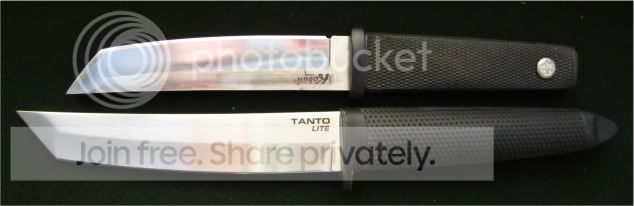
A "true tanto" is a fixed blade designed for combat, with a long 9"+ upswept blade. I sure as hell am not going to be using something like those pictures you posted to open boxes, prepare dinner, or anything like that.
Well of course not... but that style of point is going to be more practical on most any sized knife than what most people think of as a tanto point. I posted those pics as an example of the point. Not the whole knife or blade. Just the point. One a 4 inch folder that point is going to be more useful than the Americanized tanto point. Again, I'm only talking the point style, not a 9 inch fighting knife.
And that bottom one with a different handle would in fact fit in with most kitchen knife sets.

- Joined
- Jul 22, 2009
- Messages
- 11,409
I can't imagine anything I can do with an American Tanto that I can't do with a good wharncliffe blade. My Kershaw Tilt cuts cardboard and netting better than my Emerson CQC-7 ever did. If anything, I would like the traditional tanto if only to have more usable belly and ease of sharpening.
- Joined
- Aug 31, 2009
- Messages
- 2,696
A tanto is sort of like a wharncliffe, but it has the additional edge.
Only the tanto doesn't have that superbly keen piercing tip...
IMO the Americanized tanto would only be useful compared to other shapes for really dirty, borderline abusive work. If I got back into the construction biz and needed one for scraping abrasive surfaces, opening paint cans, etc. Then I might get a throwaway CRKT tanto...
- Joined
- May 23, 2004
- Messages
- 1,496
My main folder for 10 years that I used for everything was a Cold Steel Voyager w/4" tanto blade. When I hear people say they are not good for daily tasks it gives me this face 
For the most part the americanized tanto shape (and serrations) being impractical is internet hype - the type of stuff people pass around having never used a good example of either and a good chance the same who really don't use their knives much at all aside from mundane tasks that a Vic Classic could handle with ease.
For the most part the americanized tanto shape (and serrations) being impractical is internet hype - the type of stuff people pass around having never used a good example of either and a good chance the same who really don't use their knives much at all aside from mundane tasks that a Vic Classic could handle with ease.
Yep. I've used the hell outta that little knife. I didn't even like tanto tips at all compared to bowies and drop points, but really liked the hollow grind on it so it got carried. Since I've been unable to kill it with reasonable abuse, and it works well for everything but wood carving I had to change my opinion about the handy tip that I still don't care for asthetically. Been carrying the Lite version bigger brother alot recently.Can't resist a brief derail.
Picksmith, are you the one who put up your Kobun in the "let's see those users" thread?

- Joined
- Mar 8, 2008
- Messages
- 26,278
Only the tanto doesn't have that superbly keen piercing tip...
It sure can. Just check out Benchmade's tantos (Americanized) or the CRKT Hissatsu (o-kissaki-zukuri) for acute versions of tanto tips. Comments like that presume that all tantos have obtuse points, when in fact they come in a multitude of variations.
 :thumbup:
Yep, not all tantos are the same, just like any blade shape. Some tantos are pointy like a clip-point, some have belly, and some have efficient grinds. But a thick tanto with a less acute tip can take a beating better than most other designs too. They all have their place.

- Joined
- Nov 25, 2006
- Messages
- 7,039
But they look kinda funky.  I have a tanto folder that has been used point in for slicing\prying off peelable tree bark. It was cool for that, other than that it's just another knife. I kind of like how some of them look actually. Motorcycles can be impractical in some regions, yet some of us still enjoy them immensely.
I have a tanto folder that has been used point in for slicing\prying off peelable tree bark. It was cool for that, other than that it's just another knife. I kind of like how some of them look actually. Motorcycles can be impractical in some regions, yet some of us still enjoy them immensely.
- Joined
- Aug 21, 2009
- Messages
- 2,932
As a child, I was always taught, "Tanto what? Those new Tanto things are ridiculous." Every time my Dad and I would peer into a knife case he would always say, dont pick one like that -pointing to the tanto shaped blades. .
Because of this upbringing, I have never really used Tanto knives enough to understand their strong points (bahdump-tshshshsh), but I would like to give them a try.
Recently I bought an Emerson 7B and I have been EDCing it on occasion. No complaints so far.
I think it is a mater of altering my perception of how things can be cut... Trying new improvised cutting techniques... Things that you have to do and feel to learn and understand... etc.
I really don't know though. I do still have the feeling that it is impractical. Lets just say, its not the only blade shape I have with me when I carry it.
. Because of this upbringing, I have never really used Tanto knives enough to understand their strong points (bahdump-tshshshsh), but I would like to give them a try.
Recently I bought an Emerson 7B and I have been EDCing it on occasion. No complaints so far.
I think it is a mater of altering my perception of how things can be cut... Trying new improvised cutting techniques... Things that you have to do and feel to learn and understand... etc.
I really don't know though. I do still have the feeling that it is impractical. Lets just say, its not the only blade shape I have with me when I carry it.

- Joined
- Feb 2, 2010
- Messages
- 2,138
Well of course not... but that style of point is going to be more practical on most any sized knife than what most people think of as a tanto point. I posted those pics as an example of the point. Not the whole knife or blade. Just the point. One a 4 inch folder that point is going to be more useful than the Americanized tanto point. Again, I'm only talking the point style, not a 9 inch fighting knife.
And that bottom one with a different handle would in fact fit in with most kitchen knife sets.
I still think you can't stereotype performance based solely on blade shape. I have got a hissastsu folder that looks kind of traditional to me, and it is of no practical use to me at all. Too thick, flat grind of maybe 1/2" and way too pointy of a tip
- Joined
- Mar 8, 2008
- Messages
- 26,278
I like the Hissatsu in all its variations, but it's definitely a "poking stuff and opening things" design and not much beyond that.

- Joined
- Sep 25, 2011
- Messages
- 150
Speaking of traditional tanto, "tanto" is not a blade profile. It refers to the length. Blade weapon of a certain length is a tanto. Longer than a tanto is a wakizashi, and longer than that is a katana. And all of the aforementioned blades can come in many different blade profile. In tanto, the most common profile is hira-zukuri, literally means "without ridge line." The second most common blade profile for tanto is shobu-zukuri. The blade profile most associated with katana, shinogi-zukuri, is rarely seen in tanto size. When it is seen, it is often the result of a broken katana or wakizashi that was remade into a tanto.
None of the Americanized tanto looks anything like traditional tanto. Even the modern version that resemble kiriha-zukuri makes little sense. The Japanese abandoned that profile very early on because it was inferior to other profiles. Kiraha-zukuri is an exact copy of the Chinese Tang Dynasty dao. The Chinese abandoned it as well. Why adopt a blade profile that the original creators deemed inferior and abandoned?
FYI, a tanto without a guard (tsuba in Japanese) is an aikuchi. A very short tanto is a kwaiken, without guard as well. All the aforementioned short blades can be curve or straight.
None of the Americanized tanto looks anything like traditional tanto. Even the modern version that resemble kiriha-zukuri makes little sense. The Japanese abandoned that profile very early on because it was inferior to other profiles. Kiraha-zukuri is an exact copy of the Chinese Tang Dynasty dao. The Chinese abandoned it as well. Why adopt a blade profile that the original creators deemed inferior and abandoned?
FYI, a tanto without a guard (tsuba in Japanese) is an aikuchi. A very short tanto is a kwaiken, without guard as well. All the aforementioned short blades can be curve or straight.
- Joined
- Feb 2, 2010
- Messages
- 2,138
Why adopt a blade profile that the original creators deemed inferior and abandoned?
Going off of this logic, the best and most "highly evolved" blade shape in history should be something like the rapier. And that birds are "better" than dinosaurs. Which they aren't. Dinosaurs are way cooler.