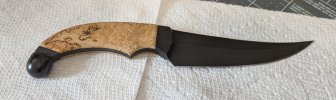
The Apadana (Persian Style Knife Designs)

Well my opinion has always been that any Persian is a trailing point… but I never gave much though to whether every trailing point was a Persian.

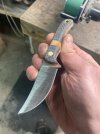
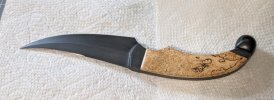
But I guess this is not:
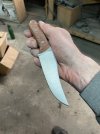
image.jpg

Maybe it’s more of what I would have thought of as a trailing point clip point hybrid, or a concave clip point.
 
Sorry, I thought knife people on a knife forum might enjoy talking about knife design and definition.

The whole "Google it with AI" response is wearing pretty thin with me already.

The poster I asked already had made some statements and I asked him for elaboration on that information. Thought it might add to the discussion.

My mistake.
Not sure but I detect an attitude in that response. For the record, I wasn’t telling you to do anything. I was
merely answering your question by stating that it was literally the answer AI gave me when I googled it. It literally said what he said verbatim.

I wasn’t making a suggestion that you google anything. I was stating that the same answer he gave is literally the exact same answer google gave. . .
 
Last edited:
The AI in google, or anything else civilian, is just one sophisticated search engine plus one hi-tech averaging program. That's it. IT AIN'T INTELLIGENT, and it's gonna average us all into the least common denominator in a short period of time.

Just sayin'.......
 
I’ve always felt that a Persian blade shape should have a more extreme curve vs what we call in the West call a trailing point. Of course, like everything else, both terms seem exchangeable these days.
 
I’m speculating here, but I think the Persian appellation comes from the shamshir sword with its extremely curved blade. It’s much more curved than the western saber.
 
Solid mic drop J. Doyle J. Doyle . That’s a good point. I guess the implication before by some, including me, was that all Persian designs were trailing points. An accident. To clarify, I’d always considered any blade shape designated as Persian to be a trailing point, and to my recollection that holds true, as I don’t recall seeing anything called a Persian that wasn’t. But clearly there are Persian overall styled knives like yours that are not the trailing point blade shape. I would have normally associated those blade shapes with, perhaps South America.
 
Solid mic drop J. Doyle J. Doyle . That’s a good point. I guess the implication before by some, including me, was that all Persian designs were trailing points. An accident. To clarify, I’d always considered any blade shape designated as Persian to be a trailing point, and to my recollection that holds true, as I don’t recall seeing anything called a Persian that wasn’t. But clearly there are Persian overall styled knives like yours that are not the trailing point blade shape. I would have normally associated those blade shapes with, perhaps South America.
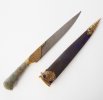
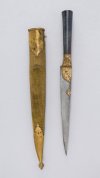
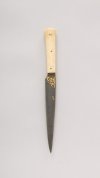
I believe the South American "gaucho" knives were probably derivative of the Persian kard, which the above are examples of. And those were inspired by other Mediterranean dagger types, or vise versa. There is probably some debate over which of those came first but both almost certainly predate gaucho knives.

There is no doubt a lot of Persian cutlery with dramatically upswept and sharply tapered points. Im not clear on whether or not they predated the Kards or the other way around. Or if they were co-existent.
 
You can easily look up Indo-Persian knife and sword designs, as I did. There are some that are straight, some that are curved, some that are very curved. I think it is human nature to take the most unique attribute and assign it to the culture that made it famous.
 
Last edited:
"A knife from Persia" is not synonymous with "persian blade shape" as it's understood within blade shape parlance.


Persian is just a blanket term, and can only do so much.
There are as many examples, if not more, of those kard style blades historically linked with Persia as there are upswept blade styles.

Who decides what the definition of "Persian blade style" is? That's what I was hoping someone could point to. And the answer isn't "google" or "ai".
 
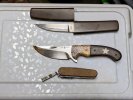
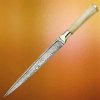
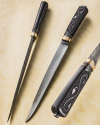
These blades don't conform to the AI definition or embody the "all Persians are trailing points" statements. 🤷‍♂️

View attachment 3117101View attachment 3117102View attachment 3117103View attachment 3117104View attachment 3117105

There are as many examples, if not more, of those kard style blades historically linked with Persia as there are upswept blade styles.

Who decides what the definition of "Persian blade style" is? That's what I was hoping someone could point to. And the answer isn't "google" or "ai".
I didn't say anything about Google or AI, actually.


It's irrelevant how many of whichever blade shape historically came out of Persia. In blade shape parlance, and within the knife community, "Persian" is a known and accepted shape. I didn't decide that, it's just the way it is.
 
Back
Top