
the hero breaks his blade AGAIN!!!!!!! GAHHHH

Joined
Jan 2, 2006
Messages
1,073
okay... this is mostly venting...
i spent a whole week on this knife.
forged from 7/8" W2 stock... stock removal was with a file
it was beautiful sharp lines, clean profile... big.... orginal design (or as orginal you can get with a traditional knife)
and then... i hardened it last night (after many trials and tribulations with the claying...)
well i got a very active hamon... but it was ugly.. and not uniform at all... so... i put it out and normalized it twice that same night...
came back the next morning... and it had all these stress fractures...
i wanted to hit something...did this little dance thingy...NOT FROM JOY

okay... am i too attatched? i mean... i got a heap of expericence... but it hurts not to get the pay off even if i were to pay someone to take the knife.. the finished product is the payoff... maybe i am going soft.

so yeah... i feel better now...
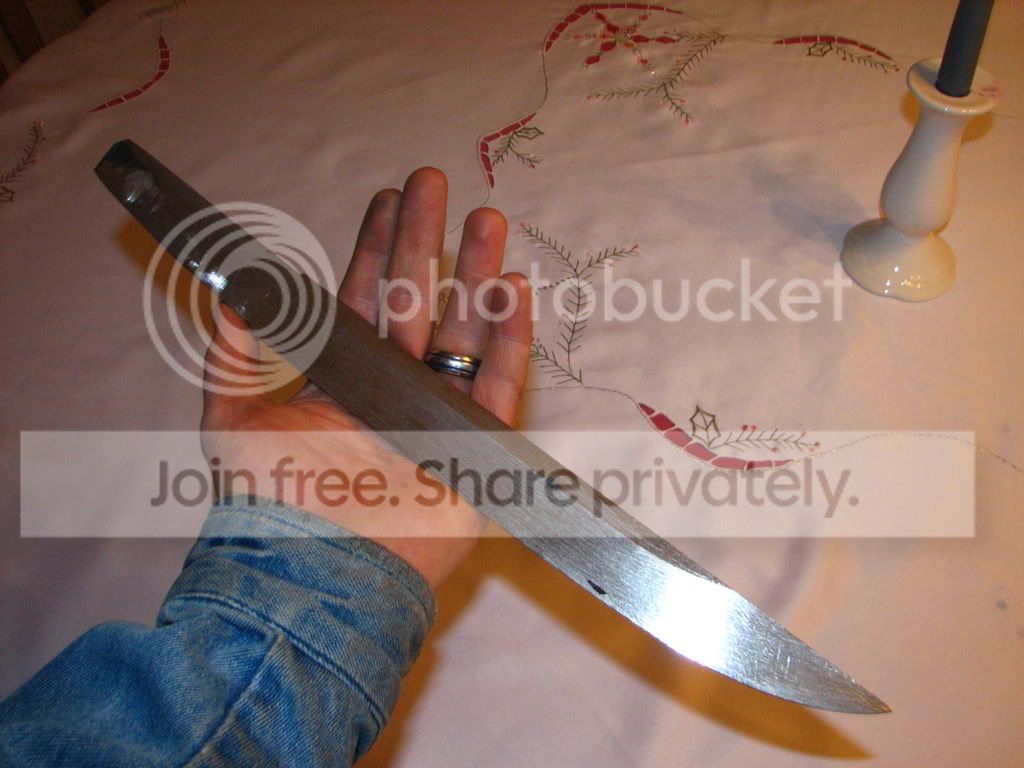
IMG_1115.jpg

sorta.. sniff sniff
it was really nice
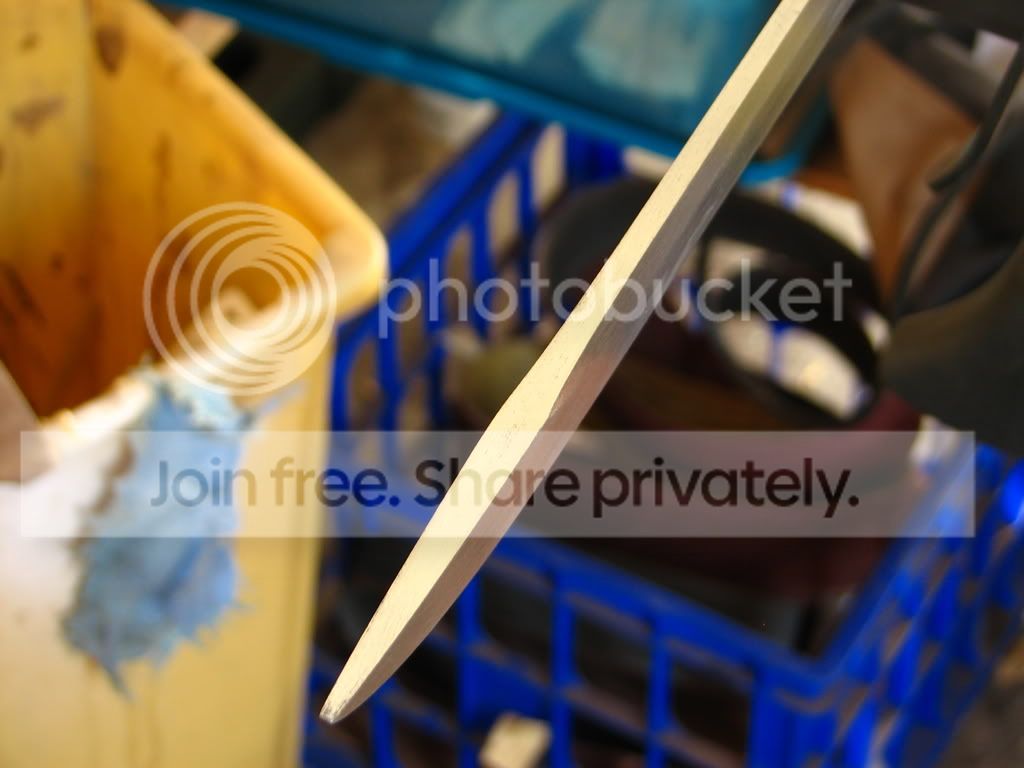
IMG_1143.jpg


sighhhh
please tell me if i am off the wall
i can take it like a man
~Chris
 
I can't really see what you mean in those pics. Are the cracks small enough to be ground out?
 
the cracks arent in those pics... but they were in the tip... so i cut the tip off... and am reworking the blade as bet i can... it isnt nearly as pretty though. i checked to see if i could grind them out... but no...

~Chris
 
Water quenching for hamon is risky. Many swordsmiths have a 50% fail rate. Also , when normalizing, keep the temperature controlled. Same for the quench. It has to be at the right temp, not just very hot. Too hot does a lot of damage. Also, you won't see the hamon until you sand down and etch the blade. What you see right out of the quench is the different decarb layers and coloration of the different steel structures. After quench, I give it one temper, sand the blade to 400 quickly (not a perfect job) and give the blade a quick etch in FC. That will show a lot of the character of the hamon. If it is OK then go back and do the second temper, and finish the blade to the finer grits required to see the detail in the hamon.Etching as you go to see the progress.
Stacy
 
Wow! That would have been a great looking knife. I'm sure all knifemakers ruin plenty of blades especially if quenching with water. I'm sure you can get a smaller tanto out of that. I know you had your heart set on the big one but that's how it goes. Keep it up!
 
Hero:) This is the reason I quench W2 in oil and not water.

If you want to continue with water, try a 2-3 second water quench, then sraight into oil.

What you have left of that blade looks damn good to me. I would go at it again.
 
Knifemaker87....

The truth is , that there is this unspoken of Monster in the room with you everytime you attempt a "Water Quench"....The "CRACK." monster.

I can only tell you about my own "crack" rate, and this is with a totally different steel...But this is what I ran into...
Of the 12 full size Japanese 1050 Katana I tried to water quench-

3 worked.

9 cracked.

Each sword took me about 2 weeks of forge and grinder work to get ready to do the quench.
And this is why I drained my water quench tank, and went back to 5160 and oil quenching.
Each time I heard the "Crack" it was like a death in the family.
 
Should we all make plans to come to your place for the W2 funeral and awaited rebirth of your 5160 baby?
 
How hot are you getting these blades before you quench? You should be around 1400f to 1425f for water. A blade at this temp doesn't look hot enough to harden but it will.
 
Wow... ben out for a while...
had to work on my truck = no forum time

couple things
Bladesmith, what you said is exactly what i did... i took it out and tempered it right away. then quickly took it to 400, etched with FC and didnt like what i saw... so normalized again. then the cracks were there next morning. rats

i think that i have read the entire engnath sight three of four times. there is some GREAT stuff on there.

Sunfish man, what kinda oil do you quench in? i LOVE the hamons you get, but i thought that you got that with water. what kind of oil? and if i do a really fast quench in water can i stick it in old motor oil after that? i still have two pieces of the 7/8" of W2.... i will beat this thing. but i would rather not break it again.

i dont have a thermocouple on my forge. i usually harden at night so i can see the color. i put the pipe in my forge and it helps control the temperature much better... but i am using a magnet to make sure that it is hot enough... but where on the non-magnetic scale should it be? should it just be on the threshold? two or three second out of the forge to magnetic or what?

sadly what is left of the blade isnt in any of the pictures. i had to cut it off right where the back starts to become a uniform width. i just dont hae the heart to finish it quite yet. workin on a 1095 knife with water quench...

thanks for all the help guys, i really do appreciate it.
~Chris
 
During WWII, the Japanese used mostly western steels for their swords. They quenched them in oil because too many cracked when water quenched. Their traditional sword steel combined with experienced smiths allowed for a water quench, though as I mentioned here earlier, even then cracking was not uncommon. You might have better luck with simple, forged carbon steels to start....Good luck!
 
Chris, I use Park's #50 quench oil but any of the faster oils will work. Fogg uses Tough Quench for 1095, look at the hamon he gets and W2 is a little deeper hardening (doesn't need quite as fast a quench). Not sure about the motor oil after water but it would be safer than water only. Most blades heat treaded in a forge are over heated. For the most active hamon and no cracks, you want to sneak up on the critical temp, no higher and soak a little. Look for the steel to go from red color to dull orange, the steel will be red, then all the sudden brighten up, that is critical. If you go above this temp, just pull out, let cool to black and continue, take your time, no need to rush this process.
 
You shouldn't soak at temp for too long to avoid grain growth....A shorter time above critical temp is best to avoid grain growth....
 
During WWII, the Japanese used mostly western steels for their swords. They quenched them in oil because too many cracked when water quenched. Their traditional sword steel combined with experienced smiths allowed for a water quench, though as I mentioned here earlier, even then cracking was not uncommon. You might have better luck with simple, forged carbon steels to start....Good luck!

W2 is a pretty simple carbon steel, like W1 with a little vanadium added. Vanadium retards grain growth at higher temps and makes the steel a little deeper hardening.

C - 1.00
Mn - .23
P - .010
s - .004
Si - .20
V - .18

Chris, keep this thought in mind when heating a blade for active hamon and no cracks. " How low can I go"
 
what I have discoverd with W2 is that it comes out of an OIL quench harder than you think it would and it comes out of a normal temper or two harder than you want it. You MUST temper immediately and at a farily high temp, I tempered twice at 430-450 or so and still got a littel chipping. 460-475 gets me where i canpass the edge flex test. On two blades, i had to temper a third time at the higher temp after doing two at the lower.
 
67-68 Rc with a water quench (65-67 Rc with oil) and 500f temper to get below 60 Rc.

The vanadium also adds a good bit of wear resistance.
 
I usually harden the steels i use with only a magnet and colors to guide me, and i must admit, that when i realized how little heat was actually necessary for a blade to harden, i was amazed.
For the steels i use, i usually just bring it up to a reddish-orange glow, where it becomes non-magnetic. Before, i thought i had to get it white hot, as that`s what i`ve seen on movies or on tv. (Probably, i`ve been screwed by the fact that the camera makes the steel glow alot more, than it does when i look at it with my own eyes.)
I`ve even melted 5160 in my forge on a few occasions, so the temperature is a big deal.

(On a side-note, the old norwegian blacksmiths and knifemakers, usually hardened their blades in the morning, because at night, they were usually so tired and unfocused, that they broke more blades than they hardened.)
 
Back
Top