The road to my first framelock

Joined
Feb 19, 2018
Messages
660
So i have been wanting to make framelocks since before I started making knives. Over the last couple years I have been building up my collection of tools and equipment. I have also been building my house wich has eaten up an enormous amount of my time and money. I am finaly at a point where i can see the light at the end of the tunnel. A milling machine is the last major piece of equipment I require to start on my framelock. My intention with this thread is to document that process and ask for advice along the way. I figured that instead of starting a numerous amount of threads about specific questions i will keep my queries to this thread for the most part. Maybe one day someone in my shoes now will find it and get some use out of it. I realize that not everyone will want to divulge their secrets or share openly. I dont expect something for nothing. If anyone is interested i have a rockwell tester and I will test blades or coupons free of charge to show my appreciation. I also have a thread in progress about making slipjoints. I still need to write my final draft but all the info is there now. If anyone wants any help or questions answered with regard to that thread I will put in as much time as is required to get you up and running. I am pretty new at this relative to alot of the experienced makers here but I will help whenever I can. So far I have just been making fixed blades and slipjoints. I have found the people here to be very helpful and I appreciate all the assistance I have recieved thus far.
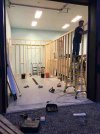
 
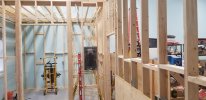
The first step of this project has been to upgrade my workspace (a bay im my garage) to be better suited to making knives. Before this I have been using half a bay of scattered tools and machines with minimal organization. That was starting to get old. I didn't want to bring in any new equipment until i had a proper work space. I spent a week or two designing the workshop and began construction a couple weeks ago. I only have time after work and weekends when im not also working. So far I have convinced a friend to help me move everthing out of the bay that will become my shop and prep the floor for epoxy. I then expoxied the floor with some home depot epoxy. I must be at least a little convincing because I was able to persuade my mom into helping me frame the walls. Me and my Dad have done all the electrical rough in except for the home run to my harage panel and that is where I sit now. I plan to do the sheeting in the near future. Some medical BS has slowed me down a bit but im still able to work away at it.
 
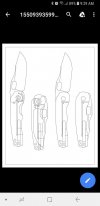
This is the design im starting with. Its not complete but feedback is always appreciated. It will be a thumb hole opener that rides on bearings. (Hopefully ceramic if i can source some). Its basically large sebenza sized in blade and handle but a little more broad. The handles will be contoured ti like the slysz bowie. Im not sure about the grind yet. Im leaning to hollow but i dont have any wheels at the moment. It may end up flat but i will grind it thin. Kind of like a socom elite or a strider sng. A bit beefier stock that comes to a thin edge. It must be able to spyder flick as well. I have left ample room for that. I am open to changing aspects of it if anyone sees any major faults.
Screenshot_20190223-092948_Drive.jpg
 
This is where i could really use some input.
I have narrowed my milling machine down to either the standard grizzly g0704 or the g 0759 (g704 with a fancy dro). I have read countless threads stating that its better to get a larger used machine. Unfortunately thats simply not an option for me. I live in canada and there are very few of those around and they are priced much greater. The 2 grizzlies can be had for 2500 or 3500 CAD plus shipping (250ish) and larger machines seem to $12000 plus. Also i dont have any experience with milling machines. I dont want another project or a lemon. I know that grizzly has decent warranty, at least from my research and parts are readily available. I also know of a few makers who churn out amazing knives that use them. Im under no pretense that they are the best but I believe they are the best fit for me and my budget. Any input between the 2 machines would be great. Im leaning to the 759. I know dros can be had cheaper than $1000CAD but they also need to be massaged a bit to get them on the machine. This seems like a good 3 axis dro thats ready to go. I have heard that the quill (hopefully thats the right term) dro that comes standard isnt the most accurate, so the 3 axis dro seems appealing.
I would love to hear opinions on what types of tooling to get with the machine. Vises, clamping, calibration equipment etc. I have researced this a bit but its always great to hear first hand info. Is the grizzly stuff good? Should I look elsewhere? What is nice to have?
I know that specific mills and counterbores will depend on the size of my screws, bearings etc. But if anyone can point me in a general direction of where to look I would appreciate it. Im still in the process of ironing out the exact hardware I want to use.
Thanks
 
This is where i could really use some input.
I have narrowed my milling machine down to either the standard grizzly g0704 or the g 0759 (g704 with a fancy dro). I have read countless threads stating that its better to get a larger used machine. Unfortunately thats simply not an option for me. I live in canada and there are very few of those around and they are priced much greater. The 2 grizzlies can be had for 2500 or 3500 CAD plus shipping (250ish) and larger machines seem to $12000 plus. Also i dont have any experience with milling machines. I dont want another project or a lemon. I know that grizzly has decent warranty, at least from my research and parts are readily available. I also know of a few makers who churn out amazing knives that use them. Im under no pretense that they are the best but I believe they are the best fit for me and my budget. Any input between the 2 machines would be great. Im leaning to the 759. I know dros can be had cheaper than $1000CAD but they also need to be massaged a bit to get them on the machine. This seems like a good 3 axis dro thats ready to go. I have heard that the quill (hopefully thats the right term) dro that comes standard isnt the most accurate, so the 3 axis dro seems appealing.
I would love to hear opinions on what types of tooling to get with the machine. Vises, clamping, calibration equipment etc. I have researced this a bit but its always great to hear first hand info. Is the grizzly stuff good? Should I look elsewhere? What is nice to have?
I know that specific mills and counterbores will depend on the size of my screws, bearings etc. But if anyone can point me in a general direction of where to look I would appreciate it. Im still in the process of ironing out the exact hardware I want to use.
Thanks

Hey man, since you live in Canada which plays right into my desire to see more Canadian makers of nice framelocks; do you mind if I ask?

Any idea on the price you might be selling the finished product for? I actually am not in love with that particular design (no criticism I think it is a good design; just not my style) but I would love to get some idea of the price incase you ever make a design I do like. I would love to support an upcoming Canadian maker.

Also it is probably premature to ask this but, any idea if you plan on using washers or bearings on this design and others in the future? Just asking because I tend to prefer washers but also do not rule out bearing knives entirely.
 
Hey man, since you live in Canada which plays right into my desire to see more Canadian makers of nice framelocks; do you mind if I ask?

Any idea on the price you might be selling the finished product for? I actually am not in love with that particular design (no criticism I think it is a good design; just not my style) but I would love to get some idea of the price incase you ever make a design I do like. I would love to support an upcoming Canadian maker.

Also it is probably premature to ask this but, any idea if you plan on using washers or bearings on this design and others in the future? Just asking because I tend to prefer washers but also do not rule out bearing knives entirely.
As far as designs go anything is on the table. This design has bearings but i like washer knives too. I would love to try both. As far as pricing goes im just starting so it will be lower than most. Its hard to say because I havent made one yet. To put my pricing into perspective my slipjoints are priced at about 200 USD. Some a bit higher and some a bit lower depending on materials. The raw materials cost of a framelock is higher so I would guess around 350USD. Ill be looking for any excuse to make them and get better, try new materials, processes, construction methods etc. At least for now I do this just for the enjoyment. I hope I have answered your questions and I hope to have a variety of designs in the future. If you have any specific critisisms or nitpicks im all ears. Its just a drawing for now. Its cheap to change at this stage. Thanks for your comments. With any luck I'll make you a knife one day.
 
As far as designs go anything is on the table. This design has bearings but i like washer knives too. I would love to try both. As far as pricing goes im just starting so it will be lower than most. Its hard to say because I havent made one yet. To put my pricing into perspective my slipjoints are priced at about 200 USD. Some a bit higher and some a bit lower depending on materials. The raw materials cost of a framelock is higher so I would guess around 350USD. Ill be looking for any excuse to make them and get better, try new materials, processes, construction methods etc. At least for now I do this just for the enjoyment. I hope I have answered your questions and I hope to have a variety of designs in the future. If you have any specific critisisms or nitpicks im all ears. Its just a drawing for now. Its cheap to change at this stage. Thanks for your comments. With any luck I'll make you a knife one day.

I’ll save any comments since it is still early in the game and you should build the knife you want so your heart and enthusiasm is behind it. Nevertheless should everything go well it would be an honour to be a patron to you especially at this early stage.

I’ll favourite this thread so I can check on your progress but I am sure we will be in touch.

A few minor suggestions that do not affect design would be to make sure the female screws are shouldered against the inside of the front scale to prevent owners from over tightening the screws which will affect knife performance. With a shouldered female screw the female screws hitting the inside of the front scale do not allow overtightening.

I also highly suggest that your female pivot screw be prevented from free spinning somehow by D shapes female pivot or some other method.
 
I’ll save any comments since it is still early in the game and you should build the knife you want so your heart and enthusiasm is behind it. Nevertheless should everything go well it would be an honour to be a patron to you especially at this early stage.

I’ll favourite this thread so I can check on your progress but I am sure we will be in touch.

A few minor suggestions that do not affect design would be to make sure the female screws are shouldered against the inside of the front scale to prevent owners from over tightening the screws which will affect knife performance. With a shouldered female screw the female screws hitting the inside of the front scale do not allow overtightening.

I also highly suggest that your female pivot screw be prevented from free spinning somehow by D shapes female pivot or some other method.
At least at this stage its my plan to mill the pivot barrel to the exact dimension from one pivot counterbore to the other so that when its firmly tightened there is no play and a free action. Kind of like a sebenza 21. Im not sure how easy that will be but its my goal. Unfortunately i dont think a d shape pivot is possible with a manual mill. The pivot will be tooled on both sides and if i can nail the tolerances so that the screws are firmly tightened they should not come loose (again like a 21). I also plan to have a shouldered 3/16 hardened stop pin. Thanks for your interest. Once I actually make one ill go over every detail. Im sure by the time its done it will look a bit different.
 
Hopefully posting my questions only on this thread works. If not ill have to venture outwards. I have modified my design a bit. And im in the process of choosing all the hardware and tooling. I want to have shouldered standoffs and a shouldered stop pin to help with lateral rigidity. I also plan to use a hinderer style stabilizer. All the counterboring seems simple for the bearings and pivot. Drill and ream to the pivot size then use a pilot counterbore to set the depth. My issue is when a pilot is not available. I want to use hardened solid stop pins. I see some people have tiny holes visible on the outside of their knives for the stop pins. I assume that those pin holes are from waterjet used to locate the placment. I am wondering how they are drilled to size for the stop pin. I cant find any counterbores that small. Do you use a twist drill then bore down? Im all ears. Any tips or methods are greatly appreciated. Similarly I have the same issue when I look for tooling to shoulder the stop pins. I hope my question is clear enough. Basically how do you shoulder your stop pins and standoffs when no pilot counterbore is available?
Thanks.
 
The reason for the hole you see on some framelocks is a locating hole... so you can drill straight through both slabs to make sure the stop pin is lined up. Blind holes are extremely hard to get perfect unless you have both a CAD file AND a DRO on your mill. You don't need a counterbore for the stop pin holes/standoffs, just use a flat end mill or even a 135° drill bit if you have enough meat to play with (I wouldn't go with a stepped pin initially, I would leave it a straight 3/16" as they are easier to get and then if you need to use stepped pins later to make the lock up earlier you have that option).
 
Make sure to budget in for tooling aswell. Your going to drop a couple hundred to get all the counterbores, drills, reamers etc you need. A typical carbide counterbore will run you in the $100+ usd range a piece, likely will need 1 or 2 of them depending on your pivot diameter and your bearing pocket diameter. Youll also want carbide reamers which are in the $50+ usd range a piece if im not mistaken. I use all carbide drills aswell, they're around $6 usd or so a piece. As long as you have a fairly accurate Z axis DRO youll be set, theres no real need for a X, Y DRO unless your doing custom milled patterns, most of your X, Y stuff can be done with dykem and scribe lines. Like it was said above, Id go with a non-shouldered stop pin for now and just have a floating pin. Drill through both liners with a small bit, then blind drill in from the backs with a endmill or a undersizes bit then ream to size and you have a nice tight fitting stop pin. If your using a 3/16" pivot, a 3/16" stop pin is quite overkill imo, if your going for 'beefy' use a 1/4" pivot and a 3/16" stop pin.
 
This isn't complete but helps me. I need to keep better notes and update it.


1) Glue pattern then cut out sides and blade then grind to rough shape.

2) Center punch hole locations.

3) Drill holes:

Pivot - #14 then ream 3/16” (both sides and blade)

Spacer holes - #41 (match scales using pivot)

Stop pin - #55 through titanium side to mark other side, then 1/8” on inside on both to create hole for end mill, then 1/8” endmill to depth

Lock bar location holes - #41 is large .096, try smaller maybe #53 .059

Detent ball – drill after lock bar is cut with #55 through lock bar and spot blade (holding blade down tight) for detent hole then drill inside lock bar #53 for detent ball

Deburr all holes

4) Counter bore holes:

Pivot outside - .375 counter bore, depth determined by scale thickness

Pivot inside – 15/32 counter bore, no more than .072 deep

Spacer holes – 2X56 counter bore, depth determined by scale thickness
 
Looks fairly good, a few things to change though. You want to assure you start with flat material, there can be no warps/bends etc in your metal. The way I do it is I start with 2 rectangle pieces of titanium and superglue them together, I then attach my template via spray adhesive. I then centerpunch all my holes and drill the holes that will go through both scales (pivot, stop pin, backspacer) and ream accordingly. I then do a rough profile of the scales. After that I break them apart and will drill the inner stop pin holes, and drill the lockbar holes for cutting it out. Doing it with the scales glued together ASSURES you that the holes are exact side to side, if you drill seperately you will never succeed unless you are using CNC. A #55 in the blade for the detent will be a fairly weak detent, hit it with a #53 for a real strong detent. Some people use #54 for a strong detent, or a #53 for a really strong detent. DO NOT debur/chamfer your detent hole in blade OR your detent hole in lockbar you will ruin it. Everything else can be chamfered. Do your lockup and detent stuff AFTER your blade is hardened and your stop pin locations are set, use carbide drills for this.
 
The reason for the hole you see on some framelocks is a locating hole... so you can drill straight through both slabs to make sure the stop pin is lined up. Blind holes are extremely hard to get perfect unless you have both a CAD file AND a DRO on your mill. You don't need a counterbore for the stop pin holes/standoffs, just use a flat end mill or even a 135° drill bit if you have enough meat to play with (I wouldn't go with a stepped pin initially, I would leave it a straight 3/16" as they are easier to get and then if you need to use stepped pins later to make the lock up earlier you have that option).
Thanks for the reply,
Im wondering what method you would use to locate and then bore the hole. I think due to my equipment limitations I will have to use waterjet to locate my holes. I imagine you can use some type of twist drill to enlarge the waterjet hole to the proper diameter then use some kind of mill to establish the proper depth and get a flat bottom. I have heard that endmills are not perfectly flat. Im trying to figure out the best process and tooling to get a shouldered stop pin done on a manual mill. Thanks for your reply. maybe this construction method isn't the most ideal for my setup but im really hoping I can get it to work. Your help is much appreciated.

Im curious what you mean by a straight 3/16 pin. Do you mean not countersunk into the ti or just that's its only one diameter. My intention is to use a straight pin that is sunk into either scale.
 
Make sure to budget in for tooling aswell. Your going to drop a couple hundred to get all the counterbores, drills, reamers etc you need. A typical carbide counterbore will run you in the $100+ usd range a piece, likely will need 1 or 2 of them depending on your pivot diameter and your bearing pocket diameter. Youll also want carbide reamers which are in the $50+ usd range a piece if im not mistaken. I use all carbide drills aswell, they're around $6 usd or so a piece. As long as you have a fairly accurate Z axis DRO youll be set, theres no real need for a X, Y DRO unless your doing custom milled patterns, most of your X, Y stuff can be done with dykem and scribe lines. Like it was said above, Id go with a non-shouldered stop pin for now and just have a floating pin. Drill through both liners with a small bit, then blind drill in from the backs with a endmill or a undersizes bit then ream to size and you have a nice tight fitting stop pin. If your using a 3/16" pivot, a 3/16" stop pin is quite overkill imo, if your going for 'beefy' use a 1/4" pivot and a 3/16" stop pin.
Thanks for the advice. you are not kidding about costs adding up. I expect to spend about 500 to 1000 on hardware and tooling. I am wondering where you source your floating pins. I am having trouble finding very many. I like that the shouldered ones are hardened to a spec hardness. I am hoping I can find a method to make them work.
 
This isn't complete but helps me. I need to keep better notes and update it.


1) Glue pattern then cut out sides and blade then grind to rough shape.

2) Center punch hole locations.

3) Drill holes:

Pivot - #14 then ream 3/16” (both sides and blade)

Spacer holes - #41 (match scales using pivot)

Stop pin - #55 through titanium side to mark other side, then 1/8” on inside on both to create hole for end mill, then 1/8” endmill to depth

Lock bar location holes - #41 is large .096, try smaller maybe #53 .059

Detent ball – drill after lock bar is cut with #55 through lock bar and spot blade (holding blade down tight) for detent hole then drill inside lock bar #53 for detent ball

Deburr all holes

4) Counter bore holes:

Pivot outside - .375 counter bore, depth determined by scale thickness

Pivot inside – 15/32 counter bore, no more than .072 deep

Spacer holes – 2X56 counter bore, depth determined by scale thickness
Thanks for the steps. Do you find that using an endmill to establish your holes after they have been started with a normal drill works well. So far that's what people seem to be saying. I did read that the endmills are not perfectly flat on the bottom but maybe im overthinking it. Are you able to get a tight fit and an accurate depth with this method.
 
Looks fairly good, a few things to change though. You want to assure you start with flat material, there can be no warps/bends etc in your metal. The way I do it is I start with 2 rectangle pieces of titanium and superglue them together, I then attach my template via spray adhesive. I then centerpunch all my holes and drill the holes that will go through both scales (pivot, stop pin, backspacer) and ream accordingly. I then do a rough profile of the scales. After that I break them apart and will drill the inner stop pin holes, and drill the lockbar holes for cutting it out. Doing it with the scales glued together ASSURES you that the holes are exact side to side, if you drill seperately you will never succeed unless you are using CNC. A #55 in the blade for the detent will be a fairly weak detent, hit it with a #53 for a real strong detent. Some people use #54 for a strong detent, or a #53 for a really strong detent. DO NOT debur/chamfer your detent hole in blade OR your detent hole in lockbar you will ruin it. Everything else can be chamfered. Do your lockup and detent stuff AFTER your blade is hardened and your stop pin locations are set, use carbide drills for this.
Thanks,
I will keep the detent info in mind, very handy tips. I was planning to use waterjet to locate my holes. Hopefully that proves accurate enough. I like the idea of gluing them together. How do you counterbore for your stop pin, or do you use a floating pin?
 
Back
Top