
-
The BladeForums.com 2024 Traditional Knife is available! Price is $250 ea (shipped within CONUS).
Order here: https://www.bladeforums.com/help/2024-traditional/
You are using an out of date browser. It may not display this or other websites correctly.
You should upgrade or use an alternative browser.
You should upgrade or use an alternative browser.
The road to my first framelock
- Thread starter Stang Bladeworks
- Start date


- Joined
- Jul 4, 2010
- Messages
- 873
I only drill in with the drill bit to establish the size (1/8") hole then use an end mill. Doing it this way I don't have to put the scales in a vise. My folders taper from one end to the other and using a vise is problematic once the taper is ground in.Do you find that using an endmill to establish your holes after they have been started with a normal drill works well

- Joined
- Feb 19, 2018
- Messages
- 660
Thanks.Not a knife maker but I just wanted to say the design looks awesome, and I will be following to see the end result!
- Joined
- Feb 19, 2018
- Messages
- 660
makes sense, do you find the bottom is flat enough? what type of end mill do you use? I assume its a square cut end mill. So far this seems to be the way to go.I only drill in with the drill bit to establish the size (1/8") hole then use an end mill. Doing it this way I don't have to put the scales in a vise. My folders taper from one end to the other and using a vise is problematic once the taper is ground in.
- Joined
- Feb 19, 2018
- Messages
- 660
I plan to go ahead and order the g0759 this week (hopefully). I know I will need a rotary table and a standard vise as well as clamping fixtures and collets etc. I figured I would order this type of stuff along with the machine. I am wondering if the grizzly stuff is good for the money or if I should look elsewhere. Some of the items seem to double in price when shipped to Canada for some reason. I also need to get some equipment to properly tram the mill. I was planning on just getting a magnetic base dial indicator. Is there something better or something in addition I should consider? Sorry for all the beginner questions, if you guys weren't so helpful I wouldn't ask... Thanks
Im open to any advice as far as beginner equipment goes. what to get and what to avoid. I have a finite budget but at the same time I don't want to waste my money on low quality stuff.
Im open to any advice as far as beginner equipment goes. what to get and what to avoid. I have a finite budget but at the same time I don't want to waste my money on low quality stuff.
- Joined
- Feb 19, 2018
- Messages
- 660
here is the latest revision of the design. I changed the stop pin to a .125 internal (still shouldered). I added a backspacer that serves to set the distance between the 2 scales. The stop pin is located via 2 .125 threaded barrels. the barrels will go all the way through the frame to make drilling easier. the barrels are held in via titanium screws. This allows for the backspacer to be made of any material (carbon fiber, titanium, g10 etc.). It also allows for a totally enclosed lanyard hole to prevent the cord from fraying. The pins pass through the scales and the backspacer so lateral rigidity and locating function is retained. I think this will make for a better knife that is easier to machine. I'm open to any and all suggestions regarding the design.
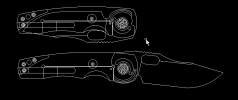
here is the latest revision of the design. I changed the stop pin to a .125 internal (still shouldered). I added a backspacer that serves to set the distance between the 2 scales. The stop pin is located via 2 .125 threaded barrels. the barrels will go all the way through the frame to make drilling easier. the barrels are held in via titanium screws. This allows for the backspacer to be made of any material (carbon fiber, titanium, g10 etc.). It also allows for a totally enclosed lanyard hole to prevent the cord from fraying. The pins pass through the scales and the backspacer so lateral rigidity and locating function is retained. I think this will make for a better knife that is easier to machine. I'm open to any and all suggestions regarding the design.
View attachment 1143390
Ill reply to this quote for all the other comments you replied to my posts for:
First you questioned about floating pins vs shouldered. Im assuming your sourcing pivots/stop pins from ticonnector since you mentioned ti screws and they're the only ones ive found that offer 1/8" stop pin/pivot barrel with ti screws. You can get spec hardened floating pins from usaknifemaker.com and also alphaknifesupply.com They are hardned to 58-60hrc I believe (the websites say what its hardened to)
In terms of waterjetting to spot holes, really theres no need until your doing many at a time. The price youll pay to have accurate jetting done outweighs the 'accuracy' because it still can be off depending WHO does your waterjet. I had stuff jetted before to spot holes and they were off believe it or not. To assure your getting dead even both sides glue the scales together and centerpunch each hole off your template and drill/ream them together. If you do it that way the holes will always line up perfectly. Now, you can go waterjet, but do you want to pay the cost to have a set jetted, and figure out the design doesn't work?
In terms of tooling/equipment. What do you need a rotary table for? No need for that unless your using that to make your 'counterbores' vs using actual counterbores. Endmills are not perfectly flat at the bottom so you cant just plunge in to create a counterbore, thats where a rotary table will come in. You can do it either way, more use counterbores, but rotary table gives a much much nicer finish.
If you source pins from usaknifemaker or alphaknifesupply you will just spot drill a hole through both scales, or through one and blind hit the next scale. Then when you split the scales apart you will drill in the back with a #31 drill making sure not to blow through the other side, then ream it with a 1/8" reamer and your pin will slide right in and be a floating pin. The only thing I use counterbores for are my 2-56 screws, collars/pivot, and bearing pockets.
littlemachineshop has good mills, they are grizzly/harbor freight mills that have upgrades to them such as dro's and higher powered motors etc. You can get a tramming device on ebay or tooling websites that hold 2 dial indicators, and it fastens into a collet so as it rotates you can see each gauge move independently.
I think that covered all your questions you relayed back that no one has answered. If you havent watched already look up ekim knives on youtube. He has a entire series about building a framelock from design to completion and tells/shows you how to do everything. That will answer 99.9% of your questions id assume. Theres like 25 or something videos each 30+ minutes on it.
- Joined
- Jul 4, 2010
- Messages
- 873
Using shouldered stop pins will require you to be dead accurate on the blade thickness and bearing pockets. What that means to me is if I get a little scratch on the ricasso and have to sand it again those measurements change. Using a floating pin allows you to just shorten the stop pin.
I use my rotary table for making the stop pin track only. I use countersinks for bearing and pivot pockets as well as for the 2x56 screws. I also typically use standoffs instead of back spacers. Do watch Ekim's linerlock series. It's very good.
I use my rotary table for making the stop pin track only. I use countersinks for bearing and pivot pockets as well as for the 2x56 screws. I also typically use standoffs instead of back spacers. Do watch Ekim's linerlock series. It's very good.
- Joined
- Feb 19, 2018
- Messages
- 660
Ill reply to this quote for all the other comments you replied to my posts for:
First you questioned about floating pins vs shouldered. Im assuming your sourcing pivots/stop pins from ticonnector since you mentioned ti screws and they're the only ones ive found that offer 1/8" stop pin/pivot barrel with ti screws. You can get spec hardened floating pins from usaknifemaker.com and also alphaknifesupply.com They are hardned to 58-60hrc I believe (the websites say what its hardened to)
In terms of waterjetting to spot holes, really theres no need until your doing many at a time. The price youll pay to have accurate jetting done outweighs the 'accuracy' because it still can be off depending WHO does your waterjet. I had stuff jetted before to spot holes and they were off believe it or not. To assure your getting dead even both sides glue the scales together and centerpunch each hole off your template and drill/ream them together. If you do it that way the holes will always line up perfectly. Now, you can go waterjet, but do you want to pay the cost to have a set jetted, and figure out the design doesn't work?
In terms of tooling/equipment. What do you need a rotary table for? No need for that unless your using that to make your 'counterbores' vs using actual counterbores. Endmills are not perfectly flat at the bottom so you cant just plunge in to create a counterbore, thats where a rotary table will come in. You can do it either way, more use counterbores, but rotary table gives a much much nicer finish.
If you source pins from usaknifemaker or alphaknifesupply you will just spot drill a hole through both scales, or through one and blind hit the next scale. Then when you split the scales apart you will drill in the back with a #31 drill making sure not to blow through the other side, then ream it with a 1/8" reamer and your pin will slide right in and be a floating pin. The only thing I use counterbores for are my 2-56 screws, collars/pivot, and bearing pockets.
littlemachineshop has good mills, they are grizzly/harbor freight mills that have upgrades to them such as dro's and higher powered motors etc. You can get a tramming device on ebay or tooling websites that hold 2 dial indicators, and it fastens into a collet so as it rotates you can see each gauge move independently.
I think that covered all your questions you relayed back that no one has answered. If you havent watched already look up ekim knives on youtube. He has a entire series about building a framelock from design to completion and tells/shows you how to do everything. That will answer 99.9% of your questions id assume. Theres like 25 or something videos each 30+ minutes on it.
Thanks for your reply,
It sounds like a floating stop pin is the way to go. At least it is shouldered which will provide some lateral rigidity. It is my intention to source the majority of my hardware from ti connector. I like the idea of having a solid stop pin that is spec hardened and recessed into the titanium. If it has to be floating that's ok I have changed my design so a small backspacer sets the distance between the scales. Between this and my pivot that should provide enough support against inward flex. The handle pins that are inside the backspacer, the stop pin, and the pivot should provide plenty of lateral support.
As far as waterjet goes. I have the same fear that it may not be accurate enough. I have used it in the past for slipjoints and it has been good enough for that. There is a place local to my work that has been great. They have a $50 minimum and they are very cost effective. About $5 per knife. They are extremely nice and I want to support their business if possible. If it turns out they are not able to handle framelocks ill look elsewhere or do it manually. I want to give it a try though. If it does work its way easier than manually cutting and profiling.
The rotary table is to account for my internal stop pin. I need it to cut the track. I also like the idea of being able to use it to make pivot collars etc. I also plan to use it to mill the pocket for the lock bar stabilizer. Maybe there is a better way to do all this stuff but I am unaware of it.
If the waterjet doesn't work I will definitely try to glue the scales together and drill all at once.
I will certainly look into little machine shop and the dual dial indicators.
I have watched the ekim knives framelock series probably 10 times. In his video he uses a threaded stop pin but most of the info is exactly what I intend to do. I think I have watched every video he has ever made. I would never have started making knives if it were not for his videos. I was lucky enough to buy a fixed blade from him once and its one of my most cherished knives. I recommend his videos to anyone who will listen to me.
Thanks for taking the time to reply to me. When I finally get all of this sorted out and make a functional framelock it will be because of people like yourself. It is awesome that so many people are willing to share their knowledge. Not many things work like this today.
- Joined
- Feb 19, 2018
- Messages
- 660
Based on the feedback I have received so far it looks like you are right. Floating is likely the way to go. Thanks for your input.Using shouldered stop pins will require you to be dead accurate on the blade thickness and bearing pockets. What that means to me is if I get a little scratch on the ricasso and have to sand it again those measurements change. Using a floating pin allows you to just shorten the stop pin.
I use my rotary table for making the stop pin track only. I use countersinks for bearing and pivot pockets as well as for the 2x56 screws. I also typically use standoffs instead of back spacers. Do watch Ekim's linerlock series. It's very good.
Thanks for your reply,
It sounds like a floating stop pin is the way to go. At least it is shouldered which will provide some lateral rigidity. It is my intention to source the majority of my hardware from ti connector. I like the idea of having a solid stop pin that is spec hardened and recessed into the titanium. If it has to be floating that's ok I have changed my design so a small backspacer sets the distance between the scales. Between this and my pivot that should provide enough support against inward flex. The handle pins that are inside the backspacer, the stop pin, and the pivot should provide plenty of lateral support.
As far as waterjet goes. I have the same fear that it may not be accurate enough. I have used it in the past for slipjoints and it has been good enough for that. There is a place local to my work that has been great. They have a $50 minimum and they are very cost effective. About $5 per knife. They are extremely nice and I want to support their business if possible. If it turns out they are not able to handle framelocks ill look elsewhere or do it manually. I want to give it a try though. If it does work its way easier than manually cutting and profiling.
The rotary table is to account for my internal stop pin. I need it to cut the track. I also like the idea of being able to use it to make pivot collars etc. I also plan to use it to mill the pocket for the lock bar stabilizer. Maybe there is a better way to do all this stuff but I am unaware of it.
If the waterjet doesn't work I will definitely try to glue the scales together and drill all at once.
I will certainly look into little machine shop and the dual dial indicators.
I have watched the ekim knives framelock series probably 10 times. In his video he uses a threaded stop pin but most of the info is exactly what I intend to do. I think I have watched every video he has ever made. I would never have started making knives if it were not for his videos. I was lucky enough to buy a fixed blade from him once and its one of my most cherished knives. I recommend his videos to anyone who will listen to me.
Thanks for taking the time to reply to me. When I finally get all of this sorted out and make a functional framelock it will be because of people like yourself. It is awesome that so many people are willing to share their knowledge. Not many things work like this today.
Regardless if you use a stop pin with screws, or a floating pin, the blade + washer/bearing to frame clearances is always what determins your backspacer thickness. You match that dimension to the backspacer and thats your support, the stop pin shouldn't be used for any of that. A floating pin is much easier because it can be a bit shorter and not expand, or pull in, the scales cause off-squareness. And I think it looks much cleaner having 2 small holes vs 2 extra screws.
Rotary table is good for what you mentioned, will definitely need one for overtravel from what I have seen. You dont need one for collars, i've made some collars using just counterbores, my hands, and my belt grinder and they are perfectly round.
Other than that seems you have most of your details nailed down. You should be able to source all your hardware from ti-connector. However, I may recommend you start with some cheaper screws like Stainless steel ones from usaknifemaker or something. Steves screws are ~$150-160+ for a bag of 100, and thats the least you can buy at once. His tooling is awesome though, everyone loves his tooling but be ready to shell out $350+ for 3 counterbores. Taps/drills/reamers are extra, but he does have everything hardware and tooling wise youd need to create one.
- Joined
- Feb 19, 2018
- Messages
- 660
Thanks to all who have replied so far.
Here is a quick update:
I have finished all the electrical in the new shop and tied into my main panel. The entire shop has been painted with fire retardant paint. I have hung a pvc strip freezer style door to separate the grinding room. Just a couple weeks until its ready for action.
I have looked into some mills that are available here in Canada, specifically at busy bee. The craftex cx601 has caught my eye. It is about twice the weight of the g0704 which hopefully translates to a more rigid machine. Also parts/warranty are local to me. The downside is they do not offer a dro variant like the g0759. when the dust settles I would save about $1000 that I could use to get some tooling and a bolt on aftermarket dro. I didn't want to have to mount it up myself but I think it will be worth the hassle. If anyone has any experience with craftex I'm all ears. I did go and check the machine out in person. the floor madel had been dropped so it wasn't in great shape. the y axis was difficult to move. The salesman assured me that a proper unit would not be like that.
I called ti connector with a barrage of questions that were all very politely answered. I will order all my hardware from them once I get everything sorted out. They seem very helpful and accommodating. As far as I'm concerned they have earned my business. I have also started to look into specific handle and blade materials. I have settled on 5/32 blade stock and .154 ti for the handles. when everything is finished the final dimension should be just under .500 total handle thickness.
In order to make the backspacer work I need .200 thick ti at minimum. I plan to source my ti from AKS and they currently do not have any ti that thick. USA knifemaker does but im trying to order from as few places as possible to save on shipping. I was thinking that since my backspacer only serves to set a fixed space I may use CF, G10, or micarta. There will be threaded barrels inside the backspacer so I don't need to tap the material. Any thoughts? the thicker ti is expensive and the synthetic material would shed some weight.
I was hoping to do all my counterbores in the ti so the blade just needs to be flattened again after HT but it looks like my web of material between the bearings and pivot screw would be too thin for my liking (.050 to.060). I will need to counterbore the blade as well. Do you guys c/b pre or post heat treat? I am worried if I set an exact depth pre heat treat that there might be a slight shift during the quench that may throw off my tolerances. my initial thought is to hog out most of the material pre heat treat and set an exact depth after heat treat. Im interested to hear peoples opinions. Will a carbide counterbore be able to leave a nice finish on hardened steel and will it cut efficiently (ish)? for refrence I will be using cpm154 because that's what I'm most familiar with. I plate quench and typically have no visible warping.
My thought are to undersize my stopping track and c/b then machine post HT to exact specs provided the machine and carbide tooling will handle it. the cx601 has a 1.5hp brushless motor and is about 575lbs if that helps at all.
Any help is much appreciated.
Here is a quick update:
I have finished all the electrical in the new shop and tied into my main panel. The entire shop has been painted with fire retardant paint. I have hung a pvc strip freezer style door to separate the grinding room. Just a couple weeks until its ready for action.
I have looked into some mills that are available here in Canada, specifically at busy bee. The craftex cx601 has caught my eye. It is about twice the weight of the g0704 which hopefully translates to a more rigid machine. Also parts/warranty are local to me. The downside is they do not offer a dro variant like the g0759. when the dust settles I would save about $1000 that I could use to get some tooling and a bolt on aftermarket dro. I didn't want to have to mount it up myself but I think it will be worth the hassle. If anyone has any experience with craftex I'm all ears. I did go and check the machine out in person. the floor madel had been dropped so it wasn't in great shape. the y axis was difficult to move. The salesman assured me that a proper unit would not be like that.
I called ti connector with a barrage of questions that were all very politely answered. I will order all my hardware from them once I get everything sorted out. They seem very helpful and accommodating. As far as I'm concerned they have earned my business. I have also started to look into specific handle and blade materials. I have settled on 5/32 blade stock and .154 ti for the handles. when everything is finished the final dimension should be just under .500 total handle thickness.
In order to make the backspacer work I need .200 thick ti at minimum. I plan to source my ti from AKS and they currently do not have any ti that thick. USA knifemaker does but im trying to order from as few places as possible to save on shipping. I was thinking that since my backspacer only serves to set a fixed space I may use CF, G10, or micarta. There will be threaded barrels inside the backspacer so I don't need to tap the material. Any thoughts? the thicker ti is expensive and the synthetic material would shed some weight.
I was hoping to do all my counterbores in the ti so the blade just needs to be flattened again after HT but it looks like my web of material between the bearings and pivot screw would be too thin for my liking (.050 to.060). I will need to counterbore the blade as well. Do you guys c/b pre or post heat treat? I am worried if I set an exact depth pre heat treat that there might be a slight shift during the quench that may throw off my tolerances. my initial thought is to hog out most of the material pre heat treat and set an exact depth after heat treat. Im interested to hear peoples opinions. Will a carbide counterbore be able to leave a nice finish on hardened steel and will it cut efficiently (ish)? for refrence I will be using cpm154 because that's what I'm most familiar with. I plate quench and typically have no visible warping.
My thought are to undersize my stopping track and c/b then machine post HT to exact specs provided the machine and carbide tooling will handle it. the cx601 has a 1.5hp brushless motor and is about 575lbs if that helps at all.
Any help is much appreciated.
Sounds like your headed in the right direction. Any material that you can get flat and square is good for a backspacer. You can use standoffs or any of the materials you listed above, plus anything else you could think of. .05-.06 is plenty of web thickness in ti scales. If you think about it you never will have enough lateral force on the blade to pop or bend that web, if you do your using the knife completely wrong and it will fail anyways. All your force will be up and down, front and back, which there will be quite a bit of meat there to support that. I know guys that go down as low as .020" web and have never had a failure.Thanks to all who have replied so far.
Here is a quick update:
I have finished all the electrical in the new shop and tied into my main panel. The entire shop has been painted with fire retardant paint. I have hung a pvc strip freezer style door to separate the grinding room. Just a couple weeks until its ready for action.
I have looked into some mills that are available here in Canada, specifically at busy bee. The craftex cx601 has caught my eye. It is about twice the weight of the g0704 which hopefully translates to a more rigid machine. Also parts/warranty are local to me. The downside is they do not offer a dro variant like the g0759. when the dust settles I would save about $1000 that I could use to get some tooling and a bolt on aftermarket dro. I didn't want to have to mount it up myself but I think it will be worth the hassle. If anyone has any experience with craftex I'm all ears. I did go and check the machine out in person. the floor madel had been dropped so it wasn't in great shape. the y axis was difficult to move. The salesman assured me that a proper unit would not be like that.
I called ti connector with a barrage of questions that were all very politely answered. I will order all my hardware from them once I get everything sorted out. They seem very helpful and accommodating. As far as I'm concerned they have earned my business. I have also started to look into specific handle and blade materials. I have settled on 5/32 blade stock and .154 ti for the handles. when everything is finished the final dimension should be just under .500 total handle thickness.
In order to make the backspacer work I need .200 thick ti at minimum. I plan to source my ti from AKS and they currently do not have any ti that thick. USA knifemaker does but im trying to order from as few places as possible to save on shipping. I was thinking that since my backspacer only serves to set a fixed space I may use CF, G10, or micarta. There will be threaded barrels inside the backspacer so I don't need to tap the material. Any thoughts? the thicker ti is expensive and the synthetic material would shed some weight.
I was hoping to do all my counterbores in the ti so the blade just needs to be flattened again after HT but it looks like my web of material between the bearings and pivot screw would be too thin for my liking (.050 to.060). I will need to counterbore the blade as well. Do you guys c/b pre or post heat treat? I am worried if I set an exact depth pre heat treat that there might be a slight shift during the quench that may throw off my tolerances. my initial thought is to hog out most of the material pre heat treat and set an exact depth after heat treat. Im interested to hear peoples opinions. Will a carbide counterbore be able to leave a nice finish on hardened steel and will it cut efficiently (ish)? for refrence I will be using cpm154 because that's what I'm most familiar with. I plate quench and typically have no visible warping.
My thought are to undersize my stopping track and c/b then machine post HT to exact specs provided the machine and carbide tooling will handle it. the cx601 has a 1.5hp brushless motor and is about 575lbs if that helps at all.
Any help is much appreciated.
You can however CB your blade if you want, but if you can keep it all in the ti its easier so you dont have to worry about having 4 seperately counterbored holes falling completely square to one another. If you can keep in in ti only, that takes it down to 2 holes with is much easier (for bearings only, plus 2 for pivots/collars). Carbide tooling will cut hardened steel, I did it myself recently. I counterbored into the blade a majority of the depth and after heat treat took another ~.010" off to give it a nice clean finish. Carbide counterbores are awesome, just run them extremely slow and they will cut very well for you.
- Joined
- Feb 19, 2018
- Messages
- 660
I was able to accomplish quite a bit this weekend. I got my 1940s surface grinder up and running with a cheap amazon vfd. I bought the machine over a year ago when I spotted it online for a great price. I also picked up a cx601 milling machine. With the help of 4 friends I was able to get all the heavy equipment in place. I ran out of time so there is still a ton of clean up to do. Next weekend I plan to tram the mill and mount the DROs as well as surface the chuck on my surface grinder. I should probably clean up a bit as well. I have a few other small tasks to get the new shop ready. I also need to start heat treating a slipjoint for a patient customer. For now I am out of disposable income but hopefully soon I can order my tooling. I already got my blade steel and I will likely grab some Ti so I can get the waterjetting started soon.

- Joined
- Apr 3, 2011
- Messages
- 6,017
Awesome love to see it all come together! Are you doing a one-off first or a run of them?
- Joined
- Feb 19, 2018
- Messages
- 660
I plan to buy enough materials to make 5 to start. I will make them one at a time start to finish. My goal is that by the last one I have the process figured out. I will try to get my mistakes made and solved in that run. It took about 5 knives for me to get my slipjoints figured out. Maybe im being optimistic but only time will tell. Im fairly certain the design will work. I have gone over my CAD a fair bit so far. It will just be a matter of developing consistent repeatable processes and executing them properly. Hopefully im up to the task. All the advice I have recieved online has been super helpful so far.Awesome love to see it all come together! Are you doing a one-off first or a run of them?
- Joined
- Apr 3, 2011
- Messages
- 6,017
Cool, the DRO will be super helpful when drilling your x-y coordinate holes so they will be spot on.I plan to buy enough materials to make 5 to start. I will make them one at a time start to finish. My goal is that by the last one I have the process figured out. I will try to get my mistakes made and solved in that run. It took about 5 knives for me to get my slipjoints figured out. Maybe im being optimistic but only time will tell. Im fairly certain the design will work. I have gone over my CAD a fair bit so far. It will just be a matter of developing consistent repeatable processes and executing them properly. Hopefully im up to the task. All the advice I have recieved online has been super helpful so far.
- Joined
- Feb 19, 2018
- Messages
- 660
I got the mill set up today. The run out as measured on the spindle is about .00025 and the table seems to be within .001. When I travel to the extreme ends (x axis) the last 6 inches of each side is about .005 high. I thought it was slightly bowed or c-shaped but when i lift slightly it affects the reading. I think the weight of the table hanging off the opposite side raises the surface .005. Im not sure if this can be adjusted or not. If i mount my work in the middle of the table i have alot of room to work with without getting into the far ends. My dial indicator and mount are a little cheap and they dont fit into a collet so i have to use the cheap jacobs chuck to sweep the table. I woukd like to find a better way of checking this but for now its within .002. When i check the y axis it is good to about .001. I did not end up adjusting the mill at all so far. I did use a 3/8 end mill to flatten a micarta scale. Seems good according to my surface plate. I may try to make an aluminum cube and check all the dimensions tomorrow to check it out a bit more. If anyone has any tips or advice im all ears. Tomorrow I will continue to get the shop ready I have alot to clean up.
- Joined
- Feb 19, 2018
- Messages
- 660
One more update for today. I did tweak my design a bit. These adjustments were to get further forward on the handle. I moved the lockface closer to the pivot and extended the region under the pivot to allow for a choked up grip. My previous rendition had me worried it would be too easy to slip forward on the blade. I think these additions will help the knife be better overall. I clipped the bottom of the extended area so it is not too close to my opening hole. I dont want anyones fingers to snag on it while opening. I had this issue with my techno 2 and it bothered me alot. If you have any input or suggestions regarding my current design let me know. Thanks.
Edit: I also moved the detent closer to the center of the lockbar so you dont have to close the blade as far to the detent onto the blade. I plan to mill a detent ramp to ensure a smooth transition.
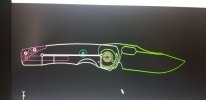
Edit: I also moved the detent closer to the center of the lockbar so you dont have to close the blade as far to the detent onto the blade. I plan to mill a detent ramp to ensure a smooth transition.