DeSotoSky
Gold Member
- Joined
- Mar 21, 2011
- Messages
- 7,033

The Turning Point by RG Smith
June 4th - June 7th, 1942. The Battle of Midway, a tiny atoll 1,300 miles NW of Hawaii
Japan's biggest goal for the attack on Pearl Harbor 6 months earlier was the destruction of the aircraft carriers stationed there. An intelligence failure, by Japan, not a single carrier was at Pearl Harbor on the day of the attack. Midway was strategically important, it had both an airbase and a submarine depot enabling submarines to remain on patrol longer without returning all the way to Hawaii. For the Japanese, the plan at Midway was 3 fold, eliminate Americas carriers, extend their defensive perimeter in the Pacific, and give them a base to threaten Hawaii. Japan had a plan to lure the American carriers to Midway in a sophisticated ambush. What Japan would not have was the element of surprise. Japanese code had been broken and it was known an attack was planned on "AF", but it was not known what "AF" stood for. Guessing it might be Midway, a clever ploy was to send out an uncoded message saying Midway was having trouble with the water treatment plant. When encrypted Japanese messages were then intercepted saying "AF" was having water treatment problems we had the answer. America would be able to prepare and turn Japan's surprise ambush into an ambush of our own. The United States deployed 3 aircraft carriers (USS Enterprise, USS Hornet, and USS Yorktown), while Japan deployed 4 fleet carriers (Akagi, Kaga, Sōryū, and Hiryū). In total deployed fleet size Japan the numerical advantage, but we had the advantage of preparation thru forwarning and a land base on Midway itself. American and Japanese ships never came within sight of each other, fighting at distances of 50-150 miles apart. It was the first major naval engagement where opposing fleets fought entirely out of visual range of each other, with carrier-based aircraft doing the fighting. Submarines were present on both sides but the contribution in the end was minimal excepting the Yorktown. The battle represented a monumental turning point in the Pacific War, fundamentally shifting naval strategy away from battleships toward aircraft carriers.
Losses:
The Japanese lost approximately 3,057 men, four carriers, one cruiser, and hundreds of aircraft. The four Japanese carriers, Akagi, Hiryu, Kaga, and Soryu, had participated in the attack on Pearl Harbor 6 months earlier on December 7th, 1941. This was a loss of 4 of Japan's 6 main Fleet Carriers.
The United States lost approximately 362 men, one carrier, one destroyer, and 144 aircraft. The Yorktown had already been heavily damaged a month before Midway, patched up on an emergency basis she entered the battle with reduced speed and already leaking compartments. Yorktown suffered 2 heavy waves of attacks and was abandoned on the 5th but able to be towed. Dead in the water she was sunk by a torpedo attack the morning of June 7th.
In Popular Culture
John Ford, legendary Hollywood director, was actually present on Midway Atoll during the historic battle in June 1942. He shot some of the only color footage of the attack, which was later used to create his 1942 documentary, The Battle of Midway. The film ultimately won an Academy Award.
Midway (1976) with Charlton Heston and Henry Fonda
Midway (2019) extensive CGI filmmaking techniques to recreate the battle (Woody Harrelson is in it so it must be good
 )
)YouTube and Internet...endless material
Thousands of books, academic analyses, first-hand accounts, and naval histories, have been written about the Battle of Midway.
*
*
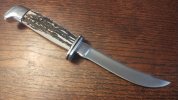
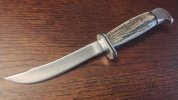
Beautiful 118 Stag from the original 1980's Custom Shop.


Last edited: