The wrong steel for the job?

Material science shows limits.

Geometry and technique may trump heat treatment.

Limited samples are of limited value. You are going to have to produce a lot more verified data to show that the steel companies and material scientists are incorrect about the relative toughness of various steels and that we should be making axes of D2, S30V, or 440C.

Steel is harder and tougher than aluminum or wood - until you arrive at knots. Any Southern Yellow Pine or Mesquite in Thailand?

mwhich50 , I take your point and I too have high-alloy knives; however, I suspect your axes are not of the three steels specified, but anything is possible.
 
I always love it when people say 440 is not tough, when you actually know how widely it can range from maker to maker...

Saying 440 is not good for big blades is pretty much like saying higher octane fuel will lead to worse accidents...

Gaston
 
I always love it when people say 440 is not tough, when you actually know how widely it can range from maker to maker...

Saying 440 is not good for big blades is pretty much like saying higher octane fuel will lead to worse accidents...

Gaston

Okay so just to give you a scenario here... If you had to have a knife to carry into the bush where you planned to spend let's say just one week. Your only allowed one knife and one multi tool from maker or company of your choice. Youv purchased the multi tool and call a maker who states 440c is all they have but like their stuff. Are you gonna pull the trigger?
 
Okay so just to give you a scenario here... If you had to have a knife to carry into the bush where you planned to spend let's say just one week. Your only allowed one knife and one multi tool from maker or company of your choice. Youv purchased the multi tool and call a maker who states 440c is all they have but like their stuff. Are you gonna pull the trigger?

If a maker tells me he can make a tough knife out of 440C, I would think that he would design it to be tough. In other words, it would probably have an Rc of 56, it would be sabre ground and thick. Possibly convexed. And I know it would work if heat treated well. I would have no problem with it. But if I wanted extreme toughness at a low price, I would go with a 1060 to 1080 steel, as it will be tougher in all conditions. If I am willing to spend more, then I can ask for L6, S7 or cpm3V. All of which are tougher than any stainless steel at the same design parameters.
 
I always love it when people say 440 is not tough, when you actually know how widely it can range from maker to maker...

Saying 440 is not good for big blades is pretty much like saying higher octane fuel will lead to worse accidents...

Gaston

Who said that? It's all steel. In an absolute sense, it''s all good. And 440C can be made more or less tough and the geometry can make it more tough at the cost of cutting sability.

But who says 440C is good choice for big blades compared to 5160, 1085, 4140, or S7? That's like saying low octane fuel is less likely to "miss" at high compression than high octane fuel.

So Buck decides to made a froe. Did they pick 440C? S30V? 5160?
 
Last edited:
I can't find pic of my S30v being abused but I have tested D2 which is even more "brittle" with 0.138" thick, FFG, 0.0196" at the edge .

12049661_893385784048868_8027829492127950870_n.jpg
12011300_893385557382224_8242035930271898917_n.jpg
12063618_893385614048885_4082893518441888058_n.jpg
12004073_893385554048891_967499280659527025_n.jpg
10897817_893385537382226_1832081117438241999_n.jpg
12039693_893385680715545_4849552976683764784_n.jpg
12049676_893385900715523_407784425053056437_n.jpg
12006294_893385907382189_5282200856934417360_n.jpg
12036706_893395607381219_1743778558769100630_n.jpg
12032070_893395620714551_3694563792477341513_n.jpg
12036614_893395650714548_7424228623718753864_n.jpg
12039664_893395714047875_6628758992625674453_n.jpg
12042775_893395667381213_7749119760616888895_n.jpg
12036895_893787364008710_4193513134273409882_n.jpg
12063572_893787477342032_7173626040678659392_n.jpg


Believe me these kind of steel are much tougher than most people thought, all you need is just proper HT.

That is impressive if it is indeed d2 as you say although iv always known d2 was tougher then s30v even if ht properly. It's strength makes it a good choice for the cutting of soft metal need be. Who was the maker? Btw weren't you the one complaining about the s30v knives you got in another thread I had and posted pics of edge damage after chopping soft wood?
 
Last edited:
Who said that? It's all steel. In an absolute sense, it''s all good. And 440C can be made more or less tough and the geometry can make it more tough at the cost of cutting sability.

But who says 440C is good choice for big blades compared to 5160, 1085, 4140, or S7? That's like saying low octane fuel is less likely to "miss" at high compression than high octane fuel.

So Buck decides to made a froe. Did they pick 440C? S30V? 5160?
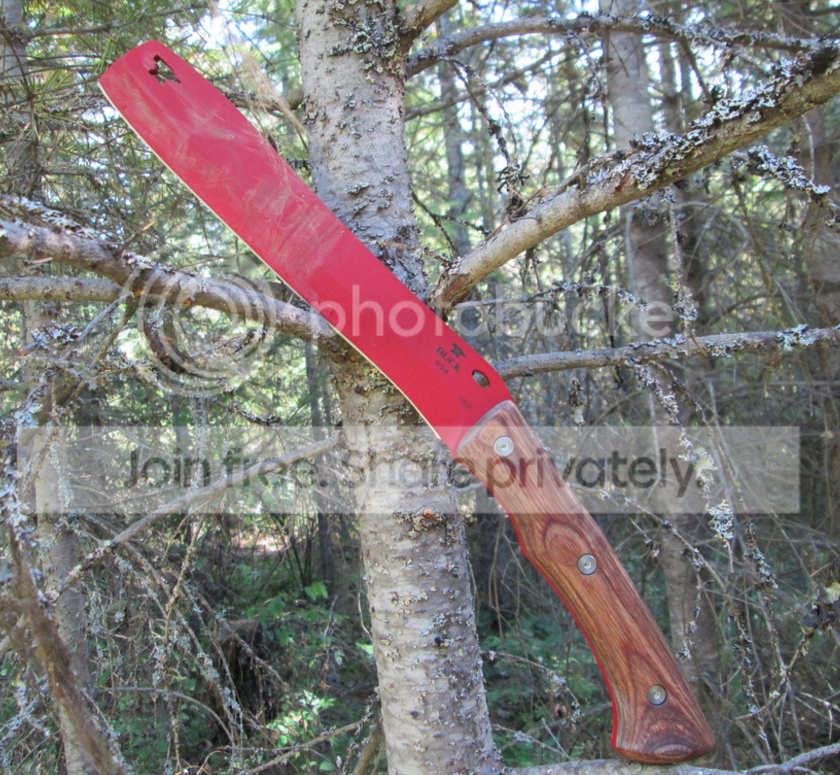
Spring steel and simple heat treat equals big bang for the buck
 
Why do so many knife makers use steels like 440c or s30v for hard use knives or vice versa use a tough steel like 1095 for a neck knife? There are even company's and makers whom claim they have a special ht to say give s30v good toughness or make it easy to sharpen. Why not use the right steel and save some money on ht advertisement and possible embarrasement.

Because 90% of those knifes are never really used at all, let alone for however you define "hard use"....
 
Good point, JR88FAN.

Dropping gallon jugs of milk on ISIS from 30,000 feet would also do some damage to personnel in the open or even under light cover. :eek:

Or you could use better material.
 
Because 90% of those knifes are never really used at all, let alone for however you define "hard use"....

Well I wonder what they would say when one got broke or damaged from let's say something like battoning? Are they not going to stand behind their product or will they say you abused it?
 
Last edited:
That is impressive if it is indeed d2 as you say although iv always known d2 was tougher then s30v even if ht properly. It's strength makes it a good choice for the cutting of soft metal need be. Who was the maker? Btw weren't you the one complaining about the s30v knives you got in another thread I had and posted pics of edge damage after chopping soft wood?

I have worked with many steel range from PM alloy like 3V, Elmax, m390, M4 to carbon like 80CRV2, 52100 etc. S30V still has been one of my favorite. I have Spyderco S30v edge blunt many time from cutting metal can by I never complaint about it.

In theory S30V will have higher impact toughness than D2 due to D2 has much higher big chunky Cr carbide and courser grain structure but in reality they are pretty much very close. I'll give very slightly edge on D2 from my experience.
 
If you look at ESEE they give an unconditional warranty for their 1095 knives but do not cover hard use (batoning etc) with their stainless 440c knives
 
Why do so many knife makers use steels like 440c or s30v for hard use knives or vice versa use a tough steel like 1095 for a neck knife? There are even company's and makers whom claim they have a special ht to say give s30v good toughness or make it easy to sharpen. Why not use the right steel and save some money on ht advertisement and possible embarrassment.

These are two steels with a long history of success in their use as knife blades. Nothing wrong with them. What is your real concern?
 
I just posted in another thread that I used a new Hinderer spanto in M390 to cut up some carpet this weekend.
Probably a max of 30 feet of plain old bedroom carpet.
I never even checked the edge afterward because I was pretty confident in the knife, but yesterday I tried to cut open a plastic bag (first use since the carpet) and it wouldn't cut it at all.
About 2" of the 25-30 dps M390 edge was rolled quite noticeably.

So yeah, maybe brand name and steel name aren't the only factors in quality. :(
 
I just posted in another thread that I used a new Hinderer spanto in M390 to cut up some carpet this weekend.
Probably a max of 30 feet of plain old bedroom carpet.
I never even checked the edge afterward because I was pretty confident in the knife, but yesterday I tried to cut open a plastic bag (first use since the carpet) and it wouldn't cut it at all.
About 2" of the 25-30 dps M390 edge was rolled quite noticeably.

So yeah, maybe brand name and steel name aren't the only factors in quality. :(

Something is wrong with your Hinderer. A knife with a total micro-bevel of 50-to-60 degrees should not be rolling. That is a pretty big bevel.

If you mean it was sharpened to 25-30 degrees total micro-bevel then it is getting into a sharpened edge that should breeze through 30' of old carpet.

Heck, I have some 440 stainless that would easily handle the job.
 
Back
Top
