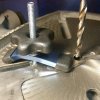
Things that make you say. Hhhhmmm

0t3lODI.jpg


LOL! :D:thumbsup:

Edit to add: When I drill a tang hole I lay the blade so that if it spins it wont be edge first. Also run my drill press as slow as it can go but not sure if that's proper.

 
Shocking story, Randy
I hate working with gloves

It kind of messes with me because if i hadnt said anything, or waited until after he was done, he probably would have been alright. He was new and i didnt realize he was that dumb/cocky. He quit after that and so basically his employment just cost the company a lot of money.

Dont wear gloves on drill presses, and respect the tools tou are using!
 
Beyond the cord issue, starting to drill with the blade already swung around to touch the column is the safest option, minus a fixed vise. An X-Y vise with rotation is probably the best choice overall, though.
 
I was just trying to chamfer the hole so my Corby bolts would go through. I was holding it lightly and it caught a burr. There was a loud pop when it cut through. It would have been funny to see the look on my face. 15 minutes to fix the cord. It's going to be a couple of hours at least to fix the blade.
 
The shortest distance between two points is a straight line. The shortest distance between your shop and the ER is carelessness.
 
Regardless of what people say about buffing wheels, the drill press is the most dangerous tool in the shop.

Not if you take some very basic safety precautions. a c-clamp on the table, or even a bolt fastened through the table slots would have prevented the "helicopter". Flipping the spine to the other side would have likely prevented the cord from severing as well.

A foot pedal (dead man switch) isn't the worst idea either.
 
Guys
I only post this for the sake of safey.
When using a drill press on bar stock, always situate the bar with the long section to the left so if it grabs, the support colum stopped the spinning bar before it guts you.

Here is a little jig I use and it works quite well. Use a block of hardwood, I use Oak. Place two large head sheet metal screws, (pan-head or round head work well) one in the right rear corner and one in the left front corner. These screws should screw into the wood at least a half inch. If located so the drill
point is along the line between these screws, the bar stock can be rotated so it slides under the screw heads while the hole is being drilled. SECURE THE BLOCK TO THE DRILL TABLE OR IN THE DRILL PRESS VISE. If the bit grabs, the barstock can only turn as far as the screws let it. If you drill through the barstock and it tries to climb up the bit, the heads on the screes will stop it.

For those of you who throw the "BS" flag, try it out. Take a piece of scrap bar stock, say 5" long, lay it on the block, spin it so the bar is under the screw heads and drill a quarter inch hole (no the hole size is not important). Just to prove the concept, don't secure the barstock, just let it wiggle around. You will find when the bit breaks through the back side and grabs, the screws will grab the barstock and break the drill, bit loose.
Jim A.
 
When I first started out I watched a Snody video on YouTube and he talked about a drill press bleeding you out. That was enough of a visual that I have always been overly careful.
I used to read those Highway Patrol magazines in high school. Funny, I've always been a pretty careful driver.

Do NOT search this on YouTube.
Worst Industrial Accidents Ever Russian Edition
 
When I first started out I watched a Snody video on YouTube and he talked about a drill press bleeding you out. That was enough of a visual that I have always been overly careful.
I used to read those Highway Patrol magazines in high school. Funny, I've always been a pretty careful driver.

Do NOT search this on YouTube.
Worst Industrial Accidents Ever Russian Edition

That video should be titled "worst crane operators and inspectors, Russian edition"
 
around 2007 i got 5 stitches in the pad of my thumb from a helicoptering blade. it happened like lightning, no time to move out of the way. i suggest drilling the pin holes right after tracing the profile on the barstock , before the blade is profiled. saves time clamping and safe.
 
Just put 2 t-nuts in your table slots, with a conical "washer" on top... the drill torque will bump your stock against them and the conical part will be your hold-down fixture. IMO it is easier setup and safer than a vise or a single clamp
 
Back
Top