This weeks project

Joined
Mar 19, 2012
Messages
7,863
I like clip point hunters so much I thought I better make one this week ;0)

Steel- OCS 5160
HT- non-magnetic quenched in heated motor oil
Temper- two one hour cycles@400F
OAL- 7 5/8
Blade- 3 3/4
Handle- 3 7/8
Handle material- left over oak from cabinet work (unfinished)
Brass pins
Blade finish- norax 16X then norton bear tex very fine
Edge- 23 degree's norex 5x razor sharp mirror finish

I think I will finish the handle out by first filling in the pores with urethane sanding sealer 5 or 6 coats, then sanded back to 600 grit, two coats of carnauba wax, and that should give it a good shine

Despite the Effing heat wave this week (4 days 100+) and my shop being unbearably hot, I think I had more fun making this knife then all the others I have done so far.


IMG_1558.jpg

IMG_1559.jpg
 
Thanks for the kind words ;0)

Funny thing, only NOW that I have put the pics on the internet did I realize that I forgot to square up the left side plunge line....... dammit back to the grinder I go LOL
 
Last edited:
Looks good. I like the clip point. The blade shape overall is appealing to the eye.

Question on a couple points.

1- do you know the austenitizing point for steel is 1474 degrees and non-magnetic is 1414?
You need to go hotter than non-magnetic....

2- Why use motor oil? Canola oil is a much better non-toxic choice...
 
This is the grain structure I am getting on a regular basis,20 or so test pieces, also I am using the "get it to non-magnetic and then a little bit more" method LOL, exactly at non-magnetic the steel still looks a little red to me and when I quench it is orange, so with any luck I am at the temp you suggest.

The motor oil thing is because after my dad passed away I found about 25 or 30 half quarts of clean unused motor oil, and figured I might as well use it

IMG_1258.jpg
 
Funny thing, only NOW that I have put the pics on the internet did I realize that I forgot to square up the left side plunge line....... dammit back to the grinder I go LOL

Personally, I would shoot for the left side rather than the right.
 
Personally, I would shoot for the left side rather than the right.

You're saying you like the plunge line with the rounded top, so far everything I have made has had the rounded top, but because this knife is very straight with a lot of square edges, I figured I would square up the plunge line as well

unfortunately the only way to round it up now would be to skinny up the Ricasso
 
Another question is why the pins in the bolsters are not the same material as the bolsters. The brass shows really bad....and will get worse with age.The brass in the handle - fine, the brass in the bolster - not so good looking.

Using matching pins - nickle silver for nickle silver, 303 for 303, 416 for 416, brass for brass,etc. is a good shop practice.
 
Another question is why the pins in the bolsters are not the same material as the bolster

I did it for the contrast, the next knife I make, I am planing to drill a hole in the bolster as close to the surface as I can get,matching the vertical line of the bolster, insert a brass pin and then grind the steel away to expose the brass, hopefully it will look as cool in my hand as it does in my head ;0)
 
Looks pretty good

As Stacy mentioned I'd go all stainless pins

I'm also drawn to the front pin, looks low to me

and I want the front curves of the bolster to be parallel and matched in the back of the bolster
can't tell from here if they are or not.


The motor oil thing is because after my dad passed away I found about 25 or 30 half quarts of clean unused motor oil, and figured I might as well use it
I'd put it in an oil can and use it to drill holes.
 
and I want the front curves of the bolster to be parallel and matched in the back of the bolster
can't tell from here if they are or not.

The vertical angle of the bolster's 2 apex shapes do not match, the front apex is leaning forward about 3 degree's, that decision was made so (in my mind) the knife would look as if it was moving forward, in a cartoon kind of way ;0)

EDIT new word "sigmoid curve" not apex although the apex of the sigmoid curve is leaning forward 3 degrees LOL
 
Last edited:
John,
The use of a straight edge from tip to tang is OK if the blade or handle doesn't have any curve and the tip is centered in the blade. Unfortunately, only a dagger normally has that symmetry.
If there is any curvature, dropped/raised point, etc. the forward pin will be high or low.
Sketch a kerambit and use a straight edge from point to butt....... you will see that the forward pin would not even be on the handle :)

It is the centerline of the handle/blade that you want to follow. The centerline can be ( and usually is) a curve.
 
It looks good. I also prefer rounded corners on the plunge lines. I try and not have many, if any, square corners or straight lines on a knife.

Be sure to post a pic of that handle once your done!!
 
If you are happy with the knife then that's all that matters

No idea how many you have made but this looks to be a very usable knife.

Richard
 
I think it's a great looking knife. I particularly like the curviness of the bolster and handle. Well done. +7 for style points.

One thing about matching the pins to the metal of the bolster... it's harder than it seems unless you make the pins from the same steel you used to make the bolster. You can get pretty close with the tips others provided, but the discerning eye can still sometimes make out differences. I don't know that I'd try to get a perfect match. I'd probably lean more in the direction you're leaning ... making it contrast, and making it an integral part of the design.
 
The use of a straight edge from tip to tang is OK if the blade or handle doesn't have any curve and the tip is centered in the blade.

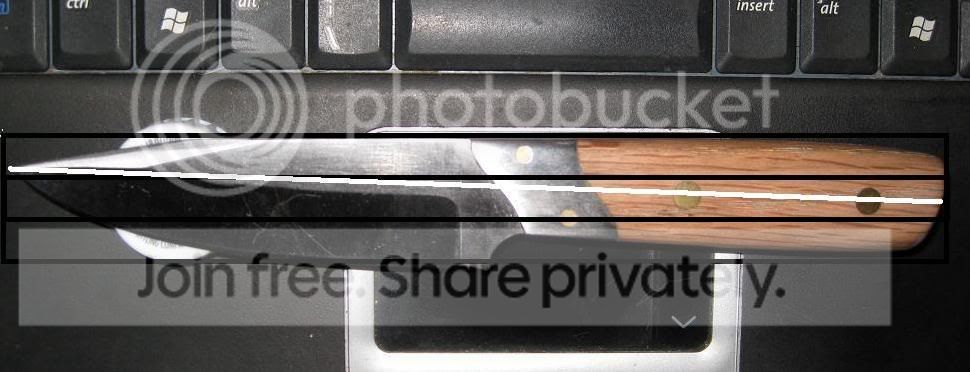
Well I solved the mystery of the front dropping pin, this is simply an optical illusion, the top edge of the knife is completely flat, to show that, I squared my camera up to the knife ( that was a bit of a trick) and using the rectangle tool in paint I drew some grid lines, the white line is the line I used to set the pins, so buy looking at this photo the front pin is a tad high, but what you cant tell from the first photos is the handle is tapered in thickness, so what happens, the lower the angle of the camera in relationship to the knife the lower the pin looks

however I agree the front pin should have been place a little higher to compensate for the handle shape.I wont make that mistake again ;0)

squareknife4.jpg

IMG_1571.jpg
 
Be sure to post a pic of that handle once your done!!

It will be a week or two, my youngest son 28 is building his first knife, and when he catches up we will start the wood work together

No idea how many you have made

This is knife number ten, and knife number six using my 2x72 grinder and 5 months total time making knives, so if you caculate that in knife making years, that makes me a little wet behind the ears ;0)

I'd probably lean more in the direction you're leaning ... making it contrast, and making it an integral part of the design.

When I make things, I really like to add a striking bit of contrast, brass pins hardly qualify as striking, but it is different, I really have high hopes that my next knife has a greater wow factor
 
I also wanted to state that you have done an excellent job.
The attention to detail ,fit and finish, and things like a tapered tang show you have been reading and studying a lot.
The sigmoid bolster is superb.

What I do in pin placement is make a line similar to the white one on your photo to find the spacing of the pins. Then I use dividers to find the center of the handle at that point. This will keep the pins along the centerline. Even then, I will draw in the pins before drilling the holes. Sometimes it needs to be a bit high or low to look right.

One last suggestion....curve the handle and bolsters a bit more. Even though the other parts are well executed, there is a bit of BHS ( blocky handle syndrome) caused by the flat surfaces and 90° corners. Generally the handle sides should be an arc, and the bottom should be narrower than the top. You can go for a full oval/ovoid or just have the four curved sides meet in rounded corners.
 
Back
Top