- Joined
- Dec 2, 2005
- Messages
- 72,359
I’ve had a few finds this week I’d like to share with you. I’ve already put a couple of pics of two of them in the ‘Old Knives’ sticky, but there’s some more pics, and some more knives here (the old British penny is the same size as a US half-dollar).

I’ve admired the Doctor’s Knife pattern for a while. They’re far from common here, and this is the first old one I’ve actually seen on sale. I had no hesitation in snapping it up. I think it’s a beautifully made knife, which has clearly been well used and much loved. Everything is absolutely solid about it. You can see the signs of wear on the pill-crusher in the final photo. I bet this old knife could tell a few tales.


I got this old Jack last week, and it has a good feel to it. It’s made by a Sheffield cutler called Alfred Blackwell, who I’ve not been able to find much out about, apart from a single date, 1893. As you can see, the knife has had a good bash at some point, maybe even been run over, but in spite of the damage, there’s no blade play at all. The main blade was originally a Lambsfoot, and when I first picked up the knife, my first thought was to re-grind the blade and have a go at fixing the covers. However, bearing in mind the age of the knife, maybe I should leave it alone, and just carry and use it, as someone else clearly has post-trauma.


I generally buy anything a bit different, and this German-made rose budding/grafting knife caught my eye. I didn’t realise it’s actually quite high-end (@ $100), with a hand-forged blade and a hand-carved walnut handle.


I don’t really have a lot of use for hawkbills, but I think this pruner has a lot of character. I bought it at the same time as the knife above, and I wonder if they had the same previous owner. Unfortunately, despite its obvious quality, there’s no tang-stamp. I don’t know if it had an etch originally. I don’t think it’s a Sheffield-made knife, and think it more likely it’s from mainland Europe, probably German like the knife above.


I’m not sure I’ll ever find a use for this big turnip chopper either, but despite the ugly blue metallic paint that was originally on the handle (it's already half sanded off in the pic at the top of this post), I find it hard to pass up forged steel. I might dye the handle, or just mucky it up!

Richards knives are still very common here, but this is the first I’ve picked up with a pouch. I thought it was embossed with a picture of the Blackpool Tower (http://en.wikipedia.org/wiki/Blackpool_Tower) at first, Blackpool being the quintissential tacky English seaside town, but of course it’s actually the Richards Lighthouse emblem (which I commonly refer to as a lamp-post!). It seems to be an unused knife, though it has suffered from being kept in the leather pouch.


Double Diamond was a well-known English beer, and paraphernalia relating to it is quite collectible (I had two fellers offering to buy this before I’d even left the market I bought it from). The knife is made by Harrison Fisher of Sheffield, who made a lot of similar patterns.


This big ugly beast reeks of a primitive workshop and low-paid labour, but it was VERY inexpensive! The saw-blade is made in quite an interesting way. Despite its lack of beauty, it has clearly seen a lot of use. I’ve no idea what I’m going to do with it!


Compared to the monster above, this 1950 Colasse manufactured Belgian Army clasp knife looks positively pretty I think! I have a few of these knives, but this one was in particularly good shape.


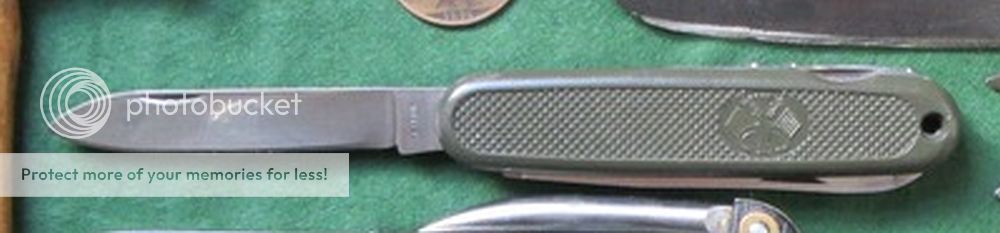
I also picked up this Aitor-made German Army Knife.


Despite my love of a bargain, every now and again I pay over the odds for a knife. I’ve been after a Wostenholm for someone for a couple of months, and couldn’t find anything. I bought this from an antiques centre, even though it wasn’t really what I was looking for and over-priced. Nice enough little gent’s knife though.


And the wee hammer is just a nice old hammer I came across, thought it might be useful for peening
The big antiques fair I was attending tomorrow has been cancelled, so this is my score for the week.
The hunt continues!
Jack
See posts 32, 45 and 123 for more finds!

I’ve admired the Doctor’s Knife pattern for a while. They’re far from common here, and this is the first old one I’ve actually seen on sale. I had no hesitation in snapping it up. I think it’s a beautifully made knife, which has clearly been well used and much loved. Everything is absolutely solid about it. You can see the signs of wear on the pill-crusher in the final photo. I bet this old knife could tell a few tales.


I got this old Jack last week, and it has a good feel to it. It’s made by a Sheffield cutler called Alfred Blackwell, who I’ve not been able to find much out about, apart from a single date, 1893. As you can see, the knife has had a good bash at some point, maybe even been run over, but in spite of the damage, there’s no blade play at all. The main blade was originally a Lambsfoot, and when I first picked up the knife, my first thought was to re-grind the blade and have a go at fixing the covers. However, bearing in mind the age of the knife, maybe I should leave it alone, and just carry and use it, as someone else clearly has post-trauma.


I generally buy anything a bit different, and this German-made rose budding/grafting knife caught my eye. I didn’t realise it’s actually quite high-end (@ $100), with a hand-forged blade and a hand-carved walnut handle.


I don’t really have a lot of use for hawkbills, but I think this pruner has a lot of character. I bought it at the same time as the knife above, and I wonder if they had the same previous owner. Unfortunately, despite its obvious quality, there’s no tang-stamp. I don’t know if it had an etch originally. I don’t think it’s a Sheffield-made knife, and think it more likely it’s from mainland Europe, probably German like the knife above.


I’m not sure I’ll ever find a use for this big turnip chopper either, but despite the ugly blue metallic paint that was originally on the handle (it's already half sanded off in the pic at the top of this post), I find it hard to pass up forged steel. I might dye the handle, or just mucky it up!

Richards knives are still very common here, but this is the first I’ve picked up with a pouch. I thought it was embossed with a picture of the Blackpool Tower (http://en.wikipedia.org/wiki/Blackpool_Tower) at first, Blackpool being the quintissential tacky English seaside town, but of course it’s actually the Richards Lighthouse emblem (which I commonly refer to as a lamp-post!). It seems to be an unused knife, though it has suffered from being kept in the leather pouch.


Double Diamond was a well-known English beer, and paraphernalia relating to it is quite collectible (I had two fellers offering to buy this before I’d even left the market I bought it from). The knife is made by Harrison Fisher of Sheffield, who made a lot of similar patterns.


This big ugly beast reeks of a primitive workshop and low-paid labour, but it was VERY inexpensive! The saw-blade is made in quite an interesting way. Despite its lack of beauty, it has clearly seen a lot of use. I’ve no idea what I’m going to do with it!


Compared to the monster above, this 1950 Colasse manufactured Belgian Army clasp knife looks positively pretty I think! I have a few of these knives, but this one was in particularly good shape.


I also picked up this Aitor-made German Army Knife.


Despite my love of a bargain, every now and again I pay over the odds for a knife. I’ve been after a Wostenholm for someone for a couple of months, and couldn’t find anything. I bought this from an antiques centre, even though it wasn’t really what I was looking for and over-priced. Nice enough little gent’s knife though.


And the wee hammer is just a nice old hammer I came across, thought it might be useful for peening
The big antiques fair I was attending tomorrow has been cancelled, so this is my score for the week.
The hunt continues!
Jack
See posts 32, 45 and 123 for more finds!
Last edited:


 The Colasse is a very clean old brute.