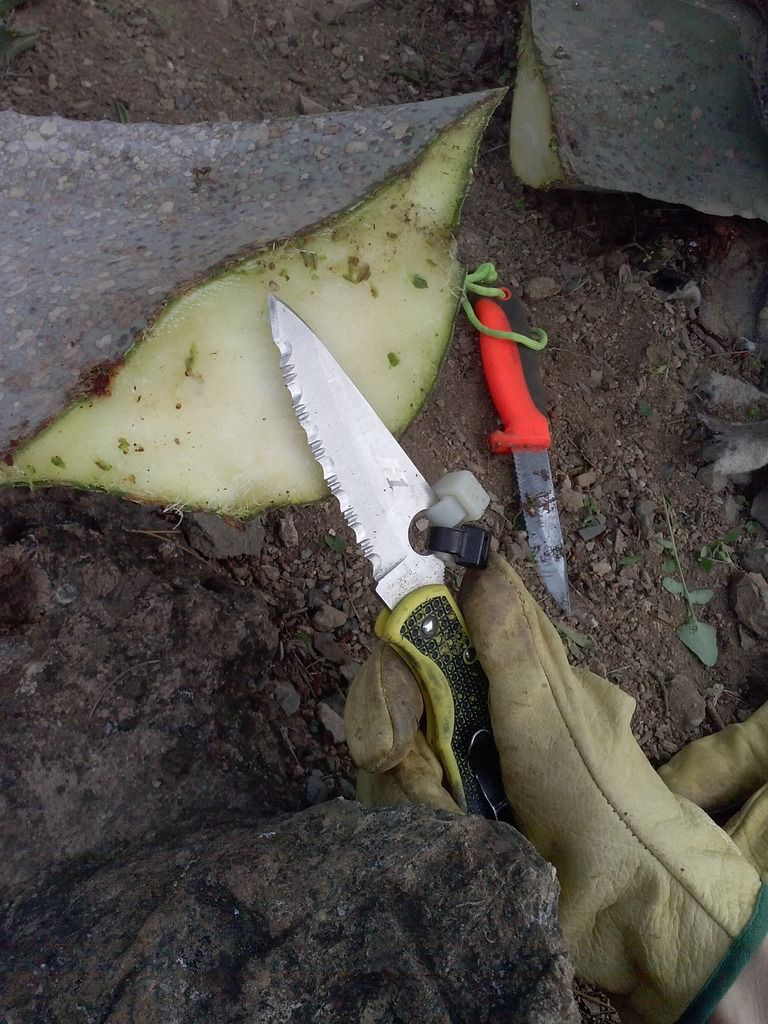
Touhest stainless knife steel

Because the data provided does not match the results in some cases, especially S30V. 3V is a different story and I do believe that data is pretty accurate. But you prove or disprove data with actual use. But for those that do not use hard use knives hard then I guess the data is good enough.

No, one doesn't.
If "data" means technical info & laboratory results, they are proven by independent reproduction.
Usage is a valid way of producing anecdotal data, but that is a different story.
 
I think that work by guys like Nathan Carothers, Dan Kefheller, Butch Harner and now some manufacturers like Survive Knives has demonstrated that the resistance to chipping AND corrosion of CPM 3V is enhanced a fair bit by using the immediate post quench cryo and low temperature tempering regimen.
 
No, one doesn't.
If "data" means technical info & laboratory results, they are proven by independent reproduction.
Usage is a valid way of producing anecdotal data, but that is a different story.

I'm going to have to agree with you here. VERY strongly. If all steel was made by ONE manufacturer, then maybe Cobalt would have reason to question the authenticity of the data. But with numerous competing manufacturers making steel, THEY would tell us if someone was publishing bogus data. If Crucible came out with some new "super steel" that claimed to be 10V wear resistant, 3V tough, and S110V corrosion resistant, trust me, some of their first customers would be Bohler, Carpenter, and all the rest. They would be testing the steel, reverse engineering it, and if they found the data to be crap, they would be publicizing it to remove a competitor from the market. The consequences of lying on data sheets would be grave. Besides just that, you would see steel failing for the end users, which would also drive a manufacturer out of business. If Crucible claimed to have such a steel and sold it to a customer needing cutting dies used in salt water, and it rusted immediately, don't you think a fiasco would ensue? Yes, it would. Data from reputable manufacturers can be trusted, and is invaluable in comparing steels.
 
I'm going to have to agree with you here. VERY strongly. If all steel was made by ONE manufacturer, then maybe Cobalt would have reason to question the authenticity of the data. .

So who else makes S30V, who else makes S110V, who else makes 3V? Have you ever seen any performance data on cpm steels published by anyone other than Crucible? Nope no one. Crucible also sells non pm steels. They publish that data as well. Have you ever asked crucible about any facts on their charpy testing? I have. They could not tell me anything about their testing. Not even a date. not a location, not anything. I tried, but to no avail.

I find cpmS30V to be the biggest sham pushed onto the knife world in all my years of collecting. I have owned more knives of it than any other steel and it is so over hyped it isn't even funny. S35vn is what s30v should have been. I do not for one minute believe the numbers posted by crucible on s30v. It is not tougher than ATS34, it is not tougher than 440C, it's edge chips out faster than both of those steels. Those are user based fact based on 15 years of use with multiple knives. I would basically take any stainless steel over s30v.
 
Because the data provided does not match the results in some cases, especially S30V. 3V is a different story and I do believe that data is pretty accurate. But you prove or disprove data with actual use. But for those that do not use hard use knives hard then I guess the data is good enough.

Read up on anecdotal evidence and why it's the weakest form thereof. If something works for you, that's great, but the idea that your experience is anywhere near broad enough to call repeatable scientific testing into question is absolutely laughable.
 
Read up on anecdotal evidence and why it's the weakest form thereof. If something works for you, that's great, but the idea that your experience is anywhere near broad enough to call repeatable scientific testing into question is absolutely laughable.

LOL, to believe data to be gospel with no other independent testing anywhere is also laughable. Also if you hang out on the forums for any length of time you know that I am not the only one who has made these claims. They are in fact pretty common.
 
LOL, to believe data to be gospel with no other independent testing anywhere is also laughable. Also if you hang out on the forums for any length of time you know that I am not the only one who has made these claims. They are in fact pretty common.

I'm not taking issue with any specific claims about specific steels, but your claims about methodology. Data from repeatable testing is gospel. Because anyone with the equipment can run the same test with the same parameters and check it. Charpy testing is an industry standard because the results come back the same.
 
LOL, to believe data to be gospel with no other independent testing anywhere is also laughable. Also if you hang out on the forums for any length of time you know that I am not the only one who has made these claims. They are in fact pretty common.
I do not think you are wrong for coming to your own conclusions about your experiences with steel, however...

Part of the issue you have with S30V's performance could be because each manufacturer is not necessarily doing the heat treat the exact same way. Additionally, each individual batch in any given production run may not have experienced the same treatment during processing, although the intention is to keep everything the same.

However, consider what we know about S30V. We know it is extremely well documented, that almost every major manufacturer uses it (Spyderco, Benchmade, ZT, Gerber, Al Mar, Boker...), and we know that collectors and users alike ("knife people"; us) report their findings to each other for comparison. Regardless of how much hype something has, the actual performance of any given steel will be proven through real use which, more often than not, results in a pretty accurate reflection of basic data points as described by the steel manufacturer.

In other words, data like relative toughness, corrosion resistance and wear resistance are all quantitive information gained through use. Yes, to be called anything close to data, the testing would have to be in controlled conditions, but this is the point of testing; to gain accurate information through use, in order to compare and inform. The fact that you discount "testing" means you're choosing to ignore the findings of both steel and knife manufacturers, who have a rather large invested interest in ensuring they are not lying or misrepresenting their product.

What do you think would have happened if S30V turned out to be garbage? If, for instance, Spyderco had rushed to push a new knife steel out into market, don't you think they'd have done their own testing of the steel after their own heat treatment? They in fact do, and place their findings in the back of their catalog every year, as far as I'm aware. Benchmade does the same thing.

Instead, you see S30V still being used as an entry to high end stainless steels. Both factory manufacturers and custom makers use it, and while I find the market very saturated, it speaks to both the performance and ability to sell a knife using the steel.

 
Last edited:
Nitrogen steels are supposed to be extremely tough!! Some as tough as spring steels. But, I do not have personal experience with it. Hopefully someone can add info.
 
My experience with Spyderco and Strider S30V have been nothing but excellent.

As people said, it more to do with the HT than the steel composition it self.

If the steel is bad, honor man like Sal Glesser wouldn't pick it as the main steel for many of his major design.
 
I'm not taking issue with any specific claims about specific steels, but your claims about methodology. Data from repeatable testing is gospel. Because anyone with the equipment can run the same test with the same parameters and check it. Charpy testing is an industry standard because the results come back the same.

Tests done well might show a lot, but gospel is hyperbolic... Anecdote is a single case/ test; the testing referred to above may be many instances/ iterations... But what are the parameters? The controls? It is still several cases (theoretically more that an anecdote) which are presented in a graph and given the aura of truth. It's still all inductive reasoning masquerading as deducted truth/ fact. The only way stats become "gospel" is through people's willingness to believe them as sacred truth... Then you use your darn knife and it chips out... So much for the "facts"...
 
I'm not taking issue with any specific claims about specific steels, but your claims about methodology. Data from repeatable testing is gospel. Because anyone with the equipment can run the same test with the same parameters and check it. Charpy testing is an industry standard because the results come back the same.

You are exactly right. Industry standards exist for a very good reason.
 
Tests done well might show a lot, but gospel is hyperbolic... Anecdote is a single case/ test; the testing referred to above may be many instances/ iterations... But what are the parameters? The controls? It is still several cases (theoretically more that an anecdote) which are presented in a graph and given the aura of truth. It's still all inductive reasoning masquerading as deducted truth/ fact. The only way stats become "gospel" is through people's willingness to believe them as sacred truth... Then you use your darn knife and it chips out... So much for the "facts"...

Repeatable testing gives parameters and controls exactly so that it can be repeated. The example I gave was charpy testing, which may or may not have anything to do with the chart shown as it's unlabeled and likely as much propoganda as fact. And if your knife does chip out, what's responsible? The toughness of the steel? Blade geometry? Torque applied while in the cutting media? Hardness of the cutting media? Force applied to the blade? All of these variables and far, far more suddenly come to a head simultaneously, so when the conclusion is, "This steal sn't very tough," I stay pretty damn skeptical.
 
Yeah, so scientific date says "x"... And then actual use entails all the other things you mentioned--so when guys really use their knives experience does not (sometimes? Often? It varies I guess) match the numbers... Or just the impression the date or charts provide. I guess my gripe is that date/ scientific method may offer uniform results, but there is nothing uniform in use. It also stands to reason that there may be plenty of variance even in so called standardized testing. The average buyer does not question the process of testing--he/she trusts the numbers, has faith their steel will work as advertised... Sometimes thier faith is rewarded... But faith is not science, and date / science is not/ ought not be gospel... Just by the very nature of it. Anecdotal evidence feels authentic because it happens to "me" under real conditions.... Confirmed by my senses and not a bar graph.

As for a tough stainless... My Randalls' seem pretty darn tough--including the #16 sp1 I have... I can tell because I've used it. I've used my Busses and Beckers too, and the Randall held its own. No need for faith or gospel... Or even data. Nothing like first hand experience.
 
I'm not taking issue with any specific claims about specific steels, but your claims about methodology. Data from repeatable testing is gospel. Because anyone with the equipment can run the same test with the same parameters and check it. Charpy testing is an industry standard because the results come back the same.

At the end of the day, you are generally correct. The numbers tell you the story and I should believe them. And I do for other cpm steels. Just not s30v. And maybe I have just had more bad luck than others. Who knows. I do like S35vn and I really like 3V. Both excellent steels.
 
I see several major problems with the way we compare various chracteristics of steels :
1- often people site expert opinion and trust it as gospel
2- most if the data are from steel making companies
3- the methods used to compare steels are seldom discussed
4- some of the qualities we look for (toughness) are difficult to define
 
Nitrogen steels are supposed to be extremely tough!! Some as tough as spring steels. But, I do not have personal experience with it. Hopefully someone can add info.

Indeed!
H1 is really tough,

CAM02754_zpskkcd3z3s.jpg


won't chip on you, it might bend or fold but is springy and soft, and not stainless, it's stainproof!

CAM01590_zpsevnwuqcb.jpg


CAM01243_zpsxuxr1ft9.jpg


440A is also very soft, very stainless and very easy to sharpen

20150821_093837_zpsmqgivqtz.jpg


20150824_102039_zpssabnnm8q.jpg


My two votes for toughest stainless, no doubt!

20150821_094159_zpsnmfxmode.jpg
 
Yeah, so scientific date says "x"... And then actual use entails all the other things you mentioned--so when guys really use their knives experience does not (sometimes? Often? It varies I guess) match the numbers... Or just the impression the date or charts provide. I guess my gripe is that date/ scientific method may offer uniform results, but there is nothing uniform in use. It also stands to reason that there may be plenty of variance even in so called standardized testing. The average buyer does not question the process of testing--he/she trusts the numbers, has faith their steel will work as advertised... Sometimes thier faith is rewarded... But faith is not science, and date / science is not/ ought not be gospel... Just by the very nature of it. Anecdotal evidence feels authentic because it happens to "me" under real conditions.... Confirmed by my senses and not a bar graph.

As for a tough stainless... My Randalls' seem pretty darn tough--including the #16 sp1 I have... I can tell because I've used it. I've used my Busses and Beckers too, and the Randall held its own. No need for faith or gospel... Or even data. Nothing like first hand experience.

Except first hand experience is filled with statements of faith, assumptions, uncontrolled variables, biases, incomplete information, a total lack of controls just to name a few. The fact that something 'feels' authentic makes it even more insidious because it makes drawing false conclusions so very, very easy. That's the whole reason we have the scientific process. As a species we badly want to jump ahead, to reach conclusions quickly and for things to work out in ways that make sense to us and make us happy. Anecdotal evidence isn't useless, but repeatable testing is vastly more reliable.
 
Back
Top