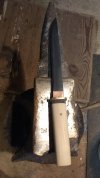
Traditional Tanto (previously titled- thinning a tsuba)

Joined
Jul 31, 2015
Messages
3,118
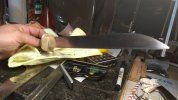
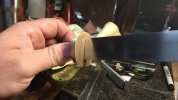
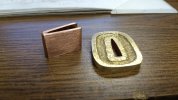
This is my first Tanto with a guard. The brass is 1/4" thick. I had a feeling before I fit it up I was going to want it thinner, and now I'm sure. Is there a good way to thin this out? I'm planning on just grinding it down on the flat platen, or, if possible taking some off with the band saw (I'd have to make some sort of jig to hold it, since it's now rounded). It's not soldered on, just slipped on currently. Any ideas?

IMG_20170824_000447464.jpg IMG_20170824_000456582.jpg
 
Uncle Al used to sell a jig for thinning non-ferrous metal guards, It had two little short pins that fit into the slot so that you could lay the guard flat on the platen like you would with a finding magnet with steel and iron.
 
if you dont have a surface grinder or mill, i would just go flat platen. honestly it doesnt look too thick to me. 3/16"? flat platen will work. i will suggest sanding the front so the back stays flat to match up with the handle.
 
you could use a height scribe around the outside edge to make sure its flat since you are doing it by hand. if you want to try the bandsaw, glue it to a block of wood, to cut a slice off, then heat the brass until the glue fails or knock it off with a piece of wood.
 
OK, here is how to get a really cool tsuba and also get it thinner.

Get some nail polish. I like "red she said", but you can use any color that looks good on you :)
Clean the brass well and don't touch it with your bare hands any more than posible.
Paint a border around the tsuba with the nail polish. It should cover the outer rim and extend about 3/16" to 1/4" inward on the front and back. This will end up as a raised rim.
Paint the center around and through the ana. Make it cover the surface about 3/8" around it. This will make the seat for the blade/habaki and tsuka.
Make up some FC about 5:1 ratio.
Soak the tsuba in the FC for fifteen minutes. Check the progress every five minutes and rotate the tsuba 90 degrees each check. It should start to eat away the exposed surface. Rotation prevents the bubbles from making deep grooves as the piece etches. Every 15 minutes, rinse well, check the polish for any that is lifting, touch up if needed, and continue to etch until the center is eaten away to a sufficient depth. At the 15 minute checks, give it a quick scrub with an old toothbrush to get the oxides off before putting back in the tank.
A micrometer is good for checking the thickness.
Once it looks eaten away enough, clean well, use acetone to remove the polish, and then clean up the surface. I start with a brass wire brush, then sand the high spots with 400 grit, and from there go wherever I want to. Bead blasting or sandblasting can look good.

If the look or depth isn't where you want yet, just re-mask the center and and rim and do it all again until the desired effect is attained. Sometimes, when it is close to the final look, I take the polish off the rim so it gets an antique look, too.

You can polish, patina dark and old, hammer distress with a tiny peening hammer ( this looks very good), or put on a matte finish. Hammer finish is done with an 8oz ball peen with the ball re-ground to a truncated cone with a small round end. This will leave tiny round dimples. It takes a couple thousand blows to do the whole surface, but it goes fast and is fun. Go around the surface in a continuous circular and wandering pattern ( don't concentrate on one area) and slowly fill in the whole surface. Do the rim separately, if needed.

Another way to get a cool tsuba is to do the above, but before you start, drill random holes from 1/8" to 3/8" throughout the surface to be etched. This will end up eating into slightly irregular holes and can look like an ancient tsuba. Use a sharpie to mark the places before you start. This avoids getting them too close or clustered.
The same thing can be done to make a zodiac tsuba. Mark and drill the star patterns for some or all of the zodiac or your favorite constellations ,,,, and etch away.
Other shapes can be sawn with a jewelers saw and then etched. Tree shapes are excellent.

The etching is slower, but the same technique can be dome with steel tsuba. Using aqua regia makes the etch faster.

The FC used for brass/copper will be no good for etching blades, but can put in a bottle and marked "COPPER" and kept for doing copper and brass. If you use it for steel it will auto-plate the copper on the blade and make weird colors.

The position in the etch tank will determine the look. If the tsuba is placed horizontal, the top and bottom will get a neat pebbly random look. I like this. It should be reversed top for bottom each 15 minute check.
Vertical hanging and regular rotation makes a different look. You can try several and see what you like.

It may be easier to etch the tsuba before the ana is cut. Just paint the area on the front ( or both sides) with a oval of nail polish sufficiently large to allow the ana and blade/habaki seat to stay unetched.

 
OK, here is how to get a really cool tsuba and also get it thinner.

Get some nail polish. I like "red she said", but you can use any color that looks good on you :)
Clean the brass well and don't touch it with your bare hands any more than posible.
Paint a border around the tsuba with the nail polish. It should cover the outer rim and extend about 3/16" to 1/4" inward on the front and back. This will end up as a raised rim.
Paint the center around and through the ana. Make it cover the surface about 3/8" around it. This will make the seat for the blade/habaki and tsuka.
Make up some FC about 5:1 ratio.
Soak the tsuba in the FC for fifteen minutes. Check the progress every five minutes and rotate the tsuba 90 degrees each check. It should start to eat away the exposed surface. Rotation prevents the bubbles from making deep grooves as the piece etches. Every 15 minutes, rinse well, check the polish for any that is lifting, touch up if needed, and continue to etch until the center is eaten away to a sufficient depth. At the 15 minute checks, give it a quick scrub with an old toothbrush to get the oxides off before putting back in the tank.
A micrometer is good for checking the thickness.
Once it looks eaten away enough, clean well, use acetone to remove the polish, and then clean up the surface. I start with a brass wire brush, then sand the high spots with 400 grit, and from there go wherever I want to. Bead blasting or sandblasting can look good.

If the look or depth isn't where you want yet, just re-mask the center and and rim and do it all again until the desired effect is attained. Sometimes, when it is close to the final look, I take the polish off the rim so it gets an antique look, too.

You can polish, patina dark and old, hammer distress with a tiny peening hammer ( this looks very good), or put on a matte finish. Hammer finish is done with an 8oz ball peen with the ball re-ground to a truncated cone with a small round end. This will leave tiny round dimples. It takes a couple thousand blows to do the whole surface, but it goes fast and is fun. Go around the surface in a continuous circular and wandering pattern ( don't concentrate on one area) and slowly fill in the whole surface. Do the rim separately, if needed.

Another way to get a cool tsuba is to do the above, but before you start, drill random holes from 1/8" to 3/8" throughout the surface to be etched. This will end up eating into slightly irregular holes and can look like an ancient tsuba. Use a sharpie to mark the places before you start. This avoids getting them too close or clustered.
The same thing can be done to make a zodiac tsuba. Mark and drill the star patterns for some or all of the zodiac or your favorite constellations ,,,, and etch away.
Other shapes can be sawn with a jewelers saw and then etched. Tree shapes are excellent.

The etching is slower, but the same technique can be dome with steel tsuba. Using aqua regia makes the etch faster.

The FC used for brass/copper will be no good for etching blades, but can put in a bottle and marked "COPPER" and kept for doing copper and brass. If you use it for steel it will auto-plate the copper on the blade and make weird colors.

The position in the etch tank will determine the look. If the tsuba is placed horizontal, the top and bottom will get a neat pebbly random look. I like this. It should be reversed top for bottom each 15 minute check.
Vertical hanging and regular rotation makes a different look. You can try several and see what you like.

It may be easier to etch the tsuba before the ana is cut. Just paint the area on the front ( or both sides) with a oval of nail polish sufficiently large to allow the ana and blade/habaki seat to stay unetched.

That sounds awesome -- gonna try it. Thanks Stacy
 
All great ideas. I think I will go with what Stacy recommends as it sounds like it will make it more interesting. I was actually thinking about have a raised edge and leaving the ana the same thickness, I just wasnt sure how to go about it. I made a habaki but i was worried my nakago was too short and I didn't want to give up the real estate.
 
for a raised/ flanged rim i put a stick or piece of wood through the hole, and hammer the edge with a small hammer while turning the tsuba/stick in my hand. hammer the edge flat and at a 45 degree angle, and all in between to round it over. it only takes about 10 minutes. i like the FC eating the brass idea, i did not know it would eat away so fast. i will have to try it. a combination of both would look good.
 
I tried the FC etching last night. It did very little after 40 minutes in solution. The ratio is 5 parts H2O to 1 part FC correct? Maybe my base FC is lower concentration?
 
I haven't done this in particular Kevin, but I use a little fish tank aerator to speed up etching when I want to remove material.
 
Good idea. The brass was oxidizing, but no bubbles, which surprised me. I upped the concentration to above what i use in my steel etch tank and it just darkened it after 20 minutes. My steel etch tank darkens hardened 1095 to the same degree within 15 seconds.
 
The scrubbing off of the oxides every few minutes is important, or it will stop etching.

You can use higher concentration of FC if you want. It can take several hours to get the desired effect. FC is used because you are always fairly safe with FC.


For the initial heavy removal in a case like this, professionals use an acid to speed things up. Muriatic or a Muriatic/H2O2 mix is commonly used. There are too many untrained folks who read this thread to give rough details on using acids. Once the depth has been eaten down enough, you can wash off and switch to FC.

A safer way is to use a 1/4" carbide ball burr and rough out the reduction areas. You can leave it rough, as the etching will just make that part of the antique look.
 
That's what the aerator does. Helps agitate the oxides off of the metal to keep the reaction going.

Although that K-Bar I was restoring and forgot in my etch over a hot weekend didn't need an aerator to be whittled down to nothing :confused:
 
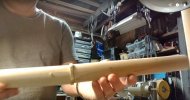
I made some progress on this one. It's taking a long time, and I greatly underestimated the hours all the hand work takes. I also underestimated how much fun it actually is. I make knives for relaxation mostly, and the zen aspect of carving out a saya or filing a hibaki is really great. Here are some current pictures. I made a stippling hammer from a very small ball peen hammer i had. The blade is 1080. The saya is poplar and I'm in the process of adding African Blackwood kojiri, koiguchi, kashira, and fuchi. I may use this same wood to make a kurikata as well. IMG_20170906_105049863.jpg IMG_20170907_234106471.jpg tantocapture.jpg
 
Back
Top