Tried to make my first figure 4 trap...

Okay, My last post was that I had all the pieces in working order and it was set up and theoretically functional.

Tonight, My son and I added peanutbutter and set the trap very lightly.

Tomorrow, we will see if it is an effective means of food procurement.

Pictures coming soon!

Thanks for everyone's help and support

Chris
 
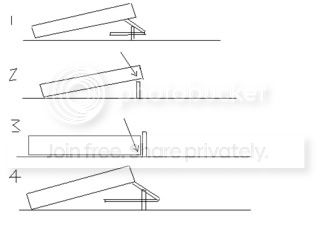
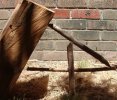
This is just from my personal experience and observations... but if you place the figure 4 mechanism directly under the deadfall there is a chance that the weight will either get hung up or redirected, by the vertical support, when tripped. I don't sink the horizontal post into the ground but on occasion have had it get caught. Anybody else experience this or is it my bad engineering skills. Please excuse the poor drawing.

1 - the fig4 directly under the deadfall.
2 - The tripped trap with the horizontal post hung up.
3 - Post placement prior to setting the trap
4 - Fig4 set with post out of the way.

fig4.jpg
 
I had it there for a while and took it away to post a pic in another thread. The basic membership doesn't give you alot of attachment space. Maybe I am doing something wrong?
 
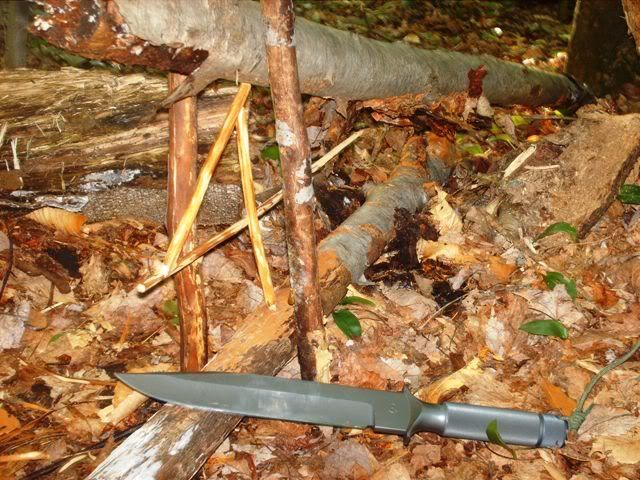
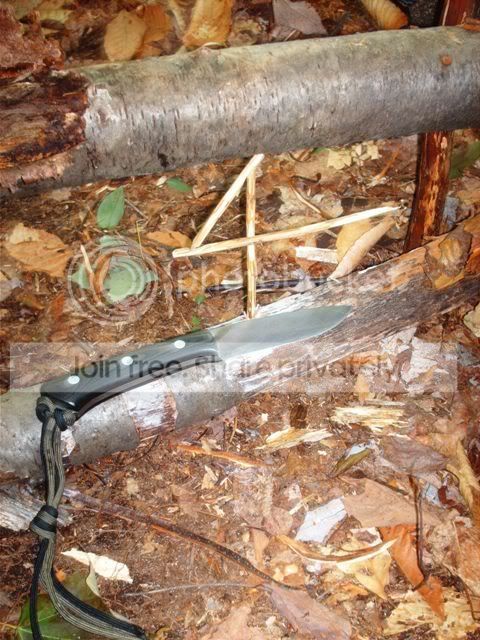
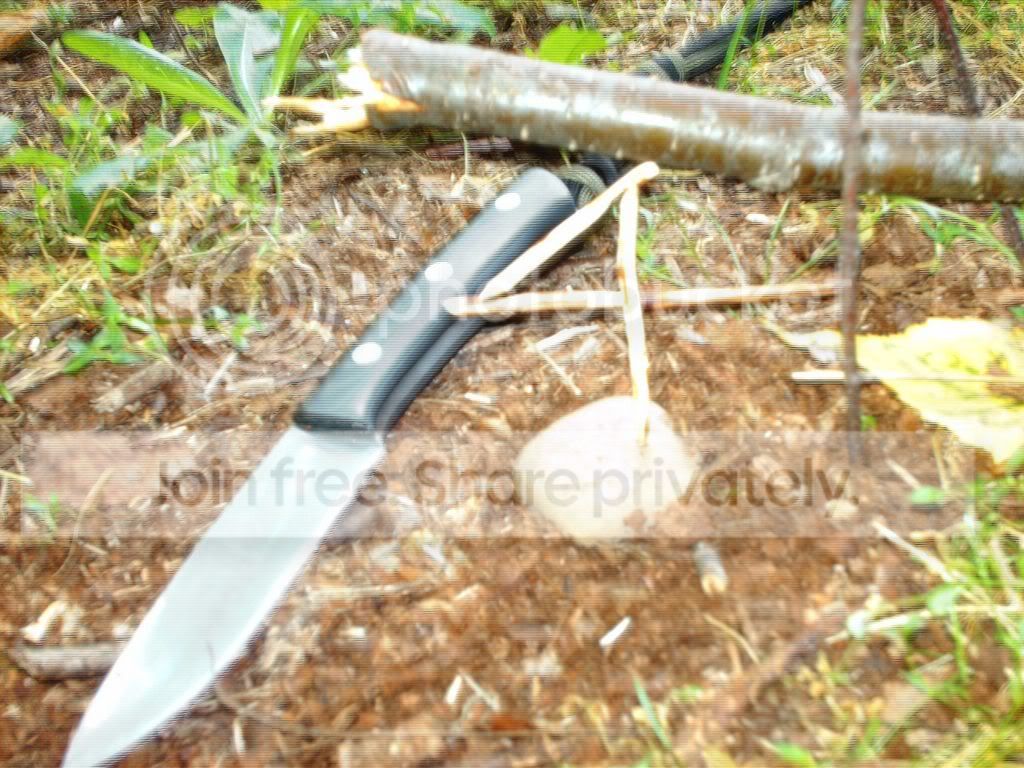
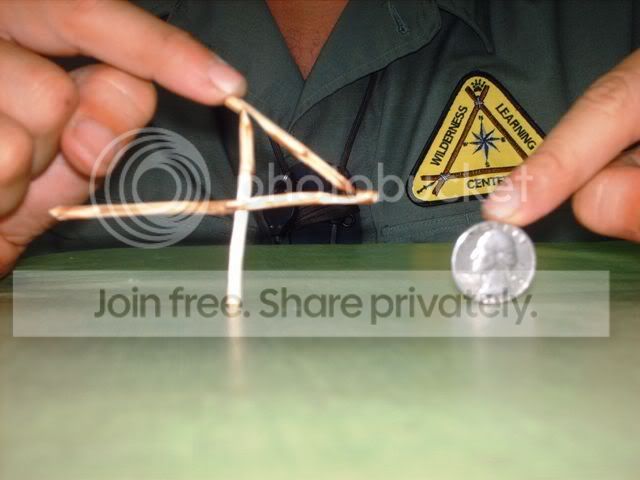
Here are a few figure 4's I made this past week in the woods. It seems as if they became significantly smaller with each one I made. All functioned flawlessly. If properly constructed, the pieces will spring out of the way of the falling weight. The last one was a challenge but it was cool to see work.

HPIM0771.jpg


Next to a Chris Reeve Knives Jereboam

HPIM0776.jpg


Next to a Bark River Knife and Tool Fox River

HPIM0783.jpg


Next to that same Fox River

HPIM0785.jpg


Next to a quarter
 
Great work K.... looks good. Is there a reason why you strip off all the bark on the trigger pieces, and what sort of animals have you caught with these?
Rick
 
Here is a picture of my figure 4 trap.

One issue I am having with the trap is when the weight of the dead fall is one the trap the weight holds the trigger-bait stick in pretty tight.

I still have it set since I made it. I put honey over peanut butter in a hole carved into the bait stick.
 

Attachments

  • sideviewfig4bladeforumssmall.jpg
    sideviewfig4bladeforumssmall.jpg
    31.6 KB · Views: 36
Here is a picture of my figure 4 trap.

One issue I am having with the trap is when the weight of the dead fall is one the trap the weight holds the trigger-bait stick in pretty tight.

I still have it set since I made it. I put honey over peanut butter in a hole carved into the bait stick.
Sounds like your notches are a little too deep and or too squared off.
 
Magnussen,

I strip the bark to get right down to the hard wood. It is also an asthetic thing to me. I just like the looks of it. Also, if the wood happens to be somewhat green, it will help it dry out a bit faster.

I haven't caught anything with the traps I made this past week. Those were made for fun and I didn't need to trap anything with a ready source of food nearby. In the past, I've caught some backyard pests with traps like ground squirrels and field mice with crushed up nuts. Now, I can't justify trapping and killing an animal just for fun. I know I can do it but that won't stop me from practicing making traps and sharing how its done with others.

Great job on the first trap chrisaloia! A little constructive criticism, either make your trap smaller or increase the weight and make the angle the weight will fall more acute. Other than that, your trap looks sound. Keep up the good work brotha!

kev
 
I know what you're saying about trapping animals without need... When I was practicing my snares I would take apart kite string and use one of the strands for the loop because it'll break under the animals weight. (just make sure you're using cotton string, not synthetic) After a few days of trapping you start to see squirrels and chipmunks running around with little white neckties...lol. They fall off after a bit.

When I learn a new skill... I do eventually put it to the test so I can live it... that way should you ever need it... you've already worked out the kinks. i see no problem with that... eat what you catch.

Rick.
 
IUKE12, I think you are right. My notch in the structural stake which holds the trigger stick is pretty deep. Next time, I will experiment with a shallower notch.
 
IUKE12, I think you are right. My notch in the structural stake which holds the trigger stick is pretty deep. Next time, I will experiment with a shallower notch.
I hope it helps. I keep meaning to try the Paiute trigger setup on the fig 4. Easier to set up??? Very quick trigger...sounds like fun:D
 
I split the bait stick at the end and force the bait into the split. This means that the critters are more likely to have to push hard to get it out of the split.

Nice pictures thanks.

I use these triggers to catch rats and mice:
Figure4Rat.jpg
 
Coote, the arrangement of your trap is interesting. It looks like it would be more effective than a standard fig 4.

Plus how did you balance that rock on the thin stick?
 
As previously mentioned, use a saw to make notches. Also, make your components out of hardwood. You have to constantly check to make sure your parts fit together nicely. When I make them, I try to make the points as fine as possible. This makes the trap trigger more readily.

Here are a couple pics of a couple Figure 4's I made last summer.

[MG]http://i192.photobucket.com/albums/z36/K_Estela/med_1156111291-RESIZED_FIGURE_FOUR_.jpg[/IMG]
[IG]http://i192.photobucket.com/albums/z36/K_Estela/med_1156112167-RESIZED_KEV_WITH_FIG.jpg[/IMG]

every once in a while I get the urge to force the "F" word into the middle of a word to describe what I'm seeing. This is one of those time. My first thought was IM-Fu**ing-PRESSIVE!!!! very nice.
 
I thought the figure four trigger in my picture was pretty much a standard figure four trigger Chrisaloia...although I guess the diagonal stick sits a bit steeper than some.

By having less diagonal stick between the vertical prop and the weight, and a steeper diagonal stick along with the accompanying shorter distance between the vertical stick and the bottom of the diagonal stick, the leverage in the system seems to favour holding a heavier weight...yet requiring only a relatively light force to fire the trap. Because of the leverage set-up, there is less force being transmitted through the 'critical' matching surfaces...the bait stick notch where it grips the vertical stick....so less force will set it off. But this can also make this arrangement a pig to set...it is just so fiddly. Thus it may be better to have less angle on the diagonal, and more overhang between the vertical stick and the weight to exert more force through the trigger...this will create more friction at the critical surfaces and the trap should be easier to set.

That last paragraph might take some mental gymnastics to grasp. Sorry about that. Experience is a much better teacher.

The big challenge in setting up a rock as shown in the 'rat' picture, is having the rock wanting to slide backwards, or twist. When it does either of these things it makes the trigger almost impossible to set.

So if the deadfall weight (eg rock) wants to move I try to jam it against something, or jam something against it, to hold it steady. In the field I might sit a heavy rock against it where it touches the ground. In the picture this rock is jammed against the polystyrene box.

Here are some further figure-four pictures that might clarify the way I do things. The first diagram shows how the trigger holds the weight (rock) in position. If the weight can sway around, or if it has a tendency to slide, then the trigger gets moved sideways and won't hold for long.

FigFourTrig.jpg


FigFourShortTrigger.jpg


At one stage I was tying my diagonal stick to my bait stick. I thought at at the time it may have made the whole thing a bit less 'fiddly' to set. Probably a bigger advantage was that it made the sticks a bit easier to find once the trap had fired.

FigureFourTrigger.jpg
 
Nice pictures of the Figure 4's. I'd just like to add a few words of advice - try moving the trigger to the outside of the trap. Sometimes when the rock/log falls the top angled piece pivots and gets wedged between the weight and the vertical segment, it jams there and the weight won't fall. If you pull the trap back you can have the tip of the angled stick holding the rock/log with the vertical standing beyond the deadfall. When the weight falls everything but the horizontal gets thrown free. The fig. 4 is mainly one directional where as the paiute can be tripped by having the bait stick pushed/pulled any direction. There is also a modified Figure 4. If you pivot the angled stick on the verticle stick so that they both point up and down. you can run the horizontal from where the 2 pieces meet in the middle. The trap has a hair trigger and is multi directional. The down side is it can be difficult to line up. You can find some varriations of it in John McPherson's Makin'Meat-2 and in the old A.R. Harding series Deadfalls & Snares page 85.
I've caught mice with all 3. Rats and Pack Rat with the Paiute.
LOL
 
Back
Top