Trying To Build An Etcher

Agreed. In your case, piece together what you have. The point I wanted to make was that after an appropriate power supply, the etching pad, electrolyte, and stencil have as much a part in a quality etch as the power supply.

A big +1 on that. AC and DC electricity is pretty straight forward, easy to come by, and hard to mess up, in my opinion. On the other hand, having a good pad, stencil, and solution is a whole other story. Each one can make or break your results.

FWIW, a carbon motor brush makes a pretty good etch pad if you're in the DIY spirit. I got a couple industrial sized motor brushes that were big enough to make 4 pads each out of, and the one I made works better than anything I've used to date.
 
A big +1 on that. AC and DC electricity is pretty straight forward, easy to come by, and hard to mess up, in my opinion. On the other hand, having a good pad, stencil, and solution is a whole other story. Each one can make or break your results.

FWIW, a carbon motor brush makes a pretty good etch pad if you're in the DIY spirit. I got a couple industrial sized motor brushes that were big enough to make 4 pads each out of, and the one I made works better than anything I've used to date.

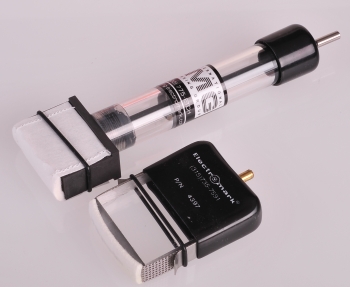
Patrica at IMG talked me into their carbon wand.. I have to admit it has fantastic workmanship and will last me a lifetime. I ordered it at the same time as my stencils and electrolyte kit from IMG in NY. Since its one of the more important pieces to make a good mark, I felt it was worth the investment. It has a nice stainless post on the end that I alligator clip my black neg wire too for etching.


I originally planned on doing the radio shack machine from Mr. LoGiudice's site, but couldn't source the parts. I did more research and had planned on getting some simple wall transformers, one for DC, one for AC and wire into the DPDT switch. But I don't remember where I found the info on the train transformer idea.. anyway, its so simple that knowing what I do now I don't really see any reason not to use them.
 
Agreed. In your case, piece together what you have. The point I wanted to make was that after an appropriate power supply, the etching pad, electrolyte, and stencil have as much a part in a quality etch as the power supply.

Yeah I haven't sourced all that, I may have something suitable for a pad I haven't really had time to look. I did look around online and the IMG site didn't seem to be working, any suggestions?
 
Yeah I haven't sourced all that, I may have something suitable for a pad I haven't really had time to look. I did look around online and the IMG site didn't seem to be working, any suggestions?

Call IMG.. I got the top one

NfD3BY3.jpg
 
However, depending on your logo size, a pad can be too big to fit on a small knife, ricasso/plunge issues, convex grinds, etc. In these cases, a paper core q-tip will work in a pinch.
 
I bought a carbon/graphite block off of ebay, I was able to cut it to the sizes I need for my logos, one large and one small.

It is a far improvement over the q tip I use to use.
 
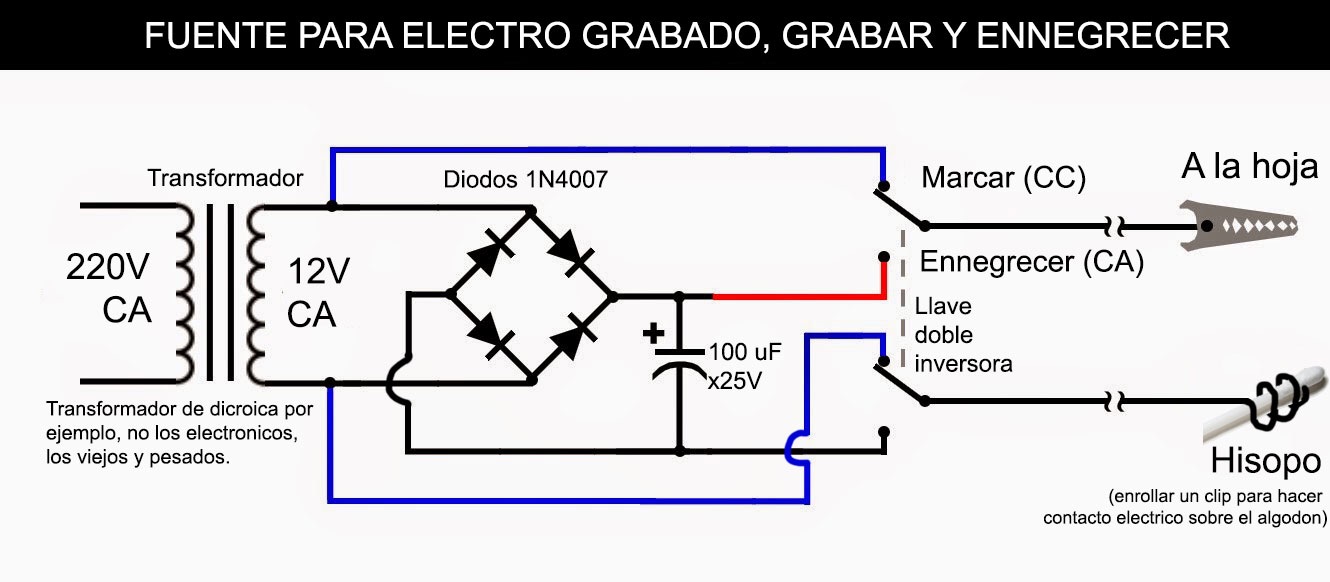
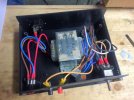
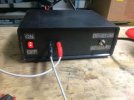
I made mine using an old 12v dichroic lamp transformer, 4 diodes, one capacitor, one double inverter switch and patience, the schematic is in spanish, but its not difficult to understand by the pictures, if needed ask me.

ot8Lc64.jpg


Pablo
 
I made mine using an old 12v dichroic lamp transformer, 4 diodes, one capacitor, one double inverter switch and patience, the schematic is in spanish, but its not difficult to understand by the pictures, if needed ask me.

ot8Lc64.jpg


Pablo

I would only caution anyone building the filtered bridge circuit above that in the U.S. you will have 115VAC on the primary side and not 220VAC. Also, rather than using IN4007 diodes you can use 1N4001. The 4007's are an overkill in this circuit. Both diodes have a maximum current rating of 1 Amp. The 4007 has a reverse blocking voltage rating of 1000V!! The maximum blocking voltage for the 4001 is 35 Volts which is fine for this circuit as the diodes only need to withstand about 34 Volts when reverse biased. (17 from the peak output of the transformer PLUS another 17 of the opposite polarity from the capacitor! ... lot of folks forget about that). Anyways, if you feel the 1N4001 are borderline, then just go to the IN4002's which if memory serves are rated at 50V reverse blocking. The 4001 and 4002 are physically smaller and less expensive than the 4007's as well. Although buying 4 diodes of either type isn't going to break the bank.

Another possibility, and perhaps easier since it would require no soldering, is to use whats called a monolithic full wave bridge. All this is, is a device with the 4 diodes built into it. They are available with 4 spade connectors so all you have to do is crimp the female part of the connector on to your wires. 2 of the wires are your a.c. in, and the other 2 are your rectified d.c. out....easy peasy. These devices are rated at anywhere from an amp up to several tens of amps. Something like this would work just fine: http://www.mpja.com/15A-100PIV-Square-Bridge-Rectifier/productinfo/25244+BR
 
Will this transformer work? It's 12 volts, but says something about being split into 6 volt outputs. I'm an electronic illiterate. Sorry.
http://www.frys.com/product/6146259?site=sr:SEARCH:MAIN_RSLT_PG

That transformer will work just fine. Its a centertap style (CT) which just means that one of the leads...the black one in this case...taps the very center of the output to give half of the full output voltage relative to one of the outside (red) leads. You can ignore that centertap, just cap it off by itself with a wire nut. The two red leads will give you the 12a.c. that you want to feed the recitifer. Plus, that transformer is rated at two amps (2000milliamps) so you've got plenty of juice.
 
Back
Top